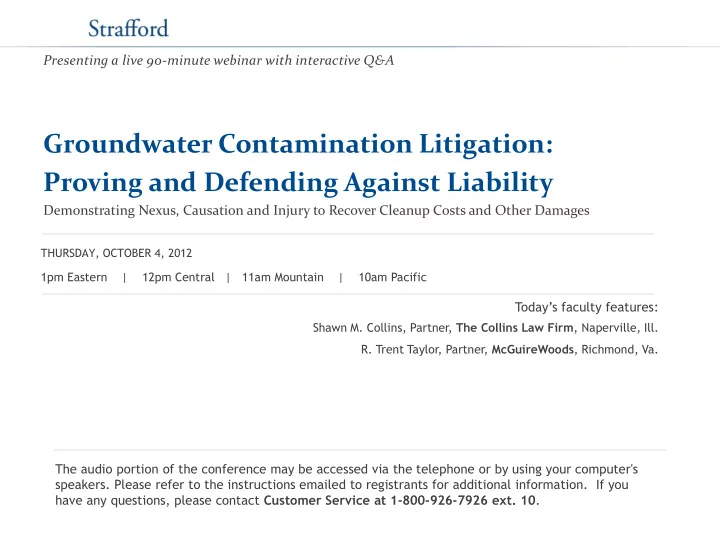
Presenting a live 90-minute webinar with interactive Q&A - - PowerPoint PPT Presentation

presenting a live 90 minute webinar with interactive q a
SMART_READER_LITE
LIVE PREVIEW

Presenting a live 90-minute webinar with interactive Q&A - - PowerPoint PPT Presentation

Presenting a live 90-minute webinar with interactive Q&A Groundwater Contamination Litigation: Proving and Defending Against Liability Demonstrating Nexus, Causation and Injury to Recover Cleanup Costs and Other Damages THURSDAY, OCTOBER 4,


slide-1
SLIDE 1

Groundwater Contamination Litigation: Proving and Defending Against Liability

Demonstrating Nexus, Causation and Injury to Recover Cleanup Costs and Other Damages

Today’s faculty features:

1pm Eastern | 12pm Central | 11am Mountain | 10am Pacific

The audio portion of the conference may be accessed via the telephone or by using your computer's

  • speakers. Please refer to the instructions emailed to registrants for additional information. If you

have any questions, please contact Customer Service at 1-800-926-7926 ext. 10.

THURSDAY, OCTOBER 4, 2012

Presenting a live 90-minute webinar with interactive Q&A

Shawn M. Collins, Partner, The Collins Law Firm, Naperville, Ill.

  • R. Trent Taylor, Partner, McGuireWoods, Richmond, Va.
slide-2
SLIDE 2

Sound Quality If you are listening via your computer speakers, please note that the quality of your sound will vary depending on the speed and quality of your internet connection. If the sound quality is not satisfactory and you are listening via your computer speakers, you may listen via the phone: dial 1-866-755-4350 and enter your PIN -when prompted. Otherwise, please send us a chat or e-mail sound@straffordpub.com immediately so we can address the problem. If you dialed in and have any difficulties during the call, press *0 for assistance. Viewing Quality To maximize your screen, press the F11 key on your keyboard. To exit full screen, press the F11 key again.

slide-3
SLIDE 3

For CLE purposes, please let us know how many people are listening at your location by completing each of the following steps:

  • In the chat box, type (1) your company name and (2) the number of

attendees at your location

  • Click the SEND button beside the box

FOR LIVE EVENT ONLY

slide-4
SLIDE 4

If you have not printed the conference materials for this program, please complete the following steps:

  • Click on the + sign next to “Conference Materials” in the middle of the left-

hand column on your screen.

  • Click on the tab labeled “Handouts” that appears, and there you will see a

PDF of the slides for today's program.

  • Double click on the PDF and a separate page will open.
  • Print the slides by clicking on the printer icon.
slide-5
SLIDE 5

Groundwater Contamination Litigation: Proving And Defending Against Liability

Shawn M. Collins Partner – The Collins Law Firm

October 2012 Strafford Publications, Inc.

slide-6
SLIDE 6

Who am I? Why do I do this

type of work?

Shawn M. Collins Partner The Collins Law Firm smc@collinslaw.com www.collinslaw.com (630) 527-1595

Groundwater Contamination Litigation 6

slide-7
SLIDE 7

Federal and State Regulatory Structures

RCRA

Resource Conservation and Recovery Act , 42 U.S.C. §6921 et seq. RCRA Citizens Suit provision: 42 U.S.C. §6972

CERCLA

Comprehensive Environmental Response Compensation and Liability Act of 1980, as amended, 42 U.S.C. § 9601 et seq.

Illinois Groundwater Protection Act

Chapter 415 Environmental Safety: 415 ILCS 55/1 et seq.

Groundwater Contamination Litigation 7

slide-8
SLIDE 8

Initial Case Assessment: Plaintiff’s Side

Are you ready for the risk? Will there be a fight about source? Can the source pay for clean-up & damages? Do you have great experts? Do you have great lead plaintiffs?

Groundwater Contamination Litigation 8

slide-9
SLIDE 9

The Role of the EPA

Whose side are they on? Are they doing their job? Should you pick a fight with

them?

Groundwater Contamination Litigation 9

slide-10
SLIDE 10

Recent Litigation and Trends

Recent verdicts and settlements Don’t let it fool you

Groundwater Contamination Litigation

1

10

slide-11
SLIDE 11

Strategies for Proving Liability

Ways to prove source (the “of course” test) Getting closest to the truth: documents What did they do when they found out? De-mystifying the science

Groundwater Contamination Litigation 11

slide-12
SLIDE 12

The Most Important Lessons I’ve learned

“You’ll never regret the case you turn down” You need to like your client Read every document yourself Get control of the documents Beware the role of emotions

Groundwater Contamination Litigation 12

slide-13
SLIDE 13

www.mcguirewoods.com

Groundwater Contamination Litigation: Proving And Defending Against Liability

Shawn M. Collins – The Collins Law Firm

  • R. Trent Taylor – McGuireWoods LLP
slide-14
SLIDE 14

McGuireWoods LLP | 14 CONFIDENTIAL

Who am I?

  • R. Trent Taylor

McGuireWoods LLP One James Center 901 East Cary Street Richmond, VA 23219-4030 804.775.1182 (Direct Line) 804.225.5409 (Direct FAX) rtaylor@mcguirewoods.com http://www.mcguirewoods.com

  • Trent Taylor focuses on defending complex

toxic tort and products liability cases. His experience includes representing clients in class actions, MDL coordinated proceedings, nationwide mass tort litigation, and appellate cases in the substantive areas

  • f toxic torts. He defends cases involving

complex scientific and medical issues, and has concentrated in the defense of novel claims brought by plaintiffs, including public nuisance, civil conspiracy, unjust enrichment, and deceptive trade practices. He is a frequent commentator on legal issues, has been quoted by the New York Times, Wall Street Journal, American Lawyer, the National Law Journal, and numerous influential legal blogs, among

  • thers, and was interviewed on NPR's "All

Things Considered" on June 8, 2010, to discuss appellate issues. He is currently authoring a treatise on nuisance and trespass litigation that will be published in 2013. http://www.cap- press.com/books/isbn/9781594607714/Nuis ance+and+Trespass+Law

slide-15
SLIDE 15

McGuireWoods LLP | 15 CONFIDENTIAL

Common Law

slide-16
SLIDE 16

McGuireWoods LLP | 16 CONFIDENTIAL

Public Nuisance

  • “An offense against, or interference with the exercise of rights

common to the public.”

slide-17
SLIDE 17

McGuireWoods LLP | 17 CONFIDENTIAL

Public Nuisance

  • “the interference

must be both substantial and unreasonable”

  • “it is ‘substantial’ if it

causes significant harm and ‘unreasonable’ if its social utility is

  • utweighed by the

gravity of the harm inflicted”

slide-18
SLIDE 18

McGuireWoods LLP | 18 CONFIDENTIAL

Private Nuisance

Private Nuisance: “a nontrespassory invasion of another’s interest in the private use and enjoyment of land.” Restatement (Second) of Torts § 821D

slide-19
SLIDE 19

McGuireWoods LLP | 19 CONFIDENTIAL

Trespass

  • Trespass is generally defined as

“an invasion of the interest in the exclusive possession of land, as by entry upon it.”

  • The key distinction between

trespass and nuisance is that “[a] claim of trespass contemplates actual physical entry or invasion, whereas nuisance liability arises merely by virtue of an activity which falls short of tangible, concrete invasion by interferes with the use and enjoyment of land.”

slide-20
SLIDE 20

McGuireWoods LLP | 20 CONFIDENTIAL

Others

  • Infliction of Emotional Distress
  • Failure to Warn
  • Battery
  • Fraud
  • Conspiracy
slide-21
SLIDE 21

McGuireWoods LLP | 21 CONFIDENTIAL

Recent Litigation and Trends

slide-22
SLIDE 22

McGuireWoods LLP | 22 CONFIDENTIAL

Targets

  • Fly/coal ash
  • Fracking
  • Uranium/Radioactive
  • Oil Spills
  • Arsenic
  • Mercury
  • Pesticides
slide-23
SLIDE 23

McGuireWoods LLP | 23 CONFIDENTIAL

Fly/Coal Ash

  • Gayle K. Queen v. Constellation Power Source

Generation Inc., Case No. 24C07009389 (Circuit Court for Baltimore City).

  • A Baltimore City judge approved a $54 million

settlement after homeowners in a nearby Maryland county accused Constellation Energy Inc. of contaminating their wells by dumping tons of toxic coal ash into a quarry near their homes.

slide-24
SLIDE 24

McGuireWoods LLP | 24 CONFIDENTIAL

Fly/Coal Ash

  • Commonwealth of Penn. Dep’t of Env. Prot. v.

FirstEnergy Generation Corp., Case No. 2:12-cv-01061 (W.D. Pa.)

  • Settlement in July 2012 where defendant agreed to pay

penalties of $800,000 and shut down a coal ash disposal site that allegedly contaminated groundwater

slide-25
SLIDE 25

McGuireWoods LLP | 25 CONFIDENTIAL

Fracking

  • Tucker v. Southwestern Energy Co. et al.
  • Filed on May 26, 2011, in federal court in Arkansas
  • Sought $6 million for named plaintiffs
  • Alleged soil, groundwater, and air contamination
  • Causes of action were: (1) Strict Liability; (2) Nuisance;

(3) Trespass; and (4) Negligence.

  • Sought class certification of all persons in AR who live
  • r own property within 3 miles of a gas well
  • Sought compensatory and punitive damages, medical

monitoring, and air, soil, and groundwater monitoring

  • Settled in July 2012
slide-26
SLIDE 26

McGuireWoods LLP | 26 CONFIDENTIAL

Fracking

  • Baker v. Anschutz Exploration Corp.
  • Filed 2/11/11 in NY state court but was removed to federal court
  • On behalf of nine families in Horseheads, New York near Elmira.
  • Allege that their residential drinking water wells have become

contaminated as a result of drilling activities by defendant Anschutz and its drilling subcontractors and that their properties and families have become exposed to combustible gases, toxic sediments, and hazardous chemicals.

  • Seeks $150 million in compensatory damages, punitive damages,

and future medical monitoring due to fear of contracting cancer.

slide-27
SLIDE 27

McGuireWoods LLP | 27 CONFIDENTIAL

Fracking

  • Berish v. Southwestern Energy Production Co.
  • Filed in PA state court on 9/14/10 on behalf of 13 families. Was removed

to federal court.

  • The Plaintiffs allege that their water wells have been contaminated due to

gas drilling operations being conducted by Defendant. Also alleges that the composition of fracking fluid includes hazardous chemicals that are carcinogenic and toxic. Diesel fuel and lubricating materials, also consisting of toxins, are also utilized during drilling and well operations.

  • The lawsuit seeks a preliminary and permanent injunction barring

Defendant from engaging in the acts cited by the complaint, as well as abatement of the nuisances, unlawful conduct, violations and damages created by those acts. It also seeks, among other things, compensatory damages, punitive damages, and the cost of future health monitoring.

  • Causes of action are: (1) Hazardous Sites Cleanup Act; (2) Negligence; (3)

Private Nuisance; (4) Strict Liability; (5) Trespass; (6) Medical Monitoring

  • Past MTD stage
slide-28
SLIDE 28

McGuireWoods LLP | 28 CONFIDENTIAL

Fracking

  • Scoma v. Chesapeake Energy Corporation
  • Filed on 6/1/10 in TX state court and then removed.
  • Plaintiffs have alleged that the fracking of gas wells contaminated

the groundwater in their water wells.

  • Causes of action were: (1) Nuisance; (2) Trespass; and (3)

Negligence.

  • Sought compensatory and punitive damages including loss of

market value of land, emotional harm and mental anguish.

  • Also sought a permanent injunction, precluding future drilling and

“fracking” activities near Plaintiffs’ land.

  • Settled in late 2011
slide-29
SLIDE 29

McGuireWoods LLP | 29 CONFIDENTIAL

Uranium/Radioactive

  • McCormick et al. v. Halliburton, Case No. CIV-11-

1272-M (W.D. Okla) (filed Nov. 2011)

  • Adkins et al v. W.R. Grace & Company et al., Case No.

2:11-cv-00173 (E.D. Tenn.) (filed June 2011)

  • Ament, et al v. Babcock & Wilcox Power Generation

Group, Inc., et al., Case No. 2:11-cv-01381-NBF (W.D. Pa.) (filed Oct. 31, 2011)

slide-30
SLIDE 30

McGuireWoods LLP | 30 CONFIDENTIAL

Oil Spills

  • Castro et al v ExxonMobil Oil et al., Case No. 1:11-cv-

00119-RFC (D. Mont.)

  • In Re: Oil Spill by the Oil Rig "Deepwater Horizon" in

the Gulf of Mexico, on April 20, 2010, Case No. 2:10- md-02179-CJB-SS (E.D. La.) (MDL 2179)

slide-31
SLIDE 31

McGuireWoods LLP | 31 CONFIDENTIAL

Arsenic

  • Crowell Land & Mineral Corp. v. Sonoran Energy, Inc.

et al., Case No. 10-cv-01684 (W.D. La.)

  • Catawba Riverkeeper Foundation Inc. v. South

Carolina Electric & Gas Co., Case No. 3:12-cv-00124 (D. S.C.)

slide-32
SLIDE 32

McGuireWoods LLP | 32 CONFIDENTIAL

Mercury

  • United States of America v. The Gillette Co., Case No.

1:12-cv-01247 (N.D. N.Y.) = Settlement of $9 million in mercury contamination case

slide-33
SLIDE 33

McGuireWoods LLP | 33 CONFIDENTIAL

Other Recent Litigation

  • City of New York v. Exxon Mobil Corp. (S.D. N.Y.)
  • Jury awarded city $105 million in compensatory damages in Oct. 2009. Court did

not permit punitive damages.

  • The jury found that gasoline containing MTBE was a defective product and a

public nuisance because Exxon Mobil gave no warnings about the product’s dangerous propensity to contaminate groundwater.

  • Jury decided against Exxon despite the fact that it found there was pre-existing

contamination of the wells at issue (for which they subtracted $70 million).

  • The damages awarded were to compensate the city for building (in the future) a

water treatment facility to treat the water for 40 years.

  • Damages were awarded even though the MTBE contamination will not peak until

2033 at levels 25% of what the EPA says is the maximum safe level.

slide-34
SLIDE 34

McGuireWoods LLP | 34 CONFIDENTIAL

Other Recent Litigation

  • (June 30, 2011) -- A Maryland jury on Friday

reportedly ordered Exxon Mobil Corp. to pay

$1.5 billion to more than 150 families and

businesses in Jacksonville, Md., that allegedly suffered personal and financial harm following an underground gasoline leak in 2006.

slide-35
SLIDE 35

McGuireWoods LLP | 35 CONFIDENTIAL

Other Recent Litigation

  • City of Modesto vs. Dow Chemical Company, et al.

(Case Nos. 999345 and 999643), 2006 Nat. Jury Verdict Review LEXIS 1583

  • Products Liability - Strict Liability - Negligence -

Continuing Trespass - Private And Public Nuisance - Failure To Warn Consumers Of Dangers Of Chemicals Introduced Into City Drinking Water - Punitive Damages Claim For Disregard For Public Safety

  • Result: $178,545,000 Verdict Including $

175,075,000 in Punitive Damages Against Three Defendants

slide-36
SLIDE 36

McGuireWoods LLP | 36 CONFIDENTIAL

Other Recent Litigation

  • $752 million – settlement amount in MDL MTBE

against various corporate defendants alleging exposure to MTBE

  • $700 million – settlement amount in a suit by a class of

Alabama residents against Monsanto Co. alleging exposure to PCBs

slide-37
SLIDE 37

McGuireWoods LLP | 37 CONFIDENTIAL

Trend #1 - The Battlefield? Causation!

slide-38
SLIDE 38

McGuireWoods LLP | 38 CONFIDENTIAL

Causation

  • Strudley v. Antero Resources Corp., Colo Dist. Ct., No.

11-CV-2218 (5/9/12)

– “Cognizant of the significant discovery and cost burdens presented by a case of this nature, the Court endeavored to invoke a more efficient procedure than that set out in the standard case management order. Accordingly, the Court required Plaintiffs, before full discovery and other procedures were allowed, to make a prima facie showing of exposure and causation . . . .”

slide-39
SLIDE 39

McGuireWoods LLP | 39 CONFIDENTIAL

Lone Pine

slide-40
SLIDE 40

McGuireWoods LLP | 40 CONFIDENTIAL

Strudley

  • Plaintiffs’ expert “suggests, at best, a very weak

circumstantial causal connection between the wells and Plaintiffs’ injuries.”

  • “[U]pon review of the Plaintiffs’ collective medical

records, [pltfs’ expert] only temporally associates Plaintiff’s symptoms with the wells being brought into production . . . [a] temporal relationship, by itself, provides no evidence of causation.”

slide-41
SLIDE 41

McGuireWoods LLP | 41 CONFIDENTIAL

Strudley

  • “Air sample, taken the day after the Plaintiffs moved out of their

Silt home, shows detectable levels of certain gasses and

  • compounds. However, this raw data is not accompanied by any

explanation of what levels are necessary to cause any of the symptoms complained of by Plaintiffs.”

  • “The Court, in reaching its decision, further relied on the fact that

the Colorado Oil and Gas Conservation Commission (“COGCC”) had conducted an investigation of the Plaintiffs’ well water and had concluded that the water supply was not affected by oil and gas operations in the vicinity.”

  • “The COGCC concluded that ‘there is no data that would indicate

the water quality in your domestic well has been impacted by nearby oil and natural gas drilling and operations.’”

slide-42
SLIDE 42

McGuireWoods LLP | 42 CONFIDENTIAL

Strudley

  • Court also noted that companies gave sworn testimony

that they conducted their activities in compliance with applicable laws and regulations to protect human health and the environment.

  • “Defendants have provided evidence to support their

contention that the air emissions-control equipment at the wells and prevailing wind patterns make it unlikely that plaintiffs or their property were exposed to harmful levels of chemicals from defendants’ activities.”

slide-43
SLIDE 43

McGuireWoods LLP | 43 CONFIDENTIAL

Strudley

  • “[Pltfs’ expert] further stated that levels of sodium and chloride

were ‘higher than EPA recommends for drinking water, and are not typical of well water used as drinking water . . . [s]uch levels are in the range expected from a number of deep well sources, such as may be produced from gas wells.’”

  • “Again, there was no statement regarding what constitutes

dangerous levels of any substance in drinking water or whether any causal link exists between the study’s results and Plaintiffs’ alleged injuries.”

  • “Though the evidence shows existence of certain gases and

compounds in both the air and water of Plaintiffs’ Silt home, there is neither sufficient data nor expert analysis stating with any level

  • f probability that a causal connection does in fact exist between

Plaintiffs’ injuries and Plaintiffs’ exposure to Defendants’ drilling activities.”

slide-44
SLIDE 44

McGuireWoods LLP | 44 CONFIDENTIAL

But Cf.

  • Hagy v. Equitable Prod., Case No. 2:10-cv-01372 (S.D.
  • W. V. 2010)
  • In suit by family seeking injunction to prevent drilling,

medical monitoring fund, and compensatory and punitive damages against companies involving in nearby shale gas drilling, court denied proposed Lone Pine order

slide-45
SLIDE 45

McGuireWoods LLP | 45 CONFIDENTIAL

Trend # 2 - Science getting better

  • Trace elements such as manganese and arsenic are found in concentrations

potentially dangerous to human health in about one of five untreated groundwater samples taken from wells nationwide, the U.S. Geological Survey recently reported.

  • A new USGS study noted that trace elements are much more likely than other

contaminants such as pesticides and volatile organic compounds to be found at what the U.S. Environmental Protection Agency considers to be potentially hazardous levels in public, private and monitoring wells.

  • Trace elements, as defined in the report, are metals and semimetallic elements

that are usually found at levels less than 1 milligram per liter in natural waters. Most trace elements enter groundwater through the weathering of rocks or human acts such as mining, construction and waste disposal, the study said.

  • “In public wells these contaminants are regulated by the [EPA], and contaminants

are removed from the water before people drink it,” USGS hydrologist and study author Joe Ayotte said in a statement. “However, trace elements could be present in water from private wells at levels that are considered to pose a risk to human health, because they aren't subject to regulations. In many cases people might not even know that they have an issue.”

slide-46
SLIDE 46

McGuireWoods LLP | 46 CONFIDENTIAL

Trend # 3 -- The harm alleged in environmental contamination suits is becoming more subjective and less tangible

  • Gates v. Rohm and Haas Co. (E.D. Pa.) – ruled that the presence of vinyl

chloride in the air, even if below background levels, constitutes a physical injury to property under nuisance law.

  • Meyer v. Fluor Corp. (Mo.) – in nuisance class suit against lead smelter to

recover prospective medical monitoring due to harmful emissions, MO S.

  • Ct. certified the class and held that recovery for medical monitoring is

not contingent upon the existence of a present physical injury

  • State of NC v. TVA – (1) numerous social and economic harms to North

Carolinians, including lost school and work days, increased pressure on the health industry due to extra doctor visits, and the general loss of well- being that results from chronic health problems; (2) harm to the environment including killing local vegetation, removing nutrients necessary for healthy forest growth, and degrading water quality; and (3) significant effects on visibility due to creating haze in many pristine areas

  • f wilderness in NC
  • Cook et al. v. Rockwell and Dow – jury verdict of almost $1 billion based

solely on decline in property values for 13,000 plaintiffs

slide-47
SLIDE 47

McGuireWoods LLP | 47 CONFIDENTIAL

In re: Tennessee Valley Authority Ash Spill Litigation, Case No. 3:09-cv-00009 (E.D. Tenn.)

  • “Although plaintiffs argue that exposure to the toxic

constituents in the ash exists by virtue of the presence

  • f ash in the environment, the mere existence of a

toxin in the environment is insufficient to establish causation without proof that the individual was actually exposed to the toxin and at a level sufficient to cause injury or stress.”

slide-48
SLIDE 48

McGuireWoods LLP | 48 CONFIDENTIAL

Other Law

  • Plaintiffs are generally required to allege that they have suffered an

“appreciable, substantial tangible injury.”

  • Courts have explained that this substantial harm must be one of

“importance, involving more than slight inconvenience or petty annoyance.” Darney v. Dragon Prods. Co., LLC, 640 F. Supp. 2d 117 (D.

  • Me. 2009) (quoting Restatement (Second) of Torts § 821F, cmt. c)).
  • Furthermore, numerous courts have held that the harm must be more

than “de minimis” and that if the alleged invasion relates to contamination, it must “rise to the level of toxicological concern.” Lamb

  • v. Martin Marietta Energy Sys., 835 F. Supp. 959 (W.D. Ky. 1993);

Benesh v. Amphenol Corp. (In re Wildewood Litig.), 52 F.3d 499 (4th

  • Cir. 1995); Brooks v. E. I. du Pont de Nemours & Co., 944 F. Supp. 448

(E.D. N.C. 1996); In re TVA Ash Spill Litig., 805 F. Supp. 2d 468, 491 (E.D. Tenn 2011) (plaintiff must show constituents reached property in sufficient concentrations to cause actual damage). An invasion of small amounts of contaminants on plaintiffs’ land is not enough to state a claim for private nuisance. Bradley v. American Smelting & Refining Co., 635

  • F. Supp. 1154, 1157-58 (W.D. Wash. 1986).
slide-49
SLIDE 49

McGuireWoods LLP | 49 CONFIDENTIAL

Cook et al. v. Rockwell and Dow 618 F.3d 1127 (10th Cir. 2010)

  • “While the resolution of these issues typically involves questions
  • f fact, a scientifically unfounded risk cannot rise to the level of an

unreasonable and substantial interference. To the extent Plaintiffs rely on anxiety from an increased risk to their health as an interference with the use and enjoyment of their properties, that anxiety must arise from scientifically verifiable evidence regarding the risk and cannot be wholly irrational.”

  • We “predict that the Colorado Supreme Court would not permit

recovery premised on a finding that an interference, in the form of anxiety or fear of health risks, is "substantial" and "unreasonable" unless that anxiety is supported by some scientific evidence. The district court erred in concluding otherwise.”

slide-50
SLIDE 50

McGuireWoods LLP | 50 CONFIDENTIAL

Trend # 4 -- “Fear of” & Emotional Distress Damages

slide-51
SLIDE 51

McGuireWoods LLP | 51 CONFIDENTIAL

Exxon Mobil Corp. v. Ford,

  • Md. Ct. Spec. App., 1804, 2/09/12
  • In reviewing a $147 million verdict, the Maryland Court of Special Appeals Feb. 9

affirmed that parties can recover for fear of cancer after being exposed to carcinogens released in a gasoline leak

  • The court found that parties who were possibly exposed to the carcinogens methyl

tertiary-butyl ether and benzene could recover damages for fear of cancer, in this first direct address of the issue by the Maryland appellate courts.

  • Most of the plaintiffs also received emotional distress damages totaling

approximately $1,000,000 per household. Altogether, the jury awarded more than $150 million in damages.

  • The court of special appeals held that damages could be recovered, provided the

fear of cancer was in fact reasonable. The court concluded that a more-likely- than-not standard was inapplicable to “fear of cancer” because, “fear of cancer is a particularized type of emotional distress, not an attempt to circumvent the limitations on recovering for disease that may or may not develop in the future.”

  • The court noted, “while the fear must be reasonable, I do not think

reasonableness requires the plaintiff to show that it is more likely than not that he or she will develop cancer.” The court did find that objective evidence of emotional distress would be required.

slide-52
SLIDE 52

McGuireWoods LLP | 52 CONFIDENTIAL

Berish v. Southwestern

  • “Plaintiffs' claims for Damages for Emotional Distress except as to

Plaintiff C.S. will be dismissed. Plaintiffs' will be allowed to amend their Complaint to seek damages for inconvenience and discomfort.”

  • “Under Pennsylvania law, claims for emotional distress require that the

plaintiff suffer an attendant physical injury. Houston v. Texaco, Inc., 538 A.2d 502, 505 (Pa. Super. Ct. 1988). Plaintiffs have only pled physical ailments as to Plaintiff C.S. Therefore, the emotional distress claims will be dismissed except as to Plaintiff C.S.”

  • “Plaintiffs have asked the Court for leave to amend their Complaint to

add a claim for damages for inconvenience and discomfort. Pennsylvania law recognizes "a cause of action for inconvenience and discomfort caused by interference with another's peaceful possession of his or her real estate." Houston, 538 A.2d at 506. Plaintiffs have complied with Fed.

  • R. Civ. P. 15(a) and Local Rule 15.1, and the Court will grant them leave

to amend in order to add claims for damages for inconvenience and

  • discomfort. This determination essentially comports with the agreement

reached at oral argument.”

slide-53
SLIDE 53

McGuireWoods LLP | 53 CONFIDENTIAL

Trend # 5 – Expert testimony

  • U.S. Steel v. Milward (recently denied cert. by U.S. Supreme Court)
  • Plaintiffs Brian and Linda Milward sued U.S. Steel Corp. and other chemical

companies for negligence, claiming Brian Milward's routine workplace exposure to benzene caused his acute promyelocytic leukemia.

  • A district judge dismissed the case, after rejecting toxicologist Martyn Smith's

expert opinion that the research about APL supports "the inference" that benzene exposure can cause the extremely rare form of leukemia.

  • The First Circuit reversed in March, affirming Smith's method, in which he

considered evidence from peer-reviewed scientific literature to eliminate unlikely conclusions and come to the most likely one.

  • “Dr. Smith estimated that ... to obtain statistically significant results, one would

need hundreds of thousands of highly exposed workers, the same number of controls and millions of dollars of funding,” the opinion said. “The court erred in treating the lack of statistical significance as a crucial flaw.”

  • The First Circuit's decision could undermine the Supreme Court's 1993 Daubert v.

Merrell Dow Pharmaceuticals ruling, which held that courts should bar “scientifically unreliable evidence,” and could also spur other courts to allow testimony based on "unsound science."

slide-54
SLIDE 54

McGuireWoods LLP | 54 CONFIDENTIAL

Nonnon v. City of New York

  • In September 2011, the New York appellate division partially

affirmed a denial of defendant’s summary judgment motion in a case involving toxic landfill seepage and alleged cancer clusters.

  • The Nonnon court stated that it is “not always necessary for a

plaintiff to quantify exposure levels precisely” and said that “so long as plaintiff’s experts have provided a scientific expression of plaintiff’s exposure levels, they will have laid an adequate foundation for opinions on specific causation.”

  • While there was no indication that plaintiffs’ experts actually

knew, let alone “scientifically expressed” the individual exposure levels, the court found that plaintiff’s proximity analysis study permitted an inference that plaintiffs’ diseases were more likely than not caused by substances from the landfill.

  • The Nonnon court ultimately held that “criticisms of [an expert’s]

analysis go to the weight of the evidence and should therefore be the subject of cross-examination at trial” rather than serve as grounds for pretrial exclusion of the expert.

slide-55
SLIDE 55

McGuireWoods LLP | 55 CONFIDENTIAL

Betz v. Pneumo Abex LLC

  • A pathology expert's controversial “any-exposure”

theory, which states that a health risk attaches even to a single asbestos fiber, is based on unproven science and is inadmissible in a test case on behalf of automobile brake workers with mesothelioma, the Pennsylvania Supreme Court ruled May 23 (Betz v. Pneumo Abex LLC, Pa., No. 38 WAP 2010, 5/23/12).

  • The expert's theory “is in irreconcilable conflict with
  • itself. Simply put, one cannot simultaneously maintain

that a single fiber among millions is substantially causative, while also conceding that a disease is dose responsive,” the Supreme Court said.

slide-56
SLIDE 56

McGuireWoods LLP | 56 CONFIDENTIAL

Trend # 6 -- Evolution of Hydraulic Fracturing Lawsuits

slide-57
SLIDE 57

McGuireWoods LLP | 57 CONFIDENTIAL

Conclusions

  • No verdict against any defendants in shale gas drilling

groundwater contamination claim as of yet

  • Trends

– Some pltfs dropping groundwater contamination claims – Less focus on injunctions, more on med. mon. – More focus on air claims – More focus on economic harms

slide-58
SLIDE 58

McGuireWoods LLP | 58 CONFIDENTIAL

Trend # 7 – Ownership of Groundwater

  • Edwards Aquifer Auth. v. Day, 369 S.W.3d 814 (Texas

2012) (holding that landowners hold rights to the groundwater beneath their property)

  • FPL Farming Ltd. v. Environmental Processing Systems

LC, no. 09-08-00083-CV (Texas Court of Appeals 2012) (reversing a jury verdict and ordering new trial in trespass case related to wastewater injection well.)

slide-59
SLIDE 59

McGuireWoods LLP | 59 CONFIDENTIAL

But Cf.

  • Commissioner of the Dep’t of Planning and Natural

Resources et al. v. Century Aluminum Co., Case No. 1:05-cv-00062 (D. V.I.) (rejecting argument that defendant cannot be held liable for groundwater contamination because it, rather than the state, owns the water).

  • The court noted that even if the defendant could prove
  • wnership, common law does not give property
  • wners the right “to pollute surface and groundwater

found on or within their land.”

slide-60
SLIDE 60

McGuireWoods LLP | 60 CONFIDENTIAL

Trend # 8 - Preemption

  • Preemption gaining momentum as a defense in environmental

contamination cases

  • Native Village of Kivalina v. Exxonmobil Corporation, 09-17490

(9th Cir. 2012) (affirming trial court dismissal of climate change suit based on displacement)

  • Comer v. Murphy Oil USA, Inc., 839 F.Supp. 849 (S.D. Miss.

2012) (dismissing climate change suit on a vareity of grounds, including preemption)

  • United States v. EME Homer City Generation L.P., 823 F. Supp. 2d

274 (W.D. Pa. 2011) (holding that common law public nuisance claims are preempted by the federal Clean Air Act and the PA Air Pollution Control Act)

slide-61
SLIDE 61

McGuireWoods LLP | 61 CONFIDENTIAL

Other Trends

slide-62
SLIDE 62

McGuireWoods LLP | 62 CONFIDENTIAL

How Do You Defend Against Them? Strategies for Defending Against Liability

slide-63
SLIDE 63

McGuireWoods LLP | 63 CONFIDENTIAL

Initial Case Assessment - Defense

  • Removal?
  • Property damage or personal injury?
  • Present or future injury?
  • Actual contamination or mere fear of it?
  • What is the evidence of contamination?
  • Alternative causes?
  • Co-defendants – Friend or Foe?
slide-64
SLIDE 64

McGuireWoods LLP | 64 CONFIDENTIAL

Disaggregation

slide-65
SLIDE 65

McGuireWoods LLP | 65 CONFIDENTIAL

Disaggregation Strategies

  • Fight Class Certification

– Get amicus or evidentiary assistance from others in the industry and experts. – Certification decisions hurt the entire industry: be willing to help your competitors avoid certification.

  • Deconsolidate Mass Actions

– General rule is that consolidation for trial is only appropriate if it will not prejudice the opposing party. – Focus on early motions practice surrounding severance of claims and deconsolidation for trial.

slide-66
SLIDE 66

McGuireWoods LLP | 66 CONFIDENTIAL

Force Concretization

slide-67
SLIDE 67

McGuireWoods LLP | 67 CONFIDENTIAL

Physical Invasion?

slide-68
SLIDE 68

McGuireWoods LLP | 68 CONFIDENTIAL

Actual Injury?

slide-69
SLIDE 69

McGuireWoods LLP | 69 CONFIDENTIAL

Concretization

  • Tucker v. Southwestern Energy Co. (E.D. Ark.)
  • Arkansas homeowners who say their drinking water

and air have been contaminated with chemicals used by natural gas drillers in the "fracking" process must file amended complaints containing more specific facts, a federal judge ruled on Feb. 17, 2012.

slide-70
SLIDE 70

McGuireWoods LLP | 70 CONFIDENTIAL

Strategies for Defending Against Liability

  • Individualize

– Do not let pltfs get away with making general, non- specific allegations of harm – Attack specific causation – Consider a motion to sever if appropriate – Consider other strategies including bringing in third- parties

slide-71
SLIDE 71

McGuireWoods LLP | 71 CONFIDENTIAL

Attack

  • Consider aggressively attacking claims that do not

seem to be based in fact or that seem to rely on faulty data

  • Motion for Sanctions
  • Counterclaims
slide-72
SLIDE 72

McGuireWoods LLP | 72 CONFIDENTIAL

Attack (cont.)

  • Range Resources, sued in June by a Parker County couple whose residential water well was

contaminated with methane, has filed a counterclaim seeking millions of dollars in damages and naming Flower Mound environmental scientist Alisa Rich as a third-party defendant.

  • Rich, owner of Wolf Eagle Environmental, did water and air testing of the water well and home
  • f Steven and Shyla Lipsky in August 2010 and urged them to contact the Environmental

Protection Agency. After conducting its own investigation, the EPA filed a Dec. 7 emergency

  • rder against Range, saying two of its Barnett Shale natural gas wells "caused or contributed" to

the methane contamination of two water wells in far south Parker County, including the Lipsky well.

  • In its counterclaim filed Thursday in state district court in Parker County, Fort Worth-based

Range contends that it has spent more than $3 million to defend itself and suffered "significant harm to its well-deserved reputation as a high-quality driller and operator" in the Barnett Shale. It seeks more than $3 million in actual damages, plus unspecified exemplary damages.

  • The Lipskys' lawsuit seeks $6.5 million for actual damages and mental anguish.
  • Range contends that Steven Lipsky and Rich conspired to produce misleading test results to get

the EPA involved in the case, even though the Texas Railroad Commission was already

  • investigating. The commission concluded in March that the Range gas wells -- drilled into the

Barnett Shale more than a mile below ground level -- did not cause the contamination.

slide-73
SLIDE 73

McGuireWoods LLP | 73 CONFIDENTIAL

Attack (cont.)

  • Baker et al. v. Chevron USA, Inc., Case No. 05-cv-00227 (S.D.

Ohio) (court awarded to defendant sanctions of $250,000 against plaintiffs’ attorneys in groundwater contamination suit)

  • The court found that the plaintiffs had “utterly failed to produce

any individualized exposure data whatsoever.”

  • “This amount will have a substantial deterrent effect on these

lawyers in light of their financial situations and, the court believes, it will effectively promote general deterrence since very few attorneys, no matter how well off, will want to run the risk of incurring such a penalty under similar circumstances.”

slide-74
SLIDE 74

McGuireWoods LLP | 74 CONFIDENTIAL

Dispositive Motions

  • In aggregated cases, individual plaintiffs will ignore or

be unable to prove elements of their claims.

  • Frequent dispositive motion issues include:

– Plaintiffs’ failure to demonstrate lack of actual injury

  • r physical invasion; and

– Plaintiffs’ inability to demonstrate causation.

  • Defendants should also raise legal arguments designed

to defeat novel claims or damages theories to guard against expansion of liability.

  • Do not leave legal arguments on the table.
slide-75
SLIDE 75

McGuireWoods LLP | 75 CONFIDENTIAL

Strategies for Defending Against Liability

  • Documents

– Defendants face possible massive discovery in groundwater contamination cases. – Determine known universe of relevant documents now, especially those related to conduct and knowledge – If possible, institute a campaign to limit harmful documents going forward

slide-76
SLIDE 76

McGuireWoods LLP | 76 CONFIDENTIAL

Strategies for Defending Against Liability

  • Science

– Get a handle on the science in your litigation as quickly as possible. Cannot attack causation without knowing the science cold. – Examine alternative causes of alleged harm

slide-77
SLIDE 77

McGuireWoods LLP | 77 CONFIDENTIAL

Strategies for Defending Against Liability

  • Experts

– Spend time to find the best experts – Lock up the key experts as quickly as possible

slide-78
SLIDE 78

McGuireWoods LLP | 78 CONFIDENTIAL

The Most Important Lessons I Have Learned

slide-79
SLIDE 79

McGuireWoods LLP | 79 CONFIDENTIAL

Questions or Comments?

www.mcguirewoods.com

 2012 McGuireWoods LLP