Presenting a live 90-minute webinar with interactive Q&A D&O - - PowerPoint PPT Presentation

presenting a live 90 minute webinar with interactive q a
SMART_READER_LITE
LIVE PREVIEW

Presenting a live 90-minute webinar with interactive Q&A D&O - - PowerPoint PPT Presentation

Presenting a live 90-minute webinar with interactive Q&A D&O Indemnification, Fee Advancement and Insurance After Yates Memo on Individual Accountability for Corporate Misconduct Leveraging Provisions in Corporate Bylaws, D&O


slide-1
SLIDE 1

The audio portion of the conference may be accessed via the telephone or by using your computer's

  • speakers. Please refer to the instructions emailed to registrants for additional information. If you

have any questions, please contact Customer Service at 1-800-926-7926 ext. 10.

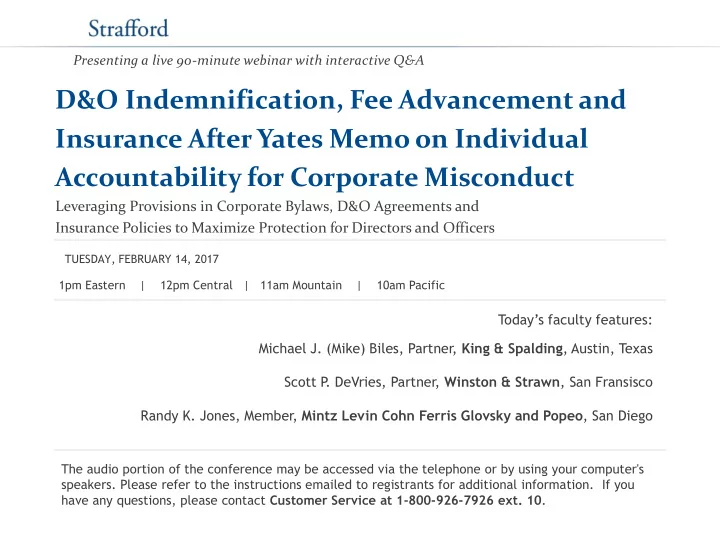
Presenting a live 90-minute webinar with interactive Q&A

D&O Indemnification, Fee Advancement and Insurance After Yates Memo on Individual Accountability for Corporate Misconduct

Leveraging Provisions in Corporate Bylaws, D&O Agreements and Insurance Policies to Maximize Protection for Directors and Officers

Today’s faculty features:

1pm Eastern | 12pm Central | 11am Mountain | 10am Pacific TUESDAY, FEBRUARY 14, 2017

Michael J. (Mike) Biles, Partner, King & Spalding, Austin, Texas Scott P . DeVries, Partner, Winston & Strawn, San Fransisco Randy K. Jones, Member, Mintz Levin Cohn Ferris Glovsky and Popeo, San Diego

slide-2
SLIDE 2

Tips for Optimal Quality

Sound Quality If you are listening via your computer speakers, please note that the quality

  • f your sound will vary depending on the speed and quality of your internet

connection. If the sound quality is not satisfactory, you may listen via the phone: dial 1-866-961-8499 and enter your PIN when prompted. Otherwise, please send us a chat or e-mail sound@straffordpub.com immediately so we can address the problem. If you dialed in and have any difficulties during the call, press *0 for assistance. Viewing Quality To maximize your screen, press the F11 key on your keyboard. To exit full screen, press the F11 key again.

FOR LIVE EVENT ONLY

slide-3
SLIDE 3

Continuing Education Credits

In order for us to process your continuing education credit, you must confirm your participation in this webinar by completing and submitting the Attendance Affirmation/Evaluation after the webinar. A link to the Attendance Affirmation/Evaluation will be in the thank you email that you will receive immediately following the program. For additional information about continuing education, call us at 1-800-926-7926

  • ext. 35.

FOR LIVE EVENT ONLY

slide-4
SLIDE 4

Program Materials

If you have not printed the conference materials for this program, please complete the following steps:

  • Click on the ^ symbol next to “Conference Materials” in the middle of the left-

hand column on your screen.

  • Click on the tab labeled “Handouts” that appears, and there you will see a

PDF of the slides for today's program.

  • Double click on the PDF and a separate page will open.
  • Print the slides by clicking on the printer icon.

FOR LIVE EVENT ONLY

slide-5
SLIDE 5

Individual Accountability for Corporate Misconduct After the Yates Memo

Randy K. Jones, Esq. Member Mintz Levin rkjones@mintz.com

slide-6
SLIDE 6
  • Sept 9, 2015: DOJ Deputy Attorney General Sally Quillian Yates issues memo

to all government prosecutors titled, Individual Accountability for Corporate Wrongdoing:

"Fighting corporate fraud and other misconduct is a top priority of the Department of Justice."

  • Holds individuals responsible for corporate misdeed, both criminal and civil

Yates Memo: Background

6

slide-7
SLIDE 7
  • In response to issues in the financial services industry, but is not limited to

that sector

  • DOJ prioritizes individual accountability for several reasons:
  • Deters illegal activity
  • Incentivizes changes in corporate behavior
  • Ensures that the proper parties are held responsible for their actions
  • Promotes the public's confidence in our justice system

Yates Memo: Why Now?

7

slide-8
SLIDE 8

Recent DOJ Memos related to bringing charges against corporations:

  • Holder Memo (1999)
  • Thompson Memo (2003)
  • McNulty Memo (2006)
  • Filip Memo (2008)
  • Yates Memo (2015)
  • U.S. Attorney's Manual (USAM)

Yates Memo: Change in DOJ Policy?

8

slide-9
SLIDE 9

1.

To be eligible for any cooperation credit, corporations must provide to DOJ all relevant facts about the individuals involved in corporate misconduct.

2.

Both criminal and civil corporate investigations should focus on individuals from the inception of the investigation.

3.

Criminal and civil attorneys handling corporate investigations should be in routine communication with one another.

4.

Absent extraordinary circumstances, no corporate resolution will provide protection from criminal or civil liability for any individuals.

5.

Corporate cases should not be resolved without a clear plan to resolve related individual cases.

6.

DOJ civil attorneys should evaluate whether to bring suit against an individual based on considerations beyond the individual's ability to pay .

Yates Memo: Six Key Steps

9

slide-10
SLIDE 10

"To be eligible for any cooperation credit, corporations must provide to the Department all relevant facts about the individuals involved in corporate misconduct."

  • DOJ serves as "rule maker, referee, and opponent."
  • "All-or-nothing" prerequisite to receive any benefit from cooperating with the

DOJ: "Companies cannot pick and choose what facts to disclose.”

  • Extent of cooperation credit depends on: the timeliness of the cooperation; the

diligence, thoroughness, and speed of the internal investigation; and the proactive nature of the cooperation.

  • Individuals will be investigated before, during and after any corporate

cooperation.

  • Permits DOJ to penalize a company for not consistently providing updates to

prosecutors.

Step #1: Eligibility for Cooperation Credit

10

slide-11
SLIDE 11

"Both criminal and civil corporate investigations should focus on individuals from the inception of the investigation."

  • Corporations act only through people.
  • Investigating conduct of individuals in the corporation helps DOJ determine the

facts and extent of corporate misconduct.

  • Increases likelihood that lower-level personnel will cooperate against

executives and others at the top.

  • Ensures both corporations and individuals will be held responsible.
  • DOJ will recognize the distinction between privileged legal advice and non-

privileged facts learned during the course of an internal investigation but companies have been forewarned that they cannot "wrongly exploit [the privilege's] legitimate purpose by using it to shield non-privileged information from investigators."

Step #2: Focus on Individuals

11

slide-12
SLIDE 12

"Criminal and civil attorneys handling corporate investigations should be in routine communication with one another. "

  • DOJ attorneys will consider the full array of civil and criminal options.
  • Criminal attorneys must notify civil attorneys early on, and vice versa.
  • DOJ attorneys are directed to follow "a number of internal reporting and

approval requirements" to facilitate consistency, oversight, and improved communication throughout the DOJ.

  • Individuals can be held civilly liable even if no criminal charges.
  • Expect aggressive charging decisions to send a message that the department is

committed to the Yates Memo's objectives.

Step #3: Communication Between Civil and Criminal Attorneys

12

slide-13
SLIDE 13

"Absent extraordinary circumstances, no corporate resolution will provide protection from criminal or civil liability for any individuals."

  • Corporate resolution of a matter still leaves individuals liable
  • No corporate resolution, absent extraordinary circumstances, that includes an

agreement to dismiss charges against, or provide immunity for, individual

  • fficers or employees.
  • Assistant General or United States Attorney must personally approve, in writing,

an agreement not to proceed with criminal or civil liability. Step #4: Corporate Resolution Will Not Provide Protection for Individuals

13

slide-14
SLIDE 14

"Corporate cases should not be resolved without a clear plan to resolve related individual cases before the statute of limitations expires and declinations as to individuals in such cases must be memorialized."

  • If a decision is made not to bring civil claims or criminal charges against the

individuals who committed the misconduct, there must be a written memo discussing potential individual liability and a plan to address it.

  • Any decision not to hold individual liable must be approved by the United

States Attorney or Assistant Attorney General office who handled the investigation, or designees.

Step #5: Clear Plan to Resolve Individual Cases

14

slide-15
SLIDE 15

"Civil attorneys should consistently focus on individuals as well as the company and evaluate whether to bring suit against an individual based on considerations beyond that individual's ability to pay."

  • The twin aims of recovering as much money as possible, and holding

wrongdoers accountable for and to deter individual misconduct are .

  • Inability to pay does not justify not bringing a civil suit against an individual
  • DOJ attorneys are to consider factors such as:

– whether the person's misconduct was serious; – whether it is actionable; – whether the admissible evidence will probably be sufficient to obtain and sustain a judgment; and – whether pursuing the action reflects an important federal interest.

Step # 6: Considerations Beyond Individual's Ability to Pay

15

slide-16
SLIDE 16
  • Potential conflict of interest between individuals and

corporation

  • Increased penalties for failure to cooperate
  • Unduly large settlements to the government
  • Chilling effect on corporation's personnel
  • Threats to attorney-client privilege and attorney work product

Yates Memo: Implications on Corporations and Individuals

16

slide-17
SLIDE 17
  • Sept. 22, 2015 – AAG Leslie Caldwell provided some practical guidance on the

memo at the Global Investigations Review Conference in New York: "If you choose to cooperate with us, we expect that you will provide us with those facts, be they good or bad. Importantly, that includes facts about individuals responsible for the misconduct, no matter how high their rank may be."

  • October 2015– Head of DOJ's Civil Division, Benjamin Mizer speaking at the

Pharmaceutical Compliance Congress and Best Practices Forum in DC : "…no partial credit for cooperation that doesn't include information about individuals"

Yates Memo: Is The Government Serious This Time?

17

slide-18
SLIDE 18
  • Nov. 2, 2015 – AAG Caldwell speaking at a SIFMA regional conference in NY,

repeated what has become one of her main themes: the importance of companies having compliance programs fine-tuned to their specific risks.

  • Nov. 3, 2015 – DOJ Criminal Division hired Hui Chen as compliance counsel for

the Fraud Section:

AAG Caldwell said Ms. Chen's experience will help the DOJ assess existing compliance programs and proposed remedial measures.

  • DOJ Fraud Chief Andrew Weissmann suggested that DOJ hopes to urge

companies to strengthen their internal compliance measures to prevent the misconduct that leads to prosecution.

Yates Memo: Is The Government Serious This Time? (cont.)

18

slide-19
SLIDE 19

1.

Sit down with in-house or outside counsel to understand the boundaries of the attorney-client privilege. It is not as simple as having an attorney present at meetings or copied on e-mail communications.

2.

Develop best practices to ensure the attorney-client privilege is preserved, when possible, at meetings and in e-mail communications.

3.

Understand the DOJ's investigation process and have a plan in place to increase the chances to earn cooperation credit.

4.

Seek counsel who can effectively communicate with the DOJ to level the playing field, hold the DOJ to the applicable standards in the USAM, and increase the chances of earning cooperation credit to avoid litigation.

5.

Educate the board and senior management about implications of the Yates Memo policies.

6.

Conduct independent assessment of your compliance program.

Yates Memo: What To Do?

19

slide-20
SLIDE 20
  • In light of the new focus on individuals, all companies and their

directors and officers should re-think their D&O policies. – More individuals are likely to face longer, and more costly, legal battles. – More individuals will be seeking to have independent counsel represent them rather than trust their fate to the hands of the lawyers representing the corporation. – All of this means that defense costs will increase.

Yates Memo: Implications on D&O Insurance

20

slide-21
SLIDE 21

Advancement Rights and Indemnity

Michael Biles mbiles@kslaw.com February 14, 2017

slide-22
SLIDE 22

Advancement v. Indemnification

  • Delaware General Corporation Law (“DGCL”)
  • Indemnification—DGCL §§ 145 (a), (b), and (c)
  • Permissive under §§ 145 (a) and (b)
  • Mandatory under § 145 (c)
  • Indemnification determined after the conclusion of the civil or criminal

matter.

  • Advancement—DGCL § 145(e)
  • Covers defense costs; obtained pre-judgment; expedited treatment
  • The Delaware Court of Chancery has stressed that:
  • “Advancement and indemnification are separate and distinct legal

actions” and

  • “The right to advancement is not dependent on the right to

indemnification”—Holley v. Nipro Diagnostics, C.A. No. 9679-VCP, 2014 WL

7336411 (Del. Ch. Dec. 23, 2014)

22

slide-23
SLIDE 23

Statutory Framework for Permissive Indemnification

  • Under Section 145 of DGCL, a corporation may indemnify a

current or former director, officer, employee or agent:

(a) In any civil or criminal matter (other than an action by or in the right of the corporation) if:

  • The matter concerns the fact that the person was a director, officer or agent
  • f the company;
  • The person acted in good faith and in the best interest of the company, or in

a criminal matter, the person did not believe his conduct was unlawful;

  • A judgement, settlement or conviction does not, by itself, create a

presumption the person is not entitled to indemnification. (b) In any action “by or in the right of the corporation” (i.e., direct or derivative) if:

  • The person acted in good faith and in the best interest of the company;
  • No indemnification shall be made if the person is adjudged to be liable to

the corporation unless the Court of Chancery determines upon application that, despite the adjudication of liability, the person is entitled indemnity.

23

slide-24
SLIDE 24

Statutory Framework for Mandatory Indemnification

  • Section 145(c) of DGCL provides:

To the extent that a present or former director or officer of a corporation has been successful on the merits or otherwise in defense

  • f any action, suit or proceeding referred to in subsections (a) and (b)
  • f this section, or in defense of any claim, issue or matter therein,

such person shall be indemnified against expenses (including attorneys' fees) actually and reasonably incurred by such person

24

slide-25
SLIDE 25

Statutory Framework for Advancement

  • Section 145 of the Delaware General Corporation Law provides:
  • “(e) Expenses (including attorneys' fees) incurred by an officer or director of the corporation in defending any

civil, criminal, administrative or investigative action, suit or proceeding may be paid by the corporation in advance of the final disposition of such action, suit or proceeding upon receipt of an undertaking by or on behalf of such director or officer to repay such amount if it shall ultimately be determined that such person is not entitled to be indemnified by the corporation as authorized in this section. Such expenses (including attorneys' fees) incurred by former directors and officers or other employees and agents of the corporation or by persons serving at the request of the corporation as directors, officers, employees or agents of another corporation, partnership, joint venture, trust or other enterprise may be so paid upon such terms and conditions, if any, as the corporation deems appropriate.”

  • “(f) The indemnification and advancement of expenses provided by, or granted pursuant to, the other

subsections of this section shall not be deemed exclusive of any other rights to which those seeking indemnification or advancement of expenses may be entitled under any bylaw, agreement, vote of stockholders

  • r disinterested directors or otherwise, both as to action in such person's official capacity and as to action in

another capacity while holding such office. …”

  • To have advancement rights, the company must
  • have a provision in its certificate of incorporation;
  • enact a bylaw;
  • vote of shareholders or disinterested directors; or
  • the D&O must have a separate agreement.

25

slide-26
SLIDE 26

Standard for Advancement

  • Standard for advancement
  • If a company has agreed to advance defense costs to

the fullest extent permitted by law in its charter, bylaws or separate agreement, the only condition for advancing defense costs is the provision of an undertaking.

  • Strong protection of advancement rights under Delaware

law

  • “Resolv[e] ambiguity in favor of indemnification and

advancement”—Blankenship v. Alpha Appalachia Holdings, Inc., C.A. No. 10610-CB (Del. Ch. May 28, 2015)

26

slide-27
SLIDE 27

But Careful Drafting is Required

  • In Charney v. American Apparel, Inc., the Delaware Chancery Court ruled that the

company’s former Chairman and CEO was not entitled to an advancement. C.A.

  • No. 11098-CB (Del. Ch. Sept. 11, 2015)
  • Takeaways from American Apparel:
  • (1) Carefully read the charter, bylaws, and your indemnification agreement
  • American Apparel’s certificate of incorporation states that the company must

indemnify any person “to the full extent permitted” by Delaware law and that the company must advance expenses to any “officer or director” entitled to indemnification.

  • Did not cover former officers or directors because provision was not explicit
  • (2) Advancement is not available for claims arising from actions that are

beyond the scope of an executive’s position

  • The indemnification agreement “mandates advancement for events or occurrences

‘related to the fact’ that Charney is or was a director or officer of the Company.”

  • Advancement required “a nexus or causal connection between the claims in the

underlying proceeding and one’s official corporate capacity to obtain advancement.”

27

slide-28
SLIDE 28

Can a board amend the bylaws to deny advancement to a former D&O? Probably

  • In Schoon v. Troy Corp., 948 A.2d 1157 (Del. Ch. 2008), the Court

held that the rights to mandatory advancement contained in the bylaws do not vest until a triggering event occurs.

  • Triggering events: filing of a suit or threatened legal action
  • In Schoon, two directors (one current and one former) sought

advancement of their defense costs in a derivative lawsuit and the company denied their requests for advancement.

  • After the former director resigned from the board and before the

derivative lawsuit was filed, the company amended its bylaws to exclude former directors from receiving advancement.

  • The Court granted the current director advancement, but denied

advancement to the former director because the triggering event

  • ccurred after his resignation and bylaw amendment

28

slide-29
SLIDE 29

Aftermath of Shoon

  • The Delaware legislature amended DGCL § 145(f) to limit a

company’s ability to impair a director’s or officer’s advancement rights retroactively.

  • DGCL § 145(f) now allows a company to amend its certificate of

incorporation

  • r

bylaws to eliminate indemnification

  • r

advancement rights after a triggering event but only if the company’s bylaws explicitly authorize subsequent amendments to terminate such rights:

  • “A right to indemnification or to advancement of expenses arising under a provision of the

certificate of incorporation or a bylaw shall not be eliminated or impaired by an amendment to the certificate of incorporation or the bylaws after the occurrence of the act or omission that is the subject of the civil, criminal, administrative or investigative action, suit or proceeding for which indemnification or advancement of expenses is sought, unless the provision in effect at the time of such act or omission explicitly authorizes such elimination or impairment after such action or omission has occurred.”

29

slide-30
SLIDE 30

Officers and Directors Should Have A Separate Indemnification and Advancement Agreement

  • Eliminates the risk that advancement rights will be unilaterally

amended or terminated by the company—i.e., avoid the Shoon scenario

  • Separate agreements can address the rights in more detail—for

example:

  • Procedures and timeframe for payments
  • Selection of counsel
  • Provide for access to documents and witnesses
  • Beware of separation agreements that purport to waive advancement
  • rights. Brady v. i2 Technologies, Inc., Civil Action No. 1543-N,

2005 WL 3691286 (Del. Ch. Dec. 14, 2005)

30

slide-31
SLIDE 31

Advancement Litigation (in Delaware)

What are my options if the company does not advance defense costs?

  • The Delaware Court of Chancery has exclusive jurisdiction to “hear

and determine all actions for advancement of expenses or indemnification.” DGCL § 145(k)

  • File an advancement action in the Delaware Chancery Court
  • An advancement action is considered a “summary proceeding”

and thus moves at a quicker pace than normal litigation

  • Demand for Fees on Fees
  • The Court has discretion to award fees on fees upon a showing

the company unreasonably refused to advance the requested fees.

  • See Blankenship v. Alpha Appalachia Holdings, Inc., C.A. No. 10610-CB

(Del. Ch. May 28, 2015)

31

slide-32
SLIDE 32

Tips for Officers and Directors

32

  • Have a separate indemnification and advancement agreement
  • Make sure the company is obligated to indemnify and advance “to

the fullest extent permitted by law”

  • Broadly define key terms like “expenses” and “proceedings” (i.e.,

make sure that informal investigations are covered)

  • Who has the right to select counsel?
  • Make sure that fees-on-fees are covered
  • Clarify the time frame for payment of fees (e.g., within 30 days)
  • Require the corporation to maintain D&O insurance
  • Access to documents and witnesses
slide-33
SLIDE 33

Building A Stronger Safety Net: Directors & Officers Insurance

Scott P. DeVries Yelitza V. Dunham

slide-34
SLIDE 34

D&O Insurance – Introduction

  • While it remains to be seen whether the Yates Memo will result in

more corporate executives being charged in criminal and civil corporate investigations, more individuals can expect to be targeted “from the inception of the investigation” (Key Step #2)

  • Insurance should not be ignored merely because indemnity

agreements are in place

  • Insurance can cover when company is in insolvent or unwilling to provide

indemnification

  • Insurance has broader scope, e.g., can cover judgment & settlements in

derivative suits

  • Insurance can provide an added layer of protection particularly where

coverage for early, informal governmental/regulatory investigations has been purchased

  • The inclusion or omission or chosen wording of any number of

policy terms, conditions, and exclusions can spell the difference between coverage or no coverage for Directors and Officers

34

slide-35
SLIDE 35

Basics of D&O Insurance: A Refresher Course

  • Coverage under a D&O Insurance is typically described as

having three major coverage parts.

  • Side A: covers the director or officer for claims not indemnified by the

company (e.g., not legally permitted to provide indemnification, or fails to do so).

  • Side B: covers the company for amounts paid to indemnify the

director or officer.

  • Side C: covers the company for claims made directly against the

company but often only securities claims

  • It is not uncommon for a D&O policy to provide a single limit
  • f liability that is shared among all three insuring

agreements and among all insureds.

35

slide-36
SLIDE 36

Maximizing Coverage Available for Directors and Officers

  • In light of the new focus on individuals, critical to maximize

coverage available to Directors and Officers. Several vehicles for accomplishing this.

  • One vehicle is to include in the policy a priority of payment

provision ensuring limits get paid out for loss sustained by individual insureds first, over any loss sustained by the company

  • This is because the D&O limits are shared among all three coverage
  • sides. If a Side C claim hits first, it may exhaust the entire policy

leaving the Directors and Officers bare for any subsequent Side A claim

36

slide-37
SLIDE 37

Coverage Specifically for Directors and Officers

  • Company should consider purchasing “Side A-only” policies, which

cover Directors and Officers exclusively.

  • Unlike general director’s and officer’s sides A/B/C policies, bankruptcy court

typically limits distribution on these policies to expense exclusively incurred for the benefit of these individuals. This also has the advantage of being non-rescindable coverage

  • One type of Side A coverage is called a Difference in Conditions (“DIC”) Policy.

Advances defense costs for directors and officers in the event the company doesn't pay an otherwise covered claim for any reason. Fewer exclusions than the typical D&O insurance policy and can be triggered even when the underlying D&O insurance is not due to an exclusion.

  • Dollar One: Side A has no retention, so Directors and Officers are

covered from "dollar one" when they aren't being indemnified.

  • Side A coverage should cover "non-indemnifiable" loss as well as "non-

indemnified" loss which covers situations where the company may balk at its indemnification obligation because:

  • It thinks the director is engaging in some sort of wrongdoing, or
  • The company itself is insolvent

37

slide-38
SLIDE 38

Covered Claims and Expenses

  • To cover informal investigations which may now be on the rise

due to the Yates Memo, policyholders should look for broad definitions of terms within the Insuring Agreement. E.g., “Claim,” “Loss”/ “Defense Costs”

  • In particular, seek PRE-CLAIM INQUIRY COST COVERAGE
  • Coverage triggered by a “Claim” made during the policy period for a covered

wrongful act

  • “Claim” typically defined to include monetary and non-monetary demands for

relief, as well as civil/criminal/regulatory proceedings initiated by complaint, indictment, notice of charges or similar documents. But insurers say this language isn’t enough to transform a formal governmental or regulatory investigation into a “Claim” absent qualifying language that the investigation was commenced by service of a Wells notice, target letter or similar document specifically naming the individual insured.

  • But waiting for a formal charge to be issued before a “Claim” is triggered kicks in

may leave some serious coverage gaps. To make sure the cost of any potential informal investigation is insured, look for pre-claim inquiry cost coverage - covers such costs as producing documents, preparing for and attending interviews/meetings requested by the government.

38

slide-39
SLIDE 39

Covered Claims and Expenses (cont’d)

  • To cover broad range of expenses which may result from both

informal and formal governmental investigations, look for a broad “Defense Costs” definition

  • Policy typically covers “Loss”: damages, settlements, judgments and

“Defense Costs”

  • “Defense Costs” generally means reasonable and necessary fees, costs

and expenses

  • Some policies cover the following expenses as part of “Defense Costs”:
  • E-DISCOVERY CONSULTANT SERVICES
  • E.g., Costs of services designed to minimize the risks and expense of e-discovery
  • REPUTATION (REPARATION) COSTS
  • E.g., Costs charged by a public relations firm, crisis management firm or law firm to

mitigate the adverse effects specifically to the insured’s reputation from a negative statement about him or her made by an enforcement body

  • ASSET PROTECTION COSTS
  • E.g., Costs incurred to oppose any effort to seize the insured’s personal assets or real

property

39

slide-40
SLIDE 40

Conduct Exclusions

  • D&O policies typically contain exclusions that bar coverage for

misconduct on the part of an insured.

  • Generally excluded: intentional dishonesty, fraud, criminal conduct and

willful violations of law.

  • While a large percentage of D&O claims include allegations of

fraud or illegal personal profiting, the simple allegation is not enough to trigger the exclusion.

  • Even an informal governmental investigation will likely implicate the

conduct exclusions so seek to limit their impact

  • Most exclusions require something like a court determination of guilt or an

admission of guilt before the exclusion can apply. Either the words "final adjudication" or "in fact" will be used in the exclusion to indicate how high the hurdle is for the carrier to apply these exclusions.

  • Exclusionary language can be refined to corporate executive’s advantage

in a number of ways including, but not limited to, addition of ‘non- appealable’ modifier.

40

slide-41
SLIDE 41

Exclusions and Severability Provision

  • Make sure the policy contains severability provision that

protects innocent insureds from losing coverage because of the “bad” acts of others.

  • Should state that for purposes of determining the applicability of exclusions,

the wrongful acts and knowledge of any one individual insured cannot be imputed to any other individual insured.

41

slide-42
SLIDE 42

Application Disclosures, Rescission, and Severability Provision

  • If an insured discovers that the application for D&O

coverage contained a misrepresentation or omission of a material fact, the insurer may seek to rescind the policy

  • A rescission could result in a loss of coverage for the

company and all insureds, including innocent directors and

  • fficers.
  • Negotiate a severability provision specific to the issue of

application disclosures which prevents the knowledge of, or material misrepresentation by, that bad actor from being imputed to the innocent insureds or the company as a whole

  • Avoid policy provision which expressly incorporates the

application into the policy and says the insurer has relied upon all the declarations and information therein.

42

slide-43
SLIDE 43

D&O Insurance Policies – Key Takeaways

  • Indemnity agreements not a substitute for insurance: each

provides an additional layer of safety in the event the government comes knocking

  • Review and negotiate key insurance policy terms at

purchase and at each renewal period

  • Things to aim for:
  • Broad definitions of “Claim” and “Defense Costs” to ensure maximal

coverage of any informal governmental or regulatory investigation

  • Limiting scope of “crime/fraud” and “personal profit” exclusions
  • Nonrescindable coverage or, at minimum, severability provision
  • Allow sufficient lead up time to have broker and coverage counsel

review for new coverage gaps created by new laws/remedies/regulations, availability of new insurance products

43

slide-44
SLIDE 44

Thank You

Scott P. DeVries Winston & Strawn 101 California Street, 35th Floor San Francisco, CA 94111-5840 sdevries@winston.com

44