Presenting a live 90-minute webinar with interactive Q&A - - PowerPoint PPT Presentation

presenting a live 90 minute webinar with interactive q a
SMART_READER_LITE
LIVE PREVIEW

Presenting a live 90-minute webinar with interactive Q&A - - PowerPoint PPT Presentation

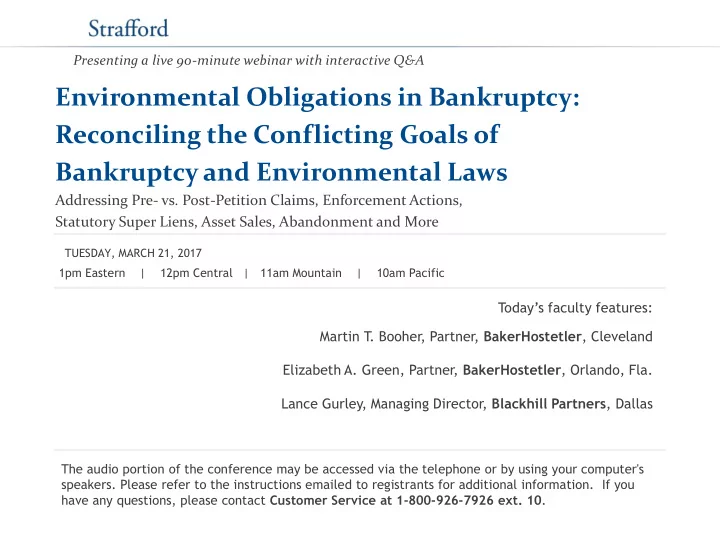
Presenting a live 90-minute webinar with interactive Q&A Environmental Obligations in Bankruptcy: Reconciling the Conflicting Goals of Bankruptcy and Environmental Laws Addressing Pre- vs. Post-Petition Claims, Enforcement Actions,


slide-1
SLIDE 1

The audio portion of the conference may be accessed via the telephone or by using your computer's

  • speakers. Please refer to the instructions emailed to registrants for additional information. If you

have any questions, please contact Customer Service at 1-800-926-7926 ext. 10.

Presenting a live 90-minute webinar with interactive Q&A

Environmental Obligations in Bankruptcy: Reconciling the Conflicting Goals of Bankruptcy and Environmental Laws

Addressing Pre- vs. Post-Petition Claims, Enforcement Actions, Statutory Super Liens, Asset Sales, Abandonment and More

Today’s faculty features:

1pm Eastern | 12pm Central | 11am Mountain | 10am Pacific TUESDAY, MARCH 21, 2017

Martin T . Booher , Partner, BakerHostetler, Cleveland Elizabeth A. Green, Partner, BakerHostetler, Orlando, Fla. Lance Gurley, Managing Director, Blackhill Partners, Dallas

slide-2
SLIDE 2

Tips for Optimal Quality

Sound Quality If you are listening via your computer speakers, please note that the quality

  • f your sound will vary depending on the speed and quality of your internet

connection. If the sound quality is not satisfactory, you may listen via the phone: dial 1-866-873-1442 and enter your PIN when prompted. Otherwise, please send us a chat or e-mail sound@straffordpub.com immediately so we can address the problem. If you dialed in and have any difficulties during the call, press *0 for assistance. Viewing Quality To maximize your screen, press the F11 key on your keyboard. To exit full screen, press the F11 key again.

FOR LIVE EVENT ONLY

slide-3
SLIDE 3

Continuing Education Credits

In order for us to process your continuing education credit, you must confirm your participation in this webinar by completing and submitting the Attendance Affirmation/Evaluation after the webinar. A link to the Attendance Affirmation/Evaluation will be in the thank you email that you will receive immediately following the program. For additional information about continuing education, call us at 1-800-926-7926

  • ext. 35.

FOR LIVE EVENT ONLY

slide-4
SLIDE 4

Program Materials

If you have not printed the conference materials for this program, please complete the following steps:

  • Click on the ^ symbol next to “Conference Materials” in the middle of the left-

hand column on your screen.

  • Click on the tab labeled “Handouts” that appears, and there you will see a

PDF of the slides for today's program.

  • Double click on the PDF and a separate page will open.
  • Print the slides by clicking on the printer icon.

FOR LIVE EVENT ONLY

slide-5
SLIDE 5

ENVIRONMENTAL CLAIMS

IN BANKRUPTCY

Reconciling the Conflicting Goals of Bankruptcy and Environmental Law

slide-6
SLIDE 6

Table of Contents

I. Introduction

  • II. Jurisdiction
  • III. Dischargeability of Environmental Claims
  • IV. Exceptions to Automatic Stay relating to

Governmental Agencies

  • V. Standing of Governmental Agencies in

Bankruptcy Cases

  • VI. Addressing Contingent Environmental

Claims VII.Disposition of Contaminated Assets

6

slide-7
SLIDE 7

Introduction (1 of 2)

  • The Conflicting Goals of Bankruptcy and

Environmental Law:

– Bankruptcy: Provide the debtor a “fresh start” by addressing all liabilities. Allowing environmental liabilities to survive or evade the otherwise comprehensive Chapter 11 plan may destroy a debtor’s ability to reorganize. – Environmental: Prevent and cleanup contamination by imposing liability on responsible parties. Eliminating environmental claims in bankruptcy case may allow guilty parties to escape liability, delay or prevent cleanup, require other parties to overpay for their relative contributions to the contamination, and unnecessarily impose costs on the government

7

slide-8
SLIDE 8

Introduction (2 of 2)

  • What Environmental Obligations?
  • Environmental obligations take many
  • forms. For example:
  • An obligation to pay money;
  • An obligation to perform a cleanup; or
  • Ongoing regulatory compliance.

8

slide-9
SLIDE 9

Jurisdiction Over Environmental Claims (1 of 2)

  • Original jurisdiction over environmental law issues rests with

state courts or U.S. District Courts (See e.g. 42 U.S.C. § 9613(b) – vesting District Courts with jurisdiction over CERCLA).

  • Removal: Once a bankruptcy case is filed, a party may

generally remove a claim or cause of action to the Bankruptcy Court under 28 U.S.C. § 1452(a). However, § 1452 expressly excepts civil actions “by a governmental unit to enforce such governmental unit’s police or regulatory power” from removal – which generally excepts environmental claims brought by a governmental entity. See e.g. City & County of San Francisco v. PG&E Corp., 433 F.3d 1115, 1123 (9th Cir. 2006) (language in § 1452 practically identical to police power exception from automatic stay in § 362, and should be interpreted consistently).

9

slide-10
SLIDE 10

Jurisdiction Over Environmental Claims (2 of 2)

  • If brought before Bankruptcy Court (for

example, non-governmental claim), court may be hesitant to resolve environmental law disputes on the merits.

– Abstention (28 U.S.C. § 1334) – Remand (28 U.S.C. § 1452(b)) – After Stern v. Marshall, does Bankruptcy Court have authority to enter final judgments in environmental law cases absent consent?

10

slide-11
SLIDE 11

Dischargeability of Environmental Claims (1 of 5)

  • Three initial questions:

– (1) is it a claim? – (2) when did the claim arise? – (3) did the creditor holding the claim have sufficient notice of the case and the debtor’s liability to participate in the bankruptcy case?

11

slide-12
SLIDE 12

Dischargeability of Environmental Claims (2 of 5)

  • First, is it a “Claim” under the Bankruptcy Code?

– 11 U.S.C. § 101(5) – “right to payment, whether or not such right is reduced to judgment, liquidated, unliquidated, fixed, contingent…” Legislative history indicates definition was intended to be broad “by this broadest possible definition…all legal obligations of the debtor, no matter how remote or contingent, will be able to be dealt with in the bankruptcy case.” H.R. Rep. No 95-595, at 309 (1978). – Holder of a claim generally may participate in the bankruptcy case, vote on the plan, and is entitled to a distribution – Claims are generally subject to discharge

12

slide-13
SLIDE 13

Dischargeability of Environmental Claims (3 of 5)

  • Second, when did the claim arise?

– For example, does claim arise when debtor contaminates a site, when contamination is discovered, when scope of contamination is understood, or when cleanup is complete and costs are fully liquidated? – Case law varies by jurisdiction and given its widely- disparate history, outcomes are difficult to predict. However, the trend appears to be toward the so-called “pre-petition relationship” or “fair contemplation” test – the creditor must have had sufficient notice and some basis upon which creditor could fairly contemplate claim against debtor. – Effect of timing: in Chapter 7, pre-petition claims are subject to discharge (§727); in Chapter 11, pre- confirmation claims are subject to discharge (§1141(d))

13

slide-14
SLIDE 14

Dischargeability of Environmental Claims (4 of 5)

  • Third, did the creditor holding the claim have sufficient notice of the

case and the debtor’s liability to participate in the bankruptcy case?

– Notice satisfies due process if it is “reasonably calculated, under the circumstances, to apprise the interested parties of the pendency of the action and afford them an opportunity to present their objections.” Mullane, 339 U.S. 306, 314 (1950) – For purposes of notice, bankruptcy law differentiates between “known” and “unknown” creditors. – Known creditors are entitled to actual notice of the claims bar date. – Notice to unknown creditors by publication is generally sufficient, as long as the noticing party acted reasonably in selecting the means to inform the persons affected. In re Nortel Networks, Inc., 531 B.R. 53, 62-63 (Bankr. Del. 2015).

  • A known creditor is one whose identity is either known or reasonably

ascertainable by the debtor. The debtor is not required to conduct “a vast,

  • pen-ended search.”. Instead, the focus is on whether the debtor “did what

was reasonable under the circumstances to provide notice to ascertainable creditors.”

14

slide-15
SLIDE 15

Dischargeability of Environmental Claims (5 of 6)

  • The few clear answers:

– Ongoing regulatory compliance obligations are generally not claims subject to discharge.

  • 28 U.S.C. § 959(b) – requires DIP to comply with applicable

“state” laws during bankruptcy case (has been interpreted to mean federal laws as well)

  • §503 generally makes post-petition violations of environmental

laws administrative expense claims

  • This continuing duty to comply with the law creates an

administrative priority claim for many types of government environmental claims.

  • Treatment of claims by co-liable parties for work they perform is a

thornier issue that depends on subrogation and other areas of law.

– Debtor cannot keep property and avoid associated environmental liabilities. Ohio v. Kovacs, 469 U.S. 274 (1985).

15

slide-16
SLIDE 16

Dischargeability of Environmental Claims (6 of 6)

  • Debtors should maximize the scope of the

discharge by conducting a reasonable search into potential environmental claimants and providing notice of the bankruptcy case to such claimants

  • Regulatory

agencies

  • r
  • ther

parties potentially liable with the debtor under environmental laws should take action upon receiving notice

  • f

bankruptcy case, because their rights could be adversely affected.

16

slide-17
SLIDE 17

Exception to Automatic Stay for Governmental Agencies (1 of 2)

  • §362(b)(4) – Exception to automatic stay

for governmental unit enforcing police or regulatory power

– “Governmental unit” defined in § 101(27) – includes state and federal environmental agencies – Pecuniary purpose and public policy tests

  • Enforcement actions generally fall into exception

under either test (See e.g. In re Gandy, 327 B.R. 796, 805 (Bankr. S.D. Tex. 2005)).

17

slide-18
SLIDE 18

Exception to Automatic Stay for Governmental Agencies (2 of 2)

  • Most states have laws creating liens for

environmental obligations; terms and conditions

  • f the laws vary widely by jurisdiction.
  • Laws that create environmental liens that prime

preexisting liens are referred to as “superlien” laws, and have been enforced. (See e.g. 229 Main Street, 262 F.3d 1 (1st Cir. 2001)).

  • Highlights need for due diligence in advance,

adequate covenants and reporting requirements, and prompt action if governmental action is taken against borrower or collateral.

18

slide-19
SLIDE 19

Standing of Government Agencies in Bankruptcy Cases

  • Government agencies are generally “parties in interest” under the

Bankruptcy Code

  • The threat of a large environmental claim can give the government

significant leverage because, absent consent, administrative claims must be paid in full on the plan effective date. (§ 1129(a)(9)(A)).

  • The government often calculates its claim with the assumption that

co-liable parties will contribute nothing. In cases where the debtor had an agreement to split environmental obligations with other entities, the government’s claim can far exceed debtor’s expected liabilities.

– For instance, many oil and gas exploration firms take partial interests in a large number of projects. In each project, the parties allocate the costs of decommissioning amongst themselves. The government often calculates its claim assuming co-liable parties will contribute nothing.

19

slide-20
SLIDE 20

Contingent Environmental Claims

  • Many environmental claims involve multiple potentially

liable parties, especially co-investors and predecessors in title, who may have rights against the debtor.

  • Section 502(e)(1)(B) disallows contingent pre-petition

claims by co-liable parties, such as speculative contribution claims.

  • Claims for cleanup expenses actually incurred by a co-

liable party post-petition, with respect to assets possessed by the debtor, may be entitled to administrative expense status.

20

slide-21
SLIDE 21

Disposition of Contaminated Assets: Abandonment (1 of 4)

  • Debtors may be able to limit environmental

administrative claims by abandoning property under § 554, so that it is no longer in their “possession” under 28 U.S.C. § 969.

  • In Midlantic, a trustee moved to abandon two
  • verburdened waste facilities packed with toxic,

carcinogen-contaminated, and explosive chemicals, without taking steps like erecting fencing or maintaining the fire suppression systems.

21

slide-22
SLIDE 22

Disposition of Contaminated Assets: Abandonment (2 of 4)

The Supreme Court held that the trustee in Midlantic could not abandon the waste sites, and that “[t]he bankruptcy court does not have the power to authorize the abandonment without formulating conditions that will adequate protect the public’s health and safety…” It characterized its rule as “narrow” and identified several situations where abandonment may be permitted to avoid environmental laws:

– A state law may be so “onerous as to interfere with the bankruptcy adjudication itself” – The bankruptcy court may establish “conditions that will adequately protect the public’s health and safety” – The violation at issue is a “speculative or indeterminate future violation”

22

slide-23
SLIDE 23

Disposition of Contaminated Assets: Abandonment (3 of 4)

  • Factors considered by Court:

– Whether the Court can set conditions to protect public health – Whether state law interferes with bankruptcy case – Whether statute is designed to protect public health and safety – Whether the harm is speculative – Whether the debtor has unencumbered assets from which to satisfy the environmental obligations – Whether allowing abandonment will aggrevate already dangerous conditions – Whether there is a present or imminent threat to public health

  • See Environmental Obligations in Bankruptcy, Lawrence R.

Ahern, III, and Darlene T. Marsh (2017), § 5.22.

23

slide-24
SLIDE 24

Disposition of Contaminated Assets: Abandonment (4 of 4)

  • If property cannot be abandoned, continuing cleanup costs

and/or costs to protect public administrative expense claims may be “actual, necessary costs” of preserving the estate under § 503(b)(1)(A).

  • Accordingly, in some cases, whether the property can be

abandoned is outcome determinative of the priority of the government’s claim.

  • Many bankruptcy courts have found that debtors need not

comply with all environmental laws, just those that pose threat to public. Additionally, as a practical matter, debtor may be unable to pay the costs of complying with all applicable environmental laws as administrative expenses.

24

slide-25
SLIDE 25

Disposition of Contaminated Assets: Environmental Reserves & Trusts

  • Distribution reserve for contingent, unliquidated or

disputed claims (In re Chemtura Corp., 448 B.R. 625 (Bankr. S.D.N.Y. 2011)

  • 363/Plan sale with trust established to satisfy

environmental remediation liabilities; parties generally negotiate regulatory and technical approvals as part of plan confirmation.

– For example: In re Shoreline Energy LLC, Case No. 16-35571 (Bankr. S.D. Tex. Feb. 11, 2017) (Court denied confirmation of debtor’s plan because it failed to protect public health and safety. Plan proposed to sell assets free and clear while inadequately funding trust to address environmental issues. Additionally, trust did not provide specifics for addressing or maintaining abandoned assets).

25

slide-26
SLIDE 26

Sources / Credits

  • Environmental Obligations in Bankruptcy,

Lawrence R. Ahern, III, and Darlene T. Marsh (2017)

  • Environmental Aspects of Real Estate and

Commercial Transactions (James B. Witkin ed., 4th ed. 2011), Chapter 15 – Treatment of Environmental Liabilities in Bankruptcy, available for purchase at www.ababooks.org.

  • Treatment of Environmental Obligations in

Bankruptcy, Christin L. Childers, and Keri L. Holleb Hotaling, IICLE Press (2014)

26

slide-27
SLIDE 27

Martin T . Booher BakerHostetler mbooher@bakerlaw.com Elizabeth A. Green BakerHostetler egreen@bakerlaw.com Lance Gurley Blackhill Partners lg@bhpllc.com

Thank You