Presenting a live 90-minute webinar with interactive Q&A - - PowerPoint PPT Presentation

presenting a live 90 minute webinar with interactive q a
SMART_READER_LITE
LIVE PREVIEW

Presenting a live 90-minute webinar with interactive Q&A - - PowerPoint PPT Presentation

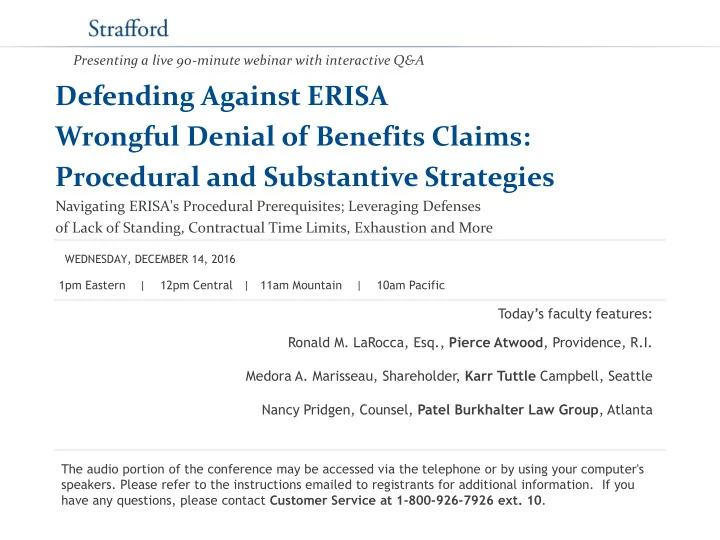
Presenting a live 90-minute webinar with interactive Q&A Defending Against ERISA Wrongful Denial of Benefits Claims: Procedural and Substantive Strategies Navigating ERISA's Procedural Prerequisites; Leveraging Defenses of Lack of Standing,


slide-1
SLIDE 1

The audio portion of the conference may be accessed via the telephone or by using your computer's

  • speakers. Please refer to the instructions emailed to registrants for additional information. If you

have any questions, please contact Customer Service at 1-800-926-7926 ext. 10.

Presenting a live 90-minute webinar with interactive Q&A

Defending Against ERISA Wrongful Denial of Benefits Claims: Procedural and Substantive Strategies

Navigating ERISA's Procedural Prerequisites; Leveraging Defenses

  • f Lack of Standing, Contractual Time Limits, Exhaustion and More

Today’s faculty features:

1pm Eastern | 12pm Central | 11am Mountain | 10am Pacific WEDNESDAY, DECEMBER 14, 2016

Ronald M. LaRocca, Esq., Pierce Atwood, Providence, R.I. Medora A. Marisseau, Shareholder, Karr Tuttle Campbell, Seattle Nancy Pridgen, Counsel, Patel Burkhalter Law Group, Atlanta

slide-2
SLIDE 2

Tips for Optimal Quality

Sound Quality If you are listening via your computer speakers, please note that the quality

  • f your sound will vary depending on the speed and quality of your internet

connection. If the sound quality is not satisfactory, you may listen via the phone: dial 1-866-258-2056 and enter your PIN when prompted. Otherwise, please send us a chat or e-mail sound@straffordpub.com immediately so we can address the problem. If you dialed in and have any difficulties during the call, press *0 for assistance. Viewing Quality To maximize your screen, press the F11 key on your keyboard. To exit full screen, press the F11 key again.

FOR LIVE EVENT ONLY

slide-3
SLIDE 3

Continuing Education Credits

In order for us to process your continuing education credit, you must confirm your participation in this webinar by completing and submitting the Attendance Affirmation/Evaluation after the webinar. A link to the Attendance Affirmation/Evaluation will be in the thank you email that you will receive immediately following the program. For additional information about continuing education, call us at 1-800-926-7926

  • ext. 35.

FOR LIVE EVENT ONLY

slide-4
SLIDE 4

Program Materials

If you have not printed the conference materials for this program, please complete the following steps:

  • Click on the ^ symbol next to “Conference Materials” in the middle of the left-

hand column on your screen.

  • Click on the tab labeled “Handouts” that appears, and there you will see a

PDF of the slides for today's program.

  • Double click on the PDF and a separate page will open.
  • Print the slides by clicking on the printer icon.

FOR LIVE EVENT ONLY

slide-5
SLIDE 5

Medora Marisseau Karr Tuttle Campbell Seattle

ERISA DENIAL OF BENEFITS LITIGATION: AVOIDING PROCEDURAL AND SUBSTANTIVE LANDMINES

mmarisseau@karrtuttle.com

slide-6
SLIDE 6

EXHAUSTION OF ADMINISTRATIVE REMEDIES FOR ERISA BENEFIT CLAIMS

Medora Marisseau Karr Tuttle Campbell Seattle

slide-7
SLIDE 7

Rule: A claimant must first avail herself or himself of a plan’s own internal review procedures before bringing suit. See Heimeshoff v. Hartford Life & Acc. Ins. Co., 134

  • S. Ct. 604, 610 (2013).
  • Judge-made rule, not part of the ERISA statute.

THE EXHAUSTION RULE

7

slide-8
SLIDE 8

Affirmative Defense. Generally considered an affirmative defense (subject to waiver), not jurisdictional. Vaught v. Scottsdale Healthcare Corp. Health Plan, 546 F.3d 620, 627 n.2 (9th Cir. 2008) Crowell v. Shell Oil Co., 541 F.3d 295, 308-09 (5th Cir. 2008) Paese v. Hartford Life & Accident Ins. Co., 449 F.3d 435, 445 (2d Cir. 2006) But See Herman v. Hartford Life & Acc. Ins. Co., 508 F. App’x 923, 926 (11th Cir. 2013) (failure to exhaust is jurisdictional)

WAIVER

8

slide-9
SLIDE 9

What Is The “Plan”?

A. The SPD is generally not the plan. Cigna Corp. v. Amara, 131

  • S. Ct. 1866, 1878 (2011);

B. Exhaustion requirement found only in SPD generally not enforceable, unless the SPD and Plan are “one and the same.” Eugene S. v. Horizon BCBS of N.J., 663 F.3d 1124 (10th Cir. 2011). See also Maher v. Aetna Life Ins. Co., 2016 U.S. Dist. Lexis 70559 (W.D. Wash)(references to “plan” and conflict resolutions provisions in SPD evidence SPD was not the plan); Calbrec v. Earon Med. Plan, 2015 U.S. Dist Lexis 82426 (E.D. Pa)(wrap document and SPD constituted the plan); Bd. Of Trustees v. Moore, 800 F.3d 214 (6th Cir 2015)(Trust agreement and SPD constituted the plan).

EXHAUSTION REQUIREMENT MUST BE BASED ON THE TERMS OF THE PLAN

9

slide-10
SLIDE 10

What is the Plan? (continued) C. A plan’s integration clause precludes the administrator from binding insureds to exhaustion requirements in extraneous

  • documents. See Pritchard v. MetLife Ins.

Co., 2015 U.S. App. Lexis 6553 (9th Cir. 2015)(group policy and certificate constitute “entire contract”);

EXHAUSTION REQUIREMENT MUST BE BASED ON THE TERMS OF THE PLAN

10

slide-11
SLIDE 11

What Is The “Plan”? (continued)

D. But, exhaustion requirement found in a denial review policy, which does not contradict, and is implicitly authorized by the plan, was enforceable. Holmes v.

  • Colo. Coalition for the Homeless LTD Plan, 762 F.3d

1195 (10th 2014);

  • E. However, denial letter cannot impose exhaustion

requirement because explicit incorporation of extraneous claims procedures is required. Montoya v. Reliance Std. Life Ins., 2015 U.S. Dist. Lexis 26044 (N.D. Cal. 2015).

EXHAUSTION REQUIREMENT MUST BE BASED ON THE TERMS OF THE PLAN

11

slide-12
SLIDE 12

Examples:  Requiring exhaustion of ERISA claims appeals “before the claim may be submitted to arbitration” did not require exhaustion prior to filing lawsuit. Montoya v. Reliance Std. Life Ins., 2015 U.S. Dist. Lexis 26044 (C.D. Cal. 2015).  “Claimant may request a review of this determination” and “failure to request a review may constitute failure to exhaust” did not unambiguously require exhaustion. Id.  Following a decision on 1 st level review, “We will also advise you of your further appeal rights, if any,” unambiguously allowed the Plan to enforce 2d level review, when communicated to the insured. Holmes, supra.

EXHAUSTION REQUIREMENT MUST BE UNAMBIGUOUS

12

slide-13
SLIDE 13
  • A. Claims procedures cannot require claimant to

file more than two appeals of an adverse benefit decision before bringing a civil action;

  • B. Plan cannot assert that a claimant has failed to

exhaust administrative remedies because the claimant did not pursue a voluntary level of appeal provided by the plan;

  • C. Voluntary levels of appeal may be pursued only

after exhaustion of mandatory appeals. See 29 CFR § 2560.503-1(c)(2), (c)(3)(i), (iii).

EXHAUSTION REQUIREMENTS ARE LIMITED BY THE ERISA CLAIMS REGULATIONS

13

slide-14
SLIDE 14
  • A. ACA requirement of external review process does

not require exhaustion of external review. Bailey v. Chevron Corp. Omn. Health Plan, 2014 U.S. Dist Lexis 76782 (C.D. Cal. 2014);29 CFR §2590.715- 2719(b)(2)(i).

  • B. Adverse benefit determination definition

expanded to include rescission, whether or not there is an effect on any particular benefit at the time, which is subject to ERISA claims

  • regulations. 29 C.F.R. § 2590.715-

2719(b)(2)(ii)(A).

EXHAUSTION AND ACA CLAIMS REGULATIONS

14

slide-15
SLIDE 15

Note: Claims for violation of Section 1557 of the ACA (prohibiting discrimination in health care or health coverage) do not require exhaustion of grievance procedures. 45 CFR Part 92 (final rule).

EXHAUSTION AND ACA CLAIMS REGULATIONS

15

slide-16
SLIDE 16

A. Administrator fails to follow internal review procedures or full and fair review is denied, (29 USC §1133), unless substantial compliance is shown (e.g. violation is de minimus).

  • Examples of Deemed Exhausted:
  • Untimely denial of claim.
  • Providing different denial reasons in 1st and 2nd level review

decisions.

  • Using same decision makers in initial and appeals decisions.

WHEN ARE CLAIMS “DEEMED EXHAUSTED”?

16

slide-17
SLIDE 17

B. Failure to follow the additional ACA internal claims and appeals processes (for non-grandfathered health plans), including full and fair review regulatory requirements and culturally and linguistically appropriate notice, unless deminimus and for good cause or outside of administrator’s

  • control. 29 CFR 2590.715-2719(b)(2)(ii)(F).
  • Examples: Failure to notify claimant of right to present

evidence/testimony as part of claims process; failure to included denial code and its meaning, and standards used in decision; failure to provide, upon request, the dx and treatment codes and meanings, associated with an adverse decision.

WHEN ARE CLAIMS “DEEMED EXHAUSTED”

17

slide-18
SLIDE 18
  • C. Pursuit of administrative remedies would be

futile.

  • Claimant has burden of proof, but dispute in circuits

whether futility must be affirmatively pled. (Compare 2nd

  • v. 9th Cir.)
  • Evidentiary standard for showing futility (“clear and

positive” indication that it is certain the claim will be denied on appeal)

  • Examples: identical claims consistently denied; claims by

similarly-situated claimants consistently denied; evidence of a fixed policy to deny such claims.

WHEN ARE CLAIMS “DEEMED EXHAUSTED”?

18

slide-19
SLIDE 19
  • A. Split in circuits as to whether exhaustion

applies to ERISA statutory violations (§1104)

  • r equitable claims, such as §1132(a)(3).
  • Not apply: 3rd, 4th, 5th 6th, 9th, and 10th Circuits
  • Does apply: 1st, 7th & 11th Circuits
  • May apply if statutory claim is based on fiduciary’s

interpretation of the plan: 2nd & 8th Circuits.

WHICH ERISA CLAIMS AND PARTIES DOES EXHAUSTION APPLY TO?

19

slide-20
SLIDE 20
  • B. Is applicable to derivative claims under

§1132(a)(2)

  • C. Applies to assignees (providers) of

participants and beneficiaries (§1132(a)(1)(B) parties).

  • D. Does not apply to subrogation/right of

reimbursement claims. Daily v. Rawlings Co., LLC, 2016 US Dist. Lexis 5254 (N. D. Ala.)

WHICH ERISA CLAIMS AND PARTIES DOES EXHAUSTION APPLY TO?

20

slide-21
SLIDE 21

STANDARD OF REVIEW

Medora Marisseau Karr Tuttle Campbell Seattle

slide-22
SLIDE 22

An administrator’s decision will be upheld unless it abuses its discretion (or acts arbitrarily and capriciously).  A decision is not an abuse of discretion or arbitrary and capricious if:

It offers a reasonable explanation based on the evidence, or reasonable interpretation of plan terms, or is based on “substantial evidence.”

DEFERENTIAL REVIEW

22

slide-23
SLIDE 23

“What Firestone requires is not ‘review’ of any kind; it is an independent decision rather than ‘review’ that Firestone contemplates.” Krolnik v. Prudential Ins. Co. of Am., 570 F.3d 841 (7th Cir. 2009)(emphasis in original)

DE NOVO REVIEW

23

slide-24
SLIDE 24
  • A. Does the plan document require deferential

review? (See prior section – “What is The Plan?”)

  • B. Is the grant of deference unambiguous?
  • C. For insured plans, does state insurance law

prohibit discretionary clauses? See Appendix 1 for List of States Prohibiting Use of Discretionary Clauses

DOES THE DEFERENTIAL STANDARD APPLY?

24

slide-25
SLIDE 25
  • D. Is the claims fiduciary operating under a

conflict of interest?

  • E. Has the claims administrator committed an

“honest mistake” v. engaged in wholesale and flagrant procedural violations?

Conkright v. Frommert, 559 U.S. 506 (2010); Moyle v. Lib. Mut.

  • R. Ben. Plan, 985 F. Supp 2d 1247 (S.D. Cal. 2013); Becknell v.

Severance Pay Plan of Johnson & Johnson, 644 Fed. Appx 205 (3d Cir 2016)(Administrator’s delay in responding to 2d appeal did not require denovo review where no prejudice occurred).

DOES THE DEFERENTIAL STANDARD APPLY?

25

slide-26
SLIDE 26
  • F. Is the claim “deemed denied” under a group

health plan due to plan’s failure to adhere to ACA internal claims and appeals processes? 29 CFR §2590.715-2719(b)(2)(F)(claim or appeal is “deemed denied without exercise

  • f discretion by fiduciary”).

DOES THE DEFERENTIAL STANDARD APPLY?

26

slide-27
SLIDE 27

Questions?

Medora A. Marisseau mmarisseau@karrtuttle.com Karr Tuttle Campbell Seattle, WA www.karrtuttle.com

slide-28
SLIDE 28

Preemption, Removal and Discovery

ERISA DENIAL OF BENEFITS LITIGATION Procedural & Substantive Strategies

STRAFFORD WEBINAR, December 14, 2016

Ronald M. LaRocca Pierce Atwood, LLP rlarocca@pierceatwood.com

slide-29
SLIDE 29

Preemption and Removal

Fundamentals

  • Federal Question, 28 U.S.C. § 1331
  • Well pleaded complaint rule: “jurisdiction is established only if a federal

question is presented on the face of the plaintiff's properly pleaded complaint.” Pet Quarters, Inc. v. Depository Trust and Clearing Corp., 559 F .3d 772, 779 (8th Cir. 2009).

  • But, there is an exception: when a federal statute wholly displaces the state-

law cause of action through complete preemption, the state claim can be removed.

  • “When the federal statute completely pre-empts the state law cause of action, a

claim which comes within the scope of that cause of action, even if pleaded in terms of state law, is in reality based on federal law. ERISA is one of these statutes.” Aetna Health, Inc. v. Davila, 542 U.S. 200, 207–08 (2004)

29

slide-30
SLIDE 30

Preemption and Removal

Express Preemption:

ERISA § 514 (29 U.S.C. § 1144) provides that ERISA “supersedes any and all State laws insofar as they may now or hereafter relate to any employee benefit plan...” - Not Removable.

Complete Preemption:

“[I]f an individual, at some point in time, could have brought his claim under ERISA § 502(a)(1)(B), and where there is no other independent legal duty that is implicated by a defendant’s actions, then the individual’s cause of action is completely pre- empted by ERISA § 502(a)(1)(B).” See Aetna Health Inc. v. Davila, 542 U.S. 200, 210 (2004) – Removable.

30

slide-31
SLIDE 31

Preemption and Removal

Is the Plan governed by ERISA?

  • Governmental Plans
  • Church Plans
  • Safe Harbor Plans

What to look for? Fact intensive - Look to contract file and public information

31

slide-32
SLIDE 32

Preemption and Removal

Governmental Plans, 29 U.S.C. § 1003(b)(1)

  • “Established or maintained for its employees by the

Government of the United States, by the government of any State or political subdivision thereof, or by any agency or instrumentality of any of the foregoing.”

32

slide-33
SLIDE 33

Preemption and Removal

Governmental Plan:

  • Smith v. Reg’l Transit Auth., 827 F.3d 412, 420 (5th Cir. 2016) (holding plan

governmental)

  • Six-factor test (IRS Ruling 57-128)
  • Whether entity used for governmental purpose and performs governmental function;
  • Whether entities functions is on behalf of state/political subdivision;
  • Whether private interests or state/political subdivisions have ownership power/interest;
  • Whether entity control/supervision vested in public authority;
  • Whether entity vested with express/implied statutory authority necessary for creation and/or use of

such instrumentality; and

  • Degree of financial autonomy and source of operating expenses;
  • Important factor: degree of control fed/state government (IRS Ruling 89-49)

33

slide-34
SLIDE 34

Preemption and Removal

Not Governmental Plan

  • Brown v. Reliance Standard Life Ins. Co., 2014 WL 4681522, at *3

(N.D. Ala. Sept. 16, 2014) (holding the plan not governmental).

  • Hospital created by an “arm of the state” (the University of Alabama);
  • Enabling statute & the University Board appoints the majority of the Hospital

Board;

  • Administrators not responsible to public officials;
  • Hospital was financially autonomous;
  • Health-care not a unique function of government;
  • State not responsible for debts/obligations;
  • Hospital could be sued in its own name;
  • Hospital remits 25% of its income to the state but received no appropriations.

34

slide-35
SLIDE 35
  • Tribal Plan, 29 U.S.C. § 1002(32)
  • A plan which is established and maintained by
  • an Indian tribal government (as defined in section 7701(a)(40) of Title 26), a

subdivision of an Indian tribal government (determined in accordance with section 7871(d) of Title 26), or an agency or instrumentality of either,

  • and all of the participants of which are employees of such entity,
  • substantially all of whose services as such an employee are in the

performance of essential governmental functions but not in the performance

  • f commercial activities (whether or not an essential government function)

35

slide-36
SLIDE 36

Preemption and Removal

Church Plans, 29 USC § 1002(33)(C)(i)

  • A plan established and maintained for its employees (or

their beneficiaries) by a church or by a convention or association of churches includes

  • a plan maintained by an organization, whether a civil law corporation
  • r otherwise,
  • the principal purpose or function of which is the administration or

funding of a plan or program for the provision of retirement benefits or welfare benefits, or both, for the employees of a church or a convention or association of churches,

  • if such organization is controlled by or associated with a church or a

convention or association of churches.

36

slide-37
SLIDE 37

Preemption and Removal

Church Plans - Kaplan v. Saint Peter's Healthcare Sys., 810 F

.3d 175, 177 (3d

  • Cir. 2015), cert. granted, No. 16-86, 2016 WL 3906477 (U.S. Dec. 2, 2016)

(not a church plan)

  • Hospital system, hospital established the retirement plan in 1974;
  • Bishop of Metuchen appoints all but two members of its Board of Governors;
  • Bishop retains veto authority over the Board's actions;
  • Hospital includes daily Mass, Catholic devotional pictures and statues

throughout the building;

  • Hospital ran plan as if subject to ERISA;

37

slide-38
SLIDE 38

Preemption and Removal

Safe Harbor Plans

  • Exempts “those arrangements in which employer involvement is completely

absent.” Vazquez v. Paul Revere Life Ins. Co., 298 F. Supp.2d 727, 731 (E.D.

  • Va. 2001).
  • Employer’s “sole function . . . with respect to the program are, without

endorsing the program, to permit the insurer to publicize the program to

  • employees. . . to collect premiums through payroll deductions . . . and to

remit them to the insurer.”

  • Employer cannot play a role in plan administration, including determination of which

employees eligible for benefits. Swenson v. Eldorado Casino Shreveport Joint Venture, 2016 WL 1084279, at *3 (W.D. La. Jan. 6, 2016); Gross v. Sun Life Assur. Co., 734 F.3d 1, 10-11 (1st Cir. 2013).

38

slide-39
SLIDE 39

Preemption and Removal

Facts to look for:

  • Purchasing insurance and choosing insurer
  • Determining eligibility
  • Dictating provisions
  • Contributing to premiums
  • Distributing highlights forms/SPD’s
  • Serving as Plan Administrator- filing 550’s
  • Look to “bundle” voluntary coverage with basic coverage.

39

slide-40
SLIDE 40

Preemption and Removal

Recognize potential for conflict with Employer. See McMurtry v. Aetna Life Ins. Co., 273 Fed.

  • Appx. 758 (10th Cir. Apr. 11, 2008).

40

slide-41
SLIDE 41

Preemption and Removal

Once removed, move to dismiss preempted claims or are they “transmuted” into ERISA claims? Do you want to tee up disputes re potential exemptions? Court has obligation to ensure subject matter jurisdiction jurisdiction and can raise at any stage of the proceedings. Plead diversity in the alternative.

41

slide-42
SLIDE 42

Conflict Discovery

Affirmatively offer conflict evidence? Timing?

  • Local rules/scheduling orders/Initial disclosures
  • Denmark v. Liberty Life Assurance Co., 566 F.3d 1, 10

(1st Cir. 2009) (“plan administrators, aware of Glenn, can be expected as a matter of course to document the procedures used to prevent or mitigate the effect of structural conflicts. . . Conflict-oriented discovery will be needed only to the extent that there are gaps in the administrative record.”).

  • Potentially helpful both re discovery and merits

42

slide-43
SLIDE 43

Conflict Discovery

Tee up at Rule 16 Conference or simply object to requests? What is the standard of review? How does that impact? Jurisdictions vary. 2nd, 7th and 9th Circuits most discovery friendly.

  • Dennison v. MONY Life Retirement Income Security Plan for Retirees, 710

F.3d 741, 747 (7th Cir.2013),(“discovery still is not permitted in the run-

  • f-the-mill case in the Seventh Circuit, and the two-part test established

in Semien remains instructive. . . plaintiff still must identify a specific conflict or instance of misconduct and make a prima facie showing that there is good cause to believe that limited discovery will reveal a procedural defect.” ).

43

slide-44
SLIDE 44

Conflict Discovery

Topics for conflict affidavit:

  • Walling off/separate units
  • Compensation structure (no payment for claim outcomes)
  • duties to plan
  • selection/compensation of medical reviewers/vendor

relationships

  • required by DOL regulations
  • do not make claim decisions
  • vendors choose physicians
  • no compensation for content

44

slide-45
SLIDE 45

Conflict Discovery

  • Requests to describe efforts made to mitigate

the effects of structural conflict.

45

slide-46
SLIDE 46

Conflict Discovery

  • Requests for claims statistics:

Holmstrom v. Metro. Life Ins. Co., 615 F .3d 758 (7th Cir. 2010) (“Glenn did not invite a ‘batting average’ approach” to assessing structural conflict”). Rickaby v. Hartford Life & Accident Ins. Co., 2016 WL 1597589, at *3 (D.

  • Colo. Apr. 21, 2016) (“a simple tally of the number of grants and denials

would lack meaning, particularly where there is no information regarding whether the denials were wrongly decided”) Atkins v. UPMC Healthcare Benefits Trust, 2014 WL 1572439, at *3 (W.D.

  • Pa. Apr. 17, 2014) (declining to authorize “batting average” discovery)

46

slide-47
SLIDE 47

Conflict Discovery

  • Requests for information re other claims:

DOL Benefit Claims Procedure Regulation FAQ at D- 12 (other claims files need not be disclosed). Liston v. Unum Corp. Officer Severance Plan, 330 F.3d 19, 26 (1st Cir. 2003)(“expensive inquiry into ‘collateral issues’ . . . [that] would be only the predicate to further dispute about the significance of the information; and it probably would not be conclusive.”).

47

slide-48
SLIDE 48

Conflict Discovery

Requests for reviewing physician statistics:

  • Medical reviewers do not make claim

determinations;

  • Actual determinations based on far more than

medical reviews;

  • Medical reviews conducted only when

impairment in question;

  • Explain vendor relationships

48

slide-49
SLIDE 49

Conflict Discovery

Requests for claims handling guidelines:

  • Relevant documents include documents that

“constitute a statement of policy or guidance with respect to the plan concerning the denied treatment option or benefit for the claimant’s diagnosis, without regard to whether such advice

  • r statement was relied upon in making the

benefit determination.” 29 C.F.R. § 2560.503-1(m)(8)

49

slide-50
SLIDE 50

Conflict Discovery

Requests for claims handling guidelines.

  • Glista v. Unum Life Ins. Co. of America, 378

F.3d 113, 123-25 (1st Cir. 2004)(training materials and claims manual provisions with respect to pre-existing condition limitation discoverable because they “interpret. . . the language of the Plan and provid[e]. . . the standard for evaluation

  • f

the facts presented.”)

  • Generalized claims handling guidelines rarely

even mention “the plan.”

50

slide-51
SLIDE 51

Conflict Discovery

Requests for performance evaluations.

  • Personal, private, confidential
  • publicly identified even if redacted
  • difficult to recruit good people
  • Explain compensation system
  • not dependent on claim outcomes
  • If ordered, explain shorthand, abbreviations,

acronyms and job duties.

51

slide-52
SLIDE 52

Conflict Discovery

Avoid boilerplate Include case law Every claim is unique Why does the information “matter”?

52

slide-53
SLIDE 53

Conflict Discovery

Maintaining Confidentiality of Discovery Materials Will plaintiff fight protective order? Use watermarks Be wary of attempts to share with “co-counsel”

  • New affiliations and “of counsel”

relationships

53

slide-54
SLIDE 54

Questions?

Ronald M. LaRocca Pierce Atwood LLP 72 Pine Street Providence, RI 02903 (401) 490-3426 rlarocca@pierceatwood.com

54

slide-55
SLIDE 55

Procedural Battles in ERISA Benefits Litigation

Nancy B. Pridgen, Esq.

PATEL BURKHALTER LAW GROUP ATLANTA, GEORGIA npridgen@patelburkhalter.com

ERISA DENIAL OF BENEFITS LITIGATION STRAFFORD WEBINAR, December 14, 2016

slide-56
SLIDE 56

Overview

  • Statutes of Limitations / Plan-based

Limitations Periods

  • Pre-Judgment Interest
  • Attorneys Fees Post-Hardt

56

slide-57
SLIDE 57

Plan-Based Limitation Periods

 Enforced Nationwide if Reasonable

 Heimeshoff v. Hartford Life & Acc. Ins. Co., 134 S.Ct. 604 (2013) (3 year contractual limitations period beginning at time proof of loss is due is enforceable; rejects argument that accrual only begins when admin process is over; if unusual/unfair consequences would obtain, courts can apply equitable tolling/ waiver/estoppel doctrines, as needed).  Post-Heimeshoff: Gonzalez v. Sterling, Inc., 2016 U.S. Dist. LEXIS 111305, *16-17 (N.D. Ill. Aug. 22, 2016) (one year filing period enforceable); University of Wisconsin Hosp. & Clinics Auth. v. Southwest Catholic Health Network Corp., 2015 WL 402739, *6 (W.D. Wisc. Jan. 28, 2015) (“[A] contractual limitation requiring an ERISA suit to be commenced within 180 days from a final review notice is reasonable and thus enforceable.”); Russell v. Catholic Healthcare Partners Employee Long Term Disability Plan, 577 Fed. Appx. 390, 392 (6th Cir. 2014) (unpub.) (six months found reasonable); Tuminello v. Aetna Life Ins. Co., 2014 WL 572367, *2 (S.D.N.Y. 2014) (nine months “not an unreasonably short period of time”).  Unreasonably short: Ctr. for Restorative Breast Surgery, L.L.C. v. Blue Cross Blue Shield of La., 2016 U.S. Dist. LEXIS 61071, *49 (E.D. La. May 6, 2016) (less than 90 days or before appeals final = unreasonably short); Nelson v. Standard Ins. Co., 2014 WL 4244048, *5 (S.D. Cal. 2014) (“Defendant cites no legal authority holding a period of approximately 100 days . . . constitutes a reasonable period”).

57

slide-58
SLIDE 58

Plan-Based Limitation Periods

 Adverse Benefit Determinations Should Contain Notice of Limitations Period

 See, e.g., Santana-Díaz v. Metro. Life Ins. Co., 816 F.3d 172, 180 (1st Cir. 2016); Mirza v. Ins. Adm'r of Am., Inc., 800 F.3d 129, 131 (3d Cir. 2015); Moyer v. Met. Life.

  • Ins. Co., 762 F.3d 503, 506–07 (6th Cir. 2014); McGowan v. New Orleans Empl'rs

Int'l Longshoremen's Ass'n, 538 Fed.Appx. 495, 498 (5th Cir. 2013); Novick v. MetLife Ins. Co., 764 F.Supp.2d 653, 660–64 (S.D.N.Y. 2011).  But see, e.g., Wilson v. Standard Ins. Co., 613 F. App'x 841, 844 (11th Cir. 2015) (unpub.) (29 C.F.R. § 2560.503-1(g)(1)(iv) "can also be reasonably read to mean that notice must be given of the time limits applicable to the 'plan's review procedures,' and the letter must also inform the claimant of her right to bring a civil action without requiring notice of the time period for doing so"); Scharff v. Raytheon Co. Short Term Disability Plan, 581 F.3d 899, 907-08 (9th Cir. 2009) (declining to require express disclosure of a statute of limitations); Young v. United Parcel Services, 416 F. App'x 734, 740 (10th Cir. 2011) (unpub.) (requiring denial letters to include time limits applicable to filing suit "conflates the internal appeals process, and its associated deadlines, with the filing of a legal action after that process has been fully exhausted").

58

slide-59
SLIDE 59

Plan-Based Limitation Periods

  • Enforce Plan’s Appeal Deadlines!

– Gayle v. United Parcel Serv., Inc., 401 F.3d 222, 226 (4th Cir.2005) (“[I]nternal appeal limitations periods in ERISA plans are to be followed just as

  • rdinary statutes of limitations. Failure to file a

request for review within [a plan’s] limitations period is one means by which a claimant may fail to exhaust her administrative remedies.”).

  • Raise Early in Litigation [Rule 12(c)]

59

slide-60
SLIDE 60

Statute of Limitations Issues

 Benefits SoL = State Breach of Contract

 Schumacher v. AK Steel Corp. Retirement Accumulation Pension Plan, 711 F.3d 675, 682 (6th Cir. 2013) (pension claim (“whipsaw”); timely under most analogous state SoL); Raymond v. Barry Callebaut, U.S.A., LLC, 2013 WL 150232, *2 (3d Cir. Jan. 15, 2013); Kifafi v. Hilton Hotels Retirement Plan, 701 F.3d 718, 728 (D.C. Cir. 2012); Santaliz-Rios v. MetLife Ins. Co., 693 F.3d 57 (1st Cir. 2012); Serton v. Lockheed Martin Corp., 459 Fed. Appx. 463, 465 (5th Cir. 2012); Muto v. CBS Corp., 668 F.3d 53, 58 (2d Cir. 2012).

 Accrual Issues – exhaustion, discovery or

earlier? Tolling? Forum State?

 Add-On Fiduciary Breach Claims

 29 U.S.C. § 1113 – three years (actual knowledge) or six years  Estoppel? Cigna v. Amara and its progeny

60

slide-61
SLIDE 61

Prejudgment Interest

  • Inclusion of % as a plan term.
  • Rate used by the state in which the

federal litigation is pending.

  • The federal post-judgment statute.
  • Constructed, compensatory rate.
  • Or, may pick and choose.

61

slide-62
SLIDE 62

Prejudgment Interest

1st: Various. See, e.g., Enos v. Union Stone, Inc., 732 F.3d 45, 50 (1st Cir. 2013) (finding prejudgment interest not abuse of discretion when plan required it: “The district court did not abuse its broad discretion by selecting an interest rate set out in the parties' own agreement.”); Merrimon v. Unum Life Ins. Co., 2013 WL 4854367, *12 (D. Me. Sept. 11, 2013) (setting prejudgment interest at post-judgment rate under 28 U.S.C. § 1961) (opinion vacated on other grounds); Smith v. Jefferson Pilot Financial Ins. Co., 2010 WL 818788, *3 (D. Mass. Mar. 5, 2010) (citing .Cottrill v. Sparrow, Johnson & Ursillo, Inc., 100 F.3d 220, 223 (1st Cir.1996)) (“Here, however, the state rate of 12% is too high, and the federal funds rate is too low, especially given the current historically low rates, as it represents a completely risk-free rate of return. A more equitable measure here is 6%, the rough average of the prime rate over the relevant period, which better reflects the value of the unpaid money

  • ver time, and thus better serves to make Smith whole and prevent

unjust enrichment, compounded annually.”).

62

slide-63
SLIDE 63

Prejudgment Interest

2nd: Various. See, e.g., Rood v. New York State Teamsters Conference Pension and Retirement Fund, ___ F.Supp.3d ___, 2014 WL 4114330, *10 (N.D.N.Y. Aug 20, 2014) (awarding NY statutory 9% rate); accord Levitian v. Sun Life & Health Ins. Co. (U.S.), 2013 WL 3829623, at *12 (S.D.N.Y. July 24, 2013), report and recommendation adopted 2013 WL 4399026 (S.D.N.Y. Aug. 15, 2013); Milgram v. Orthopedic Associates Defined Contribution Pension Plan, 666 F.3d 68, 79 (2d Cir. 2011) (“awarding accumulated earnings and interest under a contract theory” where plan specifically provided for it if QDRO found invalid after distribution made); Novella v. Westchester County, 661 F.3d 128, 150 (2d

  • Cir. 2011) (“[T]he district court's determination that the proper interest

rate is 7.5 percent—the Fund's assumed rate of return—was within its discretion … .”) (but vacating award because class de-certified); Trustees

  • f Local 813 Ins. Trust Fund v. Freedom Demolition Inc., 2014 WL

5305983, *6 (E.D.N.Y. Oct. 15, 2014) (awarding prejudgment interest on unpaid contributions based on rate set forth in plan document).

63

slide-64
SLIDE 64

Prejudgment Interest

3rd: Generally use 28 U.S.C. § 1961 or fashion another rate when the equities so require. See National Sec. Systems, Inc. v. Iola, 700 F.3d 65, 102-03 (3d Cir. 2012) (“[T]he District Court imposed a modest prejudgment interest rate of 3.91% … borrowed … from the post- judgment interest rate set by 28 U.S.C. § 1961 and applied the average rate from the time the plaintiffs established the plans to the date of the

  • rder.”); see also Chaaban v. Criscito, 468 Fed. Appx. 156, 164 (3d Cir.

2012) (fiduciary charged with fraudulently removing money from investment account for own use) (“The use of the VFCP calculator [Voluntary Fiduciary Correction Program online calculator] was an appropriate way for the District Court to resolve the problem of calculating [prejudgment interest, noting other district courts faced with this problem have also used this calculator]); Secretary of Labor v. Doyle, 2014 WL 6747882, * 20 (D.N.J. Dec. 1, 2014) (“The restored losses to the Plan are subject to computation of prejudgment interest by the Secretary to the date of judgment in this case at the § 6621 IRS underpayment rate.”).

64

slide-65
SLIDE 65

Prejudgment Interest

4th: Various. See West Virginia Carpenters Benefit Trust v. First Const. Corp., 2014 WL 6390311, *3 (S.D.W.Va. Nov. 17, 2014) (using the “West Virginia Code § 55–6–31, which governs prejudgment interest on judgments and decrees, is 7%” rate for unpaid contributions); Special Agents Mut. Ben. Ass'n v. Cowger, 2014 WL 1048546, *4 (N.D.W.Va.

  • Mar. 18, 2014 (awarding 14% interest, as set forth in one of the plan

documents); West Virginia Laborers Pension Trust Fund v. Burkhammer, 2013 WL 3754822, *3 (S.D.W.Va. July 13, 2013) (using post-judgment rate set by 28 U.S.C. § 1961(a) for prejudgment interest); Feldman's Medical Center Pharmacy, Inc. v. CareFirst, Inc., 541 Fed. Appx. 322, 323 (4th Cir. 2013) (1.35% prejudgment interest; approving, describing “award of prejudgment interest in favor of Feldman's was ‘trivial’ since the court rejected Feldman's central theory for calculating the interest

  • wed and ultimately awarded a much lower amount than Feldman’s

sought”).

65

slide-66
SLIDE 66

Prejudgment Interest

5th: Use the prejudgment rate of the state in which the federal litigation is pending. See Chavarria v. Metropolitan Life Ins. Co., ___ F.Supp.3d ___, 2014 WL 6684925, *6-7 (E.D. La. Nov. 25, 2014) (“Because there is no federal statute governing the rate of pre- judgment interest in ERISA cases, courts ordinarily look to state law. In this case, the Court elects to award prejudgment interest … at the rate provided in Louisiana Revised Statute 13:4202. In this case, that rate is 4% [see https://www.lsba.org/Members/ JudicialInterestRate.aspx].”) (internal citations omitted); Perez v. Bruister, ___ F.Supp.3d ____, 2014 WL 5308404, *44 (S.D. Miss. 2014) (“[W]hen awarding prejudgment interest in an action brought under ERISA, it is appropriate for the district court to look to state law for guidance in determining the rate

  • f interest. Under Mississippi law, a prejudgment interest rate of 8%

per annum compounded annually has been held appropriate.”) (internal citations/quotations omitted).

66

slide-67
SLIDE 67

Prejudgment Interest

6th: Use 28 U.S.C. §1961 rate, courts are but questioning its use. See Hi-Lex Controls, Inc. v. Blue Cross Blue Shield of Mich., 751 F.3d 740, 751-52 (6th Cir. 2014) (“In this case, however, the district court did not use a single rate in calculating the prejudgment interest. Instead, the court utilized a blended rate for each of the 17 years during which the Disputed Fees were charged—a range from 6.13% to 0.14%. … Because the district court avoided a mechanical application of § 1961, it did not abuse its discretion in calculating the prejudgment interest award.”); Schumacher v. AK Steel Corp. Retirement Accumulation Pension Plan, 711 F.3d 675, 686 (6th Cir. 2013) (disapproving federal statutory post- judgment rate as too low to compensate plaintiff for loss of money, when CPI was 2.75% at same time, remanding for reconsideration); Harris v. A.D. Vallett & Co., 2014 WL 1280490, *4 (M.D. Tenn. Mar. 27, 2014) (approving IRS underpayment rate from 26 U.S.C. § 6621(a)(2) for funds defendant removed from plan); Helfman v. GE Group Life Assur. Co., 2012 WL 5389842, *4 (E.D. Mich. Nov. 5, 2012) (“Interest is to be calculated pursuant to 28 U.S.C. § 1961, from the date Plaintiff was entitled to the benefits on October 1, 2005, until it was paid on August 23, 2011.”).

67

slide-68
SLIDE 68

Prejudgment Interest

7th: Use the prime rate. See Curtis v. Hartford Life & Acc. Ins. Co., 2014 WL 4185233, *22 (N.D. Ill. Aug. 20, 2014) (rejecting plaintiff’s argument for Illinois’ 9% prejudgment interest rate, following Gorenstein, applying prime rate of 3.25%, gleaned from http://www.bankrate.com/rates/ interest-rates/wall-street-prime- rate.aspx (citing Gorenstein Enters., Inc. v. Quality Care USA, Inc., 874 F.2d 431, 437 (7th Cir. 1989) (suggesting “the prime rate” is appropriate for fixing prejudgment rate “where there is no statutory interest rate” but “cautioning … against the danger of setting [it] too low”)). 8th: Generally use 28 U.S.C. § 1961, but have leeway to use other calculation

  • methods. See Werb v. ReliaStar Life Ins. Co., 2014 WL 2881468, *12 (D. Minn. June

25, 2014) (“The Court therefore awards prejudgment interest to be calculated under 28 U.S.C. § 1961.” (citing Mansker v. TMG Life Ins. Co., 54 F.3d 1322, 1331 (8th Cir. 1995) (prejudgment interest on ERISA claims is calculated under § 1961)); Johnson v. United of Omaha Life Ins. Co., 2013 WL 3400095, *2 (D. Neb. July 5, 2013) (applying federal post-judgment statutory rate); McClelland v. Life Ins. Co. of North America, 679 F.3d 755, 762 (8th Cir. 2012) ($26,384.11 in prejudgment interest on $250,000 AD&D claim was affirmed). Sheehan v. Guardian Life Ins. Co., 372 F.3d 962, 969 (8th Cir. 2004) (using 28 U.S.C. § 1961(a) post-judgment amount for prejudgment interest awards).

68

slide-69
SLIDE 69

Prejudgment Interest

9th: Various. See Grosz–Salomon v. Paul Revere Life Ins. Co., 237 F.3d 1154, 1164 (9th

  • Cir. 2001) (“The interest rate prescribed for post-judgment interest under 28 USC § 1961

is appropriate for fixing the rate of pre-judgment interest unless the trial judge finds, on substantial evidence, that the equities of that particular case require a different rate.”); James v. Group Life and Health Benefits Plan for Employees of Participating AMR Corp. Subsidiaries, 2014 WL 4684885, *4 (D. Or. Sept. 19, 2014) (“this court declines to impose the historically low rate under 28 USC § 1961 or Oregon's statutory rate of 9% and instead awards an interest rate of 5% [the prime rate]”); Sullivan v. Prudential Ins. Co., 2014 WL 3529974, 36 (E.D.Cal. July 15, 2014) (federal post-judgment rate applied); Oster

  • v. Standard Ins. Co., 768 F Supp2d 1026, 1039-40 (N.D. Cal. 2011) (declining to award

prejudgment interest at 10% rate set by the California Ins. Code or at low .3% U.S. Treasury Rate, and instead awarding 5% rate); Lested v. Alaris Med. Sys., Inc., 2010 WL 1416544, at *2 (S.D. Cal. Apr. 8, 2010) (awarding prejudgment interest rate of 5% as “a reasonable approximation of the time value of the money improperly withheld”); Blankenship v. Liberty Life Assur. Co. of Boston, 486 F.3d 620 (9th Cir. 2007) (district court made factual findings about appropriate rate of return on money, and awarded prejudgment interest in that rate). But see Gilson v. Macy’s Inc. Long Term Disability Plan, 2014 U.S. Dist. LEXIS 2762 (N.D. Cal. Jan. 9, 2014) (court found California Ins. Code § 10111.2 (setting prejudgment interest at 10% per year) preempted, not saved from ERISA preemption by the savings clause, because it is not “ ‘specifically directed toward the [insurance industry]’ ”) (quoting Pilot Life v. Dedeaux, 481 U.S. 41, 50 (1987)).

69

slide-70
SLIDE 70

Prejudgment Interest

10th: Use the prejudgment rate of the forum state. See Garrett v. Principal Life Ins. Co., 557 Fed. Appx. 734, 738 (10th Cir. 2014) (medical benefits denied) (“The district court awarded Mr. Garrett prejudgment interest and tied this award to the rate specified by Oklahoma law (15% per annum). In particular, it found ‘that the rate of 15% per year would adequately, but not excessively, compensate [Mr. Garrett] for the lost use of the money ... [and] that this 15% rate is in no way meant to punish [Principal] for any wrongdoing.’ ”); Reiling v. Sun Life Assur. Co. of Canada, 2014 WL 6895951, *9 (D. Kan. Dec. 5, 2014) (“[T]he Court

  • rders an award of prejudgment interest at the [Kansas state] statutory

rate of 10% running from July 23, 2012, the date Plaintiff filed its claim for benefits.”); Lynn R. v. ValueOptions, 2014 WL 6832903, *3 (D. Utah

  • Dec. 3, 2014) (prejudgment interest 10% per annum, Utah’s state rate).

70

slide-71
SLIDE 71

Prejudgment Interest

11th: Use the prejudgment rate of the forum state. See Williams v. United of Omaha Life Ins. Co., 2013 WL 5519525 (N.D. Ala. Sept. 30, 2013) (awarding prejudgment interest at 6%, current Alabama statutory rate); Fornell v. Morgan Keegan & Co., Inc., 2013 WL 656457 (M.D. Fla. Feb. 20, 2013) (awarding prejudgment interest at 4.75%, current Florida statutory rate); see also Smith v. American Int’l Life Assurance Co., 50 F.3d 956, 958 (11th Cir. 1995) (affirming award of prejudgment interest based on Georgia’s post-judgment interest rate

  • f 12%); Nightingale v. Blue Cross/Blue Shield of Ala., 41 F.3d 1476,

1484 (11th Cir. 1995 (affirming award of prejudgment interest at 18% [the then-current Alabama statutory rate which required insurer to pay 18% if claim denied for invalid reason(s)]).

71

slide-72
SLIDE 72

Attorneys Fees Post-Hardt

Statutory Basis for Fees

ERISA § 502(g)(1): in an action “by a participant, beneficiary or fiduciary, the court in its discretion may allow reasonable attorneys fees and costs to either party”

Hardt v. Reliance Standard Life Ins. Co., 560 U.S. 3 (2009) (“prevailing party” not required, just “some degree of success on the merits”).

72

slide-73
SLIDE 73

Attorneys Fees Post-Hardt

Multi-Factor Tests Still Alive? ~yes~

Huss v. IBM Medical & Dental Plan, 418 Fed. Appx. 498 (7th Cir. 2011) (holding that even after Hardt, application of its traditional twin tests was still relevant to inform that court’s analysis regarding whether an award of fees is appropriate); Toussaint v. JJ Weiser, Inc., 648 F.3d 108, 110 (2d Cir. 2011) (“A court may apply—but is not required to apply—the [five-factor test] in “channeling [its] discretion when awarding fees” under § 1132(g)(1).”).

73

slide-74
SLIDE 74

Attorneys Fees Post-Hardt

  • Multi-Factor Tests Still Alive? ~yes~

See generally McKay v. Reliance Std. Life Ins. Co., 428

  • Fed. Appx. 537 (6th Cir. 2011); Williams v. Metro. Life
  • Ins. Co., 609 F.3d 622 (4th Cir. 2010) but see Rinaldi v.

CCX, Inc., 388 Fed. Appx. 290 (4th Cir. 2010) (success but no fees); Simonia v. Glendale Nissan-Infinity Disability Plan, 608 F.3d 1118 (9th Cir. 2010); Gastronomical Workers’ Union Local 610 v. Dorado Beach Hotel Corp., 617 F.3d 54 (1st Cir. 2010).

74

slide-75
SLIDE 75

Attorneys Fees Post-Hardt

Generally, Five Factors Are:

  • 1. Losing party’s bad faith or culpability.
  • 2. Ability of the losing party to pay fees.
  • 3. Deterrent effect of an award for fees.
  • 4. Whether the claimant sought to confer a

common benefits on all participants and beneficiaries in a plan or to resolve a significant legal issue.

  • 5. Relative merits of the parties’ positions.

75

slide-76
SLIDE 76

Attorneys Fees Post-Hardt

Remand Cases Post-Hardt

1st - McCarthy v. Commerce Group, Inc., 831 F.Supp.2d 459 (D.Mass. 2011) (remand only on claim for denial of top hat benefits equaled some degree of success on the merits). 2nd- Barrett v. Hartford Life and Acc. Ins. Co., 2012 WL 6929143 (S.D.N.Y. Nov. 9, 2012) (remand only; plaintiff received only 40% of her fees). 3rd - Templin v. Independence Blue Cross, 785 F.3d 861 (3d Cir. 2015) (“catalyst theory”); Haisley v. Sedgwick Claims Management Services, Inc., 2011 WL 4565494 (W.D.Pa. Sept. 29, 2011) (court awarded 2 years of benefits and remanded for evaluation beyond 2 years).

76

slide-77
SLIDE 77

Attorneys Fees Post-Hardt

Remand Cases Post-Hardt

4th - Scott v. PNC Bank Corp. & Affiliates Long Term Disability Plan, 2011 WL 2601569 (D.Md. 2011) (R&R; full discussion; failed 5-factor test). 5th - Tesch v. Prudential Ins. Co., 829 F.Supp.2d 483 (W.D.La. 2011). 6th - McKay v. Reliance Std. Life Ins. Co., 428

  • Fed. Appx. 537 (6th Cir. 2011) (claimant lost

after remand, but was still awarded fees). 7th - Young v. Verizon's Bell Atl. Cash Balance Plan, 748 F.Supp.2d 903 (N.D.Ill.2010).

77

slide-78
SLIDE 78

Attorneys Fees Post-Hardt

Remand Cases Post-Hardt

8th - Greenwald v. Liberty Life Assur. Co. of Boston, 2013 WL 3716416 (D. Neb. 2013). 9th - Langston v. North Am. Asset Dev. Corp. Group Disability Plan, 2010 WL 330085 (N.D.

  • Cal. Jan 20, 2010).

10th - Adair v. El Pueblo Boys & Girls Ranch,

  • Inc. LTD Plan, 2013 WL 4775927 (D. Colo.

2013). 11th - Olds v. Ret. Plan of Int'l Paper Co., Inc., 2011 WL 2160264 (S.D. Ala. 2011).

78

slide-79
SLIDE 79

Questions?

Nancy B. Pridgen, Esq. npridgen@patelburkhalter.com

79