Presentation with Glossary Laboratory Comparatives Completed - - PowerPoint PPT Presentation

presentation with glossary laboratory comparatives
SMART_READER_LITE
LIVE PREVIEW

Presentation with Glossary Laboratory Comparatives Completed - - PowerPoint PPT Presentation

Presentation with Glossary Laboratory Comparatives Completed expanded comparative benchmarking of RAISE EER Boost refrigerant at Applied Research Laboratories ARL in Florida Completed expanded benchmarking to include R404 A at


slide-1
SLIDE 1

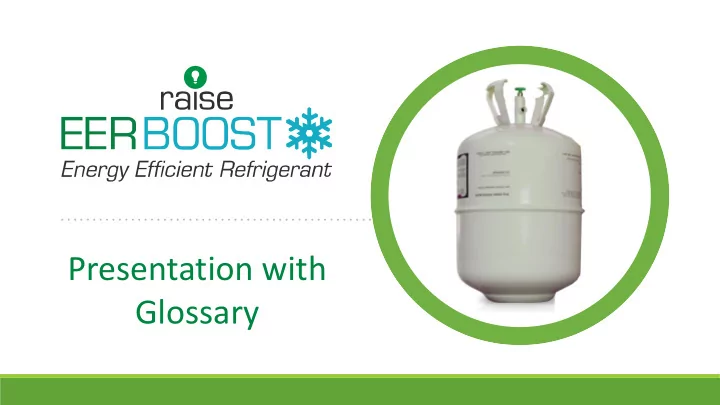
Presentation with Glossary

slide-2
SLIDE 2

2

Laboratory Comparatives

  • Completed expanded comparative benchmarking of

RAISE EER Boost refrigerant at Applied Research Laboratories “ARL” in Florida

  • Completed expanded benchmarking to include R404 A

at Electric Power Research Institute “EPRI” in conjunction with Southern California Edison

slide-3
SLIDE 3

3

*incorrect settings during test

EER Boost-L R134A % Better EERA: 10.6 10 6.00% SEERA: 9.2 8.7 5.75% EERB: 11.4 10.9 4.59% SEERB: 10 9.5 5.26% EER Boost-M R407C % Better EERA: 21.9 14.8 47.97% SEERA: 19.2 13 47.69% EERB: 26.1 19.6 33.16% SEERB: 22.8 17.2 32.56% EER Boost-M R404A % Better EERA: 8.8 7.2 22.22% SEERA: 7.7 6.3 22.22% EERB: 11.5 9.2 25.00% SEERB: 10.1 8.1 24.69% EER Boost-M R22 % Better EERA: 11.7 9 30.00% SEERA: 10.3 7.9 30.38% EERB:* 12.9 18.3

  • 29.51%

SEERB:* 11.3 16.1

  • 29.81%
slide-4
SLIDE 4

4

EER Boost-L R-134A % Better EERA: 10.6 10 6.00% SEERA: 9.2 8.7 5.75% EERB: 11.4 10.9 4.59% SEERB: 10 9.5 5.26%

slide-5
SLIDE 5

5

EER Boost-M R-404A % Better EERA: 8.8 7.2 22.22% SEERA: 7.7 6.3 22.22% EERB: 11.5 9.2 25.00% SEERB: 10.1 8.1 24.69%

slide-6
SLIDE 6

6

EER Boost-M R407C % Better EERA: 21.9 14.8 47.97% SEERA: 19.2 13 47.69% EERB: 26.1 19.6 33.16% SEERB: 22.8 17.2 32.56%

slide-7
SLIDE 7

7

EER Boost-M R-22 % Better EERA: 11.7 9 30.00% SEERA: 10.3 7.9 30.38% EERB:* 12.9 18.3

  • 29.51%

SEERB:* 11.3 16.1

  • 29.81%

*incorrect settings during test

slide-8
SLIDE 8

8

RAISE EER Boost™ Replacements

slide-9
SLIDE 9

9

Intellectual Property Development

Preparing 3 new patent application filings for:

  • composition
  • method of manufacture
  • method of use

Working with industry experts to determine the chemical structure and radiative forcing model of the RAISE EER Boost refrigerant. In order to determine a potentially lower alternative GWP number Utilizing experts in field:

  • Dr. J. Steven Brown PHD, PE professor of ME at Catholic University
  • Dr. Matthew Elrod Professor of Chemistry & BioChemistry at Oberlin College
  • Dr. Michael F. Wempe, PHD in Physical Organic Chemistry and Professor of Research at the University of

Colorado at Denver

  • Chris Seeton at Shrieve Chemical Co. Houston, TX
slide-10
SLIDE 10

10

RAISE EER EER Boost™ Molecular Structure

  • RAISE EER Boost molecular structure contains

lubricated space filling oleics that create a permanent bond to the HFC, increasing efficiency & performance, thereby decreasing energy consumption (total kWh) with a 70% greener

  • utput (GWP)
  • RAISE EER Boost molecules are physically

magnitude's larger than other refrigerants, which significantly reduces leakage

  • RAISE EER Boost is non-flammable, non-toxic

single component refrigerant with a single boiling point

  • RAISE EER Boost reduces head pressure & head

temperature increasing service life of ECU

slide-11
SLIDE 11

11

Global Refrigerant Market Developments

  • President Trump withdraws the United States from the Paris Accord
  • HCFC’s like FREON R-22 are in completion of phaseout accords in most developed

nations

  • New pressure to phaseout HFC’s in progressive developed countries. Led by the F-

Gas regulations in the European Union

  • Major impediment to HFC phaseout schemes is lack of advanced refrigerants and

hardware infrastructure. HFO’s and HC’s are only potential solutions

  • The next generation refrigerants have significant hurdles to mass adoption. Many

developed countries are looking for more realistic solutions such as low GWP HFC’s

  • r flammable HC’s as alternatives
slide-12
SLIDE 12

12

Quantitative Analysis

slide-13
SLIDE 13

13

World Refrigerant Sales (tonnes)

2010 2011 2012 2013 2014 2015 2016 2017 2018 R134A 152,658 160,474 165,910 175,917 186,880 194,457 203,133 190,266 199,787 R407C 13,254 13,503 14,962 16,052 17,096 20,159 23,481 27,586 32,919 R410A 92,466 132,751 160,102 184,026 204,278 240,988 276,097 318,035 352,603 R507 3,441 3,318 3,226 3,258 3,167 3,177 3,036 3,054 3,006 R744 (CO2) 2,366 2,670 2,924 3,557 4,742 5,259 6,146 7,385 9,061 R22 379,660 374,849 378,616 399,815 362,287 340,666 328,833 310,020 291,615 R22 reclaim 7,232 5,334 6,388 7,015 8,525 18,444 17,700 16,537 15,154 R600a (Isobutane) 61 72 73 83 93 91 104 111 116 HFO1234yf

  • 56

143 1,402 2,357 5,275 11,672 12,775 Other HFOs

  • 37

78 783 1,837 2,920 3,683 R404A 68,368 68,609 71,821 73,520 80,035 81,741 94,335 118,844 152,511 R407F 437 552 700 1,219 1,409 1,823 2,326 2,829 3,463 R407A 1,415 2,236 3,820 4,937 5,838 6,635 7,694 9,299 10,883 R290 (Propane) 123 113 116 254 1,290 4,118 6,389 8,937 11,315 R717 (Ammonia) 3,834 4,385 6,078 7,404 8,371 9,702 11,433 13,405 15,177 HC 187 247 304 482 668 1,030 1,211 1,414 1,632 R32

  • 876

1,380 1,934 2,526 3,701 4,946 Other types 9,429 9,474 11,718 16,835 19,906 26,915 28,818 28,915 31,615 Total 734,933 778,586 826,814 895,433 907,447 960,280 1,020,375 1,074,930 1,152,260

964,751 tonnes

slide-14
SLIDE 14

14

World Refrigerant Sales by Regions (tonnes)

slide-15
SLIDE 15

15

World Refrigerant Sales by Applications (tonnes)

slide-16
SLIDE 16

16

Key Potential Revenue Driver Projects

1.ComEd 2.Hitachi 3.U.S. Army / Department of Defense 4.LEDvac – Brazil 5.Vikasa - India

slide-17
SLIDE 17

17

Key Potential Drivers: ComEd

  • ComEd, Commonwealth Edison, is the largest electric utility in Illinois servicing the

Chicago and Northern Illinois area

  • A joint project between ComEd and RAISE EER Boost is currently underway in the

greater Chicago metropolitan area

  • ComEd, at its expense, is monitoring and collecting data from several of its utility

customers using RAISE EER Boost refrigerants. These customers include:

  • Marriott Hotel and Convention Center
  • Sheraton Grande
  • Taco Bell
  • Burger King
  • Hyatt
slide-18
SLIDE 18

18

Key Potential Drivers: Hitachi

  • Hitachi has identified 2 of its energy efficiency clients for assessing and spring

boarding implementation of RAISE EER Boost refrigerants

  • Dallas Independent School District (“ISD”)
  • ComCast (cable head centers – 2 sites identified in Minnesota and Georgia)
slide-19
SLIDE 19

19

Key Potential Drivers: U.S Army and DOD

  • In conjunction with Disrupttech and BAM International, RAISE EER Boost

refrigerants were introduced to heads of procurement (ranging from stationary AC to food services) within the United States Army

  • Presented in Detroit, MI on June 9, 2017
  • RAISE EER Boost has been fast tracked for vetting in connection with IPT mandate

by the armed services for review of refrigerant compliance and strategy

slide-20
SLIDE 20

20

Key Potential Drivers: U.S Army and DOD

slide-21
SLIDE 21

21

Key Potential Drivers: U.S Army and DOD

slide-22
SLIDE 22

22

Key Potential Drivers: Vikasa Holdings - India

  • Vikasa is a U.S. Company dedicated to investing in cutting-edge ‘distributed

infrastructure’ technologies that can be deployed in India and other large emerging markets

  • RAISE EER Boost will be working directly with Mr. Anil Kakani and his team to best

position and distribute RAISE EER Boost in India

  • Mr. Kakani recently served as senior advisor for India to Treasury Secretary Timothy

Geithner, where he established the U.S.- India Economic Financial Partnership (EFP) with India’s Finance Ministry

  • Mr. Kakani also acted as senior advisor in the Clinton White House to Office of

Management and Budget Director Jacob Lew

slide-23
SLIDE 23

23

Manufacturing Facility

  • Anticipated

completion of new production line at Roseburg, OR facility June 2017

  • Anticipated

production capacity equal to 4.5mm pounds a month utilizing 8 hour, 5 day, single shift

slide-24
SLIDE 24

24

Glossary

AHRI: The Air-Conditioning, Heating, and Refrigeration Institute (AHRI) is the trade association representing manufacturers of HVACR and water heating equipment within the global industry. ASHRAE: American Society of Heating, Refrigerating and Air-Conditioning Engineers

  • ASHRAE develops standards for both its members and others professionally concerned with refrigeration processes and the design and maintenance of

indoor environments. ASHRAE writes standards for the purpose of establishing consensus for: 1) methods of test for use in commerce and 2) performance criteria for use as facilitators with which to guide the industry.

ECU: Environmental Control Units EER: Energy Efficiency Ratio

  • Energy Efficiency Ratio (EER) of a particular cooling device is the ratio of output cooling energy (in BTU) to input electrical energy (in Wh) at a given
  • perating point.
  • EER is generally calculated using a 95 °F outside temp and an inside (actually return air) temp of 80 °F and 50% relative humidity.

GWP: Global warming potential

  • GWP is a relative measure of how much heat a greenhouse gas traps in the atmosphere. It compares the amount of heat trapped by a certain mass of

the gas in question to the amount of heat trapped by a similar mass of carbon dioxide.

  • A GWP is calculated over a specific time interval, commonly 20, 100, or 500 years. GWP is expressed as a factor of carbon dioxide (whose GWP is

standardized to 1).

HC: Hydrocarbon - an elementary compound of hydrogen and carbon which occurs naturally and is found in large concentrations in crude oil.

  • Used as a modern refrigerant, non-toxic hydrocarbons are an ecofriendly alternative to the CFC/HCFC/HFC fluorocarbons linked to ozone damage.
  • Though a range of HCs have refrigerant applications, isobutane (R600a) is the HC most frequently found in domestic fridges and freezers, whilst propane

(R290) is common in commercial heat pump-, air conditioning-, refrigeration- and freezer applications.

  • HCs are flammable, propane (R290) is in general use for cooking and heating, and thus the necessity for the application of standard practices for the safe

handling and deployment of such materials is recognized and accepted by all users.

slide-25
SLIDE 25

25

Glossary

IPT: Integrated Planning Team HCFC: Chlorodifluoromethane or difluoromonochloromethane is a hydrochlorofluorocarbon (HCFC).

  • This colorless gas is better known as HCFC-22, or R-22. It is commonly used as a propellant and refrigerant. These applications are being phased out in developed countries due to the

compound's ozone depletion potential (ODP) and high global warming potential (GWP), although global use of R-22 continues to increase because of high demand in developing countries.[2] R-22 is a versatile intermediate in industrial organofluorine chemistry, e.g. as a precursor to tetrafluoroethylene.

HFC: Hydrofluorocarbons are organic compounds that contain fluorine and hydrogen atoms, are the most common type of organofluorine compounds.

  • They are commonly used in air conditioning and as refrigerants [4] in place of the older chlorofluorocarbons such as R-12 and hydrochlorofluorocarbons such as R-21. They do not

harm the ozone layer as much as the compounds they replace; however, they do contribute to global warming. Their atmospheric concentrations and contribution to anthropogenic greenhouse gas emissions are rapidly increasing, causing international concern about their radiative forcing.

HFO: hydrofluoroolefin with the formula CH2=CFCF3.

  • This colorless gas has been proposed as a replacement for R-134a as a refrigerant in automobile air conditioners.
  • HFO-1234yf is the first in a new class of refrigerants acquiring a global warming potential (GWP) rating one 335th that of R-134a (and only 4 times higher than carbon dioxide, which

can also be used as a refrigerant but which has properties significantly different from those of R134a, especially requiring operation at around 5 times higher pressure) and an atmospheric lifetime of about 400 times shorter.

SEER: Seasonal Energy Efficiency Ratio

  • The efficiency of air conditioners is often rated by the Seasonal Energy Efficiency Ratio (SEER) which is defined by the Air Conditioning, Heating, and Refrigeration Institute in its 2008

standard AHRI 210/240, Performance Rating of Unitary Air-Conditioning and Air-Source Heat Pump Equipment.[1] A similar standard is the European seasonal energy efficiency ratio (ESEER).

  • The SEER rating of a unit is the cooling output during a typical cooling-season divided by the total electric energy input during the same period. The higher the unit's SEER rating the

more energy efficient it is.

slide-26
SLIDE 26

26

Appendix: Refrigerant History

slide-27
SLIDE 27

RAISE Energy Solutions is an incubator, manufacturer, and integrator of intelligent LED lighting, innovative energy efficiency products, renewable power generation, and energy storage and distribution technologies. Our holistic approach to energy efficiency begins with energy conservation and includes generation, storage, and distribution. Visit www.RaiseEnergySolutions.com to learn more. 3338 Peachtree Road, Suite 3407, Atlanta, Georgia 30326 | USA 678.331.5548 | info@raiseenergysolutions.com