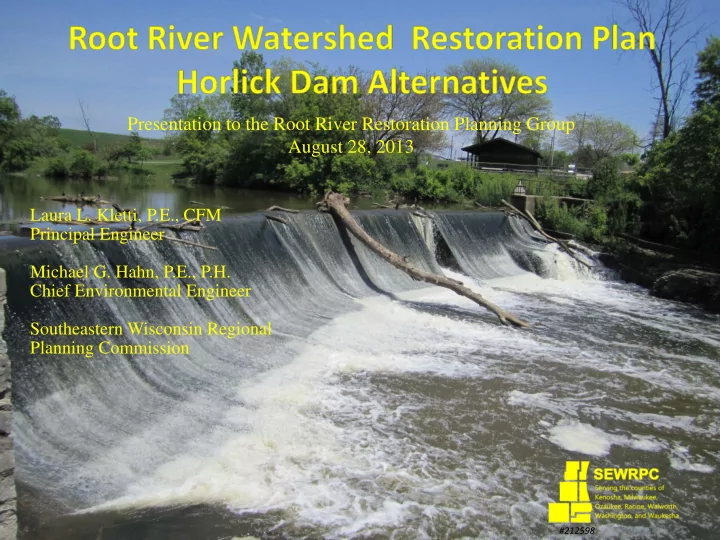
Presentation to the Root River Restoration Planning Group August 28, - - PowerPoint PPT Presentation

presentation to the root river restoration planning group
SMART_READER_LITE
LIVE PREVIEW

Presentation to the Root River Restoration Planning Group August 28, - - PowerPoint PPT Presentation

Presentation to the Root River Restoration Planning Group August 28, 2013 Laura L. Kletti, P.E., CFM Principal Engineer Michael G. Hahn, P.E., P.H. Chief Environmental Engineer Southeastern Wisconsin Regional Planning Commission #212598


slide-1
SLIDE 1

Laura L. Kletti, P.E., CFM Principal Engineer Michael G. Hahn, P.E., P.H. Chief Environmental Engineer Southeastern Wisconsin Regional Planning Commission

#212598

Presentation to the Root River Restoration Planning Group August 28, 2013

slide-2
SLIDE 2

Partners and Funding Agencies

Municipalities and Counties of the Root River Watershed

slide-3
SLIDE 3

Plan Approach

1. Second‐level plan, building from Recommendations of the 2007 SEWRPC Regional Water Quality Management Plan Update (RWQMPU) 2. Developed four focus issues based on survey and local input:

 Water quality  Habitat  Recreational use and access  In Racine County only: Flooding and status of the Horlick dam

3. Characterized the watershed concentrating on features related to the four focus issues

slide-4
SLIDE 4

Plan Approach

4. Identify targets to be achieved by the end of the five‐ year plan period 5. For Each Target, Identify Actions to be Taken 6. Identify Foundation Actions 7. Develop an Implementation Strategy

slide-5
SLIDE 5

The plan is being documented in: SEWRPC Community Assistance Planning Report

  • No. 316, A Restoration Plan for the Root River

Watershed

slide-6
SLIDE 6

Alternatives for the Horlick Dam

slide-7
SLIDE 7

Reasons for Horlick Dam Evaluation

 The dam must be upgraded to meet State

standards, or demolished and removed. Doing nothing is not an option.

 Horlick dam break analysis completed by consultant

being reviewed now by WDNR

 Preliminary conclusion is a Significant Hazard rating

which requires a 500‐year spillway capacity

 Significant Hazard dam rating indicates failure

would not result in loss of human life but would cause economic and environmental losses

slide-8
SLIDE 8

Reasons for Horlick Dam Evaluation

 Horlick dam as constructed has a 10‐year spillway

capacity

 Once WDNR approves, the County may have up to

10 years to perform modifications to meet the spillway capacity requirement if they choose to maintain the dam

slide-9
SLIDE 9

Engineering Process

Feasibility Analysis (Conceptual Alternatives) WDNR Hazard Rating Determination WDNR Order Racine County Decision on How to Proceed Preliminary Engineering Final Design Plans and Specifications Construction/Demolition

slide-10
SLIDE 10

Horlick Dam Alternatives

 Issues of Concern

 Water Quantity  Water Quality  Natural Resources  Social  Costs

 Baseline Condition  Conceptual Alternatives

slide-11
SLIDE 11

Baseline Conditions

slide-12
SLIDE 12

1975 Reconstruction

slide-13
SLIDE 13

Baseline Conditions – Side View

Flow

slide-14
SLIDE 14

Baseline Conditions – 10‐year

slide-15
SLIDE 15

Baseline Conditions – 500‐year

slide-16
SLIDE 16

Sediment Volume

Horlick dam Hwy 31 River Bend NC

slide-17
SLIDE 17

Aquatic Invasive Species (AIS)

 Species/Issues of Concern

 Sea Lamprey  Round goby  VHS – Viral Hemorrhagic Septicemia

 Horlick dam as currently constructed is a barrier to AIS

based on the WDNR criterion of the 100‐year event

 WDNR considers the Horlick dam to be most downstream

barrier to AIS from Lake Michigan

Source: Pennsylvania Sea Grant Source: http://en.academic.ru/ Source: MN DNR

slide-18
SLIDE 18

Safety Concerns

 Dam / structural failure  High flow hazards  Boater / fisherman safety  Foot access hazards

slide-19
SLIDE 19
slide-20
SLIDE 20
slide-21
SLIDE 21

Alternatives

Conceptual Alternatives

Modify Dam to Enhance Spillway Capacity

Modify Dam to Enhance Spillway Capacity & Provide Fish Passage Under Low and High Flow Conditions

Partial Removal

Full Removal

slide-22
SLIDE 22

Alternative 1

 Enhance Spillway Capacity to Meet 500‐year Standard

slide-23
SLIDE 23

Alternative 1 – Side View

Flow

slide-24
SLIDE 24

Hwy 31 Alt 1 & 2 Horlick dam

slide-25
SLIDE 25

Alternative 2

 Enhance Spillway Capacity and Fish Passage

slide-26
SLIDE 26

1915 Fishway

slide-27
SLIDE 27

Fishway Examples

Source: State of Connecticut Source: Ontario Ministry of Natural Resources

slide-28
SLIDE 28

Alternative 3

 Partially Remove Dam as Barrier

slide-29
SLIDE 29

Alternative 4

 Remove Dam

slide-30
SLIDE 30
slide-31
SLIDE 31

Table 1 Costs

Alternative Capital Cost (dollars) Annual Operation and Maintenance (dollars) Total Present Worth Cost (dollars) Alternative 1–500-Year Capacity $390,000 $4,500 $461,000 Alternative 2–Alt 1 with Fishway $480,000 $4,700 $555,000 Alternative 3–Full Notch of Dam $440,000 $2,100 $473,000 Alternative 4–Dam Removal $540,000 $ 700 $551,000

slide-32
SLIDE 32

Table 2 Summary

Alternative Flooding Upstream

  • f Dam

Water Quality Fish Passage and Overall Fish Community Improvement Safety Recreation Access to River by Riparian Land Owners Total Present Worth Costs (dollars) Paddling Fishing Upstream

  • f Dam

Recreational Salmon Fishing Immediately Downstream

  • f Dam

Baseline Condition N/A Alternative 1—500-Year Capacity + + + + – + – $461,000 Alternative 2—Alt 1 with Fishway + + ++ + – ++ – – $555,000 Alternative 3—Full Notch

  • f Dam

++ ++ ++ ++ – – +++ – – – – $473,000 Alternative 4—Dam Removal ++ +++ +++ +++ – – +++ – – – – $551,000 Basis for Evaluation Upstream flood elevations lowered Loss of impound- ment Elimination of blockage or addition of fishway Loss of structure in River Loss of consist- ent water levels Improved passage upstream Full blockage at dam removed Lower water level removes direct access
slide-33
SLIDE 33

Additional Work/Information Needs

 Additional information to be gathered during

preliminary engineering for Horlick dam

 Additional sediment sampling in impoundment  Structural integrity issues

 Dam modification alternatives (Alternatives 1, 2, and 3)  Right abutment at Riverside Inn (Alternative 4)

slide-34
SLIDE 34

Project Web Site

 http://www.sewrpc.org/SEWRPC/Environment/Root‐River‐

Watershed‐Restoration‐Plan.htm

  • Presentations from

public stakeholder meetings

  • Summary notes from Advisory

Group meetings

  • Draft chapters as they are

completed

  • Comment screen
slide-35
SLIDE 35