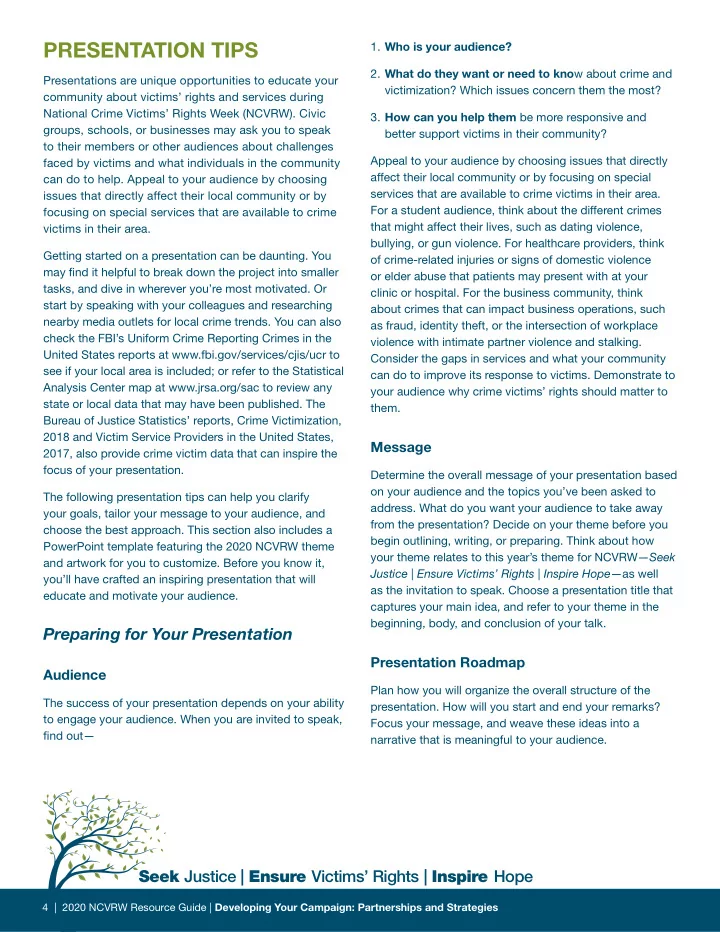
PRESENTATION TIPS 1. Who is your audience? 2. What do they want or - - PDF document

presentation tips
SMART_READER_LITE
LIVE PREVIEW

PRESENTATION TIPS 1. Who is your audience? 2. What do they want or - - PDF document

PRESENTATION TIPS 1. Who is your audience? 2. What do they want or need to kno w about crime and Presentations are unique opportunities to educate your victimization? Which issues concern them the most? community about victims rights and


slide-1
SLIDE 1

4 | 2020 NCVRW Resource Guide | Developing Your Campaign: Partnerships and Strategies

Seek Justice | Ensure Victims’ Rights | Inspire Hope

PRESENTATION TIPS

Presentations are unique opportunities to educate your community about victims’ rights and services during National Crime Victims’ Rights Week (NCVRW). Civic groups, schools, or businesses may ask you to speak to their members or other audiences about challenges faced by victims and what individuals in the community can do to help. Appeal to your audience by choosing issues that directly affect their local community or by focusing on special services that are available to crime victims in their area. Getting started on a presentation can be daunting. You may fnd it helpful to break down the project into smaller tasks, and dive in wherever you’re most motivated. Or start by speaking with your colleagues and researching nearby media outlets for local crime trends. You can also check the FBI’s Uniform Crime Reporting Crimes in the United States reports at www.fbi.gov/services/cjis/ucr to see if your local area is included; or refer to the Statistical Analysis Center map at www.jrsa.org/sac to review any state or local data that may have been published. The Bureau of Justice Statistics’ reports, Crime Victimization, 2018 and Victim Service Providers in the United States, 2017, also provide crime victim data that can inspire the focus of your presentation. The following presentation tips can help you clarify your goals, tailor your message to your audience, and choose the best approach. This section also includes a PowerPoint template featuring the 2020 NCVRW theme and artwork for you to customize. Before you know it, you’ll have crafted an inspiring presentation that will educate and motivate your audience.

Preparing for Your Presentation

Audience

The success of your presentation depends on your ability to engage your audience. When you are invited to speak, fnd out—

  • 1. Who is your audience?
  • 2. What do they want or need to know about crime and

victimization? Which issues concern them the most?

  • 3. How can you help them be more responsive and

better support victims in their community? Appeal to your audience by choosing issues that directly affect their local community or by focusing on special services that are available to crime victims in their area. For a student audience, think about the different crimes that might affect their lives, such as dating violence, bullying, or gun violence. For healthcare providers, think

  • f crime-related injuries or signs of domestic violence
  • r elder abuse that patients may present with at your

clinic or hospital. For the business community, think about crimes that can impact business operations, such as fraud, identity theft, or the intersection of workplace violence with intimate partner violence and stalking. Consider the gaps in services and what your community can do to improve its response to victims. Demonstrate to your audience why crime victims’ rights should matter to them.

Message

Determine the overall message of your presentation based

  • n your audience and the topics you’ve been asked to
  • address. What do you want your audience to take away

from the presentation? Decide on your theme before you begin outlining, writing, or preparing. Think about how your theme relates to this year’s theme for NCVRW—Seek Justice | Ensure Victims’ Rights | Inspire Hope—as well as the invitation to speak. Choose a presentation title that captures your main idea, and refer to your theme in the beginning, body, and conclusion of your talk.

Presentation Roadmap

Plan how you will organize the overall structure of the

  • presentation. How will you start and end your remarks?

Focus your message, and weave these ideas into a narrative that is meaningful to your audience.

slide-2
SLIDE 2

2020 NCVRW Resource Guide | Developing Your Campaign: Partnerships and Strategies | 5

Seek Justice | Ensure Victims’ Rights | Inspire Hope

  • 1. Opening: Grab your audience’s attention.
  • Tell a short, compelling story about a crime in your

community, emphasizing the victim’s experience.

  • Cite a surprising and impactful statistic.
  • Ask your audience to guess the facts about

a specifc crime (e.g., the number of times a particular crime happens annually in the community).

  • Relate your story or statistics back to your main

message (e.g., some crime victim populations face additional barriers to reporting, or nontraditional partners are essential to the crime victims’ movement).

  • 2. Body: Build your presentation around three supporting

ideas, placed in a logical pattern that leads to a clear

  • conclusion. Your topic will determine your pattern. The

following are some typical idea development structures1:

  • Chronological (past, present, future).
  • Sequential (a step-by-step process, e.g., for project

rollout).

  • Climactic (least to most important).
  • Problem/solution (problem, solution, and benefts).
  • Compare/contrast (similarities and differences of

specifc factors).

  • Cause and effect (causes and results of specifc

situations).

  • Advantage/disadvantage (good or bad sides of

an issue). Once you have decided how to structure your presentation, write down supporting ideas and evidence, illustrations, or stories to support your main message.

  • 3. Conclusion: Re-state your theme and main points.

Ask the audience to take specifc action such as liking your organization’s Facebook page, signing up for communications, or donating to a fundraising event

  • r campaign for victims of a specifc crime, such as a

mass casualty event.

1 Nancy Duarte, Resonate: Present Visual Stories That Transform

Audiences (Hoboken, NJ: John Wiley & Sons, 2010), 129.

Method

Regardless of how you share your information (e.g., PowerPoint, poster, webinar, interactive activity), remember to engage your audience by periodically asking them to break into small discussion groups and allowing time for questions throughout the presentation or at the

  • end. Practice your presentation until you feel comfortable.

Know how long it takes to deliver, and adjust your talking points to meet the time requirements of the presentation. If you choose PowerPoint or another similar software, public-speaking experts suggest the following guidelines for preparing effective slides:

  • Design: Choose a simple, uncluttered design and solid
  • colors. Use the same design on every slide. Use dark

text on light backgrounds.

  • Bullets: Limit yourself to six bullets per slide, and no

more than eight words per bullet.

  • Font: Use sans-serif fonts (e.g., Arial, Verdana) for
  • readability. Avoid using all uppercase letters, except

for titles, and use italics sparingly.

  • Font size: Use at least 24-point type.
  • Graphics, charts, and photos: Use simple graphics

and photos that are visible to the audience. (The 2020 NCVRW theme artwork is available to use, as well as the 2020 NCVRW PowerPoint template.)

  • Animation: Limit the use of animation and sound

effects.

  • Video: Use video sparingly, and only to support the

theme; embed your videos into PowerPoint rather than stream them from the Internet. (See “Theme in Action” for ideas on how to use the 2020 NCVRW Theme Video.)

  • Spelling and grammar: Use spell-check and proofread

your slides several times.

  • Preview: Preview the presentation in its entirety before

delivering.

slide-3
SLIDE 3

6 | 2020 NCVRW Resource Guide | Developing Your Campaign: Partnerships and Strategies

Seek Justice | Ensure Victims’ Rights | Inspire Hope

Never read your slides verbatim, but use them as a guide. As you rehearse, track how long it takes you to go through all the slides, and then edit them accordingly.

Communicating Effectively

Public speaking makes everyone a bit nervous. Practice lessening your anxieties by preparing carefully and concentrating on the audience when you speak. Your goal is to tell a story about a problem and let your audience know how they can help solve it. Remember, you are an expert in what you are presenting. The following suggestions will help your presentation go smoothly:

  • 1. Speak in a positive, warm tone.
  • 2. Smile and make eye contact with the audience.
  • 3. Avoid physical mannerisms and gestures.
  • 4. Set expectations by telling the audience whether

you would like them to ask questions throughout the presentation or at the end. Let them know if they may share details of the presentation on social media.

  • 5. Practice, practice, practice.

Prepare the Room

On the day of your presentation, arrive 30 to 45 minutes early to check in with the host, test the equipment, and arrange the room to suit your needs. It may be helpful to ask someone to help you test the volume of your voice. Always have two ways to access your presentation, such as an accessible email account, removable drive, or hardcopy.

Sample PowerPoint Template

Accompanying this section is a sample PowerPoint template featuring the 2020 NCVRW theme and design. Use the template to prepare and customize your own NCVRW PowerPoint presentations. Images of the master title and content slides appear on this page. The PowerPoint fle is available for download on the NCVRW website, www.ovc.gov/ncvrw2020, along with a range of

  • ther theme artwork fles.