Presentation script Slide Screenshot Script SLIDE 1 DO: [Welcome - - PDF document

presentation script
SMART_READER_LITE
LIVE PREVIEW

Presentation script Slide Screenshot Script SLIDE 1 DO: [Welcome - - PDF document

Resources Presentation script Slide Screenshot Script SLIDE 1 DO: [Welcome leaders to the education session.] SAY: The American College of Rheumatology (ACR) has Lupus PowerPoint presentation: launched The Playbook, a set of local lupus


slide-1
SLIDE 1

Raising Lupus Awareness

Lupus PowerPoint presentation:

32

befiercetakecontrol.org Presentation script

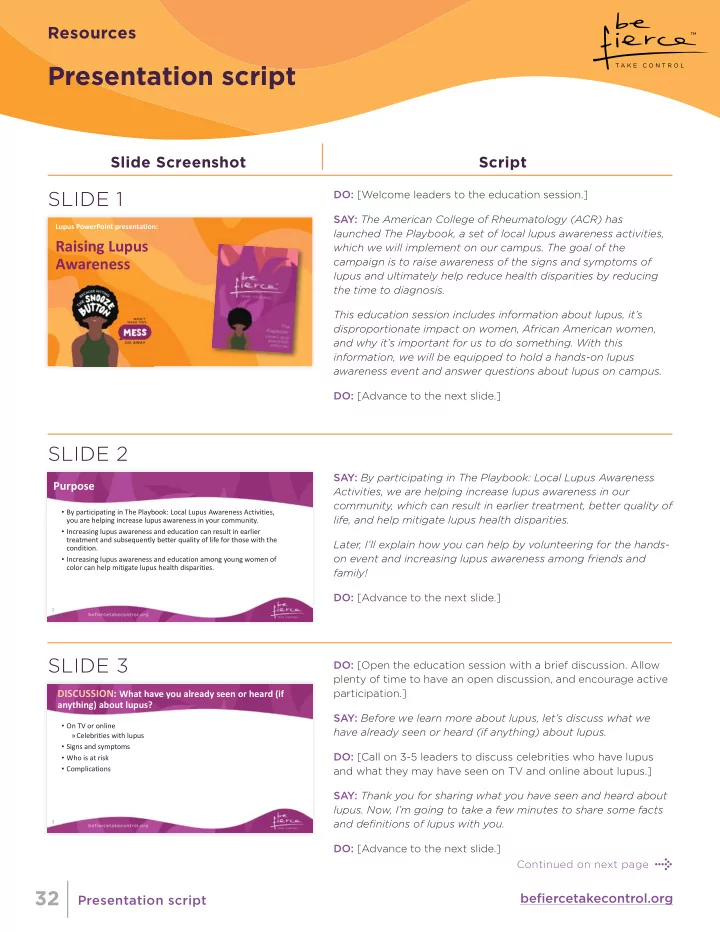
DO: [Welcome leaders to the education session.] SAY: The American College of Rheumatology (ACR) has launched The Playbook, a set of local lupus awareness activities, which we will implement on our campus. The goal of the campaign is to raise awareness of the signs and symptoms of lupus and ultimately help reduce health disparities by reducing the time to diagnosis. This education session includes information about lupus, it’s disproportionate impact on women, African American women, and why it’s important for us to do something. With this information, we will be equipped to hold a hands-on lupus awareness event and answer questions about lupus on campus. DO: [Advance to the next slide.] SAY: By participating in The Playbook: Local Lupus Awareness Activities, we are helping increase lupus awareness in our community, which can result in earlier treatment, better quality of life, and help mitigate lupus health disparities. Later, I’ll explain how you can help by volunteering for the hands-

  • n event and increasing lupus awareness among friends and

family! DO: [Advance to the next slide.] DO: [Open the education session with a brief discussion. Allow plenty of time to have an open discussion, and encourage active participation.] SAY: Before we learn more about lupus, let’s discuss what we have already seen or heard (if anything) about lupus. DO: [Call on 3-5 leaders to discuss celebrities who have lupus and what they may have seen on TV and online about lupus.] SAY: Thank you for sharing what you have seen and heard about

  • lupus. Now, I’m going to take a few minutes to share some facts

and definitions of lupus with you. DO: [Advance to the next slide.]

SLIDE 1 SLIDE 2 SLIDE 3

Script Slide Screenshot

Resources

Presentation script

Continued on next page 1

Purpose

By participating in The Playbook: Local Lupus Awareness Activities, you are helping increase lupus awareness in your community. Increasing lupus awareness and education can result in earlier treatment and subsequently better quality of life for those with the condition. Increasing lupus awareness and education among young women of color can help mitigate lupus health disparities.

2

DISCUSSION: What have you already seen or heard (if

anything) about lupus?

On TV or online »Celebrities with lupus Signs and symptoms Who is at risk Complications

3

slide-2
SLIDE 2

33

befiercetakecontrol.org Presentation script

Continued on next page 1 Presentation script

Continued

1

What is lupus?

Systemic lupus erythematosus, referred to as SLE or lupus, is a chronic disease, meaning it is a long term disease that should be managed. Lupus affects the immune system and is called an autoimmune disease. The immune system’s job is to fight foreign invaders, like germs and

  • viruses. But in autoimmune diseases, the immune system is out of control

and mistakenly attacks healthy tissue. Lupus can cause pain, inflammation, and tissue damage to various organs in the body like the kidneys, live, heart, lungs, and brain. While there is no cure for lupus, medical treatments and lifestyle changes can help control it.

4

SAY: Lupus is a chronic disease, meaning it is a long term disease that should be managed. Lupus is also an autoimmune disease. In autoimmune diseases, like lupus, the immune system is out of control and mistakenly attacks healthy tissue. Lupus can cause pain, inflammation, and tissue damage to various organs in the body like the kidneys, live, heart, lungs, and

  • brain. Some lupus patients experience kidney involvement, that

if not managed, can lead to organ damage. While there is no cure for lupus, medical treatments and lifestyle changes can help control it. SAY: Lupus has many different signs and symptoms. Lupus is hard to detect because symptoms look like the symptoms of

  • ther diseases.

Some of the most common signs and symptoms of lupus are:

  • Pain or swelling in your joints that always seems to come back
  • Reoccurring sores in your mouth
  • Rashes on your skin
  • The lupus “butterfly rash” appears across the nose and

cheeks

  • Low-grade fevers you can’t explain
  • Extreme exhaustion no matter how much sleep you get

Lupus symptoms can show up in many different ways. Sometimes they appear out of the blue, and sometimes they can

  • linger. Each person’s experience with lupus is unique.

DO: [Advance to the next slide.] SAY: The first picture shows an example of joint swelling. The second picture shows a butterfly rash, which is a butterfly- shaped rash on the cheeks and nose. DO: [Advance to the next slide.]

SLIDE 4 SLIDE 5 SLIDE 6

What are the signs and symptoms of lupus?

5 Joint pain

  • r swelling

Extreme exhaustion Low-grade fevers Mouth sores Rashes

  • 6
slide-3
SLIDE 3

34

befiercetakecontrol.org

Continued on next page 1 Presentation script

Continued

1

DISCUSSION: Do you know someone with lupus?

How has that experience affected you? How did the signs and symptoms of lupus affect them? How were you supportive of your loved one’s needs?

7

DO: [Lead a brief, 5-minute discussion about leaders’ personal experience with lupus, either in their lives or in the lives of others. Allow plenty of time to have an open discussion, and encourage active participation.] SAY: It’s important to remember that lupus affects real people. Would anyone like to share how it’s touched your life or the life

  • f a friend or family member? When you share your experiences,

please don’t mention names. Also, please be respectful of others: experiences shared in this session, stay in this session [unless

  • therwise stated].

DO: [Advance to the next slide.] SAY: The cause of lupus is unknown. Scientists don’t have a clear answer of what causes lupus, but believe lupus is linked to environmental, genetic, and hormonal factors. This means that lupus isn’t always hereditary. But, people with lupus can live full and active lives, especially when they receive an early diagnosis and begin treatment. This is why our goal is to spread awareness on our campus – we want anyone who may be experiencing lupus symptoms to talk to their doctor. DO: [Advance to the next slide.] SAY: While it is unclear why lupus occurs and there is no way to prevent lupus, we do know that some populations are affected by lupus more than others. Approximately 160,000 to 320,000 people in the U.S. have lupus. However, the true number of people affected by lupus remains unknown. Lupus affects women more than men, and lupus usually begins during child bearing years (15-44). Minority groups are affected more than Whites. African American women are also affected more than White women – lupus is two to three times more common in African American women compared to White women. These numbers emphasize the importance of seeing a doctor when you begin experiencing symptoms or just “feel off” to get a proper diagnosis and treatment to prevent poor health

  • utcomes.

DO: [Advance to the next slide.]

SLIDE 7 SLIDE 8 SLIDE 9

What causes lupus?

The cause of lupus is unknown, but many scientists believe lupus is linked to environmental, genetic, and hormonal factors. Most people with lupus do not have family members with the disease; however, some people with lupus do have a family history of lupus. This means lupus isn’t always hereditary.

8

Who is at risk for lupus?

Approximately 160,000 to 320,000 people in the U.S. have lupus. Lupus affects women more than men. » Approximately 90 percent of individuals with lupus are female. » Lupus also usually begins during child bearing years (15-44). Minority groups—African Americans, Latinos, Asians, and American Indians/Alaska Natives—are affected more than non-Hispanic Whites. Lupus is two to three times more common in African American women compared to White women.

9

Presentation script

slide-4
SLIDE 4

35

befiercetakecontrol.org

Continued on next page 1 Presentation script

Continued

1

Lupus health disparities

The National Institute of Health defines health disparities as “the differences in the incidence, prevalence, mortality, and burden of disease and other adverse health conditions that exist among specific population groups.” Health disparities result from the complex interaction among genetic and environmental factors (e.g. race, low socioeconomic status) and health behaviors (e.g. treatment adherence, health literacy). Some researchers think that lupus health disparities may be, in part, due to limited health care access and lack of disease knowledge among affected populations.

10

SAY: As I just mentioned, lupus is two to three times more common among African American women. This is a example

  • f a health disparity, which is when certain diseases are more

common or adverse in specific populations. Health disparities result from genetic and environmental factors and health behaviors. Some researchers think that lupus health disparities may be, in part, due to limited health care access and lack of disease knowledge among affected populations. DO: [Advance to the next slide.] DO: [Take this time to have a short discussion about lupus

  • awareness. Allow plenty of time to have an open discussion, and

encourage active participation.] SAY: Think about the facts I shared earlier in this presentation. Why do you think lupus awareness is low? DO: [Call on 3-5 leaders to discuss awareness among peers, family, and nationwide.] SAY: What new facts surprised you and what will you take away from this session to share with people during the hands-on event? What were some prior misconceptions you had about lupus? DO: [Advance to the next slide.] SAY: Lupus is hard to detect because the signs and symptoms are similar to other diseases and may come and go, making it challenging for many health care providers. Lupus can often be misdiagnosed, and a health care provider should evaluate your symptom history, conduct a physical exam, and conduct a series

  • f lab tests for a diagnosis.

Because diagnosis can be challenging, your health care provider may refer you to a rheumatologist, a doctor that specializes in autoimmune diseases. Sometimes, other specialists, like a dermatologist, may also be involved, because lupus can affect so many different organs. Getting an early diagnosis of lupus is critical. Late diagnosis and delayed treatment can contribute to health complications and increased poor health outcomes. It is important to share as much information as you can about your medical history with your health care providers to help them make an accurate diagnosis. DO: [Advance to the next slide.]

SLIDE 10 SLIDE 11 SLIDE 12

DISCUSSION: Why do you think awareness about lupus is

low?

On your campus Among your friends and family Nationwide

11

How is lupus diagnosed?

Lupus is hard to detect because the signs and symptoms are similar to

  • ther diseases and may come and go.

Lupus can often be misdiagnosed if only a single blood test is used for diagnosis. A health care provider should evaluate your symptom history, conduct a physical exam, and conduct a series of lab tests for a diagnosis. Because diagnosis can be challenging, your health care provider may refer you to a rheumatologist, a doctor that specializes in autoimmune diseases. Getting an early diagnosis of lupus is critical to preventing long-term consequences of the disease.

12

Presentation script

slide-5
SLIDE 5

36

befiercetakecontrol.org

Continued on next page 1 Presentation script

Continued

1

How is lupus treated?

The goals of lupus treatment: » Work with health care providers to manage medications, side effects, and healthy life style choices. » Stop and reverse ongoing organ inflammation. » Prevent or limit irreversible organ damage. Lupus requires a team approach, because it can affect so many different

  • rgans.

Common treatment includes immunosuppressive drugs (hydroxychloroquine) and anti-inflammatory drugs (corticosteroids). Early diagnosis and proper medical care significantly improve function and quality of life for lupus patients.

13

SAY: The most important goal of lupus treatment is to work with health care providers to manage medications, side effects, and healthy life style choices. Lupus treatment stops and reverses

  • rgan inflammation, which can prevent or limit damage to major
  • rgans, which could be fatal.

While a rheumatologist provides an official diagnosis, lupus is

  • ften managed by a team of doctors and a supportive network
  • f family and friends. Getting an early lupus diagnosis is critical

to improving the quality of life for lupus patients, and preventing long-term consequences of the disease. DO: [Advance to the next slide.] SAY: Getting an early diagnosis of lupus is critical. Late diagnosis and delayed treatment can contribute to health complications and increased poor health outcomes like organ failure, infection,

  • r cardiovascular disease.

While there is no cure for lupus, medical treatments and lifestyle changes can help control it. Survival rates for lupus patients have improved drastically over the past 50 years, due to early diagnosis. For this reason, it’s critical that people seek medical care to get an early lupus diagnosis and treatment to prevent serious organ damage. DO: [Advance to the next slide.] SAY: The American College of Rheumatology (ACR) wants young leaders, like you, to use this Playbook to get you and your campus to Be Fierce. Take Control.™ The goal of the campaign is to raise awareness of the signs and symptoms of lupus, and ultimately help reduce health disparities by reducing the time to diagnosis. The campaign uses social media, video, digital advertising, and audience engagement to reach young African American women and educate them about lupus via the campaign website: befiercetakecontrol.org. DO: [Play the campaign video in a separate window.] DO: [Advance to the next slide after the video ends.]

SLIDE 13 SLIDE 14 SLIDE 15

The importance of early diagnosis

Getting an early lupus diagnosis is critical to preventing long-term consequences of the disease. Causes of premature death associated with lupus are mainly organ failure, infection, or cardiovascular disease. Lupus, especially when not treated, can lead to organ damage and reduce physical, mental, and social health. »Survival rates for lupus patients have improved drastically over the past 50 years due to earlier diagnosis, more effective treatments, and better management of organ inflammation.

14

  • 15

The Be Fierce. Take Control.™ campaign is designed to educate and empower young women of color. » Use the resources in The Playbook: Local Lupus Awareness Activities » Visit befiercetakecontrol.org – a website that provides more information and resources to help. » Watch the campaign video – https://youtu.be/tj8WTQSEyDE

Presentation script

slide-6
SLIDE 6

37

befiercetakecontrol.org

Continued on next page 1 Presentation script

Continued

1

Next steps

Review the Lupus fact sheet – detailed and other Playbook resources. Establish committees to lead the social media campaign and the on- campus event. Volunteers to promote the event on our social media accounts. Volunteers for event set-up, tabling, and event clean-up. Host the on-campus awareness event. Spread lupus awareness on campus. Celebrate the ways students on campus are being fierce and taking control of their own health.

16

DO: [Hand out copies of the Lupus fact sheet – detailed and pass around the interest sheet for leaders to sign-up for event planning committees.] SAY: Next, we all need to review the Playbook and its resources, decide who will serve on event planning committees, and host the on-campus awareness event. During the on-campus awareness event we will pass out information about lupus and encourage students to stop by our table and use the art supplies (i.e. sidewalk chalk and paint) to celebrate the ways they’re taking control of their health. The Playbook has easy-to-use talking points for us to use as students stop by the table with questions about lupus. DO: [Advance to the next slide.] DO: [Take this time to have a short discussion about spreading the word on campus. Allow plenty of time to have an open discussion, and encourage active participation.] SAY: Now, we’re at the end of the session. But our work is not

  • ver! How do you feel about spreading the word about lupus

around campus? DO: [Advance to the next slide at the end of the discussion.] SAY: If you’ve been experiencing symptoms (one or more), it’s time to schedule an appointment to talk to your health care provider! There is a guide on the campaign website if you’re not used to scheduling your own health appointments. If you think a friend may be experiencing symptoms of lupus, share befiercetakecontrol.org – a website that provides more information and resources to help. When spreading the word on social media, don’t forget to include the hashtag(s) #BeFierceTakeControl and [insert

  • rganization hashtag if applicable] on Twitter, Facebook,

Instagram and Snapchat! DO: [Advance to the next slide.]

SLIDE 16 SLIDE 17 SLIDE 18

Presentation script

slide-7
SLIDE 7

38

befiercetakecontrol.org

Presentation script

Continued

1

DISCUSSION

19

Any further questions about lupus? DO: [Open the discussion floor for final questions. Allow plenty

  • f time to have an open discussion, and encourage active

participation.] SAY: Does anyone have any further questions about lupus? DO: [Advance to the next slide.]

SCRIPT BLANK

SAY: Thanks for coming! We’ll be following up soon about the upcoming social media campaign and hands-on event. DO: [End presentation.]

SLIDE 19 SLIDE 20 SLIDE 21

Works Cited

American College of Rheumatology. (2015). Lupus. Retrieved from http://www.rheumatology.org/I-Am-A/Patient- Caregiver/Diseases-Conditions/Lupus Bruce, I. N. (2013). Lupus: the new diabetes. SLE and chronic disease management. Lupus, 22(12), 1203-1204. Centers for Disease Control and Prevention (CDC). (2017). Lupus Basic Fact Sheet. Retrieved from www.cdc.gov/lupus/basics/index.html Dall'Era, M. (2013). Chapter 21. Systemic Lupus Erythematosus. In J. B. Imboden, D. B. Hellmann, & J. H. Stone (Eds.), CURRENT Diagnosis & Treatment: Rheumatology, 3e. New York, NY: The McGraw-Hill Companies. Demas, K. L., & Costenbader, K. H. (2009). The Role of Neighborhood and Individual Socioeconomic Status in Outcomes of Systemic Lupus Erythematosus. Current Opinion in Rheumatology, 21(2), 102–109. Lim, S. S., Bayakly, A. R., Helmick, C. G., Gordon, C., Easley, K. A., & Drenkard, C. (2014). The incidence and prevalence of systemic lupus erythematosus, 2002–2004: the Georgia Lupus Registry. Arthritis & Rheumatology, 66(2), 357-368. National Institutes of Health. (2017). Health Disparities. Retrieved from https://www.nhlbi.nih.gov/health/educational/healthdisp Pons-Estel, G. J., Alarcon, G. S., Scofield, L., Reinlib, L., & Cooper, G. S. (2010). Understanding the epidemiological progression

  • f systemic lupus erythematosus. Seminars in Arthritis and Rheumatism, 39(4).

Somers, E. C., Marder, W., Cagnoli, P., Lewis, E. E., DeGuire, P., Gordon, C., ... & Leisen, J. (2014). Population-based incidence and prevalence of systemic lupus erythematosus: The Michigan lupus epidemiology and surveillance program. Arthritis & Rheumatology, 66(2), 369-378. 20 This Playbook was supported by the Grant or Cooperative Agreement Number, 6 NU58 DP006138, funded by the Centers for Disease Control and Prevention. Its contents are solely the responsibility of the authors and do not necessarily represent the official views of the Centers for Disease Control and Prevention

  • r the Department of Health and Human Services.

Presentation script