Andromeda: XSS Accurate and Scalable Security Attackers evil - - PowerPoint PPT Presentation

andromeda
SMART_READER_LITE
LIVE PREVIEW

Andromeda: XSS Accurate and Scalable Security Attackers evil - - PowerPoint PPT Presentation

Andromeda: XSS Accurate and Scalable Security Attackers evil script Analysis of Web Applications Web Application <SCRIPT>...</SCRIPT> Attackers evil script executed using victims credentials Omer Tripp Marco


slide-1
SLIDE 1

λ Andromeda:

Accurate and Scalable Security Analysis of Web Applications

Omer Tripp

Tel Aviv University & IBM

  • mert@il.ibm.com

Patrick Cousot

New York University

pcousot@cs.nyu.edu

Radhia Cousot

École Normale Supérieure

radhia.cousot@ens.fr

Salvatore Guarnieri

University of Washington & IBM

sguarni@us.ibm.com

Marco Pistoia

IBM T. J. Watson Research Center

pistoia@us.ibm.com

λ

2

OWASP* Top Ten Security Vulnerabilities

  • 1. Cross-site scripting (XSS)
  • 2. Injection flaws
  • 3. Malicious file executions
  • 4. Insecure direct object reference
  • 5. Cross site request forgery (CSRF)
  • 6. Information leakage and improper error handling
  • 7. Broken authentication and improper session management
  • 8. Unsecure cryptographic storage
  • 9. Unsecure communications
  • 10. Failure to restrict URL accesses

* Open Web Application Security Project (OWASP): http://www.owasp.org

λ

3

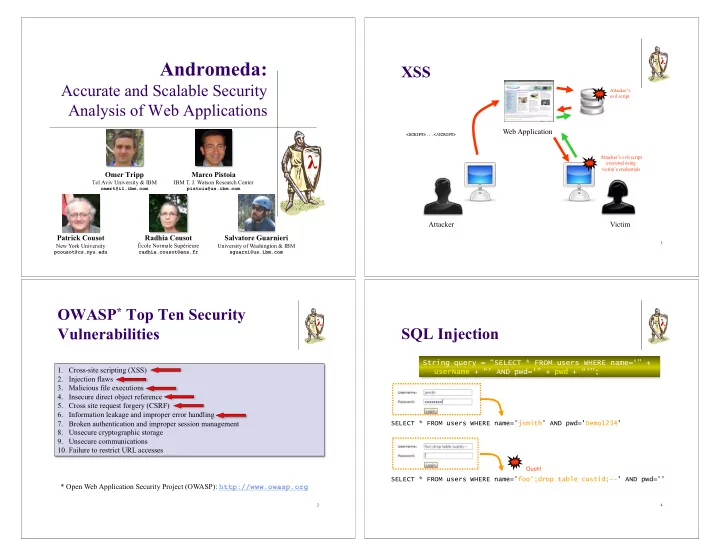
XSS

Attacker Victim

Attacker’s evil script Attacker’s evil script executed using victim’s credentials

Web Application

<SCRIPT>...</SCRIPT>

λ

4

SQL Injection

SELECT * FROM users WHERE name='jsmith' AND pwd='Demo1234' SELECT * FROM users WHERE name='foo';drop table custid;--' AND pwd=''

String query = “SELECT * FROM users WHERE name=‘” + userName + “’ AND pwd=‘” + pwd + “’”;

Ouch!

slide-2
SLIDE 2

λ

5

Malicious File Executions

 Web application manage files in the file system  The name or contents of such files are often

  • btained from user input

 Maliciously crafted user inputs could cause the

execution or deletion of security-sensitive files

λ

6

Information Leakage and Improper Error Handling

λ

7

Existing Static-Analysis Solutions

 Type systems:

  • Complex, conservative, require code annotations

 Classic slicing:

  • Has not been shown to scale to large applications while

maintaining sufficient accuracy

λ

Motivation

 Web applications are large and complex  Sound analyses

 If too precise, do not scale well  If too imprecise, have too many false positives

 Unsound analyses

 Have false negatives  Are often unstable (extra-sensitivity to program

changes)

slide-3
SLIDE 3

λ

Intuition behind Andromeda

 Taint analysis can be

treated as a demand- driven problem

 This enables lazy

computation of vulnerable information flows, instead

  • f eagerly computing a

complete data-flow solution

λ

Publications on Andromeda

FASE 2013 – Andromeda algorithm

Omer Tripp, Marco Pistoia, Patrick Cousot, Radhia Cousot, Salvatore Guarnieri, “Andromeda: Accurate and Scalable Security Analysis of Web Applications”

OOPSLA 2011 – Integration with Framework for Frameworks (F4F)

Manu Sridharan, Shay Artzi, Marco Pistoia, Salvatore Guarnieri, Omer Tripp, Ryan Berg, “F4F: Taint Analysis of Framework-based Web Applications”

ISSTA 2011 (1) – Andromeda for JavaScript

Salvatore Guarnieri, Marco Pistoia, Omer Tripp, Julian Dolby, Stephen Teilhet, Ryan Berg, “Saving the World Wide Web from Vulnerable JavaScript”

ISSTA 2011 (2) – Andromeda as the basis for String Analysis (ACM SIGSOFT Distinguished Paper Award)

Takaaki Tateishi, Marco Pistoia, Omer Tripp, “Path- and Index-sensitive String Analysis based on Monadic Second-order Logic”

IBM Journal on Research and Development 2013 – Permission analysis for Android applications

Dragoș Sbîrlea, Michael G. Burke, Salvatore Guarnieri, Marco Pistoia, Vivek Sarkar, “Automatic Detection of Inter-application Permission Leaks in Android Applications”

λ

Motivating Example

public class Aliasing5 extends HttpServlet { protected void doGet(HttpServletRequest req, HttpServletResponse resp) throws ServletException, IOException { StringBuffer buf = new StringBuffer("abc"); foo(buf, buf, resp, req); } void foo(StringBuffer buf, StringBuffer buf2, ServletResponse resp, ServletRequest req) throws IOException { String name = req.getParameter("name"); buf.append(name); PrintWriter writer = resp.getWriter(); writer.println(buf2.toString()); /* BAD */ } }

λ

Contributions of Andromeda

 Scalable and sound demand-driven taint analysis  Modular analysis  Incremental analysis  Framework and library support  Multiple language support (Java, .NET,

JavaScript)

 Inclusion in an IBM product: IBM Security

AppScan Source

slide-4
SLIDE 4

λ

High-level Algorithm

 Input: Web application plus supporting rules

 {(Sources, Sinks, Sanitizers)}

 Build class hierarchy  Construct CHA-based call graph with intra-

procedural type-inference optimization

 Perform data-flow analysis (explained next)  Report any flow from a source to a sink not

intercepted by a sanitizer in the same rule

λ

Abstract Domain

 Consists of triplets:

 Method where Static Single Assignment (SSA) variable is

defined

 SSA variable ID  Access path

 Inputs form a lattice according to subsumption relation defined

  • n access paths, e.g.:
  • .* ≥ o.f.* ≥ o.f.g

 The * symbol represents any feasible sub-path  Array load/store semantics is applied to arrays, maps, session

  • bjects, etc.

λ

Modularity of the Analysis

 Runs on data flow (def-to-use)  Produces and uses pre-compiled models

 Format:

<method, entry>  <method, exit>

 Example:

<m, v2.f.g>  <m, v1.h>

λ

A Novel Approach to Taint Analysis

 Start from taint sources  Propagate taint intra-

procedurally through def-to-use

 Inter-procedurally propagate

taint forward and record constraints in callees

 Record constraints on call sites,

recursively (allows for polymorphism)

 Resolve aliasing by going back

to allocation sites

 In the final constraint-

propagation graph, detect paths between sources and sinks not intercepted by sanitizers

m1() m2(p1, p2, p3) m3(q1, q2)

slide-5
SLIDE 5

λ

Modular Analysis

 Persist constraint edges at

library entrypoints

 Constraint edges are

mapped to contexts

 During analysis time, the

constraint edges specific to a particular context are used

 Summaries are source-,

sink- and sanitizer- specific

Library

m3(q1, q2)

Application

m1() m2(p1, p2, p3)

λ

Backward Propagation

 Pushes constraints back to callers

 Infinite context sensitivity  Polymorphism with respect to taint

 The constraint p1.f.g  p2.h in m3 is

propagated to m1 and m2 (and, recursively, to their callers)

 x1.f.g  x2.h  y1.f.g  y2.h

m1() m2() m3(p1,p2) // ... m3(x1,x2); // ... // ... m3(y1,y2); // ...

λ

Incremental Analysis

 A taint constraint is an edge in

the constraint-propagation graph

 The support graph records

how constraints were learned (i.e., based on which other constraints)

 Facts learned in a scope that

underwent change are transitively invalidated

 Preconditions recomputed  Fixed-point analysis

recommenced

λ

Integration with F4F

 F4F (OOPSLA 2011) analyzes code and metadata

  • f frameworks and represents them in artifacts

written in an XML-like language

 Andromeda translates those artifacts into legal

Java code that – from a data-flow perspective – is equivalent to the original framework code

 New code is human-readable and reusable by

  • ther analyzers

 New code is compiled and added to the analysis

scope

slide-6
SLIDE 6

λ

Experimental Results*

* More details in paper

λ

Conclusion

 The notorious scalability barrier finally lifted

without compromising soundness

 Incremental analysis is a great promise for

developers

 Production summaries already generated

λ Thank You!

pistoia@us.ibm.com