Abstraction via the OS Device Drivers Jonathan Misurda - - PDF document

abstraction via the os device drivers
SMART_READER_LITE
LIVE PREVIEW

Abstraction via the OS Device Drivers Jonathan Misurda - - PDF document

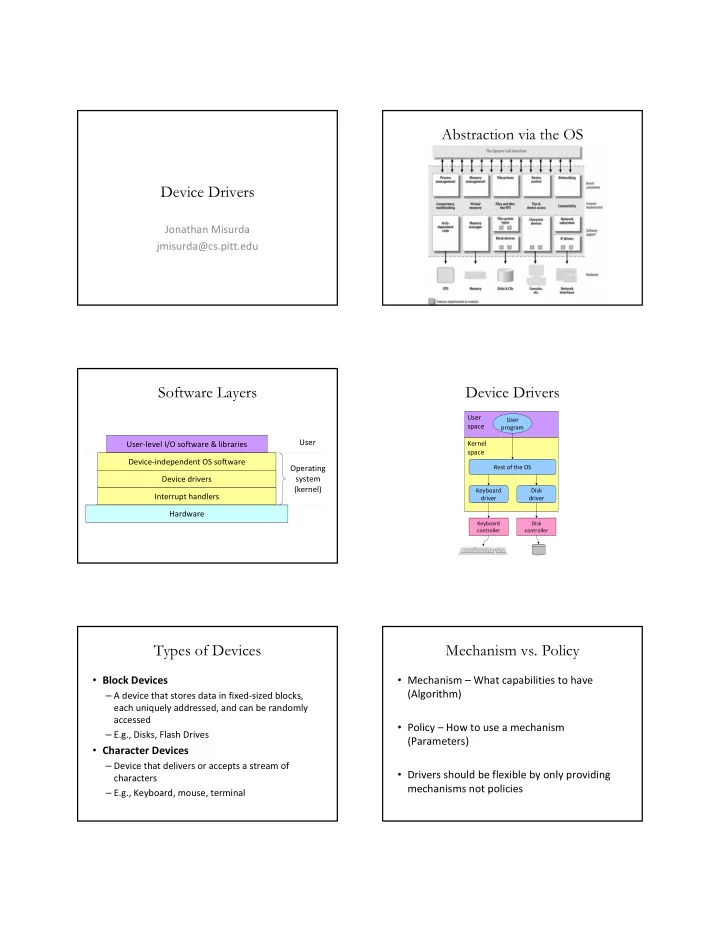
Abstraction via the OS Device Drivers Jonathan Misurda jmisurda@cs.pitt.edu Software Layers Device Drivers User User space program User User level I/O software & libraries Kernel space Device independent OS software Operating


slide-1
SLIDE 1

Device Drivers

Jonathan Misurda jmisurda@cs.pitt.edu

Abstraction via the OS Software Layers

User‐level I/O software & libraries Device‐independent OS software Device drivers Interrupt handlers Hardware Operating system (kernel) User

Device Drivers

User space Kernel space

User program Keyboard driver Disk driver Rest of the OS

Keyboard controller Disk controller

Types of Devices

  • Block Devices

– A device that stores data in fixed‐sized blocks, each uniquely addressed, and can be randomly accessed – E.g., Disks, Flash Drives

  • Character Devices

– Device that delivers or accepts a stream of characters – E.g., Keyboard, mouse, terminal

Mechanism vs. Policy

  • Mechanism – What capabilities to have

(Algorithm)

  • Policy – How to use a mechanism

(Parameters)

  • Drivers should be flexible by only providing

mechanisms not policies

slide-2
SLIDE 2

Device Drivers in Linux

  • Can be compiled into the kernel
  • Can be loaded dynamically as Modules

/dev

  • Character and block devices can be exposed

via a filesystem

  • /dev/ typically contains “files” that represent

the different devices on a system

  • /dev/console – the console
  • /dev/fd/ ‐ a process’s open file descriptors

/proc

  • Virtual filesystem with information about the

system and running programs

  • /proc/cpuinfo – text “file” containing CPU

information

Sysfs

  • Exports information about devices and drivers

to userspace,

  • Can configure aspects of device
  • /sys/

Hello World Module

#include <linux/init.h> #include <linux/module.h> MODULE_LICENSE("Dual BSD/GPL"); static int hello_init(void) { printk(KERN_ALERT "Hello, world\n"); return 0; } static void hello_exit(void) { printk(KERN_ALERT "Goodbye, cruel world\n"); } module_init(hello_init); module_exit(hello_exit);

Build and Run

% make make[1]: Entering directory `/usr/src/linux‐2.6.10' CC [M] /home/ldd3/src/misc‐modules/hello.o Building modules, stage 2. MODPOST CC /home/ldd3/src/misc‐modules/hello.mod.o LD [M] /home/ldd3/src/misc‐modules/hello.ko make[1]: Leaving directory `/usr/src/linux‐2.6.10' % su root# insmod ./hello.ko Hello, world root# rmmod hello Goodbye cruel world root#

slide-3
SLIDE 3

Module Helper Programs

  • insmod – loads a module
  • rmmod – unloads a module
  • lsmod – lists what modules are loaded
  • modprobe – loads a module checking

dependencies

Why printk?

  • The kernel does not have access to libraries
  • Can’t use printf or many other standard

functions (FILE stuff, strtok, etc.)

  • Modules are linked against the kernel only
  • Kernel provides useful set of common

functions like strcpy, strcat, etc.

MODULE_LICENSE

  • Informs the kernel what license the module

source code is under

  • Affects which symbols (functions, variables,

etc.) it may access in the kernel

  • A GPL‐licensed module can access everything
  • Certain (or not specifying one) module license

will “taint” the kernel

Loading a Module Things you can’t do in the kernel

  • Stack allocate big arrays

– The stack is small, maybe only a single page (4KB) – Use kmalloc to allocate heap space

  • Floating point arithmetic

– Context switch into the kernel does not save floating point registers

Error Handling

int __init my_init_function(void) { int err; /* registration takes a pointer and a name */ err = register_this(ptr1, “driver”); if (err) goto fail_this; err = register_that(ptr2, “driver”); if (err) goto fail_that; err = register_those(ptr3, “driver”); if (err) goto fail_those; return 0; /* success */ fail_those: unregister_that(ptr2, “driver”); fail_that: unregister_this(ptr1, “driver”); fail_this: return err; /* propagate the error */ }

slide-4
SLIDE 4

Driver Stacking Race Conditions

  • The kernel will make calls into your module

while your initialization function is still running

Module Parameters

insmod hellop howmany=10 whom=“Mom” static char *whom = "world"; static int howmany = 1; module_param(howmany, int, S_IRUGO); module_param(whom, charp, S_IRUGO);

Parameter Types

  • bool, invbool (int)
  • charp
  • int, long, short
  • uint, ulong, ushort
  • Array parameters, where the values are

supplied as a comma‐separated list:

– module_param_array(name,type,num,perm);

Permissions

  • Module parameters show up as files in the

sysfs entry

– If perm is set to 0, there is no sysfs entry at all

  • S_IRUGO – Read Only
  • S_IRUGO|S_IWUSR – Writeable by root

Makefile

  • bj‐m := hello_dev.o

KDIR := /u/SysLab/shared/linux‐2.6.23.1 PWD := $(shell pwd) default: $(MAKE) ‐C $(KDIR) M=$(PWD) modules

slide-5
SLIDE 5

User Space Drivers

  • FUSE – Filesystem in User Space
  • Newest Kernels support other user space

drivers

  • Advantages?