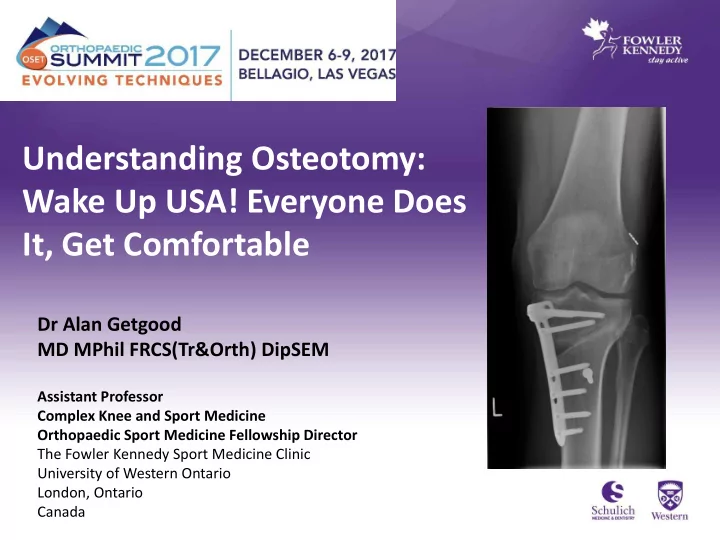
Understanding Osteotomy: Wake Up USA! Everyone Does It, Get - - PowerPoint PPT Presentation

understanding osteotomy wake up usa everyone does it get
SMART_READER_LITE
LIVE PREVIEW

Understanding Osteotomy: Wake Up USA! Everyone Does It, Get - - PowerPoint PPT Presentation

Understanding Osteotomy: Wake Up USA! Everyone Does It, Get Comfortable Dr Alan Getgood MD MPhil FRCS(Tr&Orth) DipSEM Assistant Professor Complex Knee and Sport Medicine Orthopaedic Sport Medicine Fellowship Director The Fowler Kennedy


slide-1
SLIDE 1

Dr Alan Getgood MD MPhil FRCS(Tr&Orth) DipSEM

Assistant Professor Complex Knee and Sport Medicine Orthopaedic Sport Medicine Fellowship Director The Fowler Kennedy Sport Medicine Clinic University of Western Ontario London, Ontario Canada

Understanding Osteotomy: Wake Up USA! Everyone Does It, Get Comfortable

slide-2
SLIDE 2
  • Research Support

– Canadian Foundation for Innovation – ISAKOS/OREF – Musculoskeletal Transplant Foundation – Canadian Institute for Health Research – Arthritis Society – Ontario Research Fund – Smith & Nephew Inc. – Arthrex Inc. – Conmed Inc. – Depuy Synthes Inc. – Eupraxia Inc. – SBM Inc.

  • Editorial Board

– AJSM Social Media

  • Consultant

– Smith & Nephew Inc. – Conmed Inc. – Depuy Synthes Inc. – Ferring Inc. – Ossur Inc.

Disclosures

slide-3
SLIDE 3

Bare Bone Facts

  • By 2030, the demand for TJA by patients <65y is projected to

be 52% of primary THAs and 55-62% of primary or revision TKAs

  • The future demand was projected to grow the fastest for the

45-54y age category for primary TKA, which was anticipated to grow from 59,077 in 2006 to 994,104 (17 times) by 2030.

Younger Patient Demand for Primary and Revision Joint Replacement: National Projections from 2010 to 2030 The Journal of Arthroplasty, Volume 24, Issue 2, Pages e34-e34

  • S. Kurtz, E. Lau, K. Ong, K. Zhao, M. Kelly, K. Bozic
slide-4
SLIDE 4

Knee Preservation Timeline… Osteotomy/ Joint Preservation Osteotomy UKA TKA

<55 yrs old 55 yrs old >75 yrs old Young, active Demanding Jobs Sport Active, Retired, manual work Sedentary

slide-5
SLIDE 5

Treatment Strategy: Aim to stay in the green zone:

Romain Seil 2015

slide-6
SLIDE 6

HTO vs. UKA

slide-7
SLIDE 7
  • Would you rather

revise an HTO or a UKA?

HTO vs. UKA

slide-8
SLIDE 8

Swedish Registry LHSC Data

Why not UKA?

92.9% TKA 80.6% UKA

Kaplan-Meier Survival (All Revisions for Surgeries 10 years or Greater from the time of surgery) Cumulative Survival Survival Time (Years)

slide-9
SLIDE 9

years since primary procedure Cumulative Percent revised

Log-rank test for equality over strata p-value < 0.001 Hazard Ratio (adjusted for age and sex; Unicompartmental for OA V Total Knee for OA = 2.02; 95% CI (1.90,2.14) p-value < 0.001

n= 45,615 n= 494,571

21.0% 7.3%

UKA TKA

15 yrs

Australian Registry: % Revised

  • % UKA in Australia

– 15.1% in 2003 – 9.7% in 2007 – 5.7% in 2012 – 4.8% in 2015

slide-10
SLIDE 10

32.5% (15.7) 24.6% (9.9) 16.8% (6.5) ? (3.2)

Australian Registry: Age

  • < 55 yo – 32.5% rev rate

at 15 yrs

  • > 75 yo – 9.3%

rev rate at 13 yrs,

slide-11
SLIDE 11

TKA (12,298) & UKA (7,860)

Swedish Registry

Satisfied Dissatisfied Very Satisfied Uncertain

Distribution of Satisfaction (%)

(12,298) (7,860)

Robertsson et al, Acta Orthop Scand, 2000

IDENTICAL

Higher Revision rate for UKA is offset by greater patient satisfaction?

NO!

slide-12
SLIDE 12

What are we trying to achieve?

1. Coronal plane correction

– To reduce the external knee adduction moment (varus knee) or abduction moment (valgus knee)

2. Sagittal plane correction

– Alter tibial slope to reduce tibial translation and achieve sagittal balance

slide-13
SLIDE 13

Re-alignment Osteotomy

slide-14
SLIDE 14

Does it work?

Reduction in knee adduction moment (KAM) in the varus knee correlates with KOOS MCID

slide-15
SLIDE 15

What happens to Articular Cartilage after HTO?

Improvement in quality and volume of repair tissue

slide-16
SLIDE 16

Evidence - HTO

70% 10 yr survivorship

slide-17
SLIDE 17

Evidence – Varus osteotomy

slide-18
SLIDE 18

HTO + cartilage repair

slide-19
SLIDE 19

Coronal Alignment - Effect on Collaterals and Cruciates

slide-20
SLIDE 20

What are we trying to achieve?

1. Coronal plane correction

– To reduce the external knee adduction moment (varus knee) or abduction moment (valgus knee)

2. Sagittal plane correction

– Alter tibial slope to reduce tibial translation and achieve sagittal balance

slide-21
SLIDE 21
  • Sagittal plane correction
  • Reduce shear strain on ACL or

PCL by reducing or increasing the posterior tibial slope respectively

  • Alters tibiofemoral contact

pressure

  • 1mm of correction = 1o
  • f slope change

Biplanar Osteotomy (correction)

slide-22
SLIDE 22
  • Coronal alignment

– Unicompartmental OA – Joint restoration – Ligament instability

  • Sagittal alignment

– Tibial slope – Posterior/anterior wear – ACL/PCL Indications for Realignment Osteotomy

slide-23
SLIDE 23

Joint Restoration Philosophy

Biomechanics

  • Realignment Osteotomy
  • Ligament Reconstruction
  • Meniscus Allograft

Transplantation

Biology

  • Articular

Cartilage Repair

  • Adjuvant

Therapies

slide-24
SLIDE 24
  • Fluoroscopy from ipsilateral

side

  • Stand on contralateral side
  • MOWHTO

– Distal MCL release – Posterior Retractor – Biplane Osteotomy

  • Increased surface area
  • Greater rotational control
  • Slope

– Maintain: Y1 = Y2 x2 – Increase: Y1 = Y2 – Decrease: Y1 < Y2 – You have to destabilize the lateral hinge

Surgical Pearls for Osteotomy

slide-25
SLIDE 25
  • Fluoroscopy from ipsilateral

side

  • Stand on contralateral side
  • MOWHTO

– Distal MCL release – Posterior Retractor – Biplane Osteotomy

  • Increased surface area
  • Greater rotational control
  • Slope

– Maintain: Y1 = Y2 x2 – Increase: Y1 = Y2 – Decrease: Y1 < Y2 – You have to destabilize the lateral hinge

Surgical Pearls for Osteotomy

slide-26
SLIDE 26

Surgical Technique

slide-27
SLIDE 27

Summary

  • Osteoarthritis on the rise – will effect more younger

individuals

  • We are aware of the treatment gap for OA….
  • Osteotomy a key component to address that gap
  • Aim to keep young patients in the green/preservation

zone

  • Indications remain consistent – education is the key….
slide-28
SLIDE 28

Thank you!

‘Fake Knees are NOT the answer…..’