Presentation Overview My Academic Journey Focusing on whats right - - - PDF document

presentation overview
SMART_READER_LITE
LIVE PREVIEW

Presentation Overview My Academic Journey Focusing on whats right - - - PDF document

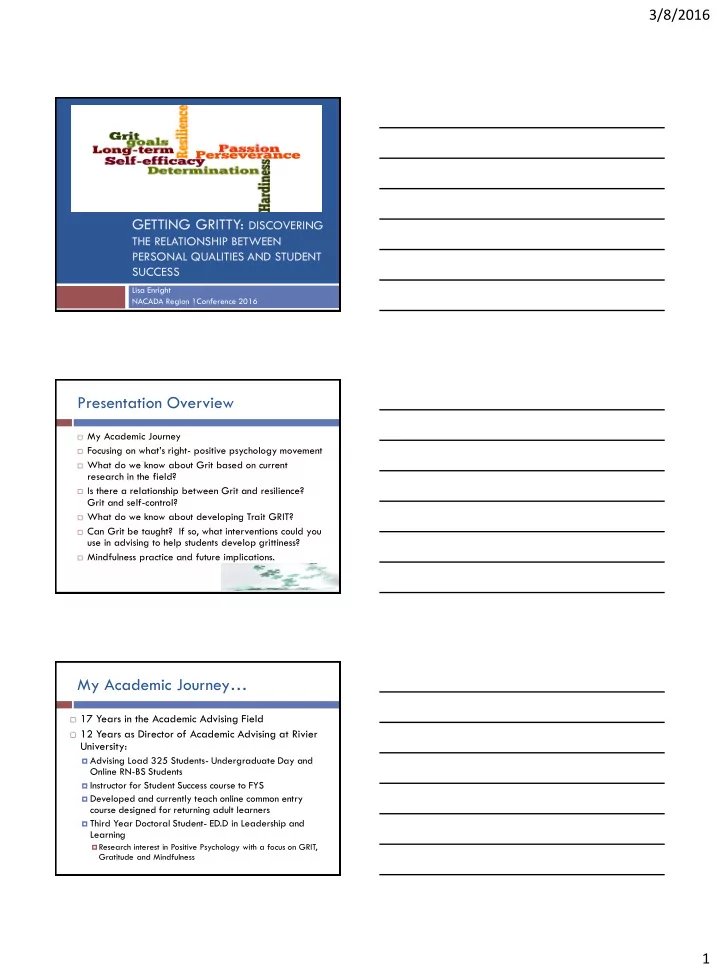
3/8/2016 GETTING GRITTY: DISCOVERING THE RELATIONSHIP BETWEEN PERSONAL QUALITIES AND STUDENT SUCCESS Lisa Enright NACADA Region 1Conference 2016 Presentation Overview My Academic Journey Focusing on whats right - positive psychology


slide-1
SLIDE 1

3/8/2016 1 GETTING GRITTY: DISCOVERING

THE RELATIONSHIP BETWEEN PERSONAL QUALITIES AND STUDENT SUCCESS

Lisa Enright NACADA Region 1Conference 2016

Presentation Overview

 My Academic Journey  Focusing on what’s right- positive psychology movement  What do we know about Grit based on current

research in the field?

 Is there a relationship between Grit and resilience?

Grit and self-control?

 What do we know about developing Trait GRIT?  Can Grit be taught? If so, what interventions could you

use in advising to help students develop grittiness?

 Mindfulness practice and future implications.

My Academic Journey…

 17 Years in the Academic Advising Field  12 Years as Director of Academic Advising at Rivier

University:

 Advising Load 325 Students- Undergraduate Day and

Online RN-BS Students

 Instructor for Student Success course to FYS  Developed and currently teach online common entry

course designed for returning adult learners

 Third Year Doctoral Student- ED.D in Leadership and

Learning

Research interest in Positive Psychology with a focus on GRIT,

Gratitude and Mindfulness

slide-2
SLIDE 2

3/8/2016 2

Looking on the Bright Side

“Human beings can alter their

lives by altering their attitudes

  • f mind.”
  • William James (1842-1910)

2000- Dr. Marin Seligman, newly elected president of the American Psychological Association introduced the Positive Psychology Movement

 Identifies attributes and innate

qualities within a person that contribute to the positive functioning

  • f individuals who experience well-

being, hope, optimism and happiness

How do you define Character?

http://npr.tumblr.com/post/120372152195/more-and-more-people-in-education-agree-on-the Illustration credit: LA Johnson/NPR (May 28, 2015)

Why Study Grit?

 Grit predicts achievement in really challenging and

personally meaningful contexts (Duckworth, 2016).

 According to Grit research*, participants who had high

Grit scores were more likely to:

 Achieve higher GPA’s  Be more optimistic and happier  Progress farther in their formal education  Value excellence in the pursuit of their goals vs. perfection  Tend to make fewer career changes, have higher job

satisfaction and long-lasting relationships

*see handouts for a list of empirical research

slide-3
SLIDE 3

3/8/2016 3

Visualizing Grit

Will Smith Video

What is Grit?

  • Dr. Angela Duckworth coined the term grit

in 2007 Grit can be defined as perseverance and passion for long-term goals.

 “The gritty individual approaches achievement as a

marathon; his or her advantage is stamina” (Duckworth, Peterson, Matthews & Kelly, 2007).

 Duckworth created the 8 and 12-point Grit Scales to

help researchers identify the personal qualities that make a person “gritty”- How gritty are you? Find out right now!

Grit Scale Online Link

http://angeladuckworth.com/grit-scale/

  • OR-

Google- Take the Grit Test - Penn Qualtrics account

slide-4
SLIDE 4

3/8/2016 4

Interpreting Your Grit Results

 Half of the questions are devoted to resilience to

situations of failure and adversity or work ethic

 Other half of the questions are about having consistent

interests- passions over a long period of time. Do you stick with an idea or life goal?

 Interpret Grit results with caution, as they are self-

reporting! Individuals hold different standards for themselves.

 Duckworth and other researchers are now exploring

  • ther methods of data collection to measure Grit such

as a 7-point rubric to rate grit using biographical data.

 Can use the Grit scale with students as a reflection or

conversation prompt!

Grit Research in Higher Education What’s In The News About Grit?

New York Times: “Who Gets to Graduate?” Tough, P. (2014) New York Times: “Testing for Joy and Grit?”- Zernike, K. (2016) These articles are in your presentation packets

slide-5
SLIDE 5

3/8/2016 5 How Does Resilience Connect to Grit?

 Characteristic and personality trait used to measure

adaptability, buoyancy, and optimism.

 Psychological construct that requires two specific

elements:

 Has to be a significant threat, risk or disruption to the

individual’s development

 The quality of adaptation or development outcome is

defined as positive or good-optimistic (Masten, 2001).

 Gritty people tend to be resilient, but resilience is only

  • ne trait of Grit. Resilient people are not necessarily

gritty!

Relationship Between Self-Control and Grit

 Self-control (the regulation of impulses) is more

relevant in everyday situations where temptation and distractions are present, whereas Grit is more relevant in challenging situations (Winkler, Gross, & Duckworth, 2016).

 Two routes of self-control: Cognitive strategies that

depend on executive function, willpower, and the like; and emotional strategies that rely on the cultivation of ideas (Desteno, 2014).

Psychological Assets of GRIT Identified by Duckworth

Grit

Interest Practice Purpose Hope Intrinsic Values, SMART Goals Superordinate Goals, Meaning, Mindfulness Deliberate practice, self- control, formation of good habits Resilience, Growth Mindset, Engagement (mentors, educational

  • pportunities)

Adapted from: http://angeladuckworth.com/qa/

slide-6
SLIDE 6

3/8/2016 6

How can you teach Grit?

Future Implications and ideas on how to develop core principles of Grit

 Power of “Not Yet”  Situational Self-Control interventions  Formulation of Long Term Goals and

Personal Strength Identification

 Adaptive healthy habits (Habit

formation—time it takes to develop a habit)

 Student must know what they value and

why!

 Mindfulness Holds the Key!  Meditation, reflection and gratitude- “Your

intentions become your reality!”

Growth Mindset Interventions

 The Power of “Not

Yet”-Carol Dweck

 Role Playing- “What

If” scenarios. Share examples

 Emphasize Plasticity

  • f the Brain! Grow

new neurological pathways when you challenge yourself.

 Devise a Plan for

Success- SMART Goals

https://pbs.twimg.com/media/B0iqO9-CIAEHkG4.jpg:large

Self Control Interventions

 Manage your time- create and keep a daily schedule  Situational Control (Should vs. Want)  The “Educable Brain” (Mischel, 2015)  Creating Good Habits

slide-7
SLIDE 7

3/8/2016 7

Personal Strength Interventions

VIA Character Strengths Finder

Mindfulness Core Principles of Mindfulness

1.

Clarifying, Setting, and Reaffirming Intention

2.

Cultivating a Witnessing Awareness

3.

Stabilizing Attention “What is it I want to remember in this moment?”

4.

Strengthening Self-Regulation

5.

Practicing Loving-Kindness

Adapted from Terry Fralich, L.C.P.C. www.mindfulnesscenter.org

slide-8
SLIDE 8

3/8/2016 8

Mindfulness Group Activity

 Pass out “Growing Mindful” cards-one card to each

3 or 4 person group

 Read your mindfulness card and discuss how you

can use this mindfulness mini-exercise when advising students? What student population would this technique work best in and why?

Parting Thoughts, Packet Overview and Questions…

 I.Q. is not a valid predictor of future academic

success- personal qualities and traits such as Grit, Growth Mindset, Self-Control and mindfulness have proven to be stronger indicators of future academic success and overall personal life satisfaction.

 Practicing mindfulness may hold the key to learning

self-control, staying true to your passion and long- term goals (Grit) and a growth mindset

 Packet articles and resources.  Questions?

References

Desteno, D. (2014, September 15). A feeling of control: How America can finally learn to deal with its

  • impulses. Pacific Standard.

Duckworth, A.L., Peterson, C., Matthews, M.D., & Kelly, D.R. (2007). Grit: Perseverance and Passion for Long-term goals. Journal of Personality and Social Psychology, 92(6),1087-1101. Fralich, T. (2016). Advanced mindfulness techniques that change the brain (pp.12). Eau Claire, WI: PESI Eskreis-Winkler, L., Gross, J. J., & Duckworth, A. L., (in press). Grit: Sustained self-regulation in the service of superordinate goals. In K. D. Vohs and R. F. Baumeister (Eds.), Handbook of self-regulation: Research, theory and applications. New York, NY: Guilford. Masten, A.S. (2001). Ordinary Magic: Resilience processes in development. American Psychologist, 56, 227-238. Mischel, W. (2015). How mind and brain enable self-control: Marshmallows and beyond. Columbia Unversity, Self-Control Conference, MIT-Harvard, MA. Lecture William James. (n.d.). BrainyQuote.com. Retrieved March 7, 2016, from BrainyQuote.com Web site: http://www.brainyquote.com/quotes/quotes/w/williamjam163783.html