Presentation on School Re-Entry and Related Issues to Indian Affairs - - PDF document

presentation on school re entry and related issues to
SMART_READER_LITE
LIVE PREVIEW

Presentation on School Re-Entry and Related Issues to Indian Affairs - - PDF document

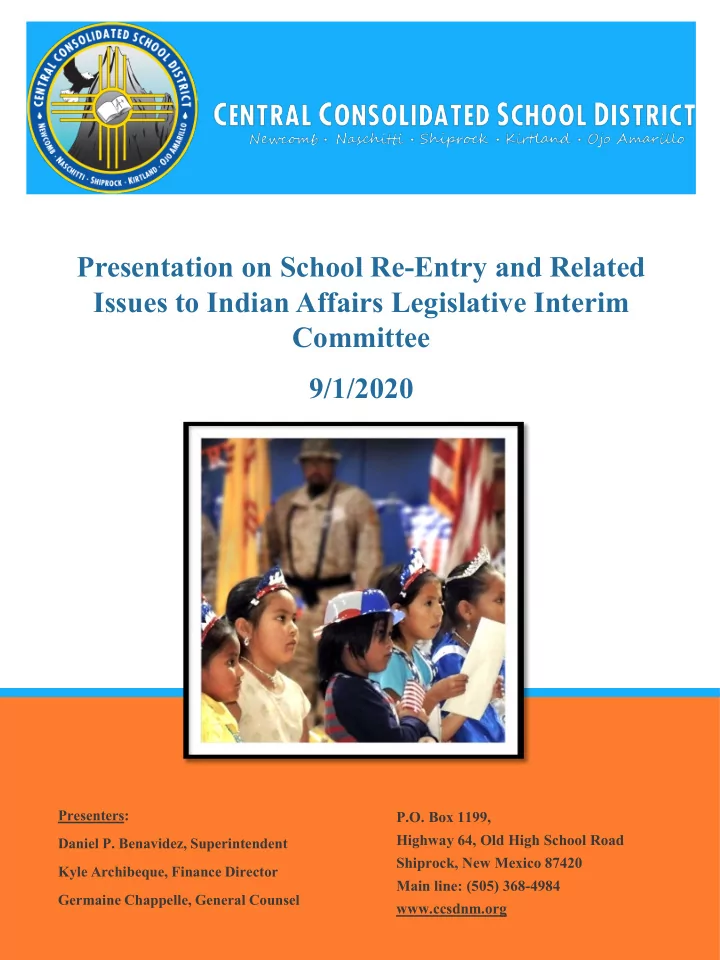
Presentation on School Re-Entry and Related Issues to Indian Affairs Legislative Interim Committee 9/1/2020 Presenters: P.O. Box 1199, Highway 64, Old High School Road Daniel P. Benavidez, Superintendent Shiprock, New Mexico 87420 Kyle


slide-1
SLIDE 1

Presenters: Daniel P. Benavidez, Superintendent Kyle Archibeque, Finance Director Germaine Chappelle, General Counsel

Presentation on School Re-Entry and Related Issues to Indian Affairs Legislative Interim Committee 9/1/2020

P.O. Box 1199, Highway 64, Old High School Road Shiprock, New Mexico 87420 Main line: (505) 368-4984 www.ccsdnm.org

slide-2
SLIDE 2
  • I. CCSD DEMOGRAPHICS

2

  • Rural and Remote
  • long travel time to bus stop

and then long bus ride to school

  • Spotty, if any, access to

internet

  • 30 to 40 % of families do not

have electricity, potable water, indoor plumbing

  • Poverty rate is almost 4 times the

national mean

  • lowest median family income
  • f $14,000
  • lowest per capita income of

$4,788

  • More than 75% of Navajo

School Age Children live in poverty

  • Unemployment 70%
  • Free and reduced meals
  • No municipal amenities
  • Unless provided by the School

District there are little to no municipal amenities (i.e., no public libraries, no municipal swimming pools, no rec centers, no parks)

  • Less than 2% taxable property

|

  • 80% of the District’s tax

revenues come from the San Juan Generating Station and Mine and the Four Corners Power Plant

COVID PANDEMIC:

  • Spotlight on poverty and lack
  • f access to technology and

infrastructure and daily meals

  • Heightened social emotional

needs of students

  • Increased Child Homelessness
  • Exponential increase in

Learning Gaps

slide-3
SLIDE 3

Turning Challenges into Opportunities

3

Challenges:

  • COVID Pandemic
  • Identified Learning Gaps:
  • Historic/Current re

Impact Aid

  • Yazzie-Martinez
  • Remote/Rural
  • Poverty
  • COVID
  • Historic Underfunding of

Capital and Maintenance/ technology infrastructure

  • Shorting of operational

budget for below standard facility needs

  • Poverty and Social

Emotional Trauma

  • Plant Closures

Opportunities:

  • COVID Re-Entry and

Technology Infrastructure Expansion

  • Focus in all Departments on

Bridging the Gap

  • Creation of InterCultural

Community Outreach Department

  • Graduate Profile
  • Stronger Community Ties

and Participation in Economic Development:

  • National
  • Statewide
  • Regional Four Corners
  • Navajo Government-to-

Government

slide-4
SLIDE 4

COVID RE-ENTRY

4

NM PED Reentry Guidelines NM Category: REMOTE Substantial Spread NM Category: Hybrid Minimal/Moderate Spread NM Category: Full Reentry Low/No Spread · Prioritize the health and safety of our students, staff, and communities · Students engage in remote learning. · The number that can be accommodated while adhering to at least six feet of social distancing

  • r 50% capacity level

caps the number of students in the building at any time. · All students eligible to return. · Maximize the amount of safe, in-person learning

  • pportunities

· Limited Small groups (special education, some K-3 students) eligible for in- person instruction if feasible. · Students not in the building engage in remote learning. · Make decisions based

  • n science and

data

Discussion of CCSD Considerations and Approach

slide-5
SLIDE 5

5

Area Challenges – Industrial Complex Closures

Closure 2020 Closure 2025

slide-6
SLIDE 6

6

Turning the Tide of Disaster – Economic Death Spiral “To understand why Mayor Nate Duckett wants Farmington, N.M., to reopen while the governor wants it shut, it helps to know something about what he calls his city’s “death spiral.” Perched in a rural corner of northwest New Mexico, Farmington watched its wealth vanish as its oil and gas industries went

  • elsewhere. Its population is one of the fastest-

shrinking in America. What keeps the lights on in Farmington is a coal-fired power plant whose fate remains uncertain. And all of that was before the virus leveled what remained of Farmington’s economy.” https://www.nytimes.com/2020/05/12/us/politi cs/farmington-nm-jobs-coronavirus- reopening.html Even harder hit by the economic downturn and potential multiple closings of area mining and electric generation facilities is the Navajo Nation located to the West of Farmington. Particularly in the most remote rural areas of the Navajo Nation, more than 1/3 of the residents do not have access to running water, indoor plumbing, electricity or the internet.

A water tank in the backyard of an elderly Navajo woman whose home lacks running water. https://www.cbsnews.com/news/coronavirus-navajo-nation- running-water-cbsn-originals/?ftag=CNM-00-10aag7e

An extreme challenge for residents of the Navajo Nation is access to jobs. Unfortunately, the jobs that do exist at area mines and power plants are set to close within the next 1 to 10 years. These jobs have enabled several Navajo generations to enter the middle class with jobs that pay upwards of $80,000 per year. Typically, these wages do not just support the immediate family of a worker, they support that worker’s extended family as well. [insert 4CED report] The poverty rate among the Navajo is three and a half times the national mean. The lowest median family income, $13,940. The Navajo also had the lowest per capita income, $4,788. More than 75% of Navajo school age children live in poverty. 100% of Navajo seniors over age 85 live in poverty. Unemployment in Navajo Nation is nearly triple the U.S. average In an area that has exponentially higher poverty and unemployment rates than the rest of the country, it isn’t hard to predict that the disproportionate impact of 6 industrial complex closures, leaving thousands of Navajo workers unemployed, will be disastrous for Navajo Nation residents.

slide-7
SLIDE 7

7

Educational opportunities for children attending the Central Consolidated School System (CCSD) and other schools located in the region have also been undermined due to the economic downturn. CCSD, for example, is located primarily within the boundaries of the Navajo Nation. Together with Four Corners Mine and Power Plant, the San Juan Generating Station and the Mine represent over 80% of the property tax revenues that CCSD receives to help fund the educational needs of its students. Additional economic development provides additional learning opportunities and career pathways for our children so when they grow up they can raise their families with family right here at home. Given the remoteness and lack of basic needs experienced by many of these children in their homes, their educational opportunities have been severely limited, which has dire conditions, have only been exacerbated during COVID-19 as they do not have access to long distance learning. Due to lack of access to running water, living conditions, and underlying health concerns attributable in large part to poverty, Navajo and

  • ther Native Americans have one of the

highest COVID-19 infection rates per capita in the U.S. Making matters even more grave, as a result of job loss of their caregivers, the homeless and poverty rates of children are likely to become even worse. CCSD’s focus is on bridging these gaps so that

  • ur children can have a bright future.

.