Presentation of the Financial Affairs Committee (FAC) to the Faculty - - PowerPoint PPT Presentation

presentation of the financial affairs committee fac to
SMART_READER_LITE
LIVE PREVIEW

Presentation of the Financial Affairs Committee (FAC) to the Faculty - - PowerPoint PPT Presentation

Presentation of the Financial Affairs Committee (FAC) to the Faculty Senate (April 20, 2016) George G. Adams, Chair Kathleen C. Kelly Professor of MIE Professor of English Helen H. Suh Harlan D. Platt Hameed Metghalchi Professor of


slide-1
SLIDE 1

Presentation of the Financial Affairs Committee (FAC) to the Faculty Senate (April 20, 2016)

1
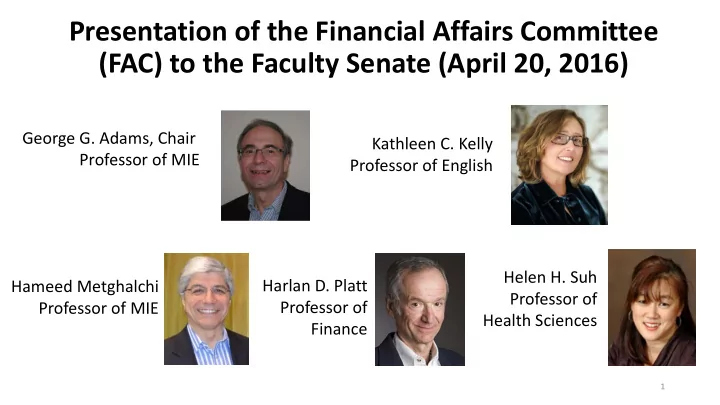
George G. Adams, Chair Professor of MIE Kathleen C. Kelly Professor of English Harlan D. Platt Professor of Finance Helen H. Suh Professor of Health Sciences Hameed Metghalchi Professor of MIE

slide-2
SLIDE 2

Unfinished Business Related to Charge #1:

Suggestions to SAC for Next Year’s FAC

  • Analyze NU data which includes non-tenure-track faculty.
  • Possibly request that AAUP collect data on TTT faculty separately

from non-tenure track.

  • Determine an appropriate metric for differential cost-of-living.
  • Evaluate the appropriateness of our current match-mates.
  • Obtain data on median as well as mean salaries from our match-mates.

2

Based on current information and any other analyses that it may wish to undertake, the Committee is asked to make recommendations on appropriate merit and market adjustment increases for FY 2017.

slide-3
SLIDE 3

Charges #2 and #3

  • The Committee shall review the existing benefit and compensation

structure, analyze any changes proposed by the administration, including cost-sharing practices for medical, dental and life insurance, and propose possible changes, and determine the impact of proposed changes on faculty and staff; and

  • The Committee shall investigate the possibility of changing the default

for pension plans and subsidizing T-Passes.

3

slide-4
SLIDE 4

Response to Charges #2 and #3

  • We met with Kater Pendergast (Vice-President of Human Resources

Management) and Tom Nedell (Senior Vice President for Finance and Treasurer) to discuss fringe benefits and related financial issues. Benefits Summary

  • Health Insurance: the university pays 70% of the core plan regardless
  • f health plan is chosen (~65% of enhanced plan, ~79% of HD plan).
  • We investigated 5 other Boston-area universities (BC, BU, Brandeis,

Harvard, Tufts).

  • Other universities pay between ~60%-80% of a core plan.
  • Detailed comparisons are difficult to make. Deductibles and benefits
  • differ. NU has 3 plans, Harvard has 8 plans. Tufts and BU have family

plans and two-person plans in addition to individual plans.

4

slide-5
SLIDE 5

Benefits

  • Retirement Plans (TIAA/CREF & Fidelity) NU: 10%, Individual: >5%
  • Life Insurance (100% paid by NU, Tax on imputed value).
  • Tuition Benefit is 100% for NU (admission to NU becoming harder).
  • Long-Term Care Insurance (group plans no longer available).
  • Detailed information on benefits is available on the HRM website

(www.northeastern.edu/hrm/benefits/)

  • Information on benefits is also available on the “policies” website

(www.neu.edu/policies). It should be linked with HRM to ensure consistency.

5

slide-6
SLIDE 6

Resolution #1

BE IT RESOLVED that Human Resources Management (hereafter HRM) periodically review Northeastern University’s employee benefits in comparison to other Boston area universities and report its findings to the Faculty Senate. As part of this process HRM is requested to explore the creation of a two-person health insurance plan to supplement its individual and family plans, investigate the possibility of giving cash incentives to employees who opt-out of the group plan in order to join other plans (e.g. Medicare, spousal plans, etc.), and explore the possibility of including medical care benefits at in-network rates to full time faculty traveling away from Northeastern University and to dependent children while away at

  • college. It is recommended that HRM report to the senate in January 2017

and every four years thereafter.

6

slide-7
SLIDE 7

Resolution #2

BE IT RESOLVED that HRM along with the Russell J. Call Children’s Center explore the feasibility of including infant care. The costs and extra space required as well as the need and other implications should be determined. Alternatives such as cooperative arrangements with

  • ther day-care centers should also be explored.

7

  • Children’s Center provides high quality daycare at a reasonable cost.
  • Minimum age is 2 years and 9 months.
  • Emergency backup care for children and adults has recently been

made available at very favorable rates through care.com.

slide-8
SLIDE 8

8

Resolution #3

BE IT RESOLVED that HRM explore the impact of subsidizing T-passes in

  • rder to encourage the use of public transportation and thereby reduce

Northeastern’s carbon footprint.

  • Subsidy of T-passes would encourage more Northeastern employees to

take public transportation.

  • T-passes can currently be purchased pre-tax (up to $250 per month).
  • Tax break is of disproportionately less benefit to lower paid personnel.
slide-9
SLIDE 9

Charge #4

The Committee is asked to make recommendations on University resource allocation and budget priorities.

9

  • This charge is central to the concept of shared governance.
  • How are resources allocated now?
  • There is a lack of available information needed to address this charge.
  • The following two resolutions are intended to address this issue so as

to enable FAC to satisfy its obligations as well as to bring increased financial transparency to the university community.

slide-10
SLIDE 10

Resolution #4

BE IT RESOLVED that the university provide transparency in the

  • peration of its Hybrid/RCM budget model with respect to its Cost
  • Centers. In particular, the Allocated Costs of each of the Cost Centers

and the total of all Allocated Costs for each of the last three fiscal years should be reported annually to the Faculty Senate and made available to the University’s constituents.

10

slide-11
SLIDE 11

Resolution #5

BE IT RESOLVED that the University provide transparency in the

  • peration of its Hybrid/RCM budget model with respect to its

Responsibility Centers. For each Responsibility Center, the data requested for the last fiscal year should include the total revenue (with a break-down among undergraduate and graduate tuition, externally funded research, giving, and other revenues), the total direct expenses, and the total amount of allocated costs paid to the university. This information should be reported annually to the Faculty Senate and made available to the University’s constituents.

11

slide-12
SLIDE 12

Financial Transparency

  • Shared governance is at the heart of a university.
  • Faculty are not simply employees.
  • The term “managerial employees” is often used to classify faculty.
  • We have control over some items (e.g. curriculum matters) and make

recommendations on other matters (e.g. financial).

  • Providing recommendations requires information.
  • More information encourages more responsibility.

12

slide-13
SLIDE 13

Why Hybrid Budget Management Now at Northeastern? (https://hybrid.neu.edu)

13

slide-14
SLIDE 14

Specifically, NU’s budget system needs to:

  • couple academic authority with financial responsibility;
  • be compatible with shared governance;
  • build in accountability at all levels;
  • offer budget transparency;

The statement on budget transparency is characteristic of virtually all RCM budget models.

14

(https://hybrid.neu.edu)