Presentation of some previous work with connections to BLLAST Erik - - PowerPoint PPT Presentation

presentation of some previous work with connections to
SMART_READER_LITE
LIVE PREVIEW

Presentation of some previous work with connections to BLLAST Erik - - PowerPoint PPT Presentation

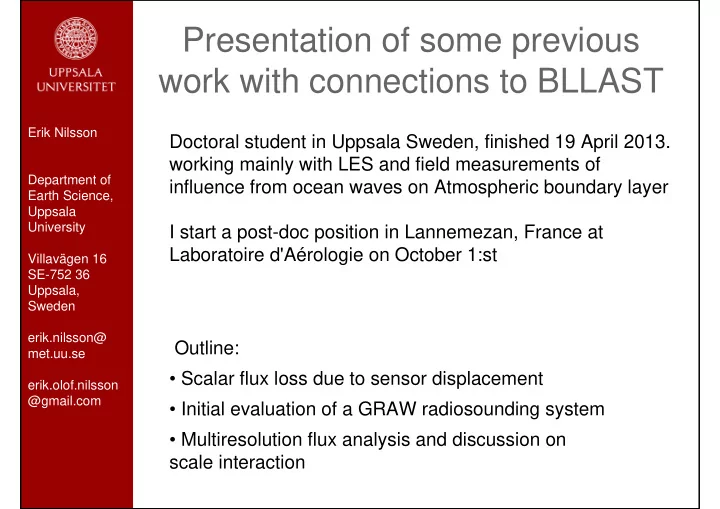
Presentation of some previous work with connections to BLLAST Erik Nilsson Doctoral student in Uppsala Sweden, finished 19 April 2013. working mainly with LES and field measurements of Department of influence from ocean waves on Atmospheric


slide-1
SLIDE 1

Presentation of some previous work with connections to BLLAST

Outline:

  • Scalar flux loss due to sensor displacement
  • Initial evaluation of a GRAW radiosounding system
  • Multiresolution flux analysis and discussion on

scale interaction

Erik Nilsson Department of Earth Science, Uppsala University Villavägen 16 SE-752 36 Uppsala, Sweden erik.nilsson@ met.uu.se erik.olof.nilsson @gmail.com

Doctoral student in Uppsala Sweden, finished 19 April 2013. working mainly with LES and field measurements of influence from ocean waves on Atmospheric boundary layer I start a post-doc position in Lannemezan, France at Laboratoire d'Aérologie on October 1:st

slide-2
SLIDE 2

c c

w F ρ′ ′ =

w is the vertical component of the wind ρc is the mass density of some scalar c sensor separation

Eddy covariance method to determine scalar fluxes

Nilsson et al. 2010

Erik Nilsson Department of Earth Science, Uppsala University Laboratoire d'Aérologie

slide-3
SLIDE 3

In the context of BLLAST: lots of very nice

measurements with different sensor configurations

  • Need for correction in stable stratification? Horst and Lenschow (2009)
  • Possibility to study reason for vertical assymetry?

Why is flux loss with scalar sensor placed below the velocity sensor less?

slide-4
SLIDE 4
  • One field week 28th June to

2nd July 2010

  • 16 radiosondes were launched

+ standard soundings at Gotland two times a day.

  • Total of 48 theodolite trackings

including double trackings

Initial evaluation of a GRAW radiosounding system

Erik Nilsson Department of Earth Science, Uppsala University Laboratoire d'Aérologie

slide-5
SLIDE 5

GRAW worked well for U and WD Bias in average rising speed for the ABL

  • f about 0.2 m/s?

Uncertainty in the comparison was large

Nilsson et al. 2013 written report

Erik Nilsson Department of Earth Science, Uppsala University Laboratoire d'Aérologie

slide-6
SLIDE 6

GRAW worked well for U and WD Bias in average rising speed for the ABL

  • f about 0.2 m/s?

Uncertainty in the comparison was large

Nilsson et al. 2013 written report

Erik Nilsson Department of Earth Science, Uppsala University Laboratoire d'Aérologie

slide-7
SLIDE 7

GRAW slightly too humid? GRAW worked well for U and WD Bias in average rising speed for the ABL

  • f about 0.2 m/s?

Uncertainty in the comparison was large From Firenze workshop courtesy of Marie Lothon

Nilsson et al. 2013 written report

Erik Nilsson Department of Earth Science, Uppsala University Laboratoire d'Aérologie

slide-8
SLIDE 8

Multiresolution analysis of eddy-fluxes

Nilsson et al. (In revision)

  • MR analysis involves

averaging data over different averaging lengths.

  • Fluctuations in horizontal

and vertical wind combine to give vertical momentum ’fluxes’

  • We assessed the amount of

variability in a timeseries of turbulent flux

  • n different scales with

respect to vertical wind and ’advected’ variable

  • Investigation of correlation

between different scales is also possible (ongoing

discussions with Larry Mahrt)

Erik Nilsson Department of Earth Science, Uppsala University Laboratoire d'Aérologie

Measurements LES

slide-9
SLIDE 9
  • Investigation of correlation

between different scales is also possible (ongoing

discussions with Larry Mahrt)

  • We are interested in the

interaction between scales

  • For instance between

submeso or meso-scale motions (large scale) and turbulence (small scale)

  • Can large-scale motions

modulate turbulence on small-scales directly? without spectral cascade?

  • Transitioning periods an

example? When we may expect several governing time-scales?

Multiresolution analysis of eddy-fluxes ”Fourier thinking” ”Non- Fourier thinking”

Erik Nilsson Department of Earth Science, Uppsala University Laboratoire d'Aérologie

slide-10
SLIDE 10

Multiresolution analysis of eddy-fluxes

Possible to investigate the correlation between horizontal wind fluctuations (ordinate axis) and vertical wind variance (abscissa) on different scales Imagine for instance that a period of increased wind speed taking place over a long time scale initiates turbulent vertical wind motions on mainly smaller scale This could then also generate increased time- averaged fluxes on this smaller scale Without going through a spectral transfer

Some work remains We are looking for nice data with scale interactions to

  • analyse. Do you have it?

erik.nilsson@met.uu.se or erik.olof.nilsson@gmail.com BLLAST Post-doc 2013-2015

Erik Nilsson Department of Earth Science, Uppsala University Laboratoire d'Aérologie

slide-11
SLIDE 11

Thank you! Questions?

Fluxes? Scales? Fourier and Multiresolution? What was he talking about?

Erik Nilsson Department of Earth Science, Uppsala University Laboratoire d'Aérologie erik.nilsson@ met.uu.se erik.olof.nilsson @gmail.com

GRAW humidity and rising speed bias?