Georges Painvin chapter, what are some conditions that seem (1886 - - PDF document

georges painvin
SMART_READER_LITE
LIVE PREVIEW

Georges Painvin chapter, what are some conditions that seem (1886 - - PDF document

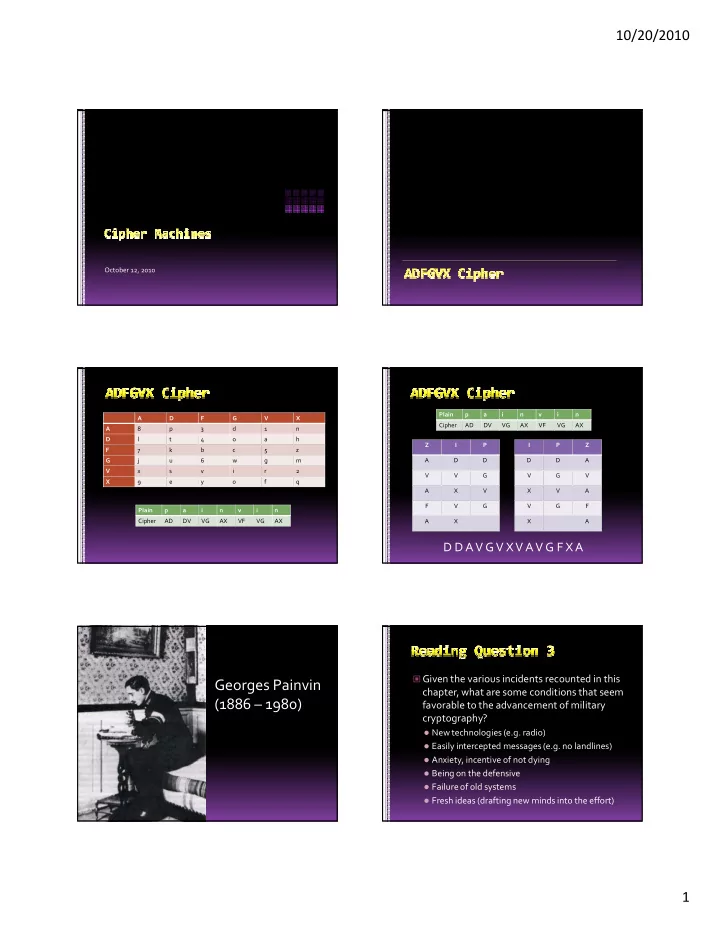
10/20/2010 October 12, 2010 Plain p a i n v i n A D F G V X Cipher AD DV VG AX VF VG AX A 8 p 3 d 1 n D l t 4 o a h Z I P I P Z F 7 k b c 5 z A D D D D A G j u 6 w g m V x s v i r


slide-1
SLIDE 1

10/20/2010 1

October 12, 2010

A D F G V X A 8 p 3 d 1 n D l t 4

  • a

h F 7 k b c 5 z G j u 6 w g m V x s v i r 2 X 9 e y f q Plain p a i n v i n Cipher AD DV VG AX VF VG AX Z I P A D D V V G A X V F V G A X Plain p a i n v i n Cipher AD DV VG AX VF VG AX I P Z D D A V G V X V A V G F X A

D D A V G V X V A V G F X A

Georges Painvin (1886 – 1980)

Given the various incidents recounted in this

chapter, what are some conditions that seem favorable to the advancement of military cryptography?

New technologies (e.g. radio) Easily intercepted messages (e.g. no landlines) Anxiety, incentive of not dying Being on the defensive Failure of old systems Fresh ideas (drafting new minds into the effort)

slide-2
SLIDE 2

10/20/2010 2

The Telegraph The Telegraph Radio Radio 21 21st

st Century Technologies

Century Technologies

When the Zimmerman telegram was

deciphered by the cryptanalysts of Britain’s Room 40, Admiral William Hall decided not to tell American President Woodrow Wilson about its contents because doing so might let the Germans know that Britain was capable

  • f breaking their codes. Given the danger

posed to America by the unrestricted U-boat warfare indicated in the telegram, was this ethical of Admiral Hall?

This was a tough decision, but I think it was an ethical one. Yes, Admiral Hall’s decision was ethical… I think that it was an ethical decision… I think this was an ethical decision

  • n Admiral Hall’s part…

The decision… was an ethical decision on the part

  • f Admiral Hall.

…In the end I believe he chose the lesser of two evils by keeping Room 40 a secret. I think Admiral Hall’s decision was ethical. I think it was ethical… I think he was acting in the best interest of Americans.

slide-3
SLIDE 3

10/20/2010 3

When the Zimmerman telegram was

deciphered by the cryptanalysts of Britain’s Room 40, Admiral William Hall decided not to tell American President Woodrow Wilson about its contents because doing so might let the Germans know that Britain was capable

  • f breaking their codes. Given the danger

posed to America by the unrestricted U-boat warfare indicated in the telegram, was this ethical of Admiral Hall?

Ethical Not Ethical

  • Whole country, way of life at risk.
  • Who’s “pulling the trigger”?

Germany, not England.

  • Who’s lying here? Germany, not

England.

  • The good of the many over the

good of the (relative) few.

  • Message hasn’t been deciphered

fully.

  • Could it be a fake German

message?

  • By not telling the Americans,

people would definitely die. Telling the Americans wouldn’t necessarily save lives.

  • What England did was as

unethical as what Germany did— manipulating the Americans for their own ends.

Germany learned that Britain had broken

their codes from histories of the First World War written by Winston Churchill and the British Royal Navy. Given that this knowledge prompted Germany to invest in the Enigma machine technology prior to the Second World War, should these histories have been published? What might have motivated Britain to make their code- breaking success known in this fashion?

Pros (Share the Story) Cons (Don’t Share)

The Enigma Machine

slide-4
SLIDE 4

10/20/2010 4