Presentation of psoriatic arthritis in the literature: a twenty-year - - PDF document

presentation of psoriatic arthritis in the literature a
SMART_READER_LITE
LIVE PREVIEW

Presentation of psoriatic arthritis in the literature: a twenty-year - - PDF document

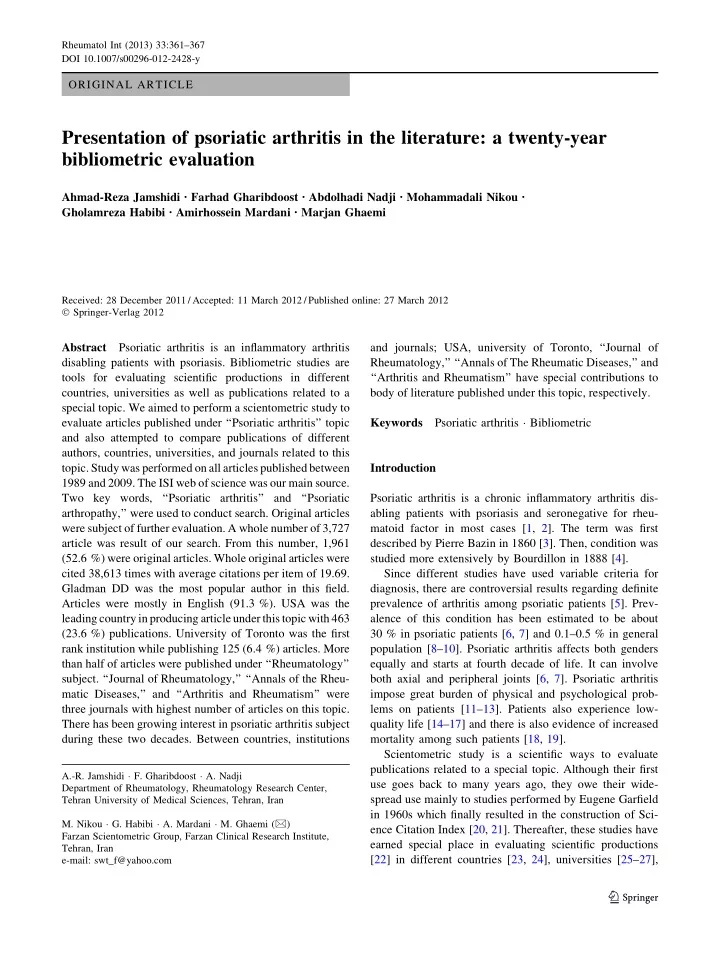
Rheumatol Int (2013) 33:361367 DOI 10.1007/s00296-012-2428-y ORIGINAL ARTICLE Presentation of psoriatic arthritis in the literature: a twenty-year bibliometric evaluation Ahmad-Reza Jamshidi Farhad Gharibdoost Abdolhadi Nadji


slide-1
SLIDE 1

ORIGINAL ARTICLE

Presentation of psoriatic arthritis in the literature: a twenty-year bibliometric evaluation

Ahmad-Reza Jamshidi • Farhad Gharibdoost • Abdolhadi Nadji • Mohammadali Nikou • Gholamreza Habibi • Amirhossein Mardani • Marjan Ghaemi

Received: 28 December 2011 / Accepted: 11 March 2012 / Published online: 27 March 2012 Springer-Verlag 2012

Abstract Psoriatic arthritis is an inflammatory arthritis disabling patients with psoriasis. Bibliometric studies are tools for evaluating scientific productions in different countries, universities as well as publications related to a special topic. We aimed to perform a scientometric study to evaluate articles published under ‘‘Psoriatic arthritis’’ topic and also attempted to compare publications of different authors, countries, universities, and journals related to this

  • topic. Study was performed on all articles published between

1989 and 2009. The ISI web of science was our main source. Two key words, ‘‘Psoriatic arthritis’’ and ‘‘Psoriatic arthropathy,’’ were used to conduct search. Original articles were subject of further evaluation. A whole number of 3,727 article was result of our search. From this number, 1,961 (52.6 %) were original articles. Whole original articles were cited 38,613 times with average citations per item of 19.69. Gladman DD was the most popular author in this field. Articles were mostly in English (91.3 %). USA was the leading country in producing article under this topic with 463 (23.6 %) publications. University of Toronto was the first rank institution while publishing 125 (6.4 %) articles. More than half of articles were published under ‘‘Rheumatology’’

  • subject. ‘‘Journal of Rheumatology,’’ ‘‘Annals of the Rheu-

matic Diseases,’’ and ‘‘Arthritis and Rheumatism’’ were three journals with highest number of articles on this topic. There has been growing interest in psoriatic arthritis subject during these two decades. Between countries, institutions and journals; USA, university of Toronto, ‘‘Journal of Rheumatology,’’ ‘‘Annals of The Rheumatic Diseases,’’ and ‘‘Arthritis and Rheumatism’’ have special contributions to body of literature published under this topic, respectively. Keywords Psoriatic arthritis Bibliometric Introduction Psoriatic arthritis is a chronic inflammatory arthritis dis- abling patients with psoriasis and seronegative for rheu- matoid factor in most cases [1, 2]. The term was first described by Pierre Bazin in 1860 [3]. Then, condition was studied more extensively by Bourdillon in 1888 [4]. Since different studies have used variable criteria for diagnosis, there are controversial results regarding definite prevalence of arthritis among psoriatic patients [5]. Prev- alence of this condition has been estimated to be about 30 % in psoriatic patients [6, 7] and 0.1–0.5 % in general population [8–10]. Psoriatic arthritis affects both genders equally and starts at fourth decade of life. It can involve both axial and peripheral joints [6, 7]. Psoriatic arthritis impose great burden of physical and psychological prob- lems on patients [11–13]. Patients also experience low- quality life [14–17] and there is also evidence of increased mortality among such patients [18, 19]. Scientometric study is a scientific ways to evaluate publications related to a special topic. Although their first use goes back to many years ago, they owe their wide- spread use mainly to studies performed by Eugene Garfield in 1960s which finally resulted in the construction of Sci- ence Citation Index [20, 21]. Thereafter, these studies have earned special place in evaluating scientific productions [22] in different countries [23, 24], universities [25–27],

A.-R. Jamshidi F. Gharibdoost A. Nadji Department of Rheumatology, Rheumatology Research Center, Tehran University of Medical Sciences, Tehran, Iran

  • M. Nikou G. Habibi A. Mardani M. Ghaemi (&)

Farzan Scientometric Group, Farzan Clinical Research Institute, Tehran, Iran e-mail: swt_f@yahoo.com

123

Rheumatol Int (2013) 33:361–367 DOI 10.1007/s00296-012-2428-y

slide-2
SLIDE 2

journals [28] as well as publications related to a special topic [29]. Although there are many epidemiologic studies [7] and clinical reviews [8] on psoriatic arthritis [30, 31] and also scientometric studies investigating general topic arthritis, quantitative description

  • f

publications

  • n

psoriatic arthritis specifically is lacking. So we aimed to perform this scientometric study to evaluate articles published under topic ‘‘psoriatic arthritis’’ using ISI web of science. Methods A bibliometric study was performed on the articles related to ‘‘Psoriatic arthritis’’ published between 1989 and 2009. The ISIweb of science availableathttp://www.isiknowledge.com was our main source. Two mesh terms—‘‘Psoriatic arthritis’’ and ‘‘Psoriatic arthropathy’’—already checked in Pubmed mesh database—were used to conduct search. Our search formula was ‘‘TS = (Psoriatic arthritis) OR TS = (Psoriatic arthropathy) Databases = SCI-EXPANDED, SSCI, CPCI-S, CPCI-SSH Timespan = 1990-2009’’. Original articles were subject of further evaluation. Extracted articles were evaluated regarding citation characteristics, contributing role of each author, country, funding agency, institution, journal and language of pub- lished articles. Articles were also evaluated regarding trend

  • f publication and citation during time and also subject

areas which were published under. Articles that were published in 10 countries with greatest number of publications on the topic were analyzed

  • separately. Articles published by each country were eval-

uated regarding subject areas and publishing journals. Special attention was paid to total citations with and without self-citation, citation per year, citation per item for journals of each country. Articles that were cited more than 100 times were eval- uated regarding year of publication, country of affiliation of first author and publishing journal. Number, country, and year of collaborative studies came under focus in this part. Finally, level and type of collaboration between coun- tries was evaluated. Type of collaboration between coun- tries was analyzed using method developed by Kim [32]. IntColl software available at http://www.leydesdorff.net/ software/intcoll/intcoll.exe and Pajek software available at http://vlado.fmf.uni-lj.si/pub/networks/pajek/ were used for analysis and visual presentation of collaboration between countries. Results A whole number of 3,727 article was result of our search. From this number, 1,961 (52.6 %) were original articles. The rest were meeting abstracts, review articles, letters, proceeding papers, and editorial materials. Notes, correc- tions and news items separately covered less than 1 % of literature mass. Exact frequencies and percents relating to each item are presented in Table 1. Trend of publications and citations Maximum number of publications during one year is 208 (10.6 % of whole) in 2008 and 2009 which shows a 9.5- fold increase compared with years 1989 and 1990. There is a sudden rise in number of published articles in 2002 which is followed by an obvious decline in two following years and another considerable rise in 2005. Figure 1 presents trend of publication during two studied decades. In con- trast, number of citations to articles on this topic during these two decades shows a steady rise during time. Figure 2 presents trend of citations to articles on the topic.

Table 1 Frequency and percent of each article type published under psoriatic arthritis subject between 1989 and 2009 Article type Frequency (%) Article 1,961 (52.62) Meeting abstract 881 (23.64) Review 381 (10.22) Letter 210 (5.63) Proceedings paper 130 (3.49) Editorial material 111 (2.98) Note 35 (0.94) Correction 11 (0.29) News item 6 (0.16)

  • Fig. 1 Trend of changes in number of publications from 1989 to

2009 362 Rheumatol Int (2013) 33:361–367

123

slide-3
SLIDE 3

Articles profile From 1,961 found results, 1,744 (89 %) were cited at least

  • nce and 217 articles (11 %) were not cited. Whole articles

were cited 38,613 times with average citations per item of 19.69. H index for authors on this topic was 78. Gladman DD with a number of 103 publications (5.2 %) was the most popular author in this field. Articles were mostly in English (91.3 %) followed by articles in Germany, French, and Russian, respectively. USA was the leading country in producing article under this topic with 463 (23.6 %) pub-

  • lications. Germany, England, Italy, and Canada also had

great contribution while publishing more than two hundred

  • articles. University of Toronto was the first rank institution

while publishing 125 (6.4 %) articles related to topic. Maximum number of articles supported by a special funding agency was 5 (0.25 %) where Abbot and Abbot Laboratories agencies each had supported publishing such a number. Where more than half of articles were published under ‘‘Rheumatology’’ subject, more than one hundred articles were also published under subjects ‘‘Dermatol-

  • gy,’’ ‘‘Medicine, General and Internal,’’ and ‘‘Immunol-
  • gy’’. Table 2 shows percent and frequency of first ten

author, country, institution and language of published

  • articles. List of journals with greatest number of publica-

tions have come in Table 3.

  • Fig. 2 Trend of changes in number of citations to articles from 1989

to 2009 Table 2 Frequency and percent showing contributory role of first ten author, country, institution, and language in publishing articles between 1989 and 2009 Rank Author Frequency (%) Country Frequency (%) Institution Frequency (%) Language Frequency (%) 1 Gladman, DD 103 (5.25) USA 463 (23.61) Univ Toronto 125 (6.37) English 1,791 (91.33) 2 Farewell, Vt 41 (2.09) Germany 238 (12.14) Univ Leeds 55 (2.80) German 79 (4.03) 3 Fitzgerald, O 37 (1.89) England 235 (11.98) Univ Waterloo 40 (2.04) French 34 (1.73) 4 Olivieri, I 34 (1.73) Italy 224 (11.42) Toronto Western Hosp 35 (1.78) Russian 31 (1.58) 5 Rahman, P 30 (1.53) Canada 208 (10.60) St Vincents Univ Hosp 32 (1.63) Spanish 10 (0.51) 6 Braun, J 29 (1.48) France 123 (6.27) Univ Calif San Diego 29 (1.48) Turkish 5 (0.25) 7 Bresnihan, B 29 (1.48) Netherlands 84 (4.28) Univ Roma La Sapienza 28 (1.43) Czech 3 (0.15) 8 Mease, PJ 29 (1.48) Spain 78 (3.98) Univ Washington 28 (1.43) Portuguese 2 (0.10) 9 Salvarani, C 28 (1.43) Belgium 69 (3.52) Univ Erlangen Nurnberg 26 (1.33) Serbian 2 (0.10) 10 Schentag, CT 27 (1.38) Ireland 56 (2.86) Univ Utah 26 (1.33) Slovene 2 (0.10) Table 3 First ten countries in number of articles published under psoriatic subject and number of their highly cited articles, total citations and average citations per item for highly cited articles between 1989 and 2009 Journal Frequency (%)

  • f published articles

Number of highly cited articles Total citations to highly cited articles Citations per highly cited article Journal of Rheumatology 246 (12.66) 4 513 128.25 Annals of The Rheumatic Diseases 176 (9.06) 6 856 142.66 Arthritis and Rheumatism 109 (5.61) 26 5,566 214.07 Clinical and Experimental Rheumatology 98 (5.04) Clinical Rheumatology 70 (3.60) Rheumatology 60 (3.08) 1 106 106 Rheumatology International 44 (2.26) Arthritis and Rheumatism-Arthritis Care and Research 33 (1.69) British Journal of Rheumatology 33 (1.69) 4 474 118.5 Scandinavian Journal of Rheumatology 33 (1.69) Rheumatol Int (2013) 33:361–367 363

123

slide-4
SLIDE 4

Country-based evaluation Next, articles that were published in 10 countries with greatest number of publications on the topic were analyzed

  • individually. Countries did not vary regarding subjects

where articles had been published. ‘‘Journal of Rheuma- tology,’’ ‘‘Annals

  • f

the Rheumatic Diseases,’’ and ‘‘Arthritis and Rheumatism’’ were three journals with highest number of articles on this topic in the majority of these countries such as USA, England, Canada, the Neth- erlands, and Ireland. Other countries, especially those with

  • fficial languages other than English had a little different

pattern of journal selection. Counting self-citations or not, Articles published by USA, England, Germany, and Canada had been cited more than other countries. When evaluating citation per article, Belgium was first and Canada, France, and England came after. Results of country-based evaluation are summarized in Table 4.

Table 4 First ten countries in number of articles published between 1989 and 2009 under psoriatic arthritis subject and total citations and average citations per item to their articles Rank Name of country Number of articles (%) Total citation Total citation without self-citation Average citations per item Number of highly cited articles Number of collaborative study 1 USA 463 (23.61) 8,115 7,786 27.99 29 15 2 Germany 238 (12.14) 3,646 3,507 22.34 13 7 3 England 235 (11.98) 4,311 4,139 28.15 15 11 4 Italy 224 (11.42) 2,560 2,430 15.75 3 3 5 Canada 208 (10.60) 3,667 3,486 33.16 14 13 6 France 123 (6.27) 2,763 2,696 28.56 4 4 7 Netherlands 84 (4.28) 1,651 1,602 27.37 6 5 8 Spain 78 (3.98) 1,228 1,201 18.85 2 1 9 Belgium 69 (3.52) 1,871 1,822 39.70 7 4 10 Ireland 56 (2.86) 1,300 1,258 26.84 3 Also presents number of highly cited and collaborative studies published by these countries

  • Fig. 3 Visual presentation of collaboration between countries for producing original articles on ‘‘psoriatic arthritis’’ from 1989 till 2009 by Pajek

software 364 Rheumatol Int (2013) 33:361–367

123

slide-5
SLIDE 5

Collaboration between countries From 1,961 original articles, 75 articles were published by

  • ne author and were not subject of further evaluation for
  • collaboration. From remaining 1,886 articles, 156 articles

were result of internal institutional collaboration and 381 articles were result of external institutional collaboration. International collaboration results in producing remaining 1,349 articles. Figure 3 represents visual pattern of col- laboration between countries in this field. Frequency, total number of citations, and average number of citations per item for each group of collaborative studies is summarized in Table 5. Highly cited articles There were 55 articles that were cited more than 100 times. USA, Canada, England, and Germany had greatest contri- bution in publishing highly cited articles, respectively. Number of cited articles, total number of citations and citations per article were evaluated for each journal. ‘‘Arthritis and Rheumatism’’ journal with total number of 29 cited articles, 5,958 citations and 205 citations per published article was the first rank journal in two former

  • fields. ‘‘Lancet’’ with 2 cited articles and total number of

792 citations, resulting in 396 citations per article was first in the latter. It is also worth noting ‘‘Journal of Clinical Investigation’’ in this part with 2 highly cited articles, 424 citations to them and average number of 212 citations per

  • item. Five was the highest number of highly cited articles

published during one year in 1998, 2003, and 2005. From 55 highly cited articles, 21 articles were result of collaboration between at least two countries. An article named ‘‘Sulfasalazine in the treatment of spondylarthropa- thy—A randomized, multicenter, double-blind, placebo- controlled study’’ publishedin ‘‘ArthritisandRheumatism’’ in 1995 was result of collaboration between eight countries. France, Italy, Sweden, and Australia have published all of their highly cited articles in collaboration with other

  • countries. In contrast, Ireland has published all of its highly

cited articles solely. Number of highly cited articles and collaborative studies published by each country, in each journal and year has come in Tables 3, 4 and 6, respectively. Discussion Our results showed growing interest in this topic consid- ering number of publications since 1989 which has also been accompanied with rising number of citations to these

  • publications. USA was the leading country in publishing

articles on this topic with contribution to producing about a quarter of these original articles. Three of five leading countries in this field have English as official language and many countries with other languages publish their article in

Table 5 Frequency of publications in each group of collaborative studies, total number of citations and average citations per item in each group Collaboration types Number of articles Total number

  • f citations

Average number

  • f citations

Internal institutional collaboration 156 3,572 22.9 External institutional collaboration 381 11,296 29.6 International collaboration 1,349 23,567 17.5 Total 1,886 38,435 20.4 Table 6 Number of highly cited and collaborative studies published in each year between 1989 and 2009 Years Number of highly cited articles Number of collaborative studies Years Number of highly cited articles Number of collaborative studies 1990 1 2000 4 1 1991 4 2001 2 1992 1 2002 3 1993 2 2003 5 2 1994 2 2004 4 3 1995 2 1 2005 5 4 1996 2 2006 3 3 1997 3 1 2007 2 1 1998 5 3 2008 1 1 1999 2 2009 Rheumatol Int (2013) 33:361–367 365

123

slide-6
SLIDE 6
  • English. That is why English articles compile more than

90 % of articles. USA leads not only in total number of published articles, but also in total number of highly cited articles and total citations to them. While evaluating number of citations per item, countries such as Belgium, Canada, France, and England have surpassed this country. It may be partly because a larger proportion of articles published by these countries are in collaboration with other countries. In a bibliometric study performed by Lewison et al. in 1999 on arthritis subject, USA had the same special posi- tion in producing articles under the topic. Japan, while having third rank in their ranking, has no place in our top ten ranking. Germany and Italy have higher position in our ranking compared with the same study [30]. In a biblio- metric study performed by Norman S. et al. in 2010, same countries had three first ranks in Rheumatoid arthritis subject as in our study. Belgium has first rank in citation per item but followed by USA and Canada in their study. Their study shows highest number of collaborations in USA [33]. Between institutions, university of Toronto is outstand- ing not only by its first rank in the list, but also by pro- ducing more than half of articles under topic ‘‘Psoriatic arthritis’’ in Canada. In the mentioned study performed by Norman S. et al. [33], this university has third rank. Gladman DD from this university, by participating in many

  • f these studies has probably a great role in making such a

different position. Funding agencies have little contribution to published articles in this field which may be partly because their role has not been reported. Journals have acted differently selecting their articles. Some have published large number of articles while none

  • f them are qualified enough to be in list of highly cited
  • articles. ‘‘Clinical and Experimental Rheumatology’’ with

about 100 published articles without any highly cited article can be an example for this kind of article selection. Some other journals have published much lower number of articles but still having notable number of highly cited

  • articles. ‘‘Lancet’’ despite its absence in the list of top ten

journals considering number of publications has two highly cited articles with more than 700 citations to them. How- ever, there are journals like ‘‘Journal of Rheumatology,’’ ‘‘Annals of The Rheumatic Diseases,’’ and ‘‘Arthritis and Rheumatism’’ which are outstanding in both fields. Norman S. et al. have also pointed to these journals best combining quantitative and qualitative measures in pub- lishing articles [33]. There is an overall increase in total number of articles, citations and highly cited articles during these two decades. As this steady rise is constant for number of citations, number of highly cited articles shows two declines in years 2001 and 2004. This may be due to lower number of publications during same years which is shown in Table 1. Number of highly cited articles shows downward slope after 2005, which reflects lack of enough time for articles to be cited. Evaluating highly cited articles, a growing interest in performing collaborative studies and a gradual change in subject also can be seen. When clinical studies have been more interesting for authors during earlier years, genetic and molecular studies have attracted more and more attention as time passes. Conclusion There has been growing interest in psoriatic arthritis sub- ject during these two decades. Between countries, institu- tions and journals; USA, university of Toronto, ‘‘Journal

  • f Rheumatology,’’ ‘‘Annals of The Rheumatic Diseases,’’

and ‘‘Arthritis and Rheumatism’’ have special contributions to body

  • f

literature published under this topic, respectively.

Acknowledgments The authors would like to express their sincere appreciation to Farzan Institute for Research and Technology for technical assistance.

References

  • 1. Mease P, Goffe BS (2005) Diagnosis and treatment of psoriatic
  • arthritis. J Am Acad Dermatol 52:1–19
  • 2. Anandarajah AP, Ritchlin CT (2009) The diagnosis and treatment
  • f early psoriatic arthritis. Nat Rev Rheumatol 5:634–641
  • 3. Bazin P (1860) Legons Theoretiques et Cliniques sur les Affec-

tions Cutanees de Nature Arthritique et Arthreux.: Paris. 154–161

  • 4. Bourdillon C (1888) Psoriasis et arthropathies. Paris
  • 5. Helliwell PS, Taylor WJ (2005) Classification and diagnostic

criteria for psoriatic arthritis. Ann Rheum Dis 64(Suppl 2):ii3–ii8

  • 6. Scarpa R, Oriente P, Pucino A et al (1984) Psoriatic arthritis in

psoriatic patients. Br J Rheumatol 23:246–250

  • 7. Zachariae H (2003) Prevalence of joint disease in patients with

psoriasis: implications for therapy. Am J Clin Dermatol 4:441–447

  • 8. Gladman DD (1995) Psoriatic arthritis. Baillieres Clin Rheumatol

9:319–329

  • 9. Hellgren L (1969) Association between rheumatoid arthritis and

psoriasis in total populations. Acta Rheumatol Scand 15:316–326

  • 10. van Romunde LK, Valkenburg HA, Swart-Bruinsma W et al

(1984) Psoriasis and arthritis. I. A population study. Rheumatol Int 4:55–60

  • 11. Fortune DG, Richards HL, Kirby B et al (2003) Psychological

distress impairs clearance of psoriasis in patients treated with

  • photochemotherapy. Arch Dermatol 139:752–756
  • 12. Esposito M, Saraceno R, Giunta A et al (2006) An Italian study
  • n psoriasis and depression. Dermatology 212:123–127
  • 13. Rapp SR, Feldman SR, Exum ML et al (1999) Psoriasis causes as

much disability as other major medical diseases. J Am Acad Dermatol 41(3 Pt 1):401–407

  • 14. Husted JA, Gladmand D, Farewellv T et al (1997) Validating the

SF-36 health survey questionnaire in patients with psoriatic

  • arthritis. J Rheumatol 24:511–517

366 Rheumatol Int (2013) 33:361–367

123

slide-7
SLIDE 7
  • 15. Picchianti-Diamanti A, Germano V, Ferlito C et al (2010) Health-

related quality of life and disability in patients with rheumatoid, early rheumatoid and early psoriatic arthritis treated with eta-

  • nercept. Qual Life Res 19:821–826
  • 16. Husted JA, Gladman DD, Farewell VT et al (2001) Health-related

quality of life of patients with psoriatic arthritis: a comparison with patients with rheumatoid arthritis. Arthritis Rheum 45:151–158

  • 17. Husted DS, Shapira NA, Murphy TK et al (2007) Effect of

comorbid tics on a clinically meaningful response to 8-week

  • pen-label trial of fluoxetine in obsessive compulsive disorder.

J Psychiatr Res 41:332–337

  • 18. Wong K, Gladman DD, Husted J et al (1997) Mortality studies in

psoriatic arthritis: results from a single outpatient clinic. I. Causes and risk of death. Arthritis Rheum 40:1868–1872

  • 19. Gladman DD, Farewell VT, Wong K et al (1998) Mortality

studies in psoriatic arthritis: results from a single outpatient

  • center. II. Prognostic indicators for death. Arthritis Rheum

41:1103–1110

  • 20. Garfield E (1964) ‘‘Science Citation Index’’—a new dimension in
  • indexing. Science 144:649–654
  • 21. Garfield E (1972) Citation analysis as a tool in journal evaluation.

Science 178:471–479

  • 22. Barjak F (2006) Research productivity in the internet era.

Scientometrics 68:343–360

  • 23. Allik J (2008) Quality of Estonian science estimated through

bibliometric indicators (1997–2007). Proc Estonian Acad Sci 57:255–264

  • 24. Al-Qallaf C (2003) Citation patterns in the Kuwaiti journal

Medical Principles and Practice: The first 12 years, 1989–2000. Scientometrics 56:369–382

  • 25. Moed HF, Burger WJM, Frankfort JG et al (1985) The use of

bibliometric data for the measurement of university research

  • performance. Res Policy 14:131–149
  • 26. van Raan A (1999) Advanced bibliometric methods for the

evaluation of universities. Scientometrics 45:417–423

  • 27. Tonta Y, Ilhan M (2002) Contribution of Hacettepe University

Faculty

  • f

Medicine to the world’s biomedical literature (1988–1997). Scientometrics 55:123–136

  • 28. Stegmann J, Grohmann G (2001) Citation rates, knowledge export

and international visibility of dermatology journals listed and not listed in the Journal Citation Reports. Scientometrics 50:483–502

  • 29. Schoeffel N, Mache S, Al-Mutawakel K et al (2010) A new view
  • n psoriasis research efforts. J Eur Acad Dermatol Venereol

24:85–88

  • 30. Lewison G, Devey ME (1999) Bibliometric methods for the

evaluation of arthritis research. Rheumatology (Oxford) 38:13–20

  • 31. Glazier R, Fry J, Badley E (2001) Arthritis and rheumatism are

neglected health priorities: a bibliometric study. J Rheumatol 28:706–711

  • 32. Kim K-W (2006) Measuring international research collaboration
  • f peripheral countries: taking the context into consideration.

Scientometrics 66:231–240

  • 33. Schoffel N, Mache S, Quarcoo D et al (2010) Rheumatoid

arthritis: scientific development from a critical point of view. Rheumatol Int 30:505–513 Rheumatol Int (2013) 33:361–367 367

123