Rheumatoid Arthritis Advances in Rheumatoid Arthritis Systemic - - PowerPoint PPT Presentation

rheumatoid arthritis
SMART_READER_LITE
LIVE PREVIEW

Rheumatoid Arthritis Advances in Rheumatoid Arthritis Systemic - - PowerPoint PPT Presentation

Rheumatoid Arthritis Advances in Rheumatoid Arthritis Systemic disease whose predominant 2019: Diagnosis, Assessment, and manifestation involves a chronic, inflammatory, small joint arthritis Novel Oral therapies Affects up to 1% of


slide-1
SLIDE 1

1

Advances in Rheumatoid Arthritis 2019: Diagnosis, Assessment, and Novel Oral therapies

Jonathan Graf, M.D. Professor of Medicine, UCSF Division of Rheumatology, ZSFGH Director, UCSF RA Cohort

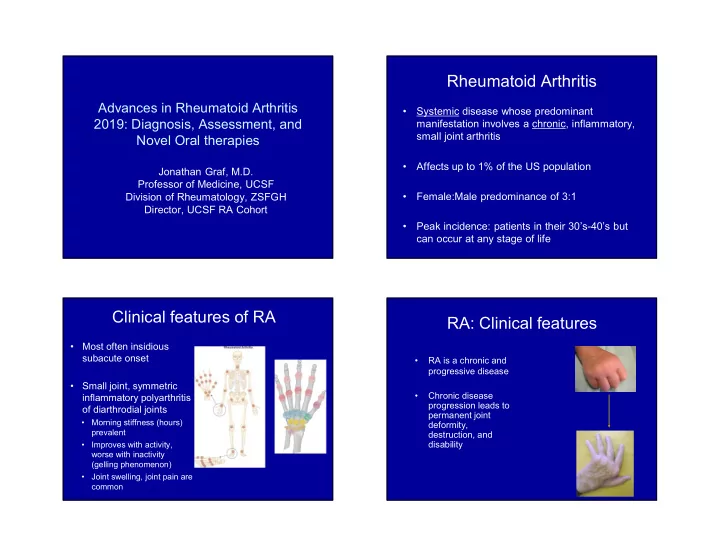
Rheumatoid Arthritis

  • Systemic disease whose predominant

manifestation involves a chronic, inflammatory, small joint arthritis

  • Affects up to 1% of the US population
  • Female:Male predominance of 3:1
  • Peak incidence: patients in their 30’s-40’s but

can occur at any stage of life

Clinical features of RA

  • Most often insidious

subacute onset

  • Small joint, symmetric

inflammatory polyarthritis

  • f diarthrodial joints
  • Morning stiffness (hours)

prevalent

  • Improves with activity,

worse with inactivity (gelling phenomenon)

  • Joint swelling, joint pain are

common

RA: Clinical features

  • RA is a chronic and

progressive disease

  • Chronic disease

progression leads to permanent joint deformity, destruction, and disability

slide-2
SLIDE 2

2

Rheumatoid Arthritis: morbidity

  • Disease associated with

significant morbidity

  • Disability costs are high, both in

terms of direct and indirect medical costs

– 35% of patients with 10 years disease duration are work- disabled

Arthritis Rheum. 2008 Mar 27;59(4):474-480

  • Significant increase in mortality

(SMR 1.4)

– Surprisingly consistent over 20 years of improved therapy

Humphreys et al. AC&R 2014

Improving Outcomes in RA

  • Improvement in timely and accurate

diagnosis and prognosis

  • Treating to defined disease activity targets
  • Improvements in therapy

Improving Outcomes in RA

  • Improvement in timely and accurate

diagnosis and prognosis

  • Treating to defined disease activity targets
  • Improvements in therapy

Early RA: The Window of Opportunity to Intervene

slide-3
SLIDE 3

3

The Window of Opportunity Eventually Closes for Many….

  • Chronic disease

progression leads to permanent joint deformity, destruction, and disability

  • Empirically, RA is a

different disease the longer disease activity progresses without effective control

– More difficult to suppress activity and treat – More extra-articular disease?

1 year prior to 6 months after 3 years after onset

  • nset of RA
  • nset of symptoms of symptoms

Rheumatoid arthritis: irreversible damage can occur early in disease course

Radiographic changes in the same joint over time

ACR Criteria for the Classification of Rheumatoid Arthritis 1987

(>4 criteria required; 1-4 must be present > 6 wks)

  • Morning stiffness > 1 hr
  • Arthritis of 3 or more joint areas
  • Arthritis of wrists, MCPs, and/or PIPs
  • Symmetric arthritis
  • Rheumatoid nodules
  • Serum rheumatoid factor
  • Radiographic changes

Limitations of ACR Classification Criteria for the diagnosis of early RA

  • Developed for the classification of patients with

longstanding disease (for clinical studies, not diagnosis)

– Many of these features (rheumatoid nodules, for ex) are seen with declining frequency

  • For early RA, 1987 classification criteria:

– Specificity: 90% – Limited sensitivity: 40-65%

  • Relying on criteria to make a diagnosis of RA can lead to

delayed or inappropriate diagnosis

slide-4
SLIDE 4

4

ACR/Eular Classification Criteria 2010

  • Joint US-European effort to classify patients

with earlier disease for research

  • Lacks many of descriptive features of 1987

criteria

  • Not as practical for clinical practice: relies on

scoring system and algorithms 2010 ACR/EULAR Classification Criteria for RA

JOINT DISTRIBUTION (0-5)

1 large joint 2-10 large joints 1 1-3 small joints (large joints not counted) 2 4-10 small joints (large joints not counted) 3 >10 joints (at least one small joint) 5

SEROLOGY (0-3)

Negative RF AND negative ACPA Low positive RF OR low positive ACPA 2 High positive RF OR high positive ACPA 3

SYMPTOM DURATION (0-1)

<6 weeks ≥6 weeks 1

ACUTE PHASE REACTANTS (0-1)

Normal CRP AND normal ESR Abnormal CRP OR abnormal ESR 1

≥6 = definite RA

What if the score is <6? Patient might fulfill the criteria…  Prospectively over time (cumulatively)  Retrospectively if data on all four domains have been adequately recorded in the past

START

(eligible patient) RA RA RA RA RA RA RA RA >10 joints (at least

  • ne small joint)

4-10 small joints 1-3 small joints 2-10 large (no small) joints No No No Serology: +/++ Yes Yes No No No Yes Yes Duration: ≥6 weeks Duration: ≥6 weeks Duration: ≥6 weeks Duration: ≥6 weeks Serology: ++ Serology: + Serology: ++ Serology: ++ APR: Abnormal APR: Abnormal APR: Abnormal APR: Abnormal Yes Yes Yes Yes Yes No No No No No No No Yes Yes Yes Yes No Yes No Yes No Yes No Yes Duration: ≥6 weeks Serology: + Yes No No Yes

Rheumatoid arthritis No classification of rheumatoid arthritis

APR: Abnormal

START

(eligible patient) RA RA RA RA RA RA RA RA >10 joints (at least

  • ne small joint)

4-10 small joints 1-3 small joints 2-10 large (no small) joints No No No Serology: +/++ Yes Yes No No No Yes Yes Duration: ≥6 weeks Duration: ≥6 weeks Duration: ≥6 weeks Duration: ≥6 weeks Serology: ++ Serology: + Serology: ++ Serology: ++ APR: Abnormal APR: Abnormal APR: Abnormal APR: Abnormal Yes Yes Yes Yes Yes No No No No No No No Yes Yes Yes Yes No Yes No Yes No Yes No Yes Duration: ≥6 weeks Serology: + Yes No No Yes

Rheumatoid arthritis No classification of rheumatoid arthritis

APR: Abnormal

slide-5
SLIDE 5

5

Diagnosis of early RA by 1987 ACR criteria

van Gaalen et al Arth Rheum 50: 709, 2004

936 patients with early inflammatory arthritis

Initial evaluation After 3 years 205 RA by ACR criteria 936 318 “undifferentiated 127 RA arthritis” 413 other diagnoses

Factors predictive of progression from undifferentiated arthritis to RA

van Gaalen et al Arth Rheum 50: 709, 2004

At initial evaluation OR (95% CI) Positive rheumatoid factor 1.7 (0.5-5.6) Positive anti-CCP antibody 38.6 (9.9-151.0) Posttranslational modification of proteins: PADI converts arginine to citrulline

RA-associated autoantibodies that recognize peptides containing citrulline

Girbal-Neuhauser et al J Immunol 162: 585, 1999

Peptide sequence Antibody recognition ESSRDGSRHPRSHD No PADI ESSRDGScitHPRSHD Yes

Actual citrullinated antigen(s) targeted in RA is/are not known

slide-6
SLIDE 6

6

Antibodies to citrullinated peptides in RA

  • Detected by ELISAs using synthetic cyclic

citrullinated peptides (CCP)

  • Sensitivity for very early RA: 50%
  • Sensitivity for early-later RA: 70-80%
  • Specificity for RA: 95-98%

Preclinical autoimmunity in RA: appearance of anti-CCP abs and RF prior to onset of arthritis

Nielen et al Arth Rheum 50: 380, 2004

RF and anti-CCP testing in a cohort

  • f 182 early RA patients

Quinn et al Rheumatology (Oxford) 45:478, 2006

RF-CCP+ RF+CCP+ RF+CCP- RF-CCP-

Progression of joint damage in subgroups of early RA

Huizinga et al Arthritis Research& Therapy 7: 949, 2005 radiographic joint damage score anti-CCP+ anti-CCP-

slide-7
SLIDE 7

7

Summary: Clinical utility of the anti- CCP antibody test

  • Diagnosis:

– Clinical suspicion of rheumatoid arthritis – Early, undifferentiated inflammatory arthritis – Distinguish RA from other RF+ polyarthritis

  • Not useful to monitor disease activity
  • Best single predictor for destructive

disease in patients with early onset RA RA: Etiology/Genetics

  • 15-20% concordance in monozygotic twins
  • RA: 60% heritable contribution
  • Most of genetic contribution from Chromosome 6: HLA DR locus
  • More copies of HLA risk alleles, higher risk for RA and more severe disease

Manhattan plot from a genome-wide association study of RA Criswell, LA Immunological Reviews 233: 55, 2010

Gene-environment interaction in RA: Is smoking an environmental trigger?

Klareskog et al Ann Rev Immunol 26:651. 2008

Evidence for an interaction between smoking and the shared epitope in risk for anti-CCP-positive RA in a European cohort

Anti-CCP positive Anti-CCP negative

Periodontitis and the link to RA

slide-8
SLIDE 8

8

Possible culprits

Konig et al. Science Translational Medicine 14 Dec 2016

  • P. Gingivalis can

citrullinate proteins directly Aggregatibacter actinomycetemcomitans Exo-toxin causes host neutrophils to auto-citrullinate their proteins

Is rheumatoid arthritis a single disease?

RA #1 RA#2 Genetic Risk +

  • (HLA DR SE)

ACPA +

  • (? environmental

citrullination)

Erosive dz +

  • Improving Outcomes in RA
  • Improvement in timely and accurate

diagnosis and prognosis

  • Treating to defined disease activity targets
  • Improvements in therapy

RA: Chronic Joint Destruction and Disability – What We Try to Prevent

slide-9
SLIDE 9

9

Joint damage in RA:

progressive narrowing and erosion of a MCP joint

At presentation: 1 year 5 years normal

Treatment of early RA

  • Effective treatment should be started when

the diagnosis is made

– “Effective treatment” = therapies shown to slow joint destruction

  • Goal is to induce and then maintain

remission

– Combination of drugs more effective than monotherapy

RA: Traditional Treatment Paradigm

  • Pyramid of therapy

– Start conservatively – Gradually ascend the pyramid in order of potency and toxicity of therapy – Only the most severely affected patients receive immuno- supressive, DMARDs – DMARD therapy begun

  • nly after period of

significant delay

Re-Thinking the RA Treatment Pyramid

  • Emphasizes earlier diagnosis and initiation of

therapy with disease modifying anti-rheumatic drugs

slide-10
SLIDE 10

10

ACR RA Practice Guidelines 2002

  • Most patients with

Rheumatoid Arthritis should be evaluated expeditiously

  • Treatment with DMARD

instituted within 3 months

  • f diagnosis
  • Goals are to prevent or

control joint damage, prevent loss of function, and decrease pain

Tight Control for Rheumatoid Arthritis

Grigor C, Porter D, et al. Lancet 2004;364(9430):263-9.

  • Pre-biologic era study
  • Randomly assigned 110

patients to “intensive” vs. usual management

  • Every three months,

independent blinded metrologist assessed disease activity Change in disease activity assessed at 18 months

TICORA Patients

  • Early disease (<2 years)
  • Active disease

– Mean SJC 11-12 – Mean CRP 38-44 mg/L

What does “Intensive Therapy” Look Like?

Standard Therapy

  • Follow up visits q 3 mo
  • DMARD monotherapy used for

active disease

  • Intra-articular injections of TAC

allowed

  • Changes or additions to

therapy were made based upon gestalt

Intensive therapy

  • Follow up visits q 1 mo
  • DMARD monotherapy used for

active disease

  • Intrarticular injections of TAC

allowed

  • Changes or additions to

therapy were based on formal disease activity (score) > moderate

slide-11
SLIDE 11

11

Mean Disease Activity

ACR Treatment Guidelines 2008

  • Building evidence from trials like TICORA suggests

better long term outcomes when treating to a defined target early in disease

  • ACR guidelines encourages regular, formal assessments
  • f disease activity

– Similar to hemoglobin A1C for diabetes – Several formal disease scores available:

  • DAS28
  • CDAI, SDAI, etc…
  • Vectra-DA biomarker assay
  • ACR: Treat to target of mild disease activity or better

Disease Activity Score 28 Joints

1. Tender Joint count 2. Swollen Joint Count 3. Patient global disease assessment (visual analog scale from 0-100mm) 4. Serum measure of inflammation (ESR/CRP)

DAS: Treating to target

  • DAS 28 disease activity cutoffs:

– DAS28 <2.6 Remission – DAS28 2.6-3.2 Mild Activity – DAS28 3.21-5.1 Moderate Activity – DAS28 >5.1 High Disease Actiivty

slide-12
SLIDE 12

12

Improving Outcomes in RA

  • Improvement in timely and accurate

diagnosis and prognosis

  • Treating to defined disease activity targets
  • Improvements in therapy

DMARD Therapies

  • Methotrexate
  • Leflunomide (Arava)
  • Sulfasalazine
  • Azathioprine
  • Mycophenolate Mofetil
  • “Corticosteroids”
  • “Hydroxychloroquine”
  • “Minocycline”

RA: Targeted Therapy Approach

  • Start with traditional DMARD
  • Check to see if low disease activity or better has

been attained

  • Advance therapy (dose), switch from oral to SQ

MTX, or add combination

  • Good data that combination DMARDs or

combination DMARD + biologic both effective (TEAR trial & CSP 551 RACAT trial)

Families of Biologic Therapies for RA

  • Anti-TNF medications

– Etanercept (TNF decoy receptor fusion protein) – Infliximab, Adalimumab, certolizumab, golimumab (variations of anti-TNF antibodies or Fab’) – Biosimilar drugs (infliximab-dyyb)

  • B-cell depleting agents

– Rituximab

  • T-cell costimulation inhibitors (receptor-ligand )

– Abatacept

  • Inhibitors of Il-6 signaling

– Tocilizumab (anti IL6 receptor antibody) – Sarilumab (anti IL6 receptor antibody)

slide-13
SLIDE 13

13

Why Move Towards Combination Regimens with Biologics?? Klareskog L. et al. TEMPO Lancet 2004

The Current Pyramid Paradigm

  • Early initiation and titration of DMARD
  • If incomplete response to DMARD alone, after reasonable

titration, addition of combination therapy recommended

“Doc, can I ever stop my RA medicines?”

  • Short answer: probably no for most patients
  • Long answer: Possibly, for a few lucky patients with RA
  • Longer answer: A significant percentage of RA patients may be able to

successfully taper their medicines

Smolen J et al. Lancet. 2014. Emery P, et al. N Eng J Med. 2014

OPTIMA 2014 PRIZE 2014

Tapering or discontinuing anti- TNF therapy

  • PRIZE study of early upfront

etanercept + MTX followed by taper

  • Those who achieved low dz activity

(DAS<3.2) at wk 39 and remission at wk 52 (open label phase) entered randomized double blinded phase

  • 1:1:1 tapered etanercept (1/2 dose) +

MTX, PBO+MTX, or double PBO

  • Those with DAS <3.2 at wk 39 had all

drug withdrawn through wk 65

Emery P, et al. N Eng J Med. 2014 Nov 6;371(19):1781-92

slide-14
SLIDE 14

14

PRIZE Results:

  • Tapering anti-TNF works for some.
  • Sustained remission off therapy achievable in small percentage

Emery P, et al. N Eng J Med. 2014 Nov 6;371(19):1781-92

Oral Small Molecule Inhibitors: ? New wave of RA therapy

  • Not proteins but are small molecules
  • Taken orally and can act intracellularly
  • “Biologic-like” effects by blocking downstream events

initiated by cytokine-receptor engagement

  • Emerging term: “Biologic response modifiers”

– Not organic, complex macromolecules but have similar effects to biological molecules

  • First class of kinase inhibitors for RA: JAK inhibitors

– JAK 1, JAK 2, JAK 3, TYK 2

Cytokine Signaling through Kinases

Cytokine:

  • eg. TNF/IL6

Kinases

Transcription Biologic Effect: Proliferation Activation Cytokine production Current Biologic Therapies

Cytokine Signaling through Kinases

Cytokine:

  • eg. TNF/IL6

Kinases

Current Biologic Therapies New Kinase Inhibitors

slide-15
SLIDE 15

15

Overview of cytokine signaling through Jak and selective inhibition by JAKi’s

  • Pan selective JAKi’s

have advantage of knocking down multiple cytokine pathways vs more selctive JAKi’s or single anti-cytokine therapy (eg. Anti- TNF)

  • Also come with risk
  • f inhibiting

important constituitive functions (JAK2 and hematopoesis)

Schwartz, O’Shea et al. Nat Rev Drug Discov. 2017 Dec;16(12):843-862.

Pipeline of Oral Small Molecule Inhibitors

  • Tofacitinib (PAN JAKi: JAK 1/3 >2 kinase inhibitor)

– Rheumatoid Arthritis (FDA approved 2012; Failed twice to get approval in Europe until 2017) – Now also approved for psoriatic arthritis and ulcerative colitis (2018) – Potential future indications: psoriasis, atopic dermatitis, and alopecia areata

  • Baricitinib (Pan JAKi: JAK 1/2 kinase inhibitor)
  • FDA approved for RA 2018*
  • In development

– Upadacitinib (JAK 1 selective: approval expected 2019) – Filgotinib (JAK 1 selective: approval expected in 2019-2020)

Lee EB et al. N Engl J Med 2014;370:2377-2386.

  • 40% of MTX naïve

patients with active RA achieved a 70% response on Tofacitinib 10 mg vs. 10% on MTX.

  • Predictable adverse

events similar to anti- iL6 therapy

– Liver, neutropenia, lipids, infections, etc. – Caution that JAK signaling more widespread than for IL6 alone

Baricitnib: RA- BEACON

Genovese et al. NEJM 2016

Active RA refractory to conventional DMARDs and biological DMARDs

slide-16
SLIDE 16

16

Baricitinib: RA-BEAM

Taylor et al. NEJM 2017

Active RA despite MTX: Comparing Baricitinib to Adalimumab and PBO

Baricitinib: A cautionary tale FDA approval blocked 2017 Baricitinib: Analysis of VTE/PE events

Scott et al. Drug Safety July 2018, Volume 41, Issue 7, pp 645–653

Taylor et al. Arth & Rheum 2019 in press

6/997 patients 4 mg @24 wk

  • vs. 0 PBO/2 mg @ 24 wk

FDA approves amended application for Baricitinib 2018

  • FDA originally required new clinical safety

trial but changed its mind and accepted amended application with additional secondary analyses of existing clinical trial data

  • Black box warning for serious infections

and VTE/PE risk

  • Only 2 mg (low dose) approved in US. 2 &

4 mg doses already approved in Europe since 2017 and safety surveillance ongoing

  • Based upon additional data: Baricitinib

should be used with caution in patients with risk factors for DVT/PE :

– older age, obesity, a medical history of thrombosis, hypercoagulable state, recent surgery or immobilization

slide-17
SLIDE 17

17

Brighter Future for Patients with RA

EXTRA SLIDES