
SLIDE 1
·487·
PRESENTATION OF LONG-TERM MATRIC SUCTION MEASUREMENTS IN A HIGHWAY SUBGRADE USING THERMAL CONDUCTIVITY SENSORS
- Q. Nguyen1, L. Samarasekera1, D.G. Fredlund2 & B.L. Marjerison3
1) University of Saskatchewan, Saskatoon, Canada 2) Golder Associates Ltd., Saskatoon, Canada 3) Saskatchewan Highways and Transportation, Saskatoon, Canada
Abstract: At each of two Thin Membrane Surface (TMS) highway locations in Saskatchewan, Canada, 16 thermal conductivity sensors had been installed to monitor in situ matric suctions. The matric suctions were calculated using the drying branch of the hysteresis loop that represents the calibration curve. The soil suction measurements showed a strong seasonal pattern. Suctions showed a correlation to rainfall. Relatively constant suctions were encountered under the driving-lane. Under the side-slope, the matric suctions were found to vary considerably with time and location. For the depths below 2.0 m, the differences in matric suctions under the driving-lane and under the side-slope were small.
- 1. INTRODUCTION
Thin Membrane Surface (TMS) highways consist of compacted native soils forming the subgrade material covered with a thin layer of asphalt to provide a dust free driving surface. The strength of the highway subgrade depends not only
- n total stresses but also on matric suction in the
- soil. Matric suction can be measured using thermal
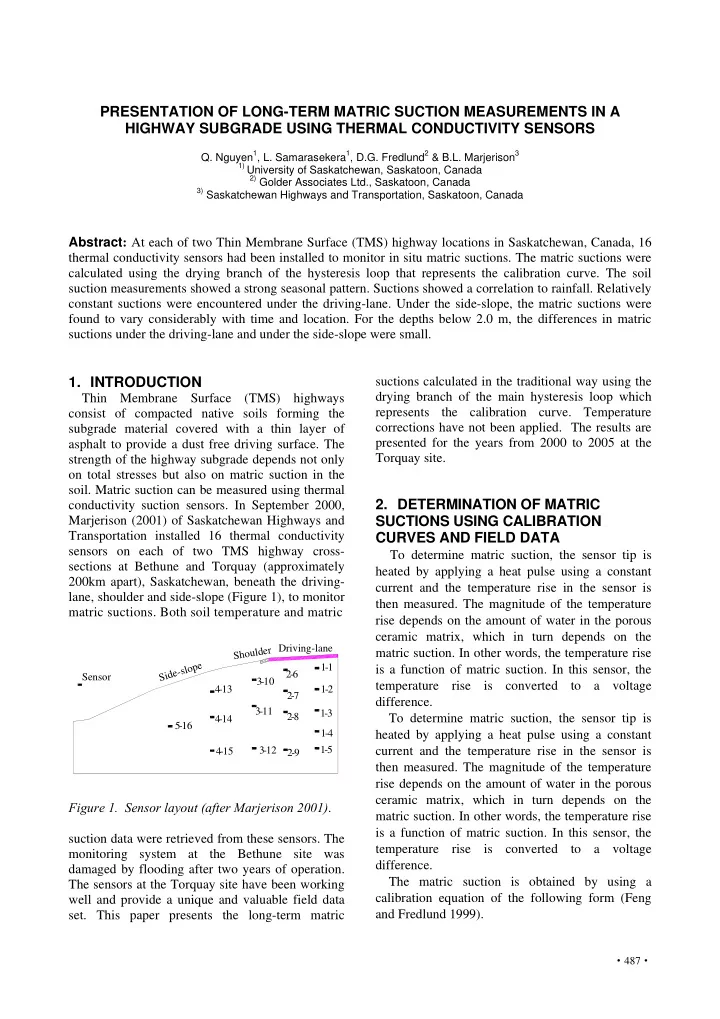
conductivity suction sensors. In September 2000, Marjerison (2001) of Saskatchewan Highways and Transportation installed 16 thermal conductivity sensors on each of two TMS highway cross- sections at Bethune and Torquay (approximately 200km apart), Saskatchewan, beneath the driving- lane, shoulder and side-slope (Figure 1), to monitor matric suctions. Both soil temperature and matric
Shoulder Side-slope Driving-lane 1-1 2-8 1-2 2-7 1-3 1-4 4-15 4-14 5-16 4-13 1-5 3-11 3-10 2-6 3-12 2-9 Sensor
Figure 1. Sensor layout (after Marjerison 2001). suction data were retrieved from these sensors. The monitoring system at the Bethune site was damaged by flooding after two years of operation. The sensors at the Torquay site have been working well and provide a unique and valuable field data
- set. This paper presents the long-term matric
suctions calculated in the traditional way using the drying branch of the main hysteresis loop which represents the calibration curve. Temperature corrections have not been applied. The results are presented for the years from 2000 to 2005 at the Torquay site.
- 2. DETERMINATION OF MATRIC