Presentation of Annual Report January to December 2016 From Beacons - - PowerPoint PPT Presentation

presentation of annual report
SMART_READER_LITE
LIVE PREVIEW

Presentation of Annual Report January to December 2016 From Beacons - - PowerPoint PPT Presentation

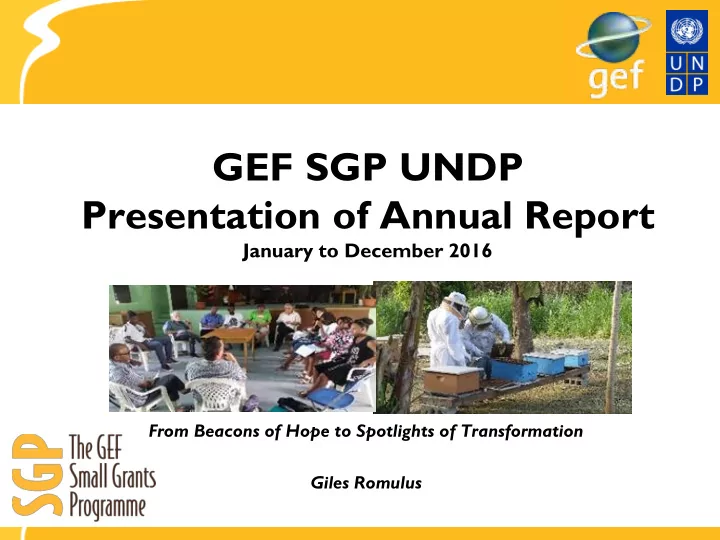
GEF SGP UNDP Presentation of Annual Report January to December 2016 From Beacons of Hope to Spotlights of Transformation Giles Romulus WHO ARE WE? WHO ARE WE? A corporate programme of To achieve the GEF which is Environmental

slide-1
SLIDE 1

GEF SGP UNDP Presentation of Annual Report

January to December 2016

From Beacons of Hope to Spotlights of Transformation Giles Romulus

slide-2
SLIDE 2

WHO ARE WE?

slide-3
SLIDE 3

WHO ARE WE?

  • A corporate programme of

the GEF which is implemented by UNDP on behalf of the GEF Partnership (The World Bank; UNEP; UNDP; FAO-UN; IADB; etc. etc.)

  • 20, 000 communities
  • 125 countries
  • US$900 million invested in

the last 25 years

  • To achieve

Environmental Sustainability

  • To reduce or alleviate

poverty.

  • To build capacity
slide-4
SLIDE 4

Who are we?

  • GEF Focal Areas of: Climate

Change Mitigation & Adaptation; Biodiversity Conservation; Land Degradation and Sustainable Forest Management; Chemicals & Waste; and International Waters.

slide-5
SLIDE 5

A TRANSITIONAL YEAR

  • OP 5 to OP 6

(methodological change)

  • Departure of two

members of the NSC.

  • Change in GOSL
  • Less than 1% economic

growth.

  • Unemployment >21%
  • Unemployment of >43%

among the youth,

  • Poverty rate 28.8%

(2005/2006)

The Three Pillars of Sustainable Development

slide-6
SLIDE 6

A TRANSITIONAL YEAR

slide-7
SLIDE 7

METHODOLOGICAL CHANGE

  • Use of Spatial Mapping
  • Specific criteria such as:
  • Environmental
  • Economic
  • Poverty
  • CSO Capacity
  • Conceptual Modelling
  • Preference Ranking

(66% of investment funds)

LANDSCAPE APPROACH

slide-8
SLIDE 8

METHODOLOGICAL CHANGE

  • The Apiculture Production

Chain: use of sustainable production, harvesting and marketing methods.

  • Sustainable Agro-processing:

agro-processing methods which means methods with minimal to zero environmental impacts, which includes zero carbon footprint.

  • Agro-forestry and Preservation of

River Banks: use of methods that respect the diversity of species in

  • rder to ensure sustainability and
  • resilience. Ecological restoration.
  • Alternative Energy in Sustainable

Production Systems: Reducing carbon footprints in small and medium enterprises operating at the community level, with a benign impact on the environment.

34 % of investment funds.

slide-9
SLIDE 9

A DETERIORATING SITUATION

In 2016 the climate score card for the world deteriorated further:

– Warmest year on record (=1.1oC above pre- industrial levels); – Increase in CO2 concentrations to 400ppm – a drop in global sea-ice by more than 4 million KM2

Floods Coral Bleaching Hurricanes

slide-10
SLIDE 10

RESULTS – INVESTMENT, ECONOMIC AND SOCIAL

slide-11
SLIDE 11

Number & Value of Projects (2016)

YEAR

  • No. of Projects

Value of Projects (US$) Co-funding Ratio 2015 17 1.21 m 1:0.98 2016 5 0.320 m 1:1.19 %change (71%) (73%) 21% CumulativeT

  • tal

(Oct, 2012 – December 2016) 57 3.73 m 1:1.28

slide-12
SLIDE 12

REASONS FOR DECLINE IN NUMBER AND VALUE OF PROJECTS

(i) the length of time taken for established CSOs to complete projects and to apply for new grants. (ii) the generally low absorptive capacity of CSOs in Saint Lucia; (iii) the time dedicated to introducing CSOs to the new priorities for funding during OP 6; and (iv) staffing constraints and the level of mentoring required to assist CSOs in meeting basic project requirements.

slide-13
SLIDE 13

Employment and Income

YEAR Number of Persons Employed Income (US$) 2016 142 72,579 2015 200 81,420 % Change (29) (12.18%) Cumulative Change (Oct 2012 to Dec, 2016) 799 293,133

slide-14
SLIDE 14

Employment and Income from Investment from 4 projects.

  • 4 projects increased revenue by US$38,000
  • 2015 – US$12,424 and by 2016 after the implementing
  • f the project revenue increased by 71% to US$21,062
slide-15
SLIDE 15

CAPACITY DEVELOPMENT

YEAR Number of Persons Trained Areas of Training 2016 586

project development, project management, financial management, book keeping, record keeping, PVC installation and maintenance, manufacturing by-products from seamoss, agri-business development, effective communication, public speaking, website maintenance, community profiling and climate smart agriculture.

2015 339

farming, masonry, carpentry, welding, plumbing, transportation, tutoring in small engine repair, animation, surveying, diving,

  • perational

management, project management, electrical engineering, water tank installation, charcoal making and processing, and sea moss cultivation.

% change 73% Cumulative Change from Oct 2012 – December 2016 3106

slide-16
SLIDE 16

ENVIRONMENTAL RESULTS

slide-17
SLIDE 17

BIODIVERSITY CONSERVATION

  • Management Plan for

Laborie Bay – agreement.

  • Draft Management Plan for

Mankoté Mangrove

  • An improved health

management protocol for snake bites in Saint Lucia.

slide-18
SLIDE 18

BIODIVERSITY CONSERVATION

  • 12 persons trained in

the development of new gastronomic products as part of the strategy to protect the Leatherback Turtle.

  • Two new micro

enterprises in apiculture established.

slide-19
SLIDE 19

CLIMATE CHANGE MITIGATION

  • > 10 young persons

trained in PVC installation and maintenance.

  • Ten households fully

solarised and are ready to be grid connected as soon as the NURC and LUCELEC gives the requisite permissions.

slide-20
SLIDE 20

CLIMATE CHANGE ADAPTATION

  • 28 households now have

fully functioning rain water harvesting systems in Bouton (ten more to be completed);

  • Water supply needs are

now 93% met in Bouton during dry periods or in the aftermath of hurricanes, compared to 74% prior to the project.

slide-21
SLIDE 21

CLIMATE CHANGE ADAPTATION

  • Community Planning and Land

Use Guidelines completed for the village of Laborie. According to CARPHA (2016) “The results

show that the desalination plant developed by the Laborie Fishers and Consumers Cooperative was very efficient at removing nuisance constituents from sea water, thus turning sea water into potable

  • water. This self-sufficient system will provide water

security for the village of Laborie”

slide-22
SLIDE 22

LAND DEGRADATION

  • Over 1200 trees planted

along the Isnare River in Babonneau.

  • One acre of land leased

near the Morne Assau Bridge for ten years for the establishment of a nursery for continued reforestation along the Isnare River and

  • ther nearby rivers.
slide-23
SLIDE 23

INERNATIONAL WATERS

  • Assessment of

wastewater completed in the Canaries Watershed

  • Baseline water quality

studies completed in a micro watershed in Soufriere, the Soufriere River and the coastal zone, with very worrying results.

slide-24
SLIDE 24

Chemicals and Waste

  • Learning programme

designed for training 200 Saint Lucians in Basic Toxicology.

  • A bio stimulant from

sargassum seaweed was scientifically confirmed through laboratory test.

slide-25
SLIDE 25

CAPACITY DEVELOPMENT

  • VALIRI established, fully

incorporated and launched as Saint Lucia’s premier research and innovation

  • rganisation and as a centre

for the CD of CSOs.

  • The Coalition of Civil

Society of Saint Lucia Inc. established but needs approval of its application from the Attorney General’ Office to become formally incorporated;

slide-26
SLIDE 26

NEW PROJECT

  • US$87,500

(XCD$236,250) on livelihoods development and LD projects in the Upper Soufriere Watershed.

slide-27
SLIDE 27

SOUTH SOUTH PARTNERSHIP

To target young people who will promote and advocates for a healthier environment:

– CCM – CCA

  • Health of our Oceans.
slide-28
SLIDE 28

UPSCALING – Creating Sustainable Development Clusters

 Output – Input Models – i.e., the output

  • f one group becomes the input of

another (Figure 5)  local products or services;  R & D  Business and community approach  Multidisciplinary  Democratic Process  Benefit sharing.

slide-29
SLIDE 29

PROMOTION OF SUSTAINABLE DEVELIOPMENT GOALS

  • A more thorough

understanding of the SDGs in particular SDG 14, by various stakeholders and the general public.

slide-30
SLIDE 30

CHALLENGES

  • Capacity of CSOs in Saint Lucia.
  • Leadership
  • Institutional Environment
  • Generally the inadequate level of

constant high level support available to CSOs.

slide-31
SLIDE 31

LESSONS LEARNED

  • Institutional Capacity for assistance to

CSOs – consistent high quality is needed.

  • Pollution – water quality
  • Our Neighbour’s Keeper
  • Research and Innovation
slide-32
SLIDE 32

CONCLUSION

GEF SGP UNDP will continue to work in partnership with all national, regional and international partners in attracting grant funds to Saint Lucia and bringing the highest level of support to CSOs. Already we have started to plan for GEF 7 and in next year’s annual report presentation we hope to be very specific on a new area for investment. WE THANK YOU FOR YOUR ATTENTION AND SUPPORT!

slide-33
SLIDE 33

DISCUSSIONS QUESTIONS AND ANSWER