
SLIDE 1
1
Presentation Exercise: Chapter 24
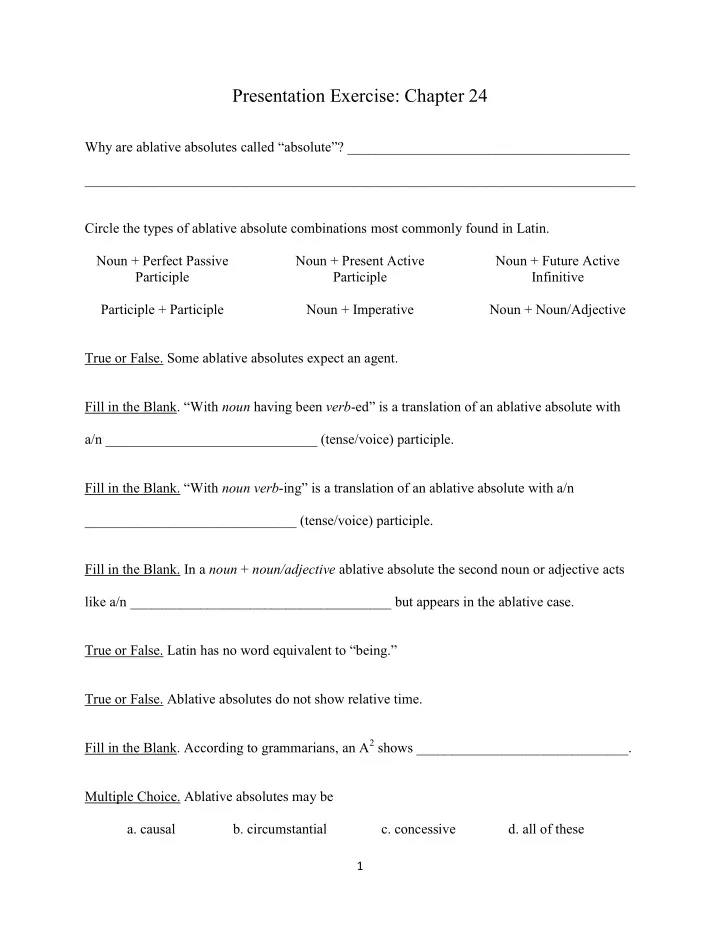
Why are ablative absolutes called “absolute”? ________________________________________ ______________________________________________________________________________ Circle the types of ablative absolute combinations most commonly found in Latin. Noun + Perfect Passive Participle Participle + Participle Noun + Present Active Participle Noun + Imperative Noun + Future Active Infinitive Noun + Noun/Adjective True or False. Some ablative absolutes expect an agent. Fill in the Blank. “With noun having been verb-ed” is a translation of an ablative absolute with a/n ______________________________ (tense/voice) participle. Fill in the Blank. “With noun verb-ing” is a translation of an ablative absolute with a/n ______________________________ (tense/voice) participle. Fill in the Blank. In a noun + noun/adjective ablative absolute the second noun or adjective acts like a/n _____________________________________ but appears in the ablative case. True or False. Latin has no word equivalent to “being.” True or False. Ablative absolutes do not show relative time. Fill in the Blank. According to grammarians, an A2 shows ______________________________. Multiple Choice. Ablative absolutes may be
- a. causal
- b. circumstantial
- c. concessive
- d. all of these