SLIDE 1
WHAT DO
O LINGUISTS HAVE TO O SAY ABOUT THE
EVOLUTION OF LANGUAGE? Bernard Comrie Max Planck Institute for Evolutionary Anthropology and University of California, Santa Barbara comrie@eva.mpg.de
SLIDE 3
- 1. Imperfect tense of ‘to bear, carry’ in Indo-European
Sanskrit
Common ancestor
SG 1
a-bhar-a-m e-pher-o-n *e-bher-o-m 2 a-bhar-a-ḥ e-pher-e-s *e-bher-e-s 3 a-bhar-a-t e-pher-e *e-bher-e-t
DU 2
a-bhar-a-tam e-pher-e-ton *e-bher-e-tom 3 a-bhar-a-tām e-pher-e-tēn *e-bher-e-tām
PL 2
a-bhar-a-ta e-pher-e-te *e-bher-e-te 3 a-bhar-a-n e-pher-o-n *e-bher-o-n Structure: Augment (*e-) – Root – Theme (e/o) – Person/Number
SLIDE 4
Regular sound changes Ancient Greek bh > ph m > n word-finally t > Ø word-finally ā > ē after a consonant (other than r) Sanskrit e, o > a s > ḥ word-finally
SLIDE 5
- 2. Reconstructed consonant system of Proto-Indo-European
Stops p b bʰ t d dʰ kʸ gʸ gʸʰ k g gʰ kʷ gʷ gʷʰ Fricatives s h₁ [h] h₂ [χ] h₃ [ɣʷ] Liquids l r Nasals m n Semivowels w y
SLIDE 6
How complex structures could have evolved from simpler structures
- n the basis of parallels with attested changes
including plausible variations on these Uniformitarian hypothesis
SLIDE 7
Structural complexity Does not exclude the possibility of simplification, which is also a historically observable kind of change
SLIDE 8
Assume a species (homo sapiens sapiens) that is biologically adapted to linguistic complexity (“language-ready”) but has not yet put into practice substantial parts of this complexity
SLIDE 9
- C. Phonetic complexity
- 3. Simple vowel system
i u a
SLIDE 10
i u a high high front back unrounded rounded low unrounded
SLIDE 11 4. i u e <a → i>
a high mid low
SLIDE 12 5. Latin aurum ‘gold’ Spanish
SLIDE 13
- 6. “Umlauted” (front rounded) vowels
ü IPA [y] <u → i> ö IPA [ø] <o → i> front rounded
SLIDE 14
SLIDE 15
7. Old High German jung [jʊŋɡ] ‘young’ jungiro [jʊŋɡɪrɔ] ‘younger (COMPARATIVE)’ Modern German jung [jʊŋ] jünger [jʏŋər]
SLIDE 16
ɯ <i → u> ɤ <e → o> back unrounded
SLIDE 17
- 9. Voicing in obstruents and sonorants
labial dental velar p t k voiceless stop s voiceless fricative m n voiced nasal l voiced liquid
SLIDE 18 labial dental velar p t k voiceless
s m n voiced sonorant l
SLIDE 19
Voiced obstruents b <p → voiced>
SLIDE 20
Latin sapere ‘to know’ Brazilian Portuguese saber [sa'bex] voiced stop
SLIDE 21
Voiceless sonorants ɬ <l → voiceless>
SLIDE 22
Welsh llan [ɬan] ‘church’ (especially in place names)
SLIDE 23
- 10. Other unusual consonants
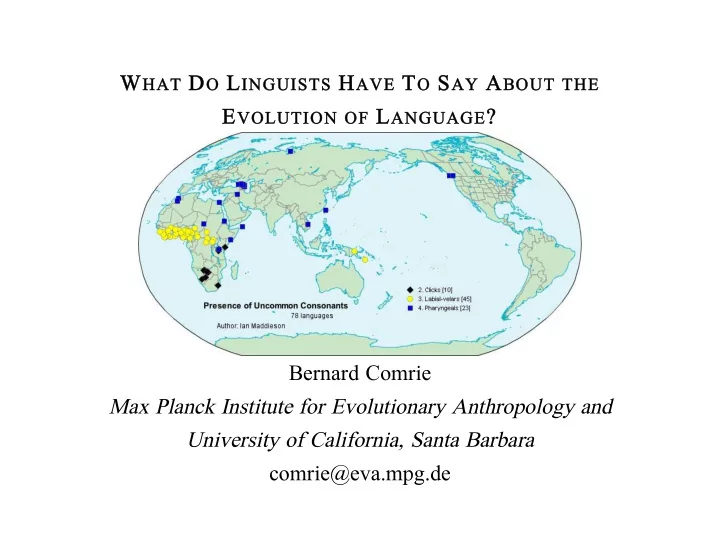
Pharyngeals [ħ] unusual place of articulation Labial-velars [k͡p] co-articulation Clicks [ʘ] non-pulmonic, ingressive
SLIDE 24
SLIDE 25
i u i u i u e
ɔ a a a
SLIDE 26
- D. Internal reconstruction
SLIDE 27
12. Old High German jung [jʊŋɡ] ‘young’ jungiro [jʊŋɡɪrɔ] ‘younger’ Intermediate jung [jʊŋɡ] jungiro [jʏŋɡɪrɔ] [ʊ] and [ʏ] are allophones Modern German jung [jʊŋ] jünger [jʏŋər] [ʊ] and [ʏ] are phonemes
SLIDE 28 Morphophonological alternations, i.e. different forms of the same morpheme in different environments ([jʊŋ] ~ [jʏŋ] + [ər]), which introduce complexity,
from regularly conditioned sound changes (e.g. vowels are fronted before [i]-like vowels) followed by loss of the conditioning environment (e.g. unstressed [ɪ] is weakened to [ə])
SLIDE 29
“Internal reconstruction” reverse-engineers this, postulating for morphophonological alternations an earlier stage with a regular phonetic environment
SLIDE 30
Evolving complexity Stage I no morphophonological alternations Stage II morphophonological alternations
SLIDE 32
‘master’ ‘table’
SG PL SG PL NOM
dominus dominī mēnsa mēnsae
VOC
domine dominī mēnsa mēnsae
ACC
dominum dominōs mēnsam mēnsās
GEN
dominī dominōrum mēnsae mēnsārum
DAT
dominō dominīs mēnsae mēnsīs
ABL
dominō dominīs mēnsā mēnsīs
SLIDE 33
14. ‘boy’ ‘with [the] boy’ Finnish (standard) poika pojan kanssa (poja-n ‘boy-GENITIVE’) Finnish (dialectal) poika pojankā (isä ‘father’ isänkǟ) (Vowel harmony) Estonian poeg pojaga (poja-ga ‘boy-COMITATIVE’)
SLIDE 34
- 15. Origin of personal suffixes in Buryat
a) minii axa I.GEN younger_brother b) minii axa-mni I.GEN younger_brother-1SG c) axa-mni younger_brother-1SG
SLIDE 35
d) bi mede-ne-b I know-PRS-1SG e) mede-ne-b know-PRS-1SG f) *bi mede-ne
SLIDE 36 Pronoun (NOM) Verb suffix (SBJ) 1SG bi
2SG ši
1PL bide
2PL ta
SLIDE 37 Pronoun (GEN) Noun suffix (POSS) 1SG minii
2SG šinii
1PL manai
2PL tanai
SLIDE 38
Problem: Genitives precede their head noun and subjects precede their verb Possessive affixes follow their head noun and subject affixes follow their verb
SLIDE 39
Khalkha g) bi med-ne I know-PRS h) med-ne bi know-PRS I
SLIDE 40
- F. Complexity and society
SLIDE 41
- 16. Latin (Horace, Odes, 1.5)
SLIDE 42 Quis multā gracilis tē puer in rosā what many slender you boy in roses perfūsus liquidīs urget
sprinkled liquid woos scents grātō, Pyrrha, sub antrō? pleasant Pyrrha in grotto
SLIDE 43
‘What slender boy, sprinkled with liquid scents, woos you, Pyrrha, in many roses in a pleasant grotto?’
SLIDE 44 Quis multā gracilis tē puer in rosā what many slender you boy in roses perfūsus liquidīs urget
sprinkled liquid woos scents grātō, Pyrrha, sub antrō? pleasant Pyrrha in grotto
NOMINATIVE SINGULAR MASCULINE
SLIDE 45 Quis multā gracilis tē puer in rosā what many slender you boy in roses perfūsus liquidīs urget
sprinkled liquid woos scents grātō, Pyrrha, sub antrō? pleasant Pyrrha in grotto
ABLATIVE SINGULAR FEMININE
SLIDE 46 Quis multā gracilis tē puer in rosā what many slender you boy in roses perfūsus liquidīs urget
sprinkled liquid woos scents grātō, Pyrrha, sub antrō? pleasant Pyrrha in grotto
ABLATIVE PLURAL
SLIDE 47 Quis multā gracilis tē puer in rosā what many slender you boy in roses perfūsus liquidīs urget
sprinkled liquid woos scents grātō, Pyrrha, sub antrō? pleasant Pyrrha in grotto
ABLATIVE SINGULAR NEUTER
SLIDE 48
- 17. Guugu Yimidhirr (Northeast Queensland, Australia)
Yarragaagamun gudaa gunday biibangun. boy dog hit father
SLIDE 49
Yarraga-aga-mu-n gudaa gunday biiba-ngun. boy-GENITIVE-mu-ERG dog.ABS hit father-ERG ‘The boy’s father hit the dog.’
ERG(ATIVE)
case for the subject/agent of a transitive verb
ABS(OLUTIVE)
case for the object/patient of a transitive verb and for the subject of an intransitive verb
SLIDE 50
Yarraga-aga-mu-n gudaa gunday biiba-ngun. boy-GENITIVE-mu-ERG dog.ABS hit father-ERG i.e. ‘boy’ is “possessor” of ‘father’ (‘the boy’s father’)
SLIDE 51
Yarraga-aga-mu-n gudaa gunday biiba-ngun. boy-GENITIVE-mu-ERG dog.ABS hit father-ERG i.e. ‘boy’ and ‘father’ belong together
SLIDE 52
- G. Development of explicitness
in written (or rather: non-face-to-face) communication Seychelles Creole
SLIDE 53
- 18. (1974 translation of Gospel according to Mark)
Lever, prend ou natte, marcher. ‘Rise, take your bed, walk.’
SLIDE 54
- 19. (1987 translation of same passage)
Lever, ranmas ou nat e marse. ‘Rise, pick_up your bed and walk.’
SLIDE 55
- 20. Son konteni pou fer parti tes dray imedyatman
‘Its contents will form part of drivers’ tests immediately e konsekanman bann bon drayver i a war la endispansab. and consequently potential drivers will find it indispensable.’
SLIDE 56
‘It is also regrettable that kanmenm en sirkiler pour kresolizasyon lo nivo nasyonal in sorti, although a circular for creolization at the national level has been issued, i ankor annan bann batiman piblik there are still public buildings ki pa ankor koriz fot lortograf lo zot lansenny. which have not yet corrected spelling mistakes in their signs.’
SLIDE 57
SLIDE 58
SLIDE 59
SLIDE 60
SLIDE 61
WHAT DO
O LINGUISTS HAVE TO O SAY ABOUT THE
EVOLUTION OF LANGUAGE? Bernard Comrie Max Planck Institute for Evolutionary Anthropology and University of California, Santa Barbara comrie@eva.mpg.de