SLIDE 1
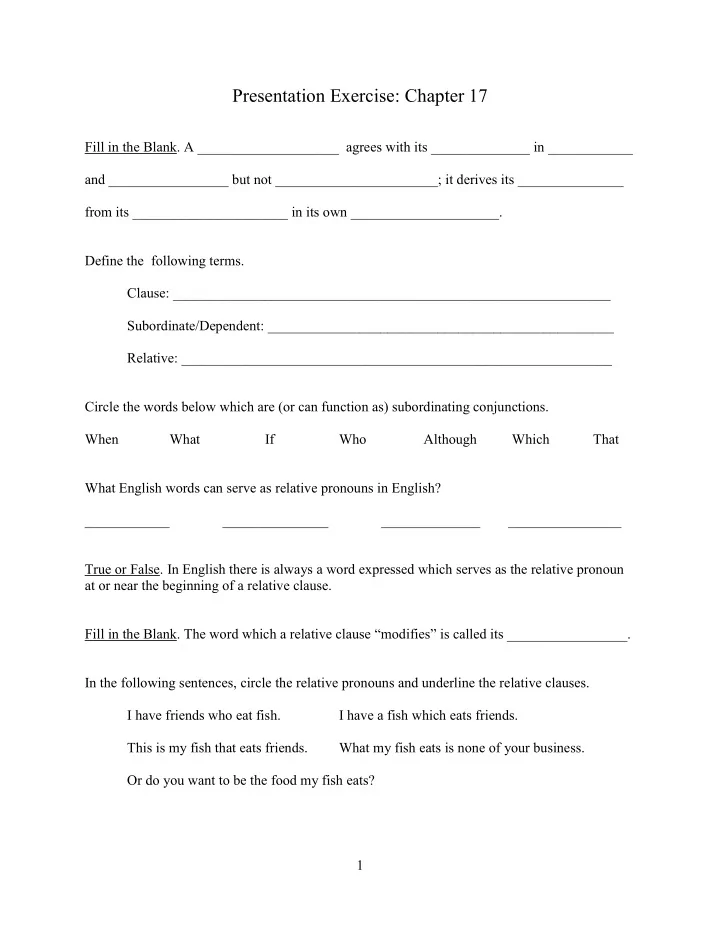
Presentation Exercise: Chapter 17 Fill in the Blank. A - - PDF document
Presentation Exercise: Chapter 17 Fill in the Blank. A ____________________ agrees with its ______________ in ____________ and _________________ but not _______________________; it derives its _______________ from its ______________________ in
SLIDE 2
SLIDE 3
3 Fill in the Blank. Supply the proper form (“Whose” or “Who’s”) in the sentences below. _____________ car is that? ________________ on first base? Circle the cases below where English does or can use “whom” (alone or with a preposition) to translate the Latin relative pronoun. Nominative Genitive Dative Accusative Ablative True or False. English “which” is never used to translate a masculine or feminine Latin relative pronoun. Multiple Choice. The case of a relative pronoun is determined by
- a. the case of its antecedent
- c. its use in its own clause
- b. apposition
- d. good guessing
Sentence Grammar. “Cops finally capture student who murdered Latin teacher.” Circle the relative pronoun in the sentence above, and underline the relative clause. If this sentence were in Latin, … … what case would the antecedent “student” be in? ______________________________ … what number and gender would the antecedent “student” be? ____________________ … what case would the relative pronoun be in? _________________________________ … give the proper Latin form of the relative pronoun which would be used here. _______ In each of the sentences on the following page: 1) circle the relative pronoun; 2) underline its antecedent; 3) give the number and gender of the antecedent; 4) give the case of the relative pronoun (as determined by its use in its own clause); 5) give the correct form of the Latin relative pronoun for that sentence.
SLIDE 4
4
- 1. Amo puellam quae ex Italiā venit. (“I love the girl who came from Italy.”)
Number/Gender of Antecedent: ______________ Case of Relative Pronoun: ______________ Proper Form of the Relative Pronoun: ______________________________________________
- 2. Homo de quo dicebas est stultus. (“The man about whom you were speaking is stupid.”)
Number/Gender of Antecedent: ______________ Case of Relative Pronoun: ______________ Proper Form of the Relative Pronoun: ______________________________________________
- 3. Puella cui librum dat est bella. (“The girl to whom he is giving the book is pretty.”)
Number/Gender of Antecedent: ______________ Case of Relative Pronoun: ______________ Proper Form of the Relative Pronoun: ______________________________________________
- 4. Puer cuius patrem iuvabamus est miser. (“The boy whose father we used to help is
unfortunate.”) Number/Gender of Antecedent: ______________ Case of Relative Pronoun: ______________ Proper Form of the Relative Pronoun: ______________________________________________
- 5. Vitam meam committam eis viris quorum virtutes laudabas. (“I will entrust my life to those
men whose virtues you used to praise.”) Number/Gender of Antecedent: ______________ Case of Relative Pronoun: ______________ Proper Form of the Relative Pronoun: ______________________________________________
- 6. Timeo periculum quod timetis. (“I fear the danger which y'all fear.”)
Number/Gender of Antecedent: ______________ Case of Relative Pronoun: ______________ Proper Form of the Relative Pronoun: ______________________________________________
SLIDE 5