Presentation, complications and Mustapha MG Ashir GM management - - PDF document

presentation complications and
SMART_READER_LITE
LIVE PREVIEW

Presentation, complications and Mustapha MG Ashir GM management - - PDF document

ORIGINAL Niger J Paed 2013; 40 (1): 30 33 Presentation, complications and Mustapha MG Ashir GM management outcome of community Alhaji MA acquired pneumonia in hospitalized Rabasa AI children in Maiduguri, Nigeria. Ibrahim BA Mustapha Z


slide-1
SLIDE 1

ORIGINAL Niger J Paed 2013; 40 (1): 30 –33

Mustapha MG Ashir GM Alhaji MA Rabasa AI Ibrahim BA Mustapha Z

Presentation, complications and management outcome of community acquired pneumonia in hospitalized children in Maiduguri, Nigeria.

Accepted: 10th June 2012 Mustapha MG Ashir GM, Alhaji MA, Rabasa AI, Ibrahim BA. Department of Paediatrics, Mustapha Z Department of Radiology, University of Maiduguri Teaching Hospital, Maiduguri, Nigeria. PMB 1414, Maiduguri. Tel: +2348038087639 Email: mgofama@yahoo.com ( ) DOI:http://dx.doi.org/10.4314/njp.v40i1.5

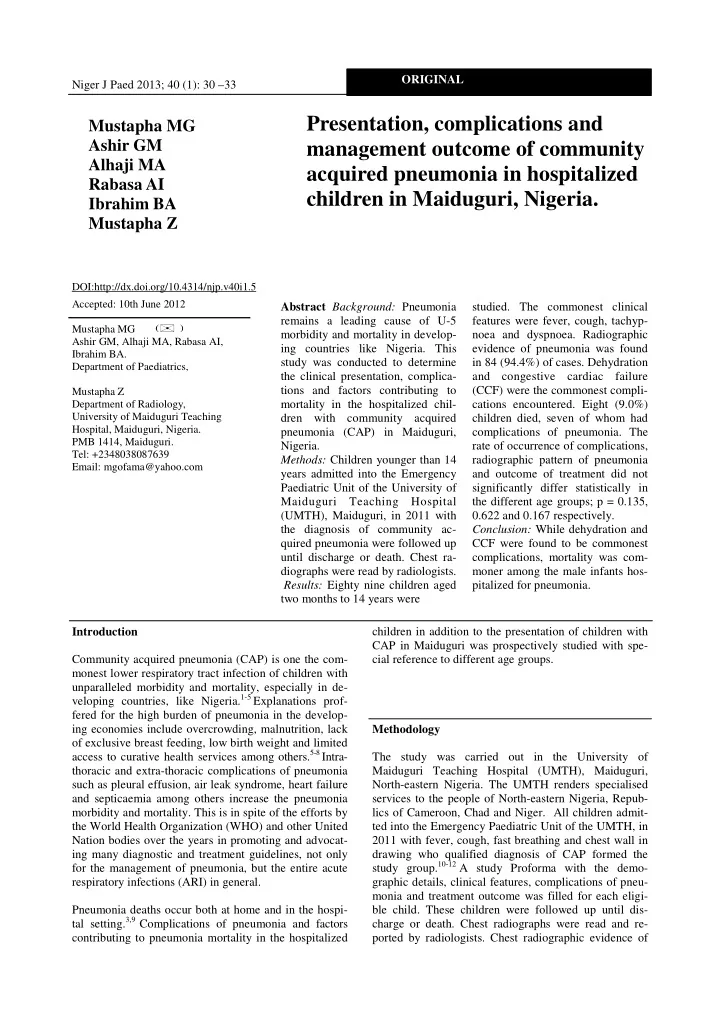
Abstract Background: Pneumonia remains a leading cause of U-5 morbidity and mortality in develop- ing countries like Nigeria. This study was conducted to determine the clinical presentation, complica- tions and factors contributing to mortality in the hospitalized chil- dren with community acquired pneumonia (CAP) in Maiduguri, Nigeria. Methods: Children younger than 14 years admitted into the Emergency Paediatric Unit of the University of Maiduguri Teaching Hospital (UMTH), Maiduguri, in 2011 with the diagnosis of community ac- quired pneumonia were followed up until discharge or death. Chest ra- diographs were read by radiologists. Results: Eighty nine children aged two months to 14 years were

  • studied. The commonest clinical

features were fever, cough, tachyp- noea and dyspnoea. Radiographic evidence of pneumonia was found in 84 (94.4%) of cases. Dehydration and congestive cardiac failure (CCF) were the commonest compli- cations encountered. Eight (9.0%) children died, seven of whom had complications of pneumonia. The rate of occurrence of complications, radiographic pattern of pneumonia and outcome of treatment did not significantly differ statistically in the different age groups; p = 0.135, 0.622 and 0.167 respectively. Conclusion: While dehydration and CCF were found to be commonest complications, mortality was com- moner among the male infants hos- pitalized for pneumonia. Introduction Community acquired pneumonia (CAP) is one the com- monest lower respiratory tract infection of children with unparalleled morbidity and mortality, especially in de- veloping countries, like Nigeria.1-5 Explanations prof- fered for the high burden of pneumonia in the develop- ing economies include overcrowding, malnutrition, lack

  • f exclusive breast feeding, low birth weight and limited

access to curative health services among others.5-8 Intra- thoracic and extra-thoracic complications of pneumonia such as pleural effusion, air leak syndrome, heart failure and septicaemia among others increase the pneumonia morbidity and mortality. This is in spite of the efforts by the World Health Organization (WHO) and other United Nation bodies over the years in promoting and advocat- ing many diagnostic and treatment guidelines, not only for the management of pneumonia, but the entire acute respiratory infections (ARI) in general. Pneumonia deaths occur both at home and in the hospi- tal setting.3,9 Complications of pneumonia and factors contributing to pneumonia mortality in the hospitalized children in addition to the presentation of children with CAP in Maiduguri was prospectively studied with spe- cial reference to different age groups. Methodology The study was carried out in the University of Maiduguri Teaching Hospital (UMTH), Maiduguri, North-eastern Nigeria. The UMTH renders specialised services to the people of North-eastern Nigeria, Repub- lics of Cameroon, Chad and Niger. All children admit- ted into the Emergency Paediatric Unit of the UMTH, in 2011 with fever, cough, fast breathing and chest wall in drawing who qualified diagnosis of CAP formed the study group.10-12 A study Proforma with the demo- graphic details, clinical features, complications of pneu- monia and treatment outcome was filled for each eligi- ble child. These children were followed up until dis- charge or death. Chest radiographs were read and re- ported by radiologists. Chest radiographic evidence of

slide-2
SLIDE 2

pneumonia includes homogeneous opacity and/or patchy infiltrates of the lung parenchyma consistent with con- solidation with or without other radiographic features of

  • pneumonia. Children with incompletely filled records

and those who did not have chest radiograph were ex-

  • cluded. Children found to have HIV infection, hospital

acquired pneumonia or aspiration pneumonia were also excluded. Data generated was entered into a computer and ana- lyzed using SPSS version 16. Results were given in pro- portions, percentages and tables. Comparisons between groups were done with appropriate chi-square test and a p-value of < 0.05 was considered significant. Results Eighty nine of the children admitted for pneumonia met the study criteria, 26 did not and thus excluded. The age ranged from two months to 14 years and the mean age (SD) was 18.44 (128.76) months. The male to female ratio was 1.5:1, but the male to female ratio was 5:1 in the age group 1-6 months. Eighty four (94.4%) of the children were U-5. The age and sex distribution of the children is shown in table 1. Table 1: Age group and sex distribution of the study population Clinical features at admission showed that cough and fast breathing were found in 98.8% of the children, table

  • 2. Five, four and eight care givers were not sure of prior

history of common cold, history of contact with person (s) with common cold and history of prior exposure to cold weather respectively. Table 2: Frequency of clinical features in study patients Sex

Age (months) Male (%) Female (%) Total (%) 1-6 20(22.47) 4(4.49) 24(26.96) 7-12 13(14.60) 14(15.73) 27(30.33) >12-59 19(21.34) 14(15.73) 33(37.07) > 59 2(2.24) 3(3.37) 5(5.61) Total 54(60.7) 35(39.3) 89(100.00)

Dehydration and congestive cardiac failure were the most prevalent complications (Table 3). No complica- tion was detected in 43 (48.3%) of the children studied. Chest radiographs of 84 (94.4%) of the children were suggestive of pneumonia; the remaining five were re- ported as normal, (Table 3). While 81(91%) of the pa- tients recovered and were discharged home, the outcome was fatal in eight of them (Table 3). The prevalence of complications, radiographic pattern of pneumonia and

  • utcome of treatment did not significantly differ signifi-

cantly in the different age groups; p = 0.135, 0.622 and 0.167 respectively. Further analysis of the eight fatal cases revealed that four had convulsions and three had CCF as complication. However, no complication was identified in the remaining child. Although, the mortal- ity rate among the males and females was seven and one respectively, no significant statistical difference was found (p = 0.140). Table 3: Age related complications, radiographic pattern and outcome of treatment of CAP.

Note: Some children had more than one complication, H pneumoth: Hydropneumothorax. CCF: congestive cardiac failure

Discussion The importance of pneumonia in particular and ARI in general to public health and especially in children can- not be over emphasized. The fact that the majority of the patients were U-5, underlines the significant contribu- tion of pneumonia to U-5 morbidity, similar to observa- tions made previously.1,2,8,10 The preponderance of in- fants in general and that of males among the children younger than six months in this study, may be attributed to the incomplete development of the immune system and the increased risks to infection of the males of this age.13,14 Fever, cough and fast breathing found in major- ity of children in this study are the hallmark for the clinical diagnosis of pneumonia, especially in chil- dren.2,15 Anorexia, vomiting and diarrhoea, although not specific respiratory symptoms, are usually found in chil- dren with pneumonia as earlier reported.2,15

Clinical Feature No of patients (per cent) Fever 84(94.4) Cough 88(99.8) Fast breathing 88(99.8) History of recent common cold 36(40.4) Contact with individual with common cold 13(14.6) History of exposure to cold weather 24(26.9) Poor appetite 67(75.3) Vomiting 49(55.1) Diarrhoea 48(53.9) Dypsnoea 89(100) Hepatomegaly 44(49.4) Splenomegaly 7(7.8) Age group (months) 1 to 6 7 to 12 > 12 to 59 ≥ 60 n = 24 n = 27 n = 33 n = 5 Complications CCF 7(29.2) 5 (18.5) 6 (18.2) 0(0.0) Seizures 4 (16.7) 3 (11.1) 1(3.0) 0(.0) Dehydration 6 (25.0) 9 (33.3) 12 (36.4) 0(0.0) Pyothorax 0 (0.0) 2 (7.4) 0 (0.0) 1(20.0) Hydropneumothorax 0 (0.0) 0 (0.0) 1(3.0) 0(0.0) None 9 (37.5) 11(40.7) 17(51.5) 4(80.0) Chest radiographic finding Bronchopneumonia 22(91.6) 24(88.9) 29(87.9) 4(80.0) Lobar pneumonia 1(4.2) 3(11.1) 1(3.0) 0(0.0) Normal radiograph 1(4.2) 0(0.0) 3(9.1) 1(20.0) Outcome Recovered 19(79.2) 25(92.6) 32(97.0) 5(100) Died 5(20.8) 2(7.4) 1(3.0) 0(0.0)

31

slide-3
SLIDE 3

These symptoms occur due to the systemic inflamma- tory effect of pneumonia. Majority of the subjects had complications directly at- tributable to pneumonia. This calls for a deliberate look for such complications in children with pneumonia. De- hydration was the commonest complication encountered but it is not usually reported as a common complication

  • f pneumonia. This may be due to the fact that most

authors lay emphasis on the direct and local complica- tions of pneumonia. Dehydration in children with pneu- monia in the present study may be due to increased in- sensible fluid loss; through the skin and the airways. This is important as majority of the subjects were in- fants; who are known to have high total body water, which makes them at risk of increased fluid loss. Diarrhoea, vomiting and poor intake found in significant proportion of the children studied can all contribute to

  • dehydration. Small body size compared to relative large

body surface area of the children (over half of children studied younger than 12 months), also predisposes them increased fluid loss and thus dehydration. Another factor contributing to dehydration in the study patients is the weather effect of Maiduguri. Like other Sahel regions of the world Maiduguri is generally dry, sunny, and hot with low humidity; these factors contribute to fluid loss via several mechanisms. Congestive cardiac failure (CCF) is a common compli- cation of pneumonia seen in this study. Fagbule et al2, reported a CCF prevalence of up to 46%, in a study con- ducted at Ilorin Teaching Hospital. Other authors have also reported CCF to be one of the common complica- tion pneumonia in children.8,16,17 Pulmonary hyperten- sion manifesting as cor pulmonale, as quoted by Shan et al18 may be the cause of heart failure in children with

  • pneumonia. Other causes are pericarditis and myocardi-

tis. While the low prevalence of pyothorax and pneumotho- rax in this study is similar to previous reports,2,16 few cite seizures as a common complication of pneumonia; probably because it is extra-thoracic. Convulsion; an acute encephalopathy in children with pneumonia in the present study may be due to febrile convulsion. It can also be a feature of sepsis manifesting as multi-organ dysfunction (MOD) in general or can arise from a secon- dary meningitis following embolic phenomena from

  • pneumonia. Olowu and Njokanma reported febrile con-

vulsion as the most prevalent complication of pneumo- nia following CCF and metabolic acidosis.16 Although there was no significant difference of the prevalence of complications and age in this study, it was reported that the prevalence of complications of pneumonia is in- versely proportional to age.19 While the chest radiograph is the standard diagnostic investigation for pneumonia, the issue of sensitivity of chest radiography in detecting pulmonary infiltrates, the accuracy of the interpretations of chest radiographs, and when should chest radiography be ordered in pa- tients with pneumonia still remains unresolved.20 Some authors have reported it to be less sensitive than high resolution CT scans in detecting pulmonary infiltrates.20 In a study of 2000 children with WHO non severe pneu- monia; children with fast breathing, an outrageous 82% were reported to have normal chest radiographs,21 com- pared to only 5.6% obtained in this study. This is proba- bly because the categories of patients studied were dif-

  • ferent. In this study, all the children met the WHO crite-

ria for severe or very severe pneumonia, which perhaps explains the high proportion of children with radiologi- cal evidence of pneumonia. While a normal chest radiograph does not exclude pneu- monia as it may not detect early changes of the dis- ease,22 the presence of other clinical features of pneumo- nia in addition to fast breathing may provide a better assessment of the child for pneumonia, as fast breathing in a coughing child could be explained by many disease

  • conditions. Of 75 children with pneumonia, Fagbule et

al2 found patchy consolidation and punctuate perihilar

  • pacities in 33 and 12 children, while lobar consolida-

tion and normal chest radiographs were found in nine and two children respectively. That study was done in hospitalized children like the present study, thus, the similarity of radiographic findings. The high prevalence

  • f bronchopneumonia in younger children compared to
  • lder ones seen in this study was reported earlier.16 This

may perhaps be due to the less ability of the younger children compared to older ones or adults in localizing infection. The mortality of hospitalized children with pneumonia in the present study of 9% is similar to 10% and 10.5% earlier reported,2,7 The high proportion of complications among the dead children calls for the need to actively and deliberately look for such complications in all hos- pitalized children. Similar to the finding in the present study, Fagbule and Adedoyin earlier reported the high rate of mortality in the young and in children with com- plications of pneumonia.23 The high rate of mortality among the infants in the present study may be as a result

  • f the combination of complications in addition to the

sub optimal state of immunity in the younger children.14 Although, the clinical diagnosis of pneumonia is simple, complications and deaths are common especially among the male hospitalized children. Certain predisposing factors and important complications of pneumonia such as septicaemia, septic embolic phenomena, syndrome of inappropriate anti diuretic hormone secretion were not looked for in this study, perhaps due to their occult oc-

  • currence. We recommend that complications such as

dehydration and CCF be looked for in all children hospi- talized for pneumonia. 32

slide-4
SLIDE 4

References

  • 1. Theodore CS, Charles GP. Pneu-
  • monia. In: Kliegman RM, Behr-

man RE, Jerson HB, Editors. Nelson Textbook of Paediatrics, 17th Edition, Philadelphia Saun- ders, USA. 2004:1432-1435.

  • 2. Fagule D, Adedoyin MA, Nzeh
  • DA. Childhood pneumonia in the

university of Ilorin Teaching hos-

  • pital. Nig J Paed 1987; 14: 73-78
  • 3. Akang EEU, Asinobi AO, Fatunde

OJ, Pindiga HU, Okpala JU, Abiola AO, Aghadiuno PU. Child- hood mortality in Ibadan: an au- topsy study. Nig J Paed 1992; 19: 30–36Bottom of Form

  • 4. Igor R, Cynthia B, Zrinka B, Kim

M, Harry C. Epidemiology and etiology of childhood pneumonia. Bull WHO 2008; 86: 408-416.

  • 5. Stephen MG, Mike E, Tabish H,

Penny E, Trevor D. Challenges to improving case management of childhood pneumonia at health facilities in resource-limited set-

  • tings. Bull WHO 2008; 86: 349–

355.

  • 6. Zulfiqar AB. Dealing with child-

hood pneumonia in developing countries: how can we make a difference? Arch Dis Child 2007; 92: 286–288.

  • 7. Karalanglin T, Rakesh L, Ravindra

MP, Shobha B, Kalaivani M, Sushil K K. Factors determining the outcome of children hospital- ized with severe pneumonia. BMC Pediatrics 2009; 9: 1-8

  • 8. Aderele WI, Johnson AWGR.
  • Pneumonias. In Azubuike JC and

Nkanginieme KEO editors. Paedi- atrics and child health in a tropical

  • region. Owerri. Afr Educational

services: 2007; 425-441. 9. Karin K, Helena H, Peter W, Ed- ward G, Stefan P, George P. De- layed care seeking for fatal pneu- monia in children aged under five years in Uganda: a case-series

  • study. Bull WHO 2008; 86: 332–

338.

  • 10. Frank S, Kate H, David T. Acute

lower respiratory tract infections in children: possible criteria for se- lection of patients for antibiotic therapy and hospital admission. Bull WHO 1984; 62 (5): 749 – 753.

  • 11. Whittle J, Fine MJ, Joyce DZ,

Lave JR, Young WW, Hough LJ, Kapoor WN. Community- Acquired Pneumonia: Can It Be Defined with Claims Data? Am J Med Qual 1997 12: 187.

  • 12. Ostapchuk M, Roberts DM, Haddy
  • R. Community acquired pneumo-

nia in infants and children. Am Fam Physician. 2004; 70: 899- 908.

  • 13. Ibe BC. Neonatal infection. In

Azubuike JC and Nkanginieme KEO editors. Paediatrics and child health in a tropical region. Owerri. Afr Educational services: 2007; 197-203.

  • 14. Buckley RH. Evaluation of the

immune system. In: Kliegman RM, Behrman RE, Jerson HB,

  • Editors. Nelson Textbook of Pae-

diatrics, 17th Edition. Philadel- phia, Saunders, 2004: 681-700

  • 15. Bennett NJ, Steele RW, Do-

machowke J, Ramero JR, Barton

  • LL. Pediatric pneumonia. http: //

www.e medicine.medscape.com/ article/967822, accessed April 2012.

  • 16. Olowu AO, Njokanma FO. Pneu-

monia in Sagamu. Niger J Paed 1993; 20: 49-54.

  • 17. Oyedeji OA, Oluwayemi IO,

Oyedeji AT, Okeniyi JA, Fadero

  • FF. Heart failure in Nigerian chil-
  • dren. The Cardiol 2010; 5: 18-22.
  • 18. Shann F, Macgregor D, Richens J,

Coakley J. Cardiac failure in chil- dren with pneumonia in Papua New Guinea. Pediatr Infect Dis J 1998; 17: 1141-1143.

  • 19. Grace E. Lee GE, Lorch SA, Shef-

fler-Collins S, Kronman MP, Shah

  • SS. National Hospitalization

Trends for Pediatric Pneumonia and Associated Complications. Pediatrics 2010; 126:204-213.

  • 20. Lionel AM, Thomas JM, Ronald

FG, Anthony WC, Robert HH and the Canadian Community- Acquired Pneumonia Working

  • Group. Canadian Guidelines for

the Initial Management of Com- munity-Acquired Pneumonia: An Evidence-Based Update by the Canadian Infectious Diseases Soci- ety and the Canadian Thoracic

  • Society. Clin Infect Dis 2000; 31:

383–421.

  • 21. Hazir T, Nisar YB, Qazi SA,

Khan SF, Raza M, Zameer S, Masood SA. Chest radiography in children aged 2-59 months diag- nosed with non-severe pneumonia as defined by World Health Or- ganization: descriptive multicentre study in Pakistan. BMJ 2006; doi:10.1136/bmj.38915.673322.80

  • 22. Friis B, Eiken M, Hornsleth A,

Jensen A. Chest X-ray appearances in pneumonia and bronchiolitis. Correlation to virological diagnosis and bacterial findings. Acta Paedi- atr Scand 1990; 79: 219-25.

  • 23. Fagbule D, Adedoyin MA. Clinical

predictors of outcome in childhood

  • pneumonia. Niger J Paed 1990;

17: 37-41.

33