
SLIDE 1
Presentation by: Debendra Dalai, IFS Director Science, Technology and Renewable Energy
Presentation by: Debendra Dalai, IFS Director Science, Technology - - PowerPoint PPT Presentation
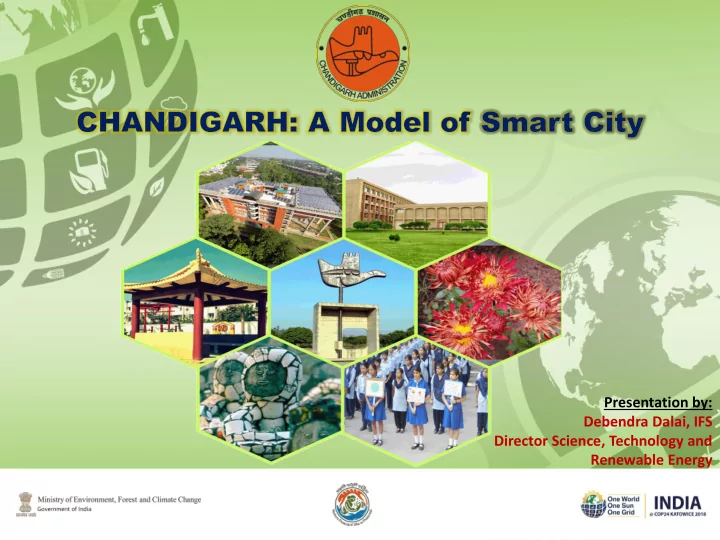
Presentation by: Debendra Dalai, IFS Director Science, Technology and Renewable Energy Chandigarh is one of the early planned cities in post- independence India and is internationally known for its architecture and urban design.
Presentation by: Debendra Dalai, IFS Director Science, Technology and Renewable Energy
planned cities in post- independence India and is internationally known for its architecture and urban design. Born as a direct result of a violent and black period of Indian history- “the partition”, Chandigarh has acquired the unique distinction of being a capital to two states i.e. Haryana & Punjab.
mother goddess
power “Chandi”, whose temple “Chandimandir” is located in vicinity
for the city.
Urban Planning in U.T., Chandigarh. Tree plantation along avenues, open spaces, green belts and around building complexes are enthralling features of the city.
conspicuous tree species, well wooded forests along the periphery of city, ‘Sukhna lake’ against the backdrop of Lake Reserve Forests, green belts running across the length and breath of the city and a beautiful ‘Sukhna Wildlife Sanctuary’ on its periphery, further enhance the ecological, environment and aesthetic richness of the city.
Chandigarh is blessed with 57.56 sq. km.
green cover which is
41.11% of UT’s total area. This
57.56 sq. km. includes 10.00 sq. km
Forest cover.
39 % increase in green cover.
urban forestry are Road Avenues, Gardens, Greenbelts, Plantation in institutes, Herbal Gardens in schools & colleges.
annual greening action plan which defines stakeholder wise targets for plantation has a important role in increase of urban forestry
Greening Action Pla lan (G (GAP)
look into all aspects of the Silvicultural & Horticultural operations within the Union Territory of Chandigarh; Greening Chandigarh Task Group has been constituted for the preparation of annual GAP.
strategies to achieve the desired results by streamlining and unifying the efforts and inputs
etc.
year 2017-18.
The Smart Cities Mission was announced by the Government of India in June 2015. Chandigarh was selected under Smart City Mission in second round i.e. fast track round with the SPV (Special Purposed Vehicle) structure named as CSCL (Chandigarh Smart City Limited) which was formed in 2016.
Introduction Strategies for the Smart City Mission
In context of Chandigarh smart City the Area Based Development (ABD) proposal aspires to address the key issues that emerged out of citizen engagement and focuses on the theme of “Prevention is better than cure”. The ABD proposal envisions retrofit of 1265 acres in the heart
the city into a vibrant regional destination.
The ABD Area of Chandigarh as a model smart area has a huge potential of becoming a model smart area with the following features:
mobility with innovative transportation solutions ensuring last-mile connectivity.
lifestyle choices; walk able, disable-friendly and well-connected; compact and mixed-use area with investments in green infrastructure.
Strategies for the Smart City Mission
CSCL plans to introduce a Bike Sharing System to provide a low-cost, environmentally friendly mobility option to city residents. Bike sharing is a flexible system
personalized public
spaced network of semi-automated stations. Users can check out bikes at one station and return them to any other station within the network. Bike sharing is a key element in a city’s strategy to expand the use of sustainable transport modes.
Public Bike Sharing System
Pan City proposal is to improve public life and safety, and livability through integration and implementation of smart solutions:
A unified portal to access services with a personalized profile based mobile app which will act as one stop app and a gateway to enable tow way citizen engagement.
center To supplement the ongoing individual initiatives Intelligent Traffic Management System (ITMS) coupled with city surveillance project shall form the basis for setting up of a unified command and control center doubling up as disaster management cell.
Both initiatives will use common cloud based Infrastructure solution and operation, data integration platforms having unified database.
SMART INFRASTRUCTURE URBAN INFRASTRUCTURE IMPROVEMENTS WASTE WATER SYSTEM
POWER DISTRIBUTION NETWORK
POLES
SOLID WASTE MANAGEMENT
collection vehicles, Bio- Methanation plant (De centralized),
POTABLE WATER
DMAs
Model Solar City and the Master Plan was approved by Ministry of New & Renewable Energy (MNRE), GOI in Feb. 2012.
target for Chandigarh Administration to be achieved by 2022.
have been identified to achieve the target, Chandigarh has already installed & commissioned 25 MWp Grid tied Rooftop Solar Plants so far.
17.961 MWp has been installed
260 Government Buildings and 5.526 MWp installed on 533 private buildings including residential houses.
MU of Solar Energy (in about last five years) which is equivalent to reduction of 33195 metric ton of CO2.
the existing building bye-laws of Chandigarh where it has been made mandatory to install SPV Power Plants
Commercial sector.
Unique Achievements of f Chandigarh
the city.
Union Territory.
meets the 100% requirement of power of the all the Govt. Schools.
State Bus Terminals of City, meeting their 100% in-house need.
Solar Power.
Expected Outcome
that can be emulated by other cities world over for a Green Smart City including meeting their energy requirement through RE and reducing dependence over conventional sources.
remarkably increased its green cover and integrating towards city with lesser carbon footprints.
to fight the malice of climate change.