+ Normal node Clusterhead 2. 2. Clusters at the edge of network - - PDF document

normal node clusterhead 2 2 clusters at the edge of
SMART_READER_LITE
LIVE PREVIEW

+ Normal node Clusterhead 2. 2. Clusters at the edge of network - - PDF document

Overview Overview Motivation Motivation Self- Self -Organized Data Organized Data- -Energy Energy- -Aware Clustering Aware Clustering Self Self- -Organization Organization and Routing for Wireless Sensor Networks and


slide-1
SLIDE 1

1

Self Self-

  • Organized Data

Organized Data-

  • Energy

Energy-

  • Aware Clustering

Aware Clustering and Routing for Wireless Sensor Networks and Routing for Wireless Sensor Networks

Ehssan Ehssan Sakhaee Sakhaee, Naoki , Naoki Wakamiya Wakamiya, Masayuki Murata , Masayuki Murata Graduate School of Information Science and Technology, Osaka Graduate School of Information Science and Technology, Osaka University, JAPAN University, JAPAN

The 2009 International Symposium on Embedded and Pervasive Syste The 2009 International Symposium on Embedded and Pervasive Systems (EPS ms (EPS-

  • 09)

09) In conjunction with the 7th IEEE/IFIP International Conference o In conjunction with the 7th IEEE/IFIP International Conference on Embedded and n Embedded and Ubiquitous Computing (EUC Ubiquitous Computing (EUC-

  • 09)

09) Session B27 Session B27 -

  • August 30, 2009

August 30, 2009 Vancouver, CANADA Vancouver, CANADA

EPS 2009 Self-Organized Data-Energy-Aware Clustering and Routing for Wireless Sensor Networks 2

Overview Overview

  • Motivation

Motivation

  • Self

Self-

  • Organization

Organization

  • Data size as a metric

Data size as a metric

  • Proposed Clustering and Routing Protocol (DECRO)

Proposed Clustering and Routing Protocol (DECRO)

  • Evaluation of

Evaluation of Proped Proped protocol protocol

  • Conclusion and Future Work

Conclusion and Future Work

EPS 2009 Self-Organized Data-Energy-Aware Clustering and Routing for Wireless Sensor Networks 3

Self Self-

  • organizing systems
  • rganizing systems
  • In

In self self-

  • organizing
  • rganizing systems, individual entities react

systems, individual entities react by following by following common rules common rules based on based on local local environment without any centralized control environment without any centralized control. .

  • Purely distributed, and no single point of failure!

Purely distributed, and no single point of failure!

  • In our model:

In our model:

  • Feedback using exchange of messages

Feedback using exchange of messages between between neighboring nodes neighboring nodes

  • All nodes follow the same rules

All nodes follow the same rules

EPS 2009 Self-Organized Data-Energy-Aware Clustering and Routing for Wireless Sensor Networks 4

Data Size as a Metric Data Size as a Metric

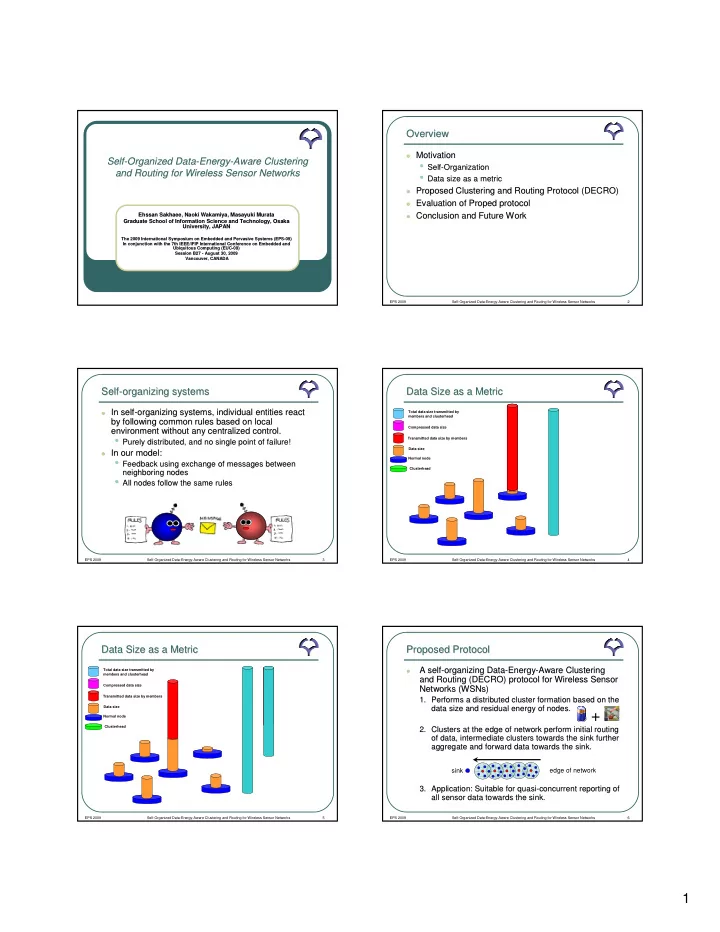
Data size Normal node Transmitted data size by members Clusterhead Compressed data size Total data size transmitted by members and clusterhead EPS 2009 Self-Organized Data-Energy-Aware Clustering and Routing for Wireless Sensor Networks 5

Data Size as a Metric Data Size as a Metric

Data size Normal node Transmitted data size by members Clusterhead Compressed data size Total data size transmitted by members and clusterhead EPS 2009 Self-Organized Data-Energy-Aware Clustering and Routing for Wireless Sensor Networks 6

Proposed Protocol Proposed Protocol

  • A self

A self-

  • organizing Data
  • rganizing Data-
  • Energy

Energy-

  • Aware Clustering

Aware Clustering and Routing (DECRO) protocol for Wireless Sensor and Routing (DECRO) protocol for Wireless Sensor Networks ( Networks (WSNs WSNs) )

1.

  • 1. Performs a distributed cluster formation based on the

Performs a distributed cluster formation based on the data size and residual energy of nodes. data size and residual energy of nodes. 2.

  • 2. Clusters at the edge of network perform initial routing

Clusters at the edge of network perform initial routing

  • f data, intermediate clusters towards the sink further
  • f data, intermediate clusters towards the sink further

aggregate and forward data towards the sink. aggregate and forward data towards the sink. 3.

  • 3. Application: Suitable for quasi

Application: Suitable for quasi-

  • concurrent reporting of

concurrent reporting of all sensor data towards the sink. all sensor data towards the sink.

+

sink edge of network

slide-2
SLIDE 2

2

EPS 2009 Self-Organized Data-Energy-Aware Clustering and Routing for Wireless Sensor Networks 7

DECRO Mechanism DECRO Mechanism

1 1 1 3 5 1 1 1 3 3 4 5 5 6 1 5 4 4 4 5 4 3 5 4 2 2 5 6 6 5 1 1 Lower Neighboring Cluster (LNC) Highest Cluster (HC) 1 1 1 1 1 1 1 1 1 1 1 1 1 1 1 1 2 2 1 3 3 3 3 4 4 4 4 4 5 5 5 5 5 5 5 6 6 6 6 6

  • 1. Hopcount-to-Sink

Initialization Phase

  • 2. Cluster Formation Phase
  • 3. Data Gathering Phase
  • 4. Routing Phase

sink

Costi = emax – ei + (ui + ut)d-1

agg ET + utER

Lowest HoTS, highest energy GW Eic = ei – eiCMD - uiET

Intermediate clusters await for data from higher clusters for further aggregation.

EPS 2009 Self-Organized Data-Energy-Aware Clustering and Routing for Wireless Sensor Networks 8

Flowchart of DECRO Flowchart of DECRO

tc expired? Become CH Send CHC

YES NO

Become CM/GW HC?

YES NO

thnc expired?

YES YES

Unicast CMD to best CH Listen for CMD Wait until tc(max) expires Wait until tc(max) expires AGW?

YES

Listen for NAD Sleep Unicast NAD Sleep

NO

tr expired? CH?

NO NO

Broadcast HoTSIM Wait tw Calculate cost Set backoff timer tc, tc(max)

EPS 2009 Self-Organized Data-Energy-Aware Clustering and Routing for Wireless Sensor Networks 9

Evaluation of DECRO Evaluation of DECRO

  • Parameter Setup

Parameter Setup

  • 10,000 nodes uniformly distributed

10,000 nodes uniformly distributed

  • Simulation area 500 m by 500 m

Simulation area 500 m by 500 m

  • 500nJ/bit for transmitter and receiver circuitry

500nJ/bit for transmitter and receiver circuitry

  • 100pJ/bit/m

100pJ/bit/m2

2 transmitter amplifier

transmitter amplifier

  • Nodes have variable data sizes of up to 8000 bits.

Nodes have variable data sizes of up to 8000 bits.

EPS 2009 Self-Organized Data-Energy-Aware Clustering and Routing for Wireless Sensor Networks 10

sink

Emerging Network Emerging Network

EPS 2009 Self-Organized Data-Energy-Aware Clustering and Routing for Wireless Sensor Networks 11

Total Network Energy with Varying Data Aggregation Total Network Energy with Varying Data Aggregation Efficiency Efficiency

EPS 2009 Self-Organized Data-Energy-Aware Clustering and Routing for Wireless Sensor Networks 12

Average number of GW and non Average number of GW and non-

  • GW members formed

GW members formed per cluster with varying transmission range. per cluster with varying transmission range.

slide-3
SLIDE 3

3

EPS 2009 Self-Organized Data-Energy-Aware Clustering and Routing for Wireless Sensor Networks 13

Relative energy consumption of CHs, Relative energy consumption of CHs, GWs GWs, and non , and non-

  • GWs

GWs. .

EPS 2009 Self-Organized Data-Energy-Aware Clustering and Routing for Wireless Sensor Networks 14

Total energy consumed Total energy consumed vs vs number of reports for number of reports for HEED HEED-

  • ER and DECRO with varying aggregation

ER and DECRO with varying aggregation

0.00 5.00 10.00 15.00 20.00 25.00 30.00 35.00 1 2 3 4 5 6 7 8 9 10

  • no. of reports

total energy consumed by network(kJ) HEED-ER(0%) DECRO(0%) HEED-ER(50%) DECRO(50%) HEED-ER(90%) DECRO(90%)

EPS 2009 Self-Organized Data-Energy-Aware Clustering and Routing for Wireless Sensor Networks 15

Conclusion and Future Work Conclusion and Future Work

  • Introduced DECRO, a self

Introduced DECRO, a self-

  • organized clustering
  • rganized clustering

consisting of several phases. consisting of several phases.

  • Suitable for quasi

Suitable for quasi-

  • concurrent reporting of sensors

concurrent reporting of sensors’ ’ data to the sink. data to the sink.

  • Simulation results show the effectiveness of DECRO

Simulation results show the effectiveness of DECRO in efficiently gathering and reporting data to the sink. in efficiently gathering and reporting data to the sink.

  • Future work should investigate the effects of various

Future work should investigate the effects of various MAC MAC-

  • protocol implementations on the system.

protocol implementations on the system.

EPS 2009 Self-Organized Data-Energy-Aware Clustering and Routing for Wireless Sensor Networks 16

Thank You.