SLIDE 1
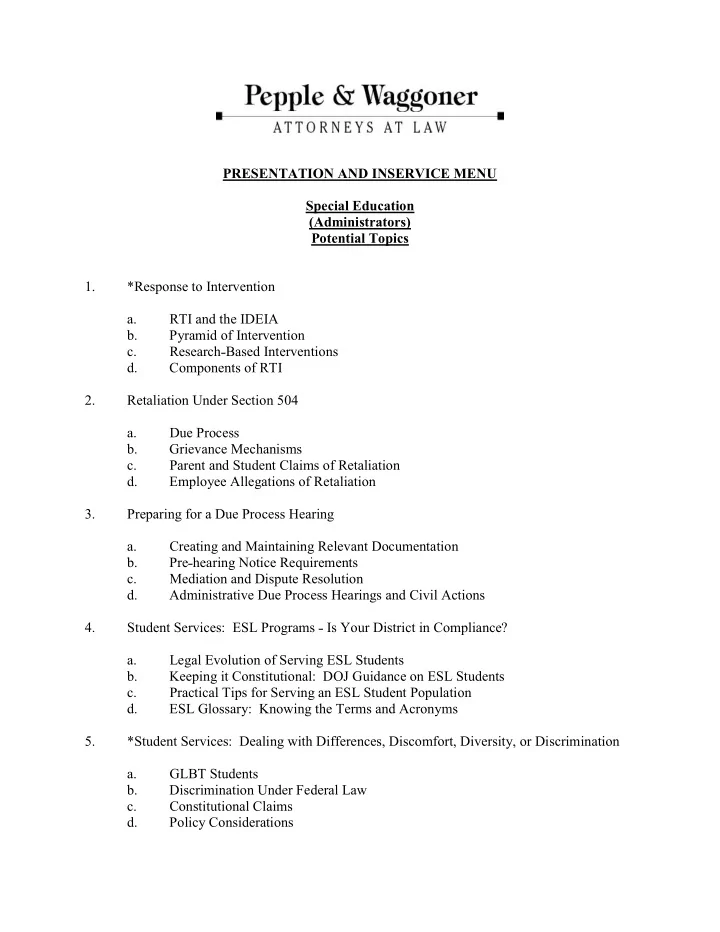
PRESENTATION AND INSERVICE MENU Special Education (Administrators) Potential Topics 1. *Response to Intervention a. RTI and the IDEIA b. Pyramid of Intervention c. Research˗Based Interventions d. Components of RTI 2. Retaliation Under Section 504 a. Due Process b. Grievance Mechanisms c. Parent and Student Claims of Retaliation d. Employee Allegations of Retaliation 3. Preparing for a Due Process Hearing a. Creating and Maintaining Relevant Documentation b. Pre˗hearing Notice Requirements c. Mediation and Dispute Resolution d. Administrative Due Process Hearings and Civil Actions 4. Student Services: ESL Programs ˗ Is Your District in Compliance? a. Legal Evolution of Serving ESL Students b. Keeping it Constitutional: DOJ Guidance on ESL Students c. Practical Tips for Serving an ESL Student Population d. ESL Glossary: Knowing the Terms and Acronyms 5. *Student Services: Dealing with Differences, Discomfort, Diversity, or Discrimination a. GLBT Students b. Discrimination Under Federal Law c. Constitutional Claims d. Policy Considerations
SLIDE 2
2 6. *Managing Special Education ˗ FAPE Fundamentals a. What Makes Special Education “Special”? b. Evaluation and Eligibility c. Individual Educational Programming d. Responsibilities of School Leaders 7. Managing Special Education ˗ Leadership Roles and Responsibilities a. Managing Meetings b. Students New to the District c. Conflict Resolution 8. Procedural Violations as a Denial of FAPE a. Procedural v. Substantive Violations b. Impact on FAPE c. View of IHOs 9. *Keep Your Name Off the Front Page: Discipline Strategies for Students with Disabilities a. Legal Requirements and Procedures b. RTI and Behavior c. Assessments and Interventions d. Dealing with Parents 10. Service Animals/Companion Animals a. What are Service Animals? Companion Animals? b. Can Animals Accompany Students to School? c. Obligations Under IDEA, Section 504, and ADA d. Effective Needs˗Based Decision Making 11. *Inclusion a. What is Inclusion? b. Supplementary Aids and Services c. Inclusion and Students with Behavioral Issues 12. *504 Eligibility Update a. Definition for Physical or Mental Impairment b. What Constitutes a “Major Life Activity” under the ADAA? c. How Limiting is “Substantially Limiting” under the ADAA? d. Whether Episodic or Mitigated Impairments are Eligible for a 504 Plan
SLIDE 3
3 13. The Effective Use of Paraprofessionals in Special Education a. Employment/Licensing of Paraprofessionals b. Paraprofessional Qualifications under NCLB and IDEIA c. Supervision/Training of Paraprofessionals d. Functions/Duties of Paraprofessionals 14. *Somebody Else is Watching: Parental/Expert Classroom Observations a. Parental Rights to Direct Their Child’s Education b. Policy and Confidentiality Considerations c. Limitations on Parent/Expert Class Observations d. Preparing for Visitors in the Classroom 15. *Restraint and Seclusion a. U.S. Government Accountability Office (GAO) Report “Examining the Abusive and Deadly Use of Seclusion and Restraint in Schools” (May 19, 2009) b. Secretary of Education Arne Duncan’s Letter to Chief State School Officers (July 31, 2009) c. Governor Strickland’s Executive Order 2009-13S (August 3, 2009) d. U.S. Department of Education “Restraint and Seclusion: Resource Document” (May 15, 2012) e. Ohio’s New Restraint and Seclusion Requirements 16. Bargaining Special Education Issues a. The Case Against Agreeing to Contract Language on Special Education b. Common Legal Issues Stemming from Special Education Bargaining Language 17. *Attacking the Autism Crisis: Strategies for Dealing with Autistic Students a. Responding in a Timely Manner b. Parent Issues c. Staff Training d. Proper Use of Methodologies 18. *Bullying and Disabled Students a. Bullying v. Harassment b. Cyberbullying c. Responding to a Claim of Bullying d. Proactive Measures for Legal Defense
SLIDE 4
4 19. Ten Common Special Education Mistakes a. Failure to Conduct a Thorough and Timely Evaluation or Reevaluation b. Failure to Address the Student’s Behavior During the IEP Process c. Failure to Have the Proper Persons Present Throughout the IEP Meeting d. Failure to Make the IEP Accessible to the Personnel Responsible for its Implementation e. Making Amendments or Changes to the IEP Without the Approval of the Parent and/or the IEP Team f. Failure to Provide Prior Written Notice g. Failure to Provide Appropriate Services after Ten Days of Suspension During the School Year h. Failure to Conduct a Manifestation Determination i. Failure to Properly Train Paraprofessionals and Other Personal Providing Services to Students with Disabilities j. Failure to Call the School Board Attorney Until After the Mess is Made 20. *Special Education Students and the Problem of Placement a. Least Restrictive Environment Under IDEA and Section 504 b. Removal from a Regular Education Placement c. Continuum of Placements 21. Dealing with Divorced and/or Separated Parents a. Definition of “parent” b. Parental participation in IEP meetings c. Obtaining parental consent 22. *Complying with Procedural Requirements for Developing an Appropriate IEP a. Parental participation in IEP meetings b. Attendance by mandatory school staff members c. Considering outside information provided by parents d. Predetermination 23. *Developing an IEP that is Substantively Appropriate a. Measurable goals b. Focus on the student’s core areas of need c. Present academic levels d. Behavioral issues e. Extended school year services f. Transition services
SLIDE 5
5 24. *Accommodating Special Education Students in Non˗Academic Activities a. OCR’s “Dear Colleague” Letter, 60 IDELR 167 (2013) b. Equal opportunity to participate c. Selective or competitive programs d. Reasonable modifications 25. Avoiding Costly Mistakes a. Send Prior Written Notice (“PWN”) Early and Often b. A Static Behavior Intervention Plan (“BIP”) is (Probably) a Bad BIP c. Failure to Remember That Most E-mails and Other Documents Are Public Records d. Forgetting the Basics of Student Discipline e. Do Something When You Hear of Bullying f. Students are Using Personal Technology – You Better Have a Plan g. Incorrectly Handling Employee Discipline h. Documentation/Documentation/Documentation i. Calling the Lawyer After the Mess Is Made [Note: Topics which would be suitable for both an Administrators’ inservice and a general staff’s inservice are denoted with an asterisk (*).]