Presentation 2: Seven Last Words to the Cross There is a fairly - - PDF document

presentation 2 seven last words to the cross there is a
SMART_READER_LITE
LIVE PREVIEW

Presentation 2: Seven Last Words to the Cross There is a fairly - - PDF document

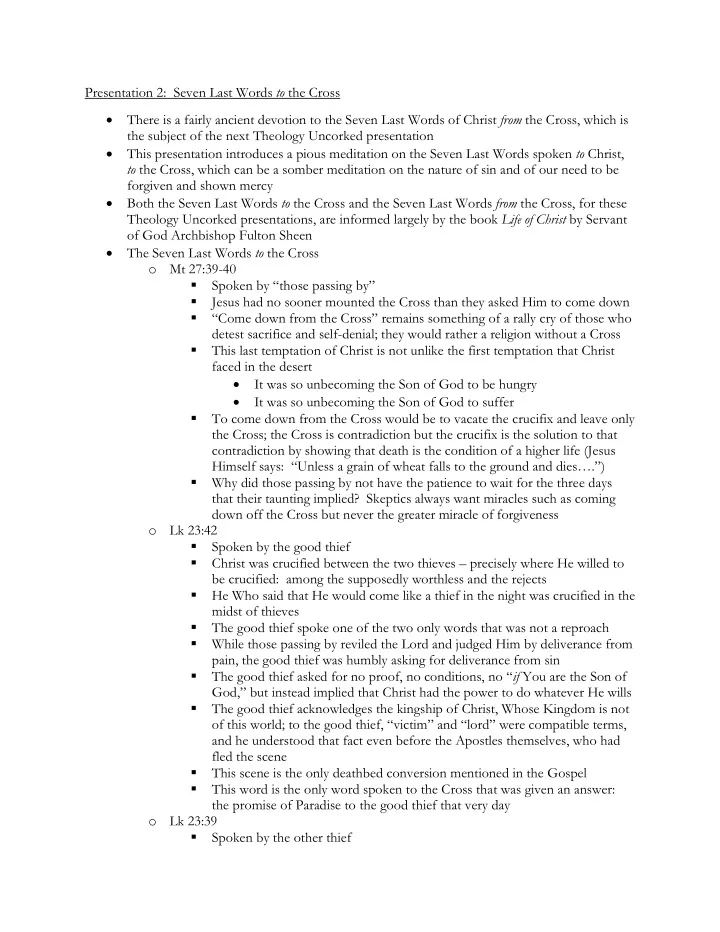
Presentation 2: Seven Last Words to the Cross There is a fairly ancient devotion to the Seven Last Words of Christ from the Cross, which is the subject of the next Theology Uncorked presentation This presentation introduces a pious


slide-1
SLIDE 1

Presentation 2: Seven Last Words to the Cross  There is a fairly ancient devotion to the Seven Last Words of Christ from the Cross, which is the subject of the next Theology Uncorked presentation  This presentation introduces a pious meditation on the Seven Last Words spoken to Christ, to the Cross, which can be a somber meditation on the nature of sin and of our need to be forgiven and shown mercy  Both the Seven Last Words to the Cross and the Seven Last Words from the Cross, for these Theology Uncorked presentations, are informed largely by the book Life of Christ by Servant

  • f God Archbishop Fulton Sheen

 The Seven Last Words to the Cross

  • Mt 27:39-40
  • Spoken by “those passing by”
  • Jesus had no sooner mounted the Cross than they asked Him to come down
  • “Come down from the Cross” remains something of a rally cry of those who

detest sacrifice and self-denial; they would rather a religion without a Cross

  • This last temptation of Christ is not unlike the first temptation that Christ

faced in the desert  It was so unbecoming the Son of God to be hungry  It was so unbecoming the Son of God to suffer

  • To come down from the Cross would be to vacate the crucifix and leave only

the Cross; the Cross is contradiction but the crucifix is the solution to that contradiction by showing that death is the condition of a higher life (Jesus Himself says: “Unless a grain of wheat falls to the ground and dies….”)

  • Why did those passing by not have the patience to wait for the three days

that their taunting implied? Skeptics always want miracles such as coming down off the Cross but never the greater miracle of forgiveness

  • Lk 23:42
  • Spoken by the good thief
  • Christ was crucified between the two thieves – precisely where He willed to

be crucified: among the supposedly worthless and the rejects

  • He Who said that He would come like a thief in the night was crucified in the

midst of thieves

  • The good thief spoke one of the two only words that was not a reproach
  • While those passing by reviled the Lord and judged Him by deliverance from

pain, the good thief was humbly asking for deliverance from sin

  • The good thief asked for no proof, no conditions, no “if You are the Son of

God,” but instead implied that Christ had the power to do whatever He wills

  • The good thief acknowledges the kingship of Christ, Whose Kingdom is not
  • f this world; to the good thief, “victim” and “lord” were compatible terms,

and he understood that fact even before the Apostles themselves, who had fled the scene

  • This scene is the only deathbed conversion mentioned in the Gospel
  • This word is the only word spoken to the Cross that was given an answer:

the promise of Paradise to the good thief that very day

  • Lk 23:39
  • Spoken by the other thief
slide-2
SLIDE 2
  • How typical that the selfish person never seems to be conscious of having

done wrong but instead demands to know: “Why did God do this to me?”

  • Such a person judges the saving power of God only by release from trials
  • Like Karl Marx, who declared religion to be the opiate of the people, the
  • ther thief implicitly wonders, “If religion cannot give relief from trial or

suffering, then what good is it?”

  • Therefore, the only salvation that the other thief could comprehend was,

rather than spiritual or moral, physical: “Save Yourself and us!” (Save our bodies, for what good is religion if it cannot stop pain?)

  • But no external means, no good example, in and of itself, is enough to

convert unless the heart itself is changed; this is why Jesus Christ, being not just man but God as well, Who knows the secrets of every heart, was silent with the other thief – for the Lord answers no one’s prayer merely to show His power

  • Mt 27:42-43
  • Spoken by the intelligentsia of that time and place – the chief priests, the

scribes, and the Pharisees

  • As manifested in just about any time and place, the intelligentsia always seem to

know just enough about religion to distort it

  • In this instance, they know enough about Christ’s religious claims to distort

them; they took each of the three Messianic titles that He used in reference to Himself and distorted them into ridicule: Savior, King of Israel, and Son

  • f God

 Savior

  • Thus He was called by the Samaritans
  • The intelligentsia finally admitted at the Cross that He had, in

fact, saved others (e.g. the daughter of Jairus; the son of the widow of Naim; Lazarus)

  • They were finally able to admit thus, for Savior was in that

moment Himself in need of salvation (“…let Him save Himself….”)

  • For them, the conclusive miracle was still lacking
  • But of course, Jesus was not about to save Himself; the rain

cannot save itself if it is to help give growth to vegetation; the sun cannot save itself if it is to light the world; and the soldier cannot save himself if he is to save his country  King of Israel

  • Thus He was called after He miraculously fed the multitude

and then went up the mountain alone to pray

  • Thus He was called again on Palm Sunday
  • “If He is the King of Israel….”
  • But must all kings be seated on thrones of gold?
  • We had already reflected upon the Cross as the

Throne of the Lord

  • Suppose the King of Israel willed to rule from a Cross

so as to be King not of their bodies through power but of their hearts through love?

slide-3
SLIDE 3
  • How foolish for them to mock a King for refusing to

come down from His throne; and suppose He did, in fact, come down, they would be the first to say, like they said before, that He was only able to do it with the power of Beelzebub.  Son of God

  • Non-religious and anti-religious people seem to be in their

glory in times of great catastrophe

  • In war, they ask: “Where is God now?”
  • Why is it that in times of strife, it is always God on

trial and not man?

  • Why, in war, do those who start the war (or at least

create the situation that gives rise to war to erupt in the first place) always seem to wonder: “Why does not God stop this war?” Well, why did you not stop this war?

  • They said that they would believe in Him if He came down
  • But they did not believe when He raised Lazarus up
  • They did not believe when He Himself was raised up
  • Later on, they tried to prevent the Apostles from any

proclamation of the Resurrection, which the Apostles knew to be fact

  • No descent from the Cross would have converted any
  • f the intelligentsia; it is human to come down, but it is

divine to stay up and hang

  • Mk 15:35-36
  • Spoken by those looking on, in response to what Jesus cries out in Mk 15:35
  • It was the belief of the Jews in that time, because of the prophecy of the

Prophet Malachi, that Elijah must come down from Heaven before the Messiah would come at all

  • But because Elijah had not yet come, Jesus, therefore, certainly could not be

the Messiah (or so they thought, though Jesus said that Elijah had come – in the person and ministry of Saint John the Baptist)

  • That Saint John the Baptist was, indeed, the Prophet Elijah come again

already was evident, insofar as his preaching began with a message of repentance – which was precisely what the Prophet Malachi prophesied regarding how the Messiah’s forerunner would announce His coming

  • But as the Jews expected a different Elijah as forerunner, they thus expected

a different Christ than One hanging on the Cross

  • Their cry to the Cross, then – hinging on the misinterpretation of a single

word (“Elijah” rather than “Eloi”) was typical of so many people who think that religion means something other than it actually does; all throughout the Crucifixion, the one unifying motif was, “Come down from the Cross”  Satan did not want Him to mount it (hence the three temptations)  Simon Peter and the other disciples were scandalized even by the very mention of it

slide-4
SLIDE 4

 Those standing by were awaiting the Prophet Elijah to come down so as to take Jesus down from the Cross  The world always seems to be waiting for this; the uncrucified Christ is the world’s desire

  • Lk 23:36-37
  • Spoken by the soldiers
  • Being Roman, the soldiers were pagan, believing that all nations had their
  • wn gods
  • Thus, apparently, the God of Israel was the weakest god of all, for He could

not even same Himself from hanging on a tree

  • The soldiers, like the other thief, were interested only a bodily salvation; and

there was an implied boast in their taunt that they had done their job so well that nobody could possibly come down

  • The soldiers were of an empire wherein a military general who sacrificed

countless many soldiers for mere temporal glory was held in high esteem, yet they scorn the General of Salvation Who Himself died, was sacrificed, so that countless many might live

  • How foolish that they would mock Him Who would die for the greater good

when they themselves, as soldiers of Rome, were called upon to die also for the greater good (that of the Empire); they were mocking in Him what they would otherwise praise in one another!

  • Mk 15:39
  • Spoken by the centurion
  • The only other word that was not a reproach
  • Tradition holds that this centurion was the same soldier who pierced the side
  • f Christ with a lance, thereby bringing forth blood and water; tradition also

holds that this soldier, converted in that very moment, would later leave the army and become Christian, eventually being martyred for the Christian faith: a martyr named St. Longinus

  • Undoubtedly, he had crucified countless many condemned before, but there

was something clearly different and mysterious about this one – Who prayed for His enemies and was strong and vital even to when He breathed His last

  • With this final word to the Cross, it is evident that already the Cross was

beginning to bear fruit: the thief had already asked for and received a place in Paradise; the soldier proclaimed the Son of God

  • While others condemned Jesus for blasphemy, the centurion St. Longinus

worshiped Him as the Son of God