Presentatio ions: Human Resource for Cardiovascular Health : - - PDF document

presentatio ions human resource for cardiovascular health
SMART_READER_LITE
LIVE PREVIEW

Presentatio ions: Human Resource for Cardiovascular Health : - - PDF document

GRIT CC Trainee Poster Presentation Abstracts Thursday, September 17, 2020 at 9:00 AM EST Zoom link: https://nyulangone.zoom.us/j/98798056826?pwd=OThVZE11V2w0V21sSTVrbWVYU DZIQT09 Presentatio ions: Human Resource for Cardiovascular Health :


slide-1
SLIDE 1

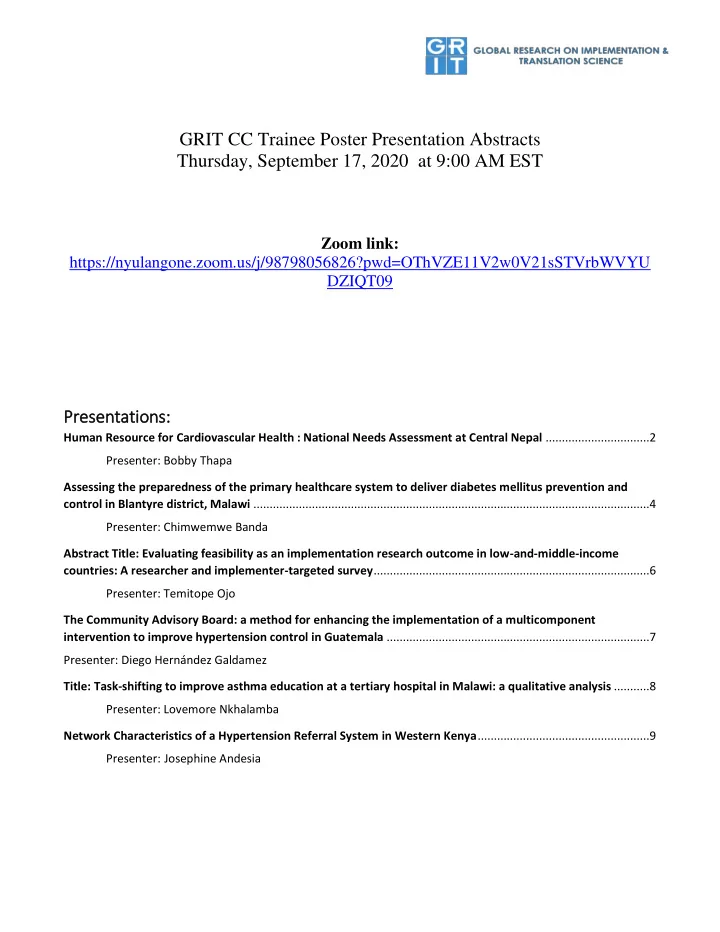
GRIT CC Trainee Poster Presentation Abstracts Thursday, September 17, 2020 at 9:00 AM EST

Zoom link: https://nyulangone.zoom.us/j/98798056826?pwd=OThVZE11V2w0V21sSTVrbWVYU DZIQT09

Presentatio ions:

Human Resource for Cardiovascular Health : National Needs Assessment at Central Nepal ................................2 Presenter: Bobby Thapa Assessing the preparedness of the primary healthcare system to deliver diabetes mellitus prevention and control in Blantyre district, Malawi ..........................................................................................................................4 Presenter: Chimwemwe Banda Abstract Title: Evaluating feasibility as an implementation research outcome in low-and-middle-income countries: A researcher and implementer-targeted survey .....................................................................................6 Presenter: Temitope Ojo The Community Advisory Board: a method for enhancing the implementation of a multicomponent intervention to improve hypertension control in Guatemala .................................................................................7 Presenter: Diego Hernández Galdamez Title: Task-shifting to improve asthma education at a tertiary hospital in Malawi: a qualitative analysis ...........8 Presenter: Lovemore Nkhalamba Network Characteristics of a Hypertension Referral System in Western Kenya .....................................................9 Presenter: Josephine Andesia

slide-2
SLIDE 2

Huma Human n Reso sour urce for Cardi diovasc scul ular He Health h : Na Nationa nal Ne Needs ds Ass ssess ssme ment nt at Cent ntral Ne Nepa pal

Bobby Thapa1, Sumitra Sharma2, Natalia Oli3

1Nursing Instructor, Tribhuvan University, Institute of Medicine, Nepalgunj Nursing Campus, Nepalgunj,

Nepal.

2Lecturer, Department of Nursing, Kathmandu Medical College Teaching Hospital, Kathmandu, Nepal 3Associate Professor, Department of Community Medicine, Kathmandu Medical College Teaching

Hospital, Kathmandu, Nepal Abstract Introduction Cardiovascular disease (CVD), one of the leading cause of deaths globally.1 In Nepal, Non-communicable diseases (NCDs) accounts for more deaths and ischemic heart disease (16.4%) is the leading cause of NCD deaths.2 Density, quality and responsibility of Human Resource for Health (HRH) are crucial factors impacting delivery of quality healthcare.3,4,5.6 lack of quality healthcare services, skilled health workers and policy maker’s commitment to invest in health programs still exists.7 Thus, the study assess the need of HRH for CVD, which will impact the policy decisions in combating CVD in Nepal. Methods Our study was sequential quantitative-qualitative study. We formed a national level task force, developed detailed protocol, conducted national workshops with stakeholders to collect feedback for the research process, incorporated their feedback and initiated data collection.8 We conducted 24 key informant interviews using semi-structured questionnaires in Nepali after desk review. We did thematic analysis and identified SWOT from the codes. Results There are 8.9 doctors, 20.8 nurses, 0.06 cardiologist and cardiac surgeon, 4.2 pharmacist, 10.2 laboratory technicians per 10000 population.9 A comprehensive HRH plan, epidemiology and disease control division exist but not particularly focused for CVD. Recently, the government of Nepal has introduced Nepal Health workforce Registry (NHWR) program to develop National Health workforce Accounts (NHWA). Different acts exist to enable a working environment. Pre-service specialized courses, in-service training and an updated curriculum are available based on epidemiology of the country. Thematic analysis shows presence of competent health workers and well-structured health systems at central level as a strength. However, there still exists the lack of a central unit of health workforce, collaboration between the public and private sector, imbalance between production and absorption of health workers.9 Nevertheless, the government can establish a well equipped central unit of health workforce,9 develop a regularly updated HRH electronic registry, collaborate with different professional councils, public/private universities and health centers for management and retention of health workforce. Brain drain and the political instability still prevails as an enormous threat to the health system. Discussion

slide-3
SLIDE 3

CVD is the leading cause of deaths in Nepal. Shortage of HRH in addition to brain drain is deteriorating the situation. Existing HRH plans and policies do not focus on CVD thus, need stringent multi-sectoral collaborative plans and policies to address the emerging problem of CVD in Nepal. Keywords Cardiovascular diseases, Human Resource for health, National need assessment, Nepal Reference

  • 1. Cardiovascular diseases (CVDs), https://www.who.int/en/news-room/fact-sheets/detail/cardiovascular-

diseases-(cvds) (accessed 11 March 2020).

  • 2. UKaid MNI. Website. Masterpiece with Imagination Pvt. Ltd., 2019.
  • 3. Guilbert J-J, -J. Guilbert J. The World Health report 2006 1 : Working together for health 2. Education for

Health: Change in Learning & Practice 2006; 19: 385–387.

  • 4. Anand S, Bärnighausen T. Health workers and vaccination coverage in developing countries: an

econometric analysis. The Lancet 2007; 369: 1277–1285.

  • 5. Speybroeck N, Kinfu Y, Dal Poz MR, et al. Reassessing the relationship between human resources for

health, intervention coverage and health outcomes, https://www.who.int/hrh/documents/reassessing_relationship.pdf.

  • 6. Microsoft Word - 5C HRH_revised draft 15May2009_reformatted.doc,

https://www.who.int/healthinfo/statistics/toolkit_hss/EN_PDF_Toolkit_HSS_HumanResources_oct08.pd f.

  • 7. Universal health coverage, https://www.who.int/health-topics/universal-health-coverage (accessed 10

March 2020).

  • 8. Archana S, Karmacharya BM, Rashmi M, et al. Stakeholder Engagement in Planning the Design of a

National Needs Assessment for Cardiovascular Disease Prevention and Management in Nepal. Glob Heart 2019; 14: 181–189.

  • 9. Status of Health Workforce in Nepal: 14 HRH indicator monitoring report.
slide-4
SLIDE 4

Ass ssessing the pr preparedness of f the pr prim imary he healt althcare sy syst stem m to de deliver di diabe betes s me mellitus us pr prevent ntion n and nd con

  • ntr

trol

  • l in

in Blan antyr yre dis istr tric ict, t, Malaw awi Authors: Banda, C. K1,2. Gombachika, B.T2, Nyirenda, M.J1,3,4, Muula, A.S1,4,5

1 University of Malawi, College of Medicine, Blantyre, Malawi 2University of Malawi, Kamuzu College of Nursing, P.O Box, 415, Blantyre 3 Uganda MRC/UVRI Research Unit, P.O. Box 49, Entebbe, Uganda 4 NCD-BRITE Consortium, University of Malawi, College of Medicine 5Africa Center of Excellence in Public Health and Herbal Medicine, University of Malawi, College of Medicine

Email: cbanda@cartafrica.org Cell: +265884711313

Background: Diabetes care services in Malawi are mainly provided at central hospitals. This contributes to overcrowding of clients at tertiary level facilities which compromises quality of care for

  • clients. Malawi adopted the World Health Organization (WHO) Package of Essential Non-

communicable Disease (NCD) interventions for strengthening of primary healthcare in low-resource settings in 2013. However, there is limited data on available resources at primary level to effectively provide diabetes services. Aim: To assess the preparedness for delivering diabetes services at primary care level within the Blantyre District Health Office (DHO) to support the response to NCD epidemic in Malawi. Methods: This case study utilized concurrent triangulation mixed methods strategy, where by qualitative and quantitative data were collected simultaneously. The case study was nested in a larger study conducting a national needs assessment for NCD response in Malawi. Fourteen primary healthcare facilities from rural and urban sites of Blantyre DHO were assessed. A checklist adapted from the WHO NCD monitoring framework was used to assess the prevalence of diabetes, human resource, equipment, medicines, laboratory facilities, and referral system. Seventeen health care works from the selected facilities participated in key informant interviews. Descriptive statistics (frequencies and percentages) were used to analyze the quantitative data. Framework analysis method guided the qualitative data analysis. Results: A total of 1962 client with diabetes were seen at the health facilities in the previous year. Eight facilities (one rural and seven urban) had the minimum personnel, equipment and medications to run a diabetes clinic. Ten facilities (three rural and seven urban) had prescription guidelines for diabetes

slide-5
SLIDE 5
  • medication. None of the facilities had a specific room for diabetes care. All the facilities indicated that

they were able to refer clients to a higher level facility for specialist care or for additional laboratory

  • tests. The key informants indicated that the most vital needs to improve diabetes services at the facilities

were equipment, staff development, medication, infrastructure development and community awareness. Discussion: The primary care facilities for Blantyre DHO were at different levels of preparedness and implementation of diabetes care. There were significant disparities in the available resources between the rural and urban facilities. Strengthening and integrating diabetes services in primary care facilities is needed in Malawi to adequately respond to growing diabetes pandemic. These findings also highlights the need to develop national guidelines for diabetes care at primary, secondary and tertiary healthcare levels. Word count: 393/400 Key words: Healthcare system, non-communicable disease, self-management support, needs assessment, chronic care

slide-6
SLIDE 6

Abs bstract Title: Ev Evalua uating ng feasi sibi bility as s an n impl mpleme ment ntation n rese search h out utcome me in n low-and nd-mi middl ddle-inc ncome me cou

  • untr

tries: A resear archer and im imple lementer-tar argeted ted surve vey Presenter: Temitope Ojo, MPH Background: Translating evidence-based interventions (EBIs) developed and tested in high income countries is only feasible if adapted to a low-and-middle-income countries (LMICs) context. Feasibility is an implementation research outcome, defined as the extent to which an innovation or strategy can be used or carried out in an existing setting or agency. There is a dearth of adequate instruments to rigorously assess feasibility of EBIs for cardiovascular diseases (CVD) in LMICs. Aim/Objective: This study seeks to capture the perceptions of researchers and implementers on contextual factors that influence the feasibility of implementing EBIs for CVD in LMICs. Methods: Guided by the Consolidated Framework for Implementation Research (CFIR) contextual domains

  • f inner and outer settings, we used a systematic review (deductive approach) and qualitative interviews

(inductive approach) to generate survey items that capture perceived contextual factors. A purposive sample of LMIC context-based researchers, implementers, and experts (n=20) will rate survey items based

  • n their importance, relevance, and appropriateness for assessing feasibility on a ‘Yes’ or ‘No’ scale. Fleiss

Kappa will be used to quantitatively assess content validity of survey items amongst expert raters and a Delphi method will be used to derive a consensus on rated survey items from a subsample of the target population for this study. The survey will be pretested online via usability tests and concurrent think-aloud

  • r retrospective cognitive tests.

Anticipated Results: Preliminary analysis from the systematic review and qualitative interviews show a preponderance of evidence of contextual factors that fall under the ‘readiness for implementation’ and ‘implementation climate’ constructs of CFIR’s inner setting domain and ‘patients’ needs and resources’ construct of CFIR’s outer setting domain. The final survey will have four components: socio-demographics, intervention details, items capturing perceived influential contextual factors of feasibility, and an existing feasibility assessment tool. Response options to survey items will be scored based on a 5-point Likert scale. Data from this survey will be used to identify cross-cutting contextual factors that influence the feasibility

  • f CVD-related EBIs in LMICs, and test the reliability of survey items for assessing feasibility.

Discussion: Administering a rigorous survey that captures perceptions of researchers and implementers about contextual factors that influence feasibility of implementing CVD interventions in LMICs will provide foundational knowledge to inform tools that better predict feasibility in resource constrained settings. Keywords: Feasibility, Implementation Science, Consolidated Framework for Implementation Research, Low- and Middle-Income Countries, Cardiovascular Disease, sub-Saharan Africa, Psychometrics, Surveys, Resource constrained settings, Low resource settings, Tool development.

slide-7
SLIDE 7

The he Communi mmunity Adv dviso sory Board: d: a me metho hod d for enha nhanc ncing ng the he impl mpleme ment ntation n of a mul multicompo mpone nent nt in interve venti tion

  • n to
  • improve

ve hyp ypertension

  • n con
  • ntrol

l in in Guatem temala la

Diego Hernández Galdamez1, Alejandra Paniagua2, Ana Lucía Peralta1, Kristyne Mansilla1, Pablo Gulayín3, Vilma Irazola3, Jiang He4, Manuel Ramírez-Zea1, Meredith Fort1,5 1 – INCAP Research Center for the Prevention of Chronic Diseases (CIIPEC), Institute of Nutrition of Central America and Panama (INCAP), Guatemala City, Guatemala 2 – Mailman School of Public Health, Columbia University, New York, New York 3 – Southern Cone American Center for Cardiovascular Health (CESCAS/SACECH), Institute for Clinical Effectiveness and Health Policy (IECS), Buenos Aires, Argentina 4 – Department of Epidemiology, School of Public Health and Tropical Medicine, Tulane University, New Orleans, Louisiana, USA 5 – Department of Health Systems, Management and Policy, Colorado School of Public Health, Denver, Colorado Background: A Community Advisory Board (CAB) is an expert consultant group that identifies barriers and facilitators, improves cultural and linguistic understanding and adaptation to the local context, and provides solutions and strategies for the implementation of health interventions from the perspective of the community to be targeted. Objective: We describe a CAB created to facilitate the implementation of a multicomponent intervention aiming to improve hypertension control in 5 health areas in Guatemala. Methods: We held four CAB meetings with separate groups corresponding to the 5 health areas of our study. CAB members included patients with hypertension and their family members, and auxiliary and professional nurses from municipalities similar to the ones participating in the study. The CAB advised the study team on: a) the informed consent process using a graphic flipchart; b) health coaching sessions and educational materials; c) participant blood pressure log and home blood pressure monitoring; d) filling out intervention forms by health providers; and e) recruitment

  • strategies. Prior to the CAB meetings, we held 21meetings with Ministry of Health authorities and providers at the

health district, area and central levels. Results: Based on CAB members’ suggestions, we made adaptations to study materials and procedures, including: a) updating the graphic informed consent to improve understandability, reinforcing the local Mayan language; b) incorporation of local and accessible food examples in educational materials; c) engagement of a literate family member to help with home blood pressure readings and registration of blood pressure values in the log ; d) unification of hypertensive listing forms and counseling sessions for better follow-up by healthcare providers; e) identification of potential participants with patients’ lists available at some health posts; and f) the identification of the Community Development Councils as important for supporting the work in the communities. Discussion: The CAB’s advice was fundamental in the process of improving the instruments, materials and procedures of the study. However, it was necessary to hold previous meetings at the health district, health area and central levels, where adaptations and validation of the intervention were discussed at the macro level. Moving forward, the CAB will play an important role in advising the study team during the implementation phase and in interpreting study findings. We are considering improving the CAB structure through a learning health system approach that will involve study participants and healthcare providers participating in the intervention. Keywords: hypertension; community-based participatory research; implementation science; translational research; rural health.

slide-8
SLIDE 8

Title: Task sk-sh shifting ng to impr mprove ast sthma hma educ ducation n at a tertiary ho hosp spital in n Malawi wi: a qua qualitative ana nalysi sis s

Presenter: Lovemore Nkhalamba Background Asthma education is key to long-term management of asthma although it is not easy to integrate in countries with healthcare worker shortages like Malawi. Task shifting is a potential solution in such settings by training lay people to take it up. This study aimed to explore the experiences of lay asthma educators to 1) assess the acceptability of using non-medical staff to deliver asthma education; 2) understand facilitators and barriers to asthma education; 3) assess the perceived value of the education sessions to the participants Methods We used qualitative methods to explore experiences of the parents, children and asthma educators and identified emerging themes from the data. We conducted focus group discussions; 2 with 15 children, 3 with 21 mothers and 1 with fathers, 4 interviews with the asthma educators and senior nurse. Results: The participants reported that they faced challenges in accessing asthma care including busy clinic environment, and access to information and medication. They said the educators were friendly and that they were free to ask any questions they had. Facilitators to the asthma education included the training the asthma educators underwent, guidelines to support them in delivering, and senior support. Some barriers included difference in levels of education of the parents. Discussion: The participants reported benefits from the asthma education including increased asthma knowledge and confidence with self-management. The educators’ confidence in delivering the sessions also increased with

  • time. We found that Asthma education can be delivered by non-medical personnel with adequate training,

supervision and support.

slide-9
SLIDE 9

Net etwor

  • rk Char

haract acter erist istics cs of

  • f a

a Hype perten ension sion Refer Referral al Sy Syste stem in in West ester ern n Ken Kenya a

Presenter: Josephine Andesia

INTRODUCTION: The Strengthening Referral Networks for Management of Hypertension Across the Health System (STRENGTHS) trial is creating and testing interventions to improve the effectiveness of referral networks for patients with hypertension in Western Kenya. PURPOSE: Network analysis of facility-based healthcare providers was used to understand the existing network

  • f referrals. The ultimate goal was to identify both structural gaps and opportunities for implementation of the

planned intervention. METHODS: A network survey was administered to providers who deliver care to patients with hypertension asking individuals to nominate a) individuals to whom, and b) facilities to which they refer patients, both up and down the health system. We analyzed survey data using centrality measures of in-degree and out-degree (number

  • f links each provider received and sent, respectively) to identify providers in strategic positions, and mixed-

effect regression models to examine how provider characteristics related to the likelihood of receiving referrals. We also calculated core-periphery correlation scores (CP) at the provider and facility level for each cluster. RESULTS: Data were collected from 152 providers across 54 sites within 9 geographically separate network

  • clusters. Each cluster consists of a mix of primary, secondary, and/or tertiary facilities. While 97% of providers

reported referring patients up to a more specialized health facility, only 55% reported referring down to lower level facilities. Individuals were more likely to receive a referral if they had higher levels of training and facility level, more job experience, or were male. Compared to a perfect CP referral network model (Correlation Score [CP] = 1.00), the provider referral networks within each cluster showed a weak tendency for CP structure with a CP range of 0.335 to 0.693. In contrast, cluster-level facility networks showed a strong tendency for CP structure, with a CP range of 0.707 to 0.949. CONCLUSIONS: The current health system across Western Kenya does not demonstrate a strong network of referrals between providers for patients with hypertension. High amounts of variability within the clusters, lack of down referrals, and poor provider linkages despite strong facility linkages, all demonstrate weaknesses in the referral network. These results highlight opportunities for interventions to strengthen provider referral patterns in

  • rder to improve blood pressure control and reduce cardiovascular risk.