Preparing Your Home & Property for the Next Earthquake Sean - - PowerPoint PPT Presentation

preparing your home amp property for the next earthquake
SMART_READER_LITE
LIVE PREVIEW

Preparing Your Home & Property for the Next Earthquake Sean - - PowerPoint PPT Presentation

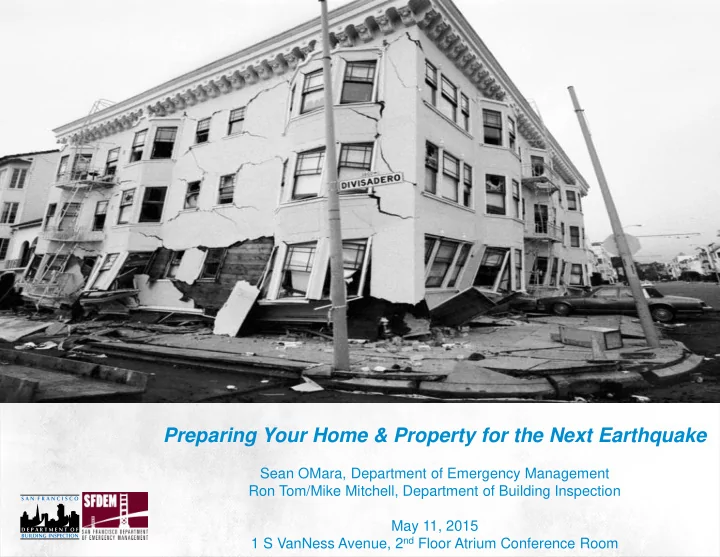
Preparing Your Home & Property for the Next Earthquake Sean OMara, Department of Emergency Management Ron Tom/Mike Mitchell, Department of Building Inspection May 11, 2015 1 S VanNess Avenue, 2 nd Floor Atrium Conference Room Agenda


slide-1
SLIDE 1

Preparing Your Home & Property for the Next Earthquake

Sean OMara, Department of Emergency Management Ron Tom/Mike Mitchell, Department of Building Inspection May 11, 2015 1 S VanNess Avenue, 2nd Floor Atrium Conference Room
slide-2
SLIDE 2

Agenda

2

  • Overview of DEM & DBI
  • Disaster Cycle and Your Role

– Mitigate – Prepare – Respond – Recover

  • Q & A
slide-3
SLIDE 3

The Disaster Cycle

3

MITIGATE PREPARE RESPOND RECOVER

CITY & DBI’s ROLE

slide-4
SLIDE 4

Department of Emergency Management (DEM)

4

We manage everyday and not-so-every day emergencies in San Francisco:

  • Emergency Services: We help San

Francisco prepared for any emergency and we coordinate response and recovery.

  • Emergency Communications (9-1-1):

When people in San Francisco have police, fire, or medical emergency our dispatchers are the first people they call.

  • Homeland Security Grant Management:

We manage homeland security priorities for the San Francisco Bay Area.

slide-5
SLIDE 5

What does DEM do?

5

We manage everyday and not-so-every day emergencies in San Francisco:

  • Emergency Services: We help San

Francisco prepared for any emergency and we coordinate response and recovery.

  • Emergency Communications (9-1-1):

When people in San Francisco have police, fire, or medical emergency our dispatchers are the first people they call.

  • Homeland Security Grant Management:

We manage homeland security priorities for the San Francisco Bay Area.

San Francisco’s Emergency Communications Center (9-1-1) answers more than 1.1 million calls per year.

slide-6
SLIDE 6

What does DEM do?

6

We manage everyday and not-so-every day emergencies in San Francisco:

  • Emergency Services: We help San

Francisco prepared for any emergency and we coordinate response and recovery.

  • Emergency Communications (9-1-1):

When people in San Francisco have police, fire, or medical emergency our dispatchers are the first people they call.

  • Homeland Security Grant Management:

We manage homeland security priorities for the San Francisco Bay Area.

BA UASI includes 12 regional governments and more than 100 cities with 7.5 million people.

slide-7
SLIDE 7

Whole Community

7

Government Business Public

Emergency Plans Continuity of Government Risk Awareness Response Coordination Continuity of Operations Community Involvement Insurance Personal preparedness Neighborhood preparedness School preparedness

slide-8
SLIDE 8

Department of Building Inspection (DBI)

8

Emergency Preparedness Coordination

– DBI Emergency Operations Plan – Conduct training as Disaster Service Workers – Specialized training for Safety Assessment Program – Building Occupancy Resumption Program (BORP)

slide-9
SLIDE 9

Mitigation: DBI’s Programs

9

  • Programs
  • Parapet Safety Program (1972)
  • Unreinforced Masonry (1989)
  • Buildings Program (1992)
  • Soft Story Retrofit Program (2014)
  • Voluntary seismic retrofit
slide-10
SLIDE 10

Mitigation: Building Occupancy Resumption Program (BORP)

10

  • Allows building owners to arrange for

private post-earthquake inspection

  • Requires contracting with qualified

engineers

  • Includes a building-specific inspection

plan

  • Deputizes engineers to post buildings

after quake

slide-11
SLIDE 11

In a serious emergency, city services will be impacted, so a basic rule

  • f thumb is to be able to

take care of each other for 72 hours before help arrives.

72 HOURS

11

slide-12
SLIDE 12

What You Can Do to Prepare

12

slide-13
SLIDE 13

www.sfdbi.org

San Francisco Department of Building Inspection | 1660 Mission Street, San Francisco CA 94103 Phone: 415-558-6088

What You Can Do to Prepare

13

  • Discuss all possible exit routes

from each room, building and neighborhood

  • Decide where you will reunite

after a disaster.

  • Conduct emergency drills and

practice “DROP, COVER and HOLD”

  • Always keep your car’s gas

tank at least half full

slide-14
SLIDE 14

Preparedness: Property Owner

14

How can I prepare my property?

  • Owner hires a civil or structural

engineer to develop a plan/report identifying how occupants can safely enter the building to remove their possessions.

  • Owner hires contractor whose staff

retrieve possessions for the tenants.

slide-15
SLIDE 15

Structural Home/Building Preparedness

15

  • Evaluate your structure
  • Underlying soil

conditions

  • Age and type of

construction

  • Structural /connection

condition

  • Remodeling impact
  • Investigate retrofit options
  • Compare retrofit costs with

insurance premiums

slide-16
SLIDE 16

Bolt Sill to Foundation Using Square Plate Washers

16

  • Square plate washers

perform better in quakes than the round one that has been replaced here.

  • They also make the

tightening of expansion bolts easier.

Plate washers must be a minimum

  • f 2” x 2” x 3/16” thick
slide-17
SLIDE 17

Strengthen Cripple Walls

17

  • A cripple wall is generally the

weakest part of older building because it has insufficiently strong sheathing materials.

  • This can cause full or partial

collapse in an earthquake.

  • These areas can be

strengthened for relatively low cost by correctly applying plywood sheathing to the cripple walls.

Crawl Space Cripple Wall First Floor

slide-18
SLIDE 18

Non-Structural Mitigation

18

  • Parapets
  • Chimneys
  • Water heaters
  • Light fixtures
  • Furniture
  • Cabinets
  • Appliances
  • Electronics
slide-19
SLIDE 19

Preparing Your Home: Water Heater

19

  • Earthquake strapping of water

heaters

  • California law requires your water

heater be properly braced so it won’t tip over in an earthquake

  • Source of water during emergency
slide-20
SLIDE 20

Preparing Your Home: Smoke Alarms

20

  • Be sure your home’s street number is

visible from the street, so emergency vehicles can find you.

  • Install a smoke alarm in each sleeping

room

  • Provide a smoke alarm outside of each

sleeping area

  • Install a smoke alarm on each additional

living level.

  • Keep at least one ABC type fire

extinguisher on each level of your home.

slide-21
SLIDE 21

Response: City/At-Large Early Stages

21

  • Evacuating/extracting people

from buildings

  • Route recovery/traffic

control

  • Mitigation of immediate

public hazards

  • Restoration of critical

services

  • Lighting of field work sites
  • Debris clearance
  • Inspection of critical facilities
slide-22
SLIDE 22

DBI’s Response

22

  • Coordinate with DPW for

inspection of critical facilities and City buildings

  • Supervise inspection of private

buildings

  • Verify red-tagged building status
  • Re-inspect buildings under

construction

  • Issue emergency repair permits
  • Inspect earthquake building

repairs

  • 72 hour window
slide-23
SLIDE 23

DBI Manages Safety Assessment

23

slide-24
SLIDE 24

Resident’s Response

24

  • Listen to public messaging

(KCBS/KGO radio)

  • If safe to do so, stay at property
  • Check in with neighbors
  • Call 911 only for emergencies
  • Carry out preparedness plan
slide-25
SLIDE 25

Utilities: Natural Gas

25

  • Train family to turn off utilities, if

necessary

  • Teach children to identify the smell of

gas Turn off gas, if: – you smell leaks & are unsure – your meter wheels are spinning

  • Be aware that you may not have

service for weeks

slide-26
SLIDE 26

Utilities: Electricity

26

Turn off electricity, if: – you smell gas leaks – wires are broken – walls are badly damaged

slide-27
SLIDE 27

27

Turn circuit breakers to OFF position

slide-28
SLIDE 28

28

Or pull fuses

slide-29
SLIDE 29

Utilities: Water

29

Turn off water if house is flooding or if water is contaminated Shut Off Water, If Necessary

  • Locate water shutoff
  • Insert tool in hole & remove

cover

  • Turn water OFF
slide-30
SLIDE 30

Road to Recovery

30

  • Rapid organized response by DBI to conduct building

damage assessment post event

  • Request for Mutual Aid to augment DBI personnel as

approved by the Mayor

  • Timely processing of repair permits
  • DBI inspection of damage repairs
  • Swift resumption of new construction plan review and

inspection

slide-31
SLIDE 31

Remind Yourself

31

  • Drill with your family at least
  • nce a year; earthquake

anniversaries are good reminders

  • Maintain first aid and other

emergency skills

  • Check family emergency

supplies, replenish them as needed

slide-32
SLIDE 32

Visit Us Online

32

  • www.alertsf.org
  • www.sfdbi.org/earthquake-preparedness
  • www.sfdbi.org/softstory
  • www.sf72.org
  • www.sf-fire.org
  • www.sfgov.org/sffdnert
  • www.businessportal.sfgov.org
  • www.redcrossbayarea.org
  • www.sfsafe.org