
SLIDE 1
Preliminary CFD Analysis for a Natural Circulation Flow between a Reactor and Steam Generator in an OPR100
Hyung Seok Kang, Sung Il Kim, Eun Hyun Ryu, and Kwang Soon Ha Korea Atomic Energy Research Institute, 989-111, Daedeok-daero, Yuseong, Daejeon, 305-353, Republic of Korea
*Corresponding author: hskang3@kaeri.re.kr
- 1. Introduction
KAERI is now performing a MELCOR analysis for the a temperature induced steam generator tube rupture accident (TI-SGTR) initiated by a station blackout in an
- ptimized power reactor 1000 MWe (OPR1000) because
the TI-SGTR is one of the most important accident scenarios and needs to be considered to confirm that an
- perating nuclear power plant meets regulations related
- n the severe accident [1]. To perform a 1-dimensional
MELCOR analysis, some input parameters considering a 3-dimensional phenomenon, such as the mixing fraction, recirculation ratio, hot tube fraction in the SG inlet plenum and the discharge coefficient in the hot leg, are needed to simulate the natural circulation flow of a hot gas from the damaged reactor core to the steam generator in the OPR1000. Thus we have performed a 3- dimensional analysis for the natural circulation flow between the hot leg and the SG during a severe accident in the OPR1000 using a commercial code ANSYS CFX 19.1 with an established analysis methodology [2,3]. The established methodology was obtained through a CFD analysis for a natural circulation between a reactor and a SG in the Westinghouse 1/7 scaled-down test facility [3,4]. In addition, we quoted the method of modeling the boundary conditions applied in a CFD analysis for a Westinghouse type plant [5].
- 2. Development of a 3-Dimensional SG Model
2.1 Grid Model and Boundary Conditions A 3-dimensional SG model was developed and validated on the basis of the OPR1000 design data [6]. The number of tubes in the SG model was reduced by a ratio of 1/8 and its diameter was increased 3 times compared to the SG design data of OPR1000. Thus, the pressure drop and heat transfer occurred when a coolant flows though the tubes in the SG model during a normal
- peration was simulated by a pressure loss coefficient
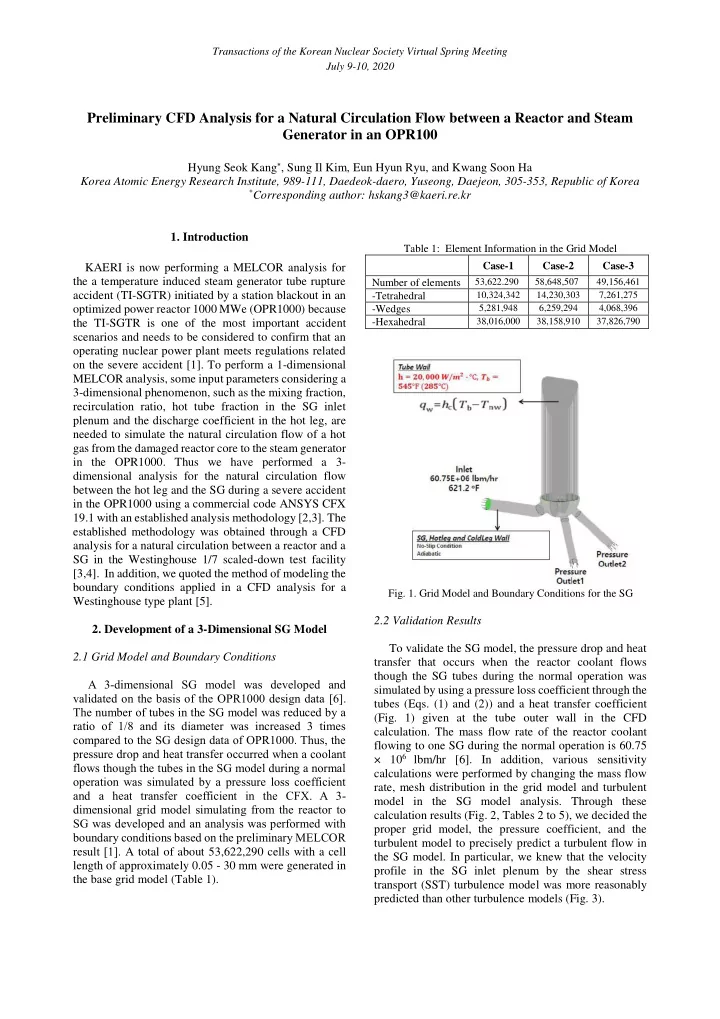
and a heat transfer coefficient in the CFX. A 3- dimensional grid model simulating from the reactor to SG was developed and an analysis was performed with boundary conditions based on the preliminary MELCOR result [1]. A total of about 53,622,290 cells with a cell length of approximately 0.05 - 30 mm were generated in the base grid model (Table 1).
Table 1: Element Information in the Grid Model Case-1 Case-2 Case-3 Number of elements
53,622.290 58,648,507 49,156,461
- Tetrahedral
10,324,342 14,230,303 7,261,275
- Wedges
5,281,948 6,259,294 4,068,396
- Hexahedral
38,016,000 38,158,910 37,826,790
- Fig. 1. Grid Model and Boundary Conditions for the SG
2.2 Validation Results To validate the SG model, the pressure drop and heat transfer that occurs when the reactor coolant flows though the SG tubes during the normal operation was simulated by using a pressure loss coefficient through the tubes (Eqs. (1) and (2)) and a heat transfer coefficient (Fig. 1) given at the tube outer wall in the CFD
- calculation. The mass flow rate of the reactor coolant