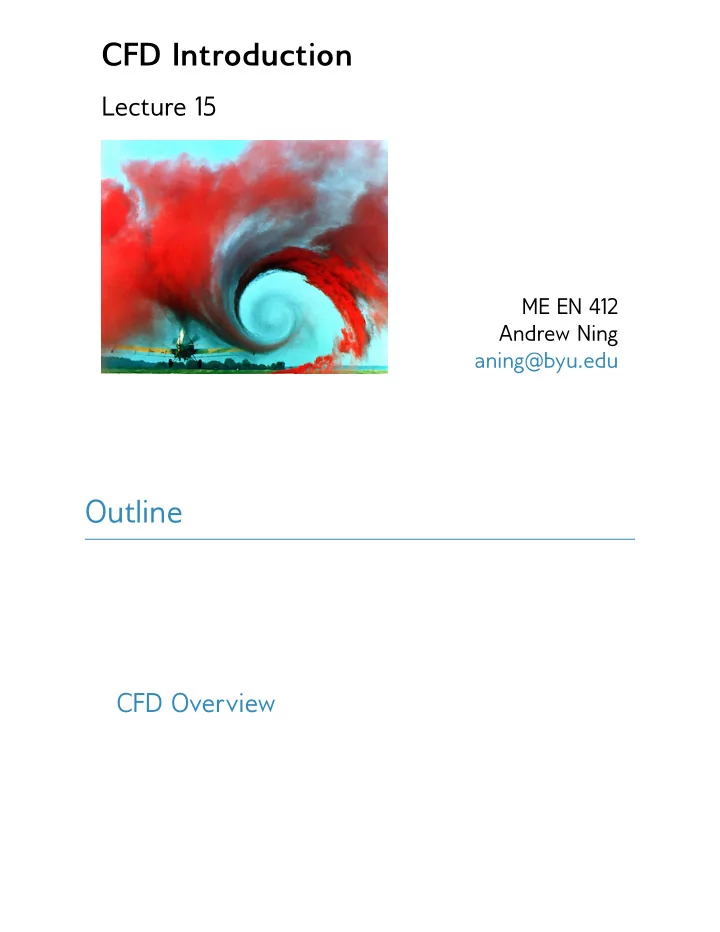
CFD Introduction Lecture 15 ME EN 412 Andrew Ning aning@byu.edu - - PDF document

cfd introduction
SMART_READER_LITE
LIVE PREVIEW

CFD Introduction Lecture 15 ME EN 412 Andrew Ning aning@byu.edu - - PDF document

CFD Introduction Lecture 15 ME EN 412 Andrew Ning aning@byu.edu Outline CFD Overview CFD Overview Simulation Process 1. Define the problem 2. Model the geometry and a fluid domain 3. Create a mesh 4. Specify boundary conditions 5.


slide-1
SLIDE 1

CFD Introduction

Lecture 15

ME EN 412 Andrew Ning aning@byu.edu

Outline

CFD Overview

slide-2
SLIDE 2

CFD Overview Simulation Process

  • 1. Define the problem
  • 2. Model the geometry and a fluid domain
  • 3. Create a mesh
  • 4. Specify boundary conditions
  • 5. Initialize flow field and iteratively solve

governing equations on mesh

  • 6. Post-process
  • 7. Verification and validation
  • 8. Repeat process
slide-3
SLIDE 3

Define the Problem Model Domain and Geometry

slide-4
SLIDE 4

Create Mesh

Structured Mesh:

slide-5
SLIDE 5

Unstructured Mesh:

From SU2, Stanford University

Always Perform a Grid Convergence Study!

slide-6
SLIDE 6

Boundary Conditions

Commonly used types available in Star-CCM+:

  • Velocity inlet: known inlet velocity. for

incompressible flows

  • Free-stream: Specify freestream pressure,

temperature, Mach number. Must be using ideal gas model.

  • Pressure outlet: outflow
  • Axis: for 2D axisymmetric flows
  • Symmetry plane
  • Wall: no normal flow. if viscous no slip as well.

From SU2, Stanford University

slide-7
SLIDE 7

Initialize and Iteratively Solve Verification and Validation

Verification: Assess accuracy of the solution to a computational model. Validation: Assess accuracy of computational simulation as compared to physical reality.