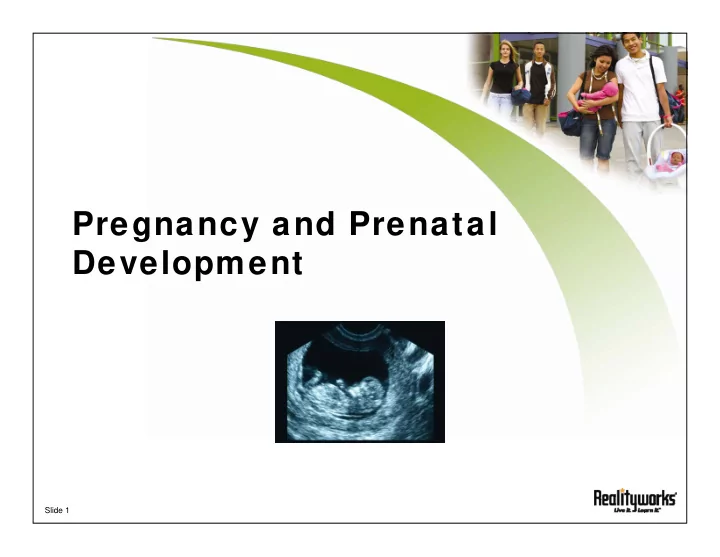
Pregnancy and Prenatal Development Slide 1 Pregnancy Symptoms - - PowerPoint PPT Presentation

pregnancy and prenatal development
SMART_READER_LITE
LIVE PREVIEW

Pregnancy and Prenatal Development Slide 1 Pregnancy Symptoms - - PowerPoint PPT Presentation

Pregnancy and Prenatal Development Slide 1 Pregnancy Symptoms and Discomforts Monthly period stops Possible stretch marks on stomach Possible sweating due to higher body temperature Possible varicose veins


slide-1
SLIDE 1

Slide 1

Pregnancy and Prenatal Development

slide-2
SLIDE 2

Slide 2

Pregnancy Symptoms and Discomforts

  • Monthly period stops
  • Possible sweating due to

higher body temperature

  • Frequent urination or leaking
  • Gain of 20-30 pounds
  • Hair may become thick and

healthy

  • Breasts become larger and

may be tender

  • Appetite increases
  • Possible stretch marks on

stomach

  • Possible varicose veins
  • Increased fatigue
  • Lower back pain
  • Trouble sleeping
  • Possible swelling feet and

hands

  • Nausea
slide-3
SLIDE 3

Slide 3

Fetal Development Stages

  • Zygote Stage – Lasts 2 weeks

– Sperm unites with ovum (egg)

  • Embryo Stage – Lasts 6 weeks

– All major body systems begin to develop:

  • Central nervous system, brain, blood vessels, stomach,

heart

  • Eyes, lungs arms legs, hands, feet
  • Fetus Stage – Lasts 7 months

– Fetus grows and matures – Rapid growth of body, head, arms, legs – Organs develop for breathing, digestions, blood circulation – Nerves and muscles develop – Heart pumps blood through veins and arteries

slide-4
SLIDE 4

Slide 4

2 nd Month- Embryo (1st Trimester)

  • Photo taken after surgery for an

ectopic pregnancy – shows development of baby at only 6 weeks after conception

  • Major organs have begun to form
  • Hair follicles and nipples form,

knees and elbows visible

  • Eyes have retina and lens
  • Major muscle system is

developed

  • End of 2nd month (8 weeks)

begins the fetal stage of development

Photograph by University of Minnesota Medical Photographer, Robert Wolfe. 1972

slide-5
SLIDE 5

Slide 5

3 rd Month – Fetus (1 st Trimester)

  • Nostrils, mouth, lips, teeth buds, and

eyelids form

  • Fingers and toes almost complete
  • Heartbeat can be heard with a

stethoscope

  • All organs are present though

immature

  • Red blood cells are produced in the

liver

slide-6
SLIDE 6

Slide 6

  • Skin is slightly less transparent
  • Fine hair covers entire body
  • Fetus can such thumb, swallow,

hiccup, move around

  • Facial features become clearer
  • Brain fully developed
  • Bones becoming harder
  • Gender is evident, testosterone is

produced in male testes

  • Can feel pain

4 th Month – Fetus (2 nd Trimester)

slide-7
SLIDE 7

Slide 7

  • Hair, eyelashes, eyebrows appear
  • Teeth continue to develop
  • Organs are maturing
  • Hands able to grip
  • Fetus becomes more active
  • “Quickening” begins (mother feels

fetus moving)

5 th Month – Fetus (2 nd Trimester)

slide-8
SLIDE 8

Slide 8

6 th Month – Fetus (2 nd Trimester)

  • Eyes open and close
  • Muscles in arms and legs strengthen
  • Fat deposits begin to appear beneath

wrinkly skin

  • Breath movement begins
  • Has hand and startle reflex
  • Footprints and fingerprints are forming
slide-9
SLIDE 9

Slide 9

7 th Month – Fetus (3 rd Trimester)

  • Fetus is covered with downy hair

called lanugo

  • Nervous, circulatory, and other

systems mature

  • Protective waxy substance (vernix)

covers skin

  • Periods of fetal activities are

followed by periods of rest and quiet

slide-10
SLIDE 10

Slide 10

  • Fetus hears sounds and may be

startled by sudden noise

  • Fetus usually moves into a

head-down position

8 th Month – Fetus (3 rd Trimester)

slide-11
SLIDE 11

Slide 11

9 th Month – Fetus (3 rd Trimester)

  • Increase of fat under skin

makes fetus look less wrinkled

  • Fetal movement decreases with

less room to move

  • Fetus gains disease-fighting

antibodies from mother’s blood

  • Fetus descends lower into

pelvis, ready for birth

http://www.youtube.com/watch?v=jvanNDQhlYI

slide-12
SLIDE 12

Slide 12

Things to Avoid During Pregnancy

  • Smoking
  • Alcohol
  • Hair Products – permanents, hair color
  • Lead
  • Work-related hazards
  • Paint
  • Household cleansers
  • Caffeine
  • Medications
  • Undercooked meat (Toxoplasmosis)
  • Contact with cat feces (Toxoplasmosis)
slide-13
SLIDE 13

Slide 13

Heredity and Genetic Diseases

  • Heredity: Transfer of traits from parent to child
  • Gene: A heredity unit that determines a particular physical or

mental trait

  • Genetic diseases: Occurs when certain genes are abnormal,

causing disease or disabilities

  • More than 200 genetic disorders
slide-14
SLIDE 14

Slide 14

Tw o Examples of Common Genetic Diseases

  • Down Syndrome

– Extra chromosome present in all or some cells – Most commonly occurring genetic disease – Up to 50% have congenital heart defects

  • Neuromuscular diseases

– Most common are muscular dystrophy and Amyotrophic Lateral Sclerosis (ALS) – Some signs appear at birth, others later

slide-15
SLIDE 15

Slide 15

Pregnancy Complications

  • Preeclampsia/Toxemia

– A type of high blood pressure – Checked for every doctor visit

  • Gestational diabetes

– Typicially disappears after delivery – Diagnosed by routine glucose screening test during 6th or 7th month

  • Post-partum depression
slide-16
SLIDE 16

Slide 16

End Notes

  • Resources:

– Wpclinic.org – YouTube