Predictive microbiology Survival, multiplication, or Predictive - - PDF document

predictive microbiology
SMART_READER_LITE
LIVE PREVIEW

Predictive microbiology Survival, multiplication, or Predictive - - PDF document

Predictive microbiology Survival, multiplication, or Predictive Modeling death of spoilage organisms or pathogens in foods Foods as ecosystems Dean O. Cliver (variables) Standard growth curve Growth curves Classical four


slide-1
SLIDE 1

1

Predictive Modeling

Dean O. Cliver

Predictive microbiology

Survival, multiplication, or

death of spoilage organisms

  • r pathogens in foods

Foods as ecosystems

(variables)

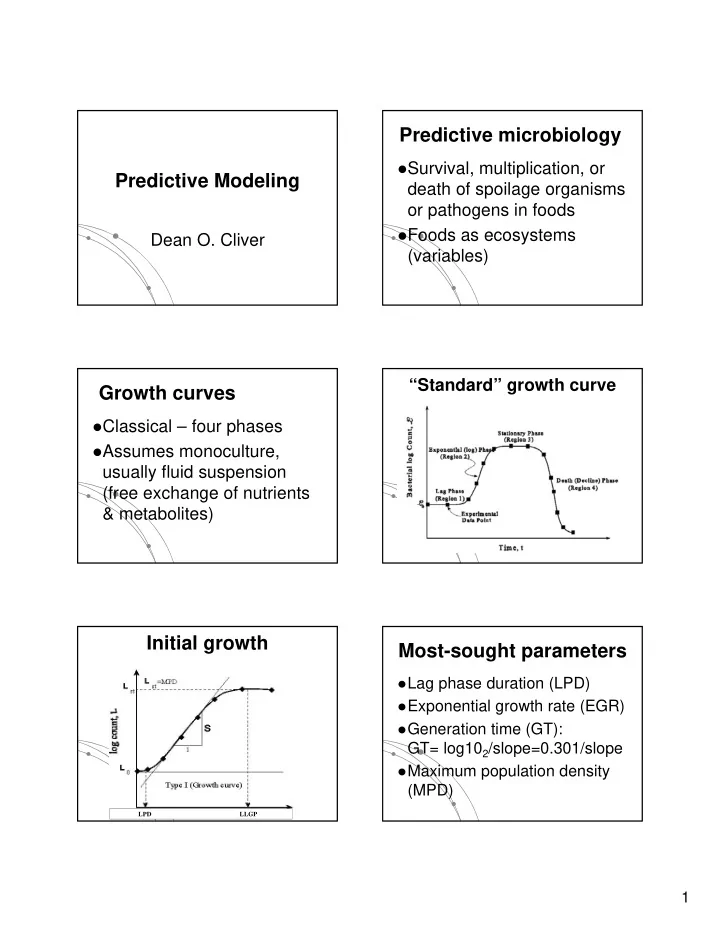
Growth curves

Classical – four phases Assumes monoculture,

usually fluid suspension (free exchange of nutrients & metabolites) “Standard” growth curve

Initial growth

LPD LLGP

Most-sought parameters

Lag phase duration (LPD) Exponential growth rate (EGR) Generation time (GT):

GT= log102/slope=0.301/slope

Maximum population density

(MPD)

slide-2
SLIDE 2

2

Modeling Process

  • 1. Planning
  • 2. Collection and analysis of

data

  • 3. Mathematical description of

data (model development)

  • 4. Validation and

maintenance of model

Modified Gompertz equation

where A, B, D, and M are empirical constants, and t is time

Most-sought parameters Generic growth curve Survival – death NaCl vs E. coli

slide-3
SLIDE 3

3

NaCl vs S. aureus

USDA (ARS) Pathogen Modeling Program (PMP)

http://www.arserrc.gov/mfs/pathogen.htm

Applications of Microbiological Modeling

Hygienic efficiency of meat

processing operations, cooling, transport, meat carton thawing

Shelf-life studies for meat,

poultry and dairy products

Applications of Microbiological Modeling

Validity of regulations, check

rationale for mandatory codes

  • f practice

Microbial fermentation,

finding optimum conditions for growth of desirable microbes (e.g., starter cultures)

Applications of Microbiological Modeling

Conditions for enrichment

  • f target microorganisms in

cultures

Process optimization and

control

Product formulation Education

HACCP – Pred. Microbiol.

  • 1. Identify

potential hazards and assess their severity at different stages

  • f processing or
  • perations.
  • 1. Identify the

microorganism(s)

  • f concern.
slide-4
SLIDE 4

4

HACCP – Pred. Microbiol.

  • 2. Identify the

Critical Control Points (CCP) where control measures need to be implemented.

  • 2. Develop an

understanding

  • f the ecology
  • f the

microorganism to better identify the source and the likelihood of contamination.

HACCP – Pred. Microbiol.

  • 3. Specification of

control criteria and methods to ensure that a control has been achieved (when necessary).

  • 3. Compare

information with preset control specifications (i.e., accept/reject criteria).

HACCP – Pred. Microbiol.

  • 4. Establish and

implement monitoring procedures, and response measures to non- compliance situations.

  • 4. Incorporate the

available information into monitoring systems that indicate microbial proliferation.

Some examples