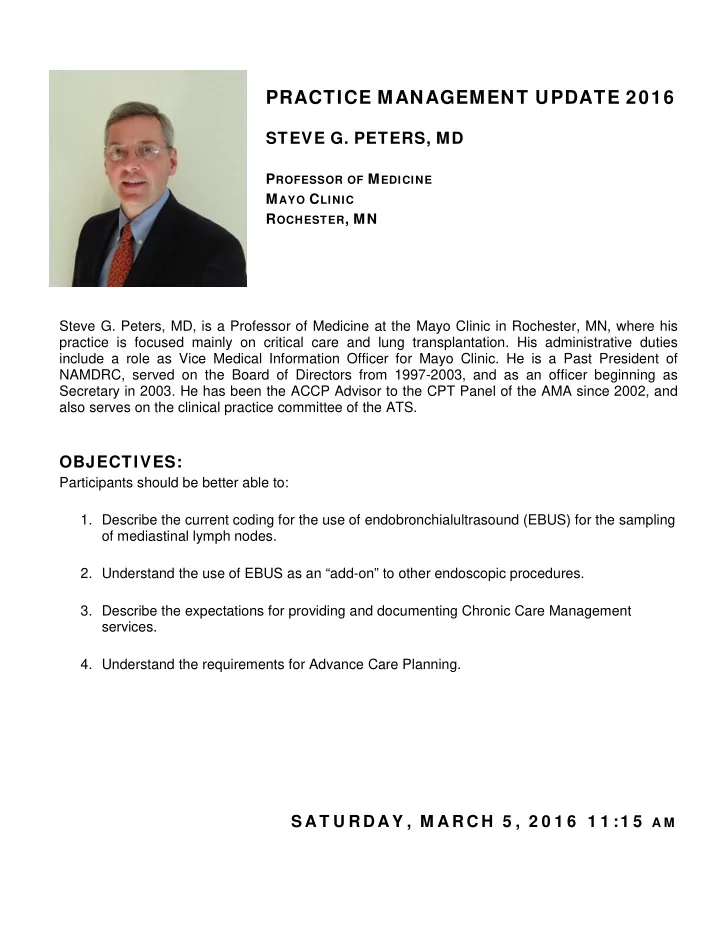
PRACTICE MANAGEMENT UPDATE 2016 STEVE G. PETERS, MD P ROFESSOR OF M - - PDF document

practice management update 2016
SMART_READER_LITE
LIVE PREVIEW

PRACTICE MANAGEMENT UPDATE 2016 STEVE G. PETERS, MD P ROFESSOR OF M - - PDF document

PRACTICE MANAGEMENT UPDATE 2016 STEVE G. PETERS, MD P ROFESSOR OF M EDICINE M AYO C LINIC R OCHESTER , MN Steve G. Peters, MD, is a Professor of Medicine at the Mayo Clinic in Rochester, MN, where his practice is focused mainly on critical care


slide-1
SLIDE 1

PRACTICE MANAGEMENT UPDATE 2016

STEVE G. PETERS, MD

PROFESSOR OF MEDICINE MAYO CLINIC ROCHESTER, MN Steve G. Peters, MD, is a Professor of Medicine at the Mayo Clinic in Rochester, MN, where his practice is focused mainly on critical care and lung transplantation. His administrative duties include a role as Vice Medical Information Officer for Mayo Clinic. He is a Past President of NAMDRC, served on the Board of Directors from 1997-2003, and as an officer beginning as Secretary in 2003. He has been the ACCP Advisor to the CPT Panel of the AMA since 2002, and also serves on the clinical practice committee of the ATS.

OBJECTIVES:

Participants should be better able to:

  • 1. Describe the current coding for the use of endobronchialultrasound (EBUS) for the sampling
  • f mediastinal lymph nodes.
  • 2. Understand the use of EBUS as an “add-on” to other endoscopic procedures.
  • 3. Describe the expectations for providing and documenting Chronic Care Management

services.

  • 4. Understand the requirements for Advance Care Planning.

S A T U R D A Y , M A R C H 5 , 2 0 1 6 1 1 :1 5 A M

slide-2
SLIDE 2

3/8/2016 1

NAMDRC Annual 2016 Steve G. Peters MD

  • Dr. Peters has declared no

conflicts of interest related to the content of his presentation.

slide-3
SLIDE 3

3/8/2016 2

Disclosure

 No financial conflict of interest  Serve on NAMDRC Board of Directors  Advisor to AMA CPT Coding Panel as ACCP

representative

 CPT is a registered trademark of the American

Medical Association

Practice Management Objectives

 Describe the current coding for the use of

endobronchial ultrasound (EBUS) for the sampling of mediastinal lymph nodes

 Understand the use of EBUS as an “add-on” to other

endoscopic procedures

 Describe the expectations for providing and

documenting Chronic Care Management services

 Understand the requirements for Advance Care

Planning

slide-4
SLIDE 4

3/8/2016 3

Node Stations

Convex-probe EBUS

Scanning Range: 50 degrees Direction of View: 30 degrees forward oblique Outer Diameter: 6.9mm

Ridges for balloon

slide-5
SLIDE 5

3/8/2016 4

Convex EBUS

  • View is 30o forward oblique
  • US and white light images can

be seen simultaneously on the same screen

  • White light image of the airway

poorer than current standard video bronchoscope

Radial EBUS for Peripheral Lesions

Radial ultrasound

probe

1.7mm probe

inserted through working channel flexible bronchoscope

slide-6
SLIDE 6

3/8/2016 5

Convex Probe vs Radial Probe

Convex Probe EBUS Radial Probe EBUS

New codes mediastinal node sampling

 31652 with endobronchial ultrasound (EBUS) guided

transtracheal and/or transbronchial sampling (eg, aspiration[s]/biopsy[ies]), one or two mediastinal and/or hilar lymph node stations or structures

 31653 with endobronchial ultrasound (EBUS) guided

transtracheal and/or transbronchial sampling (eg, aspiration[s]/biopsy[ies]), 3 or more mediastinal and/or hilar lymph node stations or structures

slide-7
SLIDE 7

3/8/2016 6

Question 1

 Which one is true regarding EBUS sampling of

mediastinal nodes?

a) Code 31653 may be used for a procedure requiring 3

passes to each of two node stations

b) 31652 should be used for a single EBUS guided biopsy of

a peripheral lung mass

c) 31653 is reported once for EBUS biopsy of four different

node stations

d) 31652 may be used twice for sampling bilateral

mediastinal masses

QUESTION 1 Which one is true regarding EBUS sampling

  • f mediastinal nodes?

a.

Code 31653 may be used for a procedure requiring 3 passes to each of two node stations

b.

31652 should be used for a single EBUS guided biopsy of a peripheral lung mass

c.

31653 is reported once for EBUS biopsy

  • f four different node stations

d.

31652 may be used twice for sampling bilateral mediastinal masses

a. b. c. d.

4% 13% 57% 26%

slide-8
SLIDE 8

3/8/2016 7

New EBUS add-on code

31620 deleted for 2016

+31654 with transendoscopic endobronchial ultrasound

(EBUS) during bronchoscopic diagnostic or therapeutic intervention(s) for peripheral lesion(s) (List separately in addition to code for primary procedure[s]) (Use 31654 in conjunction with 31622, 31623, 31624, 31625, 31626, 31628, 31629, 31640, 31643, 31645, 31646) (For EBUS to access mediastinal or hilar lymph node station[s] or adjacent structure[s], see 31652, 31653)

Base codes transbronch lung Bx, needle aspiration

 31628 with transbronchial lung biopsy(s), single lobe

(31628 should be reported only once regardless of how many transbronchial lung biopsies are performed in a lobe) (To report transbronchial lung biopsies performed on additional lobe, use 31632)

 31629 with transbronchial needle aspiration biopsy(s),

trachea, main stem and/or lobar bronchus(i)

slide-9
SLIDE 9

3/8/2016 8

Question 2

 Which one is true regarding EBUS add-on code +31654? a) This code may be added to mediastinal node sampling

31652 if two different probes are used to assess the nodes

b) If EBUS is used to guide the needle biopsy of a mass in

the right mainstem bronchus, use 31629 +31654

c) If four node stations are sampled, you may add 31654 to

31653

d)

EBUS may not be coded with bronchial biopsy, single

  • r multiple sites, 31625

QUESTION 2 Which one is true regarding EBUS add-on code +31654?

a.

This code may be added to mediastinal node sampling 31652 if two different probes are used to assess the nodes

b.

If EBUS is used to guide the needle biopsy

  • f a mass in the right mainstem bronchus,

use 31629 +31654

c.

If four node stations are sampled, you may add 31654 to 31653

d.

EBUS may not be coded with bronchial biopsy, single or multiple sites, 31625

a. b. c. d.

33% 33% 17% 17%

slide-10
SLIDE 10

3/8/2016 9

Care management services

 Management and support by clinical staff, under the direction of

a physician or other qualified health care professional, to a patient residing at home or in a domiciliary, rest home, or assisted living facility.

 May include establishing, implementing, revising, or monitoring

the care plan, coordinating other professionals and agencies, and educating the patient or caregiver about the condition, care plan, and prognosis.

 A comprehensive plan of care must be documented and shared

with the patient and/or caregiver.

 Includes face-to-face and non-face-to-face time  Does not include time if E&M also coded for a visit  Once per calendar month, only one physician

Chronic Care Coordination

Peters SG, Bunkers KS. CHEST 2015; 148 ( 4 ): 1115 -19  99490 Chronic care management services, at least 20 minutes of

clinical staff time directed by a physician or other qualified health care professional, per calendar month, with the following required elements:

  • Multiple (two or more) chronic conditions expected to last at

least 12 months, or until the death of the patient,

  • chronic conditions place the patient at significant risk of

death, acute exacerbation/decompensation or functional decline,

  • comprehensive care plan established, implemented,

revised or monitored. (Chronic care management services of less than 20 minutes duration, in a calendar month, are not reported separately)

slide-11
SLIDE 11

3/8/2016 10

Complex Chronic Care Management

 99487 Complex chronic care management services, with the

following required elements:

  • Moderate or high complexity medical decision

making;

  • 60 minutes of clinical staff time directed by a

physician or other qualified health care professional per calendar month. (Complex chronic care management services of less than 60 minutes are not reported separately)

 +99489 each additional 30 minutes of clinical staff time

directed by a physician or other qualified health care professional, per calendar month (list separately in addition to code for primary procedure)

Chronic care management for pulmonary

 Coding by any physician treating two or more chronic

conditions

 Only one physician can code each month, so must manage

all chronic conditions (e.g. COPD, CHF, diabetes)

 Since complex codes not recognized, use 99490  Patient must give consent, may have co-pay  Separate E&M can be billed but cannot count those services

  • r time toward chronic care

 No other care management services can overlap (e.g.

anticoagulation, transitional care, on-line services)

slide-12
SLIDE 12

3/8/2016 11

Question 3

 Which one accurately describes a chronic care

management service, 99490?

a) Coordinating care of a COPD patient also managed

by family physician

b) Three 15 minute phone calls in a one-month period

following a consultation for asthma

c) Care management for coordinating inpatient

hospital discharge and transition

d) 30 minutes of staff time in a calendar month,

directed by physician, for a patient at home with severe asthma and steroid-induced diabetes

Question 3 Which one accurately describes a chronic care management service, 99490?

  • a. Coordinating care of a COPD patient also

managed by family physician

  • b. Three 15 minute phone calls in a one-

month period following a consultation for asthma

c.

Care management for coordinating inpatient hospital discharge and transition

  • d. 30 minutes of staff time in a calendar

month, directed by physician, for a patient at home with severe asthma and steroid- induced diabetes

a. b. c. d.

4% 78% 17% 0%

slide-13
SLIDE 13

3/8/2016 12

Advance care planning

 Direct discussion with physician or other qualified

provider regarding wishes, options for future care, including end-of-life care and documentation, if performed

 Examples of these forms: health care proxy, durable

power of attorney for health care, living will, medical

  • rders for life-sustaining treatment

 Coverage initiated by CMS January 1, 2016

 http://federalregister.gov/a/2015-28005

 RVUs: 99497 2.4; 99498 2.09

Advance Care Planning

 99497 Advance care planning including the explanation and

discussion of advance directives such as standard forms (with completion of such forms, when performed), by the physician or other qualified health care professional; first 30 minutes, face-to-face with the patient, family member(s), and/or surrogate

 ✚ 99498 each additional 30 minutes (List separately in

addition to code for primary procedure) (Use 99498 in conjunction with 99497) (Do not report 99497 and 99498 on the same date of service as 99291, 99292, 99468, 99469, 99471, 99472, 99475, 99476, 99477, 99478, 99479, 99480)

slide-14
SLIDE 14

3/8/2016 13

Question 4

 Which one is true regarding advance care planning

codes, 99497, +99498?

a) 99497 may be billed in addition to an E&M code for

follow-up of COPD and long term oxygen

b) 99497 may be used for 40 minutes of family

counseling after one hour of direct critical care time

c) +99498 cannot be added to 99497 for care planning

discussion that takes 50 minutes

d) A living will must be on file in the record for the use

  • f advance directive codes

QUESTION 4 Which one is true regarding advance care planning codes, 99497, +99498?

a.

99497 may be billed in addition to an E&M code for follow-up of COPD and long term oxygen

b.

99497 may be used for 40 minutes of family counseling after one hour of direct critical care time

c.

+99498 cannot be added to 99497 for care planning discussion that takes 50 minutes

d.

A living will must be on file in the record for the use of advance directive codes

a. b. c. d.

50% 10% 35% 5%

slide-15
SLIDE 15

3/8/2016 14

Bronchial Valves

 31647 with balloon occlusion, when performed,

assessment of air leak, airway sizing, and insertion of bronchial valve(s), initial lobe

 ✚ 31651 with balloon occlusion, when performed,

assessment of air leak, airway sizing, and insertion of bronchial valve(s), each additional lobe (List separately in addition to code for primary procedure[s])

Endobronchial valves (EBV) for emphysema

Klooster K et al. N Engl J Med 2015; 373:2325-35

 84 patients, 16 excluded because of collateral ventilation  34 pts each to EBV vs control  EBV group showed greater improvements

 FVC 340 ml, FEV1 140 ml  Six minute walk 74 meters

 More adverse events with EBV: pneumothorax (18%),

valve replacement (12%), removal (15%), one death

 ?Use of existing codes for indication of emphysema

slide-16
SLIDE 16

3/8/2016 15

Lung volume reduction by endobronchial coils

Deslee G et al. JAMA 2016;315:175-84

 100 patients, 1:1 randomization to usual care vs coils  At six months, primary end point of >54 m

improvement in six-minute walk

 18 (36%) coil group, 9 (18%) controls  At 12 mos FEV1 +0.08 L in coil group