
SLIDE 1
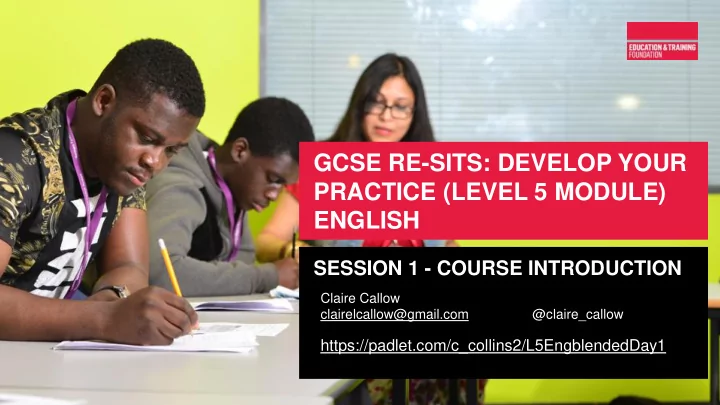
GCSE RE-SITS: DEVELOP YOUR PRACTICE (LEVEL 5 MODULE) ENGLISH
SESSION 1 - COURSE INTRODUCTION
Claire Callow clairelcallow@gmail.com @claire_callow
https://padlet.com/c_collins2/L5EngblendedDay1
PRACTICE (LEVEL 5 MODULE) ENGLISH SESSION 1 - COURSE INTRODUCTION - - PowerPoint PPT Presentation
GCSE RE-SITS: DEVELOP YOUR PRACTICE (LEVEL 5 MODULE) ENGLISH SESSION 1 - COURSE INTRODUCTION Claire Callow clairelcallow@gmail.com @claire_callow https://padlet.com/c_collins2/L5EngblendedDay1 01 Welcome Introduce yourself Are you
SESSION 1 - COURSE INTRODUCTION
Claire Callow clairelcallow@gmail.com @claire_callow
https://padlet.com/c_collins2/L5EngblendedDay1
3
Delivered by ccConsultancy for the Education and Training Foundation
4
Delivered by ccConsultancy for the Education and Training Foundation
Delivered by ccConsultancy for the Education and Training Foundation Slide 6
Can you …
Understand the contents and structure
Identify your GCSE English knowledge and pedagogical understanding? Understand some of the issues raised by the increase in learners retaking GCSE English? Analyse factors that might have disengaged GCSE English learners?
8
Day 1 Introduction to the course. Analysing GCSE course requirements. Day 2 Engaging & motivating learners in GCSE English Language. Using assessment approaches to support GCSE English Language learning. Day 3 Building on the knowledge learners already have. Improving Learning in GCSE English (1). Day 4 Improving Learning in GCSE English (2). Preparing learners for summative assessments. Day 5 Putting it all together. Course review. Next steps.
Delivered by ccConsultancy for the Education and Training Foundation
9
Delivered by ccConsultancy for the Education and Training Foundation
10
Delivered by ccConsultancy for the Education and Training Foundation
12
Delivered by ccConsultancy for the Education and Training Foundation
Delivered by ccConsultancy for the Education and Training Foundation
Slide 13
As we will have learners who have tried GCSE before, we need to have some fresh approaches and adapt
misconceptions in their existing knowledge. What do learners tell us they want? ...fun, interactive, practical, can see the point of it, timely initial assessment and support; smaller classes; teachers who can manage behaviour assertively; not to lose face in class by asking for help; a collaborative classroom climate…
(NIACE, 2015)
14
Delivered by ccConsultancy for the Education and Training Foundation
Johnston-Wilder, S, Lee,C. Garton, E., Goodlad, S. and Brindley, J. (2013)
15
Delivered by ccConsultancy for the Education and Training Foundation
16
Delivered by ccConsultancy for the Education and Training Foundation
Delivered by ccConsultancy for the Education and Training Foundation
When we create classes steeped in ‘yet’ equality happens The tyranny of now Praise can make learners vulnerable Everyone has a chance to get smarter The grade ‘not yet’ gives you a path to the future
17
Delivered by ccConsultancy for the Education and Training Foundation
Slide 18
19
Tom Sherrington’s blog School walls are oozing with unhelpful growth mindset cheese…(2017)
Delivered by ccConsultancy for the Education and Training Foundation
Delivered by ccConsultancy for the Education and Training Foundation
20
Retention and Success in Maths and English The Behavioural Research Centre, February 2018
motivational talks about resilience at the start of a course isn’t enough
develop ‘grit’ into their regular session planning and the way they give feedback
initiatives will be weakened
Principle 4 Develop Skills Beyond Maths and English
21
Delivered by ccConsultancy for the Education and Training Foundation
22
education over recent years. In general, resilience is about adjusting to adversity when it happens and bouncing back afterwards. It has been defined as: ‘The process of effectively negotiating, adapting to sources of stress, or managing significant sources of stress or trauma’ (Rook et al, 2018; Windle, 2011). There is general agreement that resilience is both a trait, i.e. a relatively stable aspect of personality, and a dynamic process, i.e. a personal behaviour that changes over time and therefore can be influenced by training and development (Chmitorz et al, 2018; Windle, 2011). Resilience develops through interaction between the person and the environment (Beltman et al, 2011). Education inspection framework: overview of research January 2019
Delivered by ccConsultancy for the Education and Training Foundation
23
Delivered by ccConsultancy for the Education and Training Foundation
Reflect using your PDPs, especially sections 1.1, 5.1 and 1.2 (although you may find other relevant sections too.)
Now can you …
Understand the contents and structure
Identify your GCSE English knowledge and pedagogical understanding? Understand some of the issues raised by the increase in learners retaking GCSE English? Analyse factors that might have disengaged GCSE English learners?
25
Delivered by ccConsultancy for the Education and Training Foundation
26
Research Centre report: Retention and Success in Maths and English
Engaging learners in GCSE maths and English, 2015
dangerous by Carol Dweck
GoConqr activity on language techniques: https://www.goconqr.com/en- US/p/3104926-Meta-language- flash_card_decks
https://www.tes.com/news/gcses- what-can-we-learn-english-examiner- reports
Delivered by ccConsultancy for the Education and Training Foundation
ETFOUNDATION.CO.UK
Claire Callow CLAIRELCALLOW@GMAIL.COM