SLIDE 1
Practical Guide to Determination of Practical Guide to Determination of Binding Constants Binding Constants
(K. Hirose, in Analytical Methods in Supramolecular Chemistry, C. A. Schalley Ed.; Wiley-VCH, Weinheim, 2005)
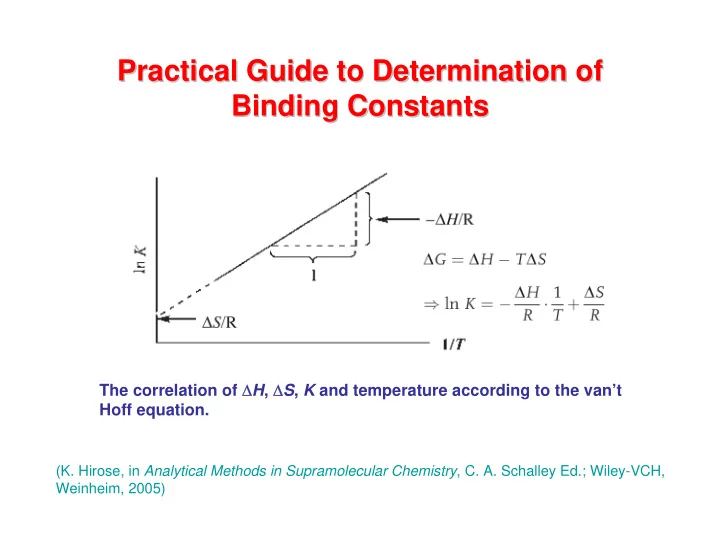
The correlation of ΔH, ΔS, K and temperature according to the van’t Hoff equation.
SLIDE 2
SLIDE 3
Guideline for Experiments Guideline for Experiments
SLIDE 4 Determination of Binding Constants by UV Determination of Binding Constants by UV-
vis Spectroscopy Spectroscopy
- Determination of stoichiometry
SLIDE 5
SLIDE 6 The molar absorptivities εh, εg can be determined from independent measurements using the pure host and the pure guest, respectively. The concentrations [H]0, [G]0, are known because they are the experimental conditions set up by the experimenter. So, the So, the stoichiometry stoichiometry is determined from a modified Job is determined from a modified Job’ ’s plot where s plot where ( (A Aobs
εh
h [H]
[H]0
0 -
εg
g –
– [G] [G]0
0 is plotted as the y
is plotted as the y-
- coordinate instead of [C].
coordinate instead of [C].
SLIDE 7
Modified Job’s Plot for complexation of host and guest (1 : 1) by UV/vis spectroscopy.
SLIDE 8 Evaluation of Complex Concentration
- Case 1: the absorption bands of host, guest and complex overlap
- Case 2: the absorption bands of only two components overlap
SLIDE 9
Precautions to be Taken when Setting Up Concentration Precautions to be Taken when Setting Up Concentration Conditions of the Titration Experiment Conditions of the Titration Experiment
Let us consider 1 : 1 host-guest complexation
SLIDE 10
Measurements below 20% and above 80% complexation ratio (x) yield uncertain values.
SLIDE 11 How to Set up [H] How to Set up [H]0
- Setting up the concentration of host [H]0 is limited by the measured
properties, the apparatus, and other features of the experiment.
- [H]0 for NMR spectroscopy is roughly in the range of 0.01 M with one
- r two orders of magnitude variation.
- [H]0 for UV-vis spectroscopy, which depends severely on the molar
absorptivity, is roughly in the range of 0.0001 M.
- [G]0 is often the only variable which can be set up in a wide range,
because [H]0 is usually governed by the experimental method.
SLIDE 12
How to Set up [G] How to Set up [G]0
e.g. when [G]0 = 0.001 M, and [H]0 = 0.0001 M, [G]0/[H]0 =10, a reliable range of K of 250 to 4000 M-1 is obtained.
SLIDE 13
SLIDE 14
Reliable regions of [H]0 and [G]0 for K determination shown for representative concentrations of UV-vis and NMR experiments.
SLIDE 15 Data Treatment Data Treatment
- Rose-Drago Method for UV-Vis Spectroscopy
SLIDE 16 Determination of Binding Constants by NMR Determination of Binding Constants by NMR Spectroscopy Spectroscopy
Case 1: The host–guest complexation equilibrium, which has a very slow exchange rate compared with the NMR time scale.
- Determination of stoichiometry
- Evaluation of complex concentration
SLIDE 17 Case 2: The host–guest complexation equilibrium, which has a very fast exchange rate compared with the NMR time scale.
- Determination of stoichiometry
SLIDE 18
- Evaluation of complex concentration
- Data Treatment: Rose-Drago method (same as UV-vis)
Illustration of a typical NMR Illustration of a typical NMR titration experiment titration experiment