
SLIDE 1
18TH INTERNATIONAL CONFERENCE ON COMPOSITE MATERIALS
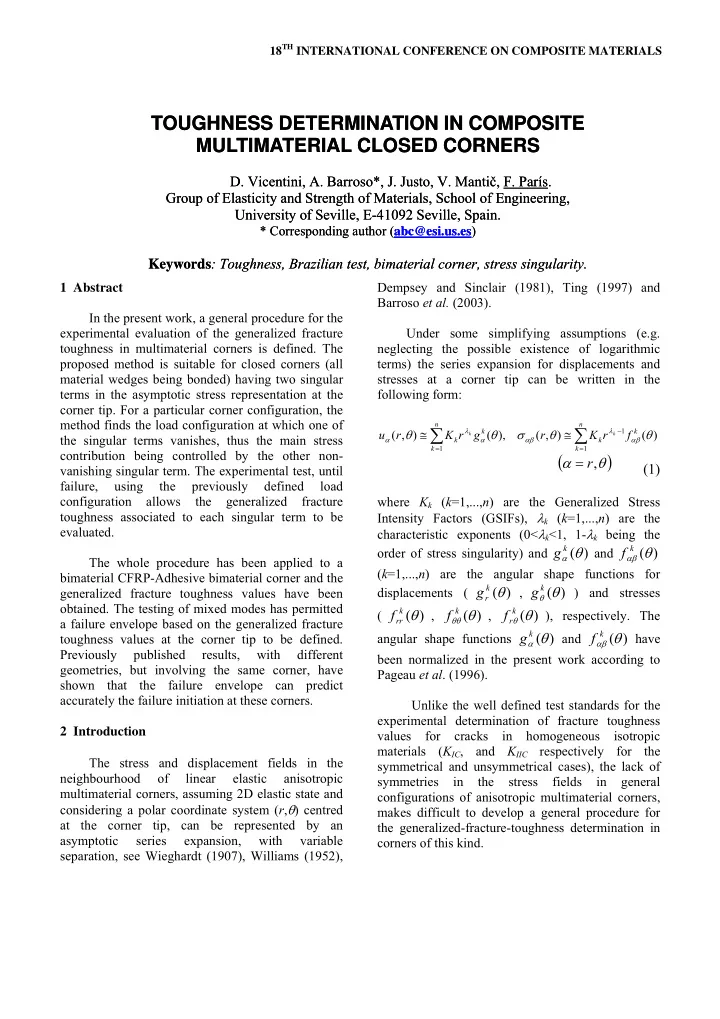
1 Abstract In the present work, a general procedure for the experimental evaluation of the generalized fracture toughness in multimaterial corners is defined. The proposed method is suitable for closed corners (all material wedges being bonded) having two singular terms in the asymptotic stress representation at the corner tip. For a particular corner configuration, the method finds the load configuration at which one of the singular terms vanishes, thus the main stress contribution being controlled by the other non- vanishing singular term. The experimental test, until failure, using the previously defined load configuration allows the generalized fracture toughness associated to each singular term to be evaluated. The whole procedure has been applied to a bimaterial CFRP-Adhesive bimaterial corner and the generalized fracture toughness values have been
- btained. The testing of mixed modes has permitted
a failure envelope based on the generalized fracture toughness values at the corner tip to be defined. Previously published results, with different geometries, but involving the same corner, have shown that the failure envelope can predict accurately the failure initiation at these corners. 2 Introduction The stress and displacement fields in the neighbourhood
- f
linear elastic anisotropic multimaterial corners, assuming 2D elastic state and considering a polar coordinate system (r,) centred at the corner tip, can be represented by an asymptotic series expansion, with variable separation, see Wieghardt (1907), Williams (1952), Dempsey and Sinclair (1981), Ting (1997) and Barroso et al. (2003). Under some simplifying assumptions (e.g. neglecting the possible existence of logarithmic terms) the series expansion for displacements and stresses at a corner tip can be written in the following form:
n k k k n k k k
f r K r g r K r u
k k
1 1 1
) ( ) , ( , ) ( ) , (
, r (1)
where Kk (k=1,...,n) are the Generalized Stress Intensity Factors (GSIFs), k (k=1,...,n) are the characteristic exponents (0<k<1, 1-k being the
- rder of stress singularity) and
) (
k
g
and
) (
k
f
(k=1,...,n) are the angular shape functions for displacements (
) (
k r
g
,
) (
k
g
) and stresses (
) (
k rr
f
,
) (
k
f
,
) (
k r
f
), respectively. The angular shape functions
) (
k
g
and
) (
k
f
have been normalized in the present work according to Pageau et al. (1996). Unlike the well defined test standards for the experimental determination of fracture toughness values for cracks in homogeneous isotropic materials (KIC, and KIIC respectively for the symmetrical and unsymmetrical cases), the lack of symmetries in the stress fields in general configurations of anisotropic multimaterial corners, makes difficult to develop a general procedure for the generalized-fracture-toughness determination in corners of this kind.
TOUGHNESS DETERMINATION IN COMPOSITE MULTIMATERIAL CLOSED CORNERS
- D. Vicentini, A. Barroso*, J. Justo, V. Mantič, F. París.
Group of Elasticity and Strength of Materials, School of Engineering, University of Seville, E-41092 Seville, Spain.
* Corresponding author (abc@esi.us.es)
Keywords: Toughness, Brazilian test, bimaterial corner, stress singularity.
TOUGHNESS DETERMINATION IN COMPOSITE MULTIMATERIAL CLOSED CORNERS
- D. Vicentini, A. Barroso*, J. Justo, V. Mantič, F. París.