
SLIDE 1
@NHS_HealthEdEng @NSHCS www.nshcs.hee.nhs.uk
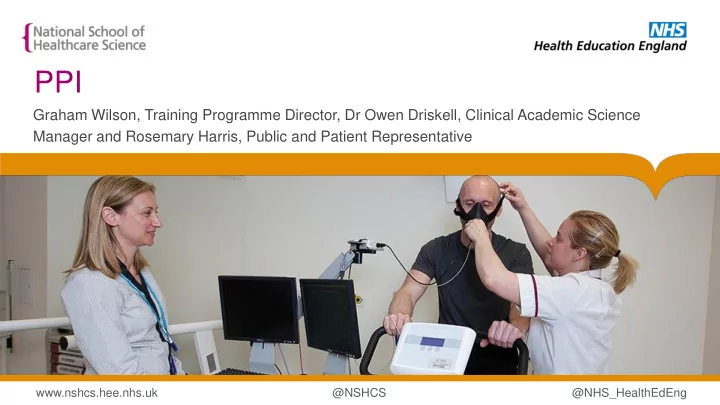
PPI
Graham Wilson, Training Programme Director, Dr Owen Driskell, Clinical Academic Science Manager and Rosemary Harris, Public and Patient Representative
PPI Graham Wilson, Training Programme Director, Dr Owen Driskell, - - PowerPoint PPT Presentation
PPI Graham Wilson, Training Programme Director, Dr Owen Driskell, Clinical Academic Science Manager and Rosemary Harris, Public and Patient Representative www.nshcs.hee.nhs.uk @NSHCS @NHS_HealthEdEng www.nshcs.hee.nhs.uk @NSHCS
@NHS_HealthEdEng @NSHCS www.nshcs.hee.nhs.uk
Graham Wilson, Training Programme Director, Dr Owen Driskell, Clinical Academic Science Manager and Rosemary Harris, Public and Patient Representative
www.nshcs.hee.nhs.uk @NSHCS @NHS_HealthEdEng
www.nshcs.hee.nhs.uk @NSHCS @NHS_HealthEdEng
www.nshcs.hee.nhs.uk @NSHCS @NHS_HealthEdEng
www.nshcs.hee.nhs.uk @NSHCS @NHS_HealthEdEng
www.nshcs.hee.nhs.uk @NSHCS @NHS_HealthEdEng
www.nshcs.hee.nhs.uk @NSHCS @NHS_HealthEdEng
www.nshcs.hee.nhs.uk @NSHCS @NHS_HealthEdEng
(STEM)
www.nshcs.hee.nhs.uk @NSHCS @NHS_HealthEdEng
place
that patients can feedback on the service and their treatment
www.nshcs.hee.nhs.uk @NSHCS @NHS_HealthEdEng
www.nshcs.hee.nhs.uk @NSHCS @NHS_HealthEdEng
It was incredibly useful to talk to a patient undergoing
ways to improve it which can really only be understood when seen from a patient’s point of view. Overall the experience was great and definitely helped to make me think about how equipment and procedures can be altered not just to improve effectiveness but also the overall quality of life for patients. Overall it was a very insightful and informative experience for us. By interacting with patients and staff we can get first-hand knowledge of the challenges in healthcare system. This knowledge will help us design our future learning and projects towards finding ways to overcome these
system more efficient, easy to access and as patient-friendly as possible. I found the days very informative as, during my rotation in radiotherapy there was limited patient contact. These sessions helped to put the work we do as clinical scientists into context. The patient had not heard of clinical scientists and could not describe any roles of hospital staff beyond doctors and nurses. He seemed to understand the role of clinical scientists once explained to him and was positive about the roles.
www.nshcs.hee.nhs.uk @NSHCS @NHS_HealthEdEng
www.nshcs.hee.nhs.uk @NSHCS @NHS_HealthEdEng
I am a member of:
I am involved in:
input
www.nshcs.hee.nhs.uk @NSHCS @NHS_HealthEdEng
Lay Representative outside of the National School including involvement with:
My perspective:
www.nshcs.hee.nhs.uk @NSHCS @NHS_HealthEdEng
https://www.nshcs.hee.nhs.uk/images/guidan ce/reports/hcs-pathways-and-ppi-report.pdf
http://www.health.org.uk/publication/impl ementing-shared-decision-making-uk
www.nshcs.hee.nhs.uk @NSHCS @NHS_HealthEdEng