Power dissipation! Electrical Engineering Department Technion Israel - - PDF document

power dissipation
SMART_READER_LITE
LIVE PREVIEW

Power dissipation! Electrical Engineering Department Technion Israel - - PDF document

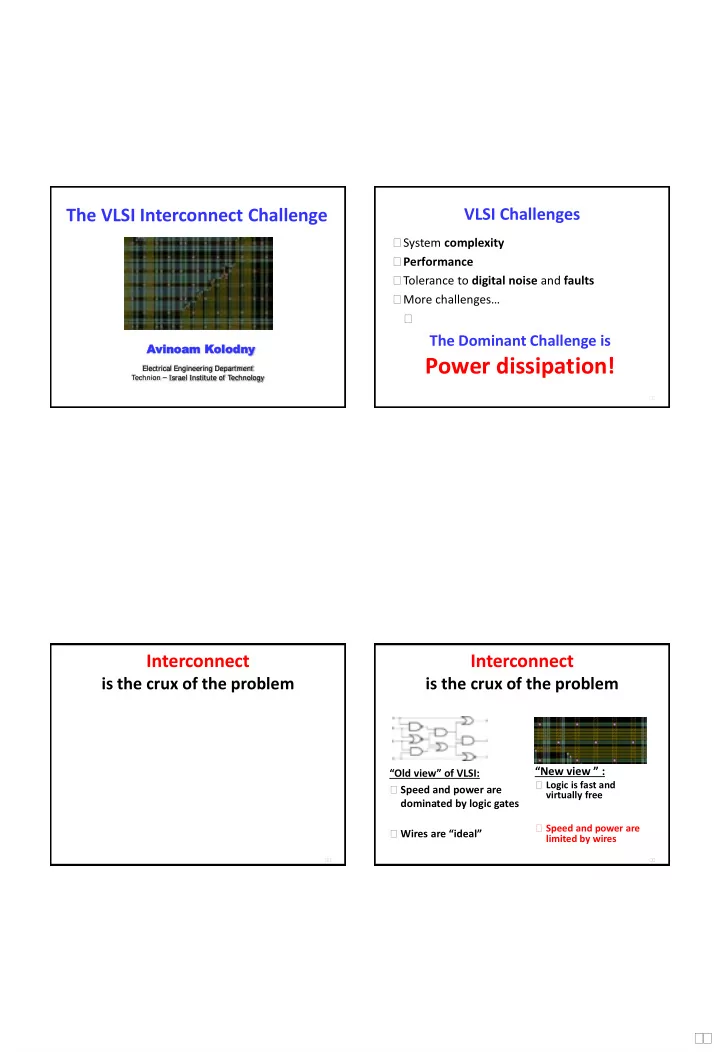
The VLSI Interconnect Challenge VLSI Challenges System complexity Performance Tolerance to digital noise and faults More challenges The Dominant Challenge is Avinoam Kolodny Power dissipation! Electrical Engineering


slide-1
SLIDE 1
  • Avinoam Kolodny

The VLSI Interconnect Challenge

Electrical Engineering Department Technion – Israel Institute of Technology

VLSI Challenges

System complexity Performance Tolerance to digital noise and faults More challenges…

  • The Dominant Challenge is

Power dissipation!

Interconnect

is the crux of the problem

  • Interconnect

is the crux of the problem

  • “Old view” of VLSI:

Speed and power are dominated by logic gates Wires are “ideal”

  • “New view ” :

Logic is fast and virtually free Speed and power are limited by wires

slide-2
SLIDE 2
  • Outline of this talk

Background of the VLSI interconnect challenge Implications for energy-efficient computing Research directions

  • 2001 - Extrapolation Towards

A Power Crisis

1 10 100 1000 10000 1970 1980 1990 2000 2010 2020

Year Power Density (W/cm2)

i386

Hot Plate Nuclear Reactor Rocket Nozzle

4004 Pentium 4 Pentium Pro 8086 i486 8080 i286 Pentium 8085 Pentium 3

NMOS to CMOS transition

  • VLSI hits the power wall

1 10 100 1000 10000 1970 1980 1990 2000 2010 2020

Year Power Density (W/cm2)

i386 4004 Pentium 4 Pentium Pro 8086 i486 8080 i286 Pentium 8085 Pentium 3

NMOS to CMOS transition

  • Intel’s Pentium-M, low-power microprocessor, 0.13 micron CMOS

Bit-Transportation energy is larger than computation energy!

Interconnect Power: A case study - 2004

slide-3
SLIDE 3
  • Chips are Like Cities:

Complexity is Shown in Connectivity

In each generation of technology:

More transistors More interconect wires

  • Technology Scaling:

Faster Transistors, Slower Wires

  • Technology Scaling:

Faster Transistors, Slower Wires

  • Trying to Keep Wire Resistance in Check

Leads to Larger Capacitances

  • 2

1 3 k

slide-4
SLIDE 4
  • If Bits Were Cars….

The Nature of Design for Low-Power

No critical root cause

Because power is cumulative Need power-saving efforts at all levels!

  • 3 Types of Improvement

1 Reduce waste of energy 2 (Optimal) Tradeoff power with delay (or other metric) 3 Change the algorithm or computational task

  • iccad
  • Wire layout optimization:

Wire Widths and Spaces in a Wire Bundle

slide-5
SLIDE 5
  • Wire layout optimization:

Finding Optimal Wire Widths and Spaces under Delay Constraints

  • Integration, 2014.
  • Wire layout optimization:

Optimal Ordering Theorem for Power

Given an interconnect channel with wires of uniform width W, use ‘Symmetric Hill’ ordering according to activity factors of the signals

  • INTEGRATION, 2007
  • 31

*R. J. Gutmann et al., “Three-Dimensional (3D) ICs: A Technology Platform for Integrated Systems and Opportunities for New Polymeric Adhesives,” Proceedings of the Conference on Polymers and Adhesives in Microelectronics and Photonics, pp. 173-180, October 2001

Bulk CMOS

Substrate Substrate

2nd plane 3rd plane 1st plane

Through silicon vias (TSV)

  • 3-D Integrated Circuit Technology
  • Circuit optimization:

Optimal Power-Delay Tradeoff for Logic Paths

  • For 2.5% delay increase,

get 12x2.5=30% energy reduction!

For 20% delay increase, get 2x20=40% energy reduction

slide-6
SLIDE 6
  • Most Power Savings

Can be Made at High Abstraction Levels

  • Pollack’s Rule on

Power Efficiency of Uniprocessors

  • = 𝜷𝟐

𝑩𝒔𝒇𝒃 𝐱𝐟𝐬 = 𝜷𝟑 (𝑩𝒔𝒇𝒃)

  • Architecture optimization:

Processor System Evolution to CMP

  • = 𝜷𝟐

𝑩𝒔𝒇𝒃 𝐱𝐟𝐬 = 𝜷𝟑 (𝑩𝒔𝒇𝒃)

  • Chip

Multi- Processors

Processor Architectures:

Uni-core, Symmetric multicore, Asymmetric (Heterogeneous)

slide-7
SLIDE 7
  • Architecture optimization:

Asymmetric Multi-Core Performance

ACCMP Performance Vs. Power

  • Relative Power

Relative Performance

  • (25

25% % serial code) de)

  •  Classes of Replicated cores

Standard modules (Processors, Accelerators, Cache banks, ...)

 Network on Chip (NoC)  Power management

Different clocks

Different operating voltages

“dark silicon”

  • If a chip is like a city,

Network-on-Chip (NoC) is like a subway system

Architecture optimization:

Network on-Chip (NoC)

slide-8
SLIDE 8
  • Issues Addressed by NoC
  • Multi-Core Processor Systems

(key to power-efficient computing)

  • Global wire design

(delay, power, noise, scalability, reliability issues)

  • System integration

productivity

(key to modular design)

  • Interconnect-aware and NoC-aware

Architectural Research Accessing On-Chip Cache Banks through a NoC

  • Where to Store the Shared Data?

What can be done better?

 Bring shared data closer to all processors  Preserve vicinity of private data

  • A small number of lines, shared by many processors,

is accessed numerous times

slide-9
SLIDE 9
  • Memory Bottleneck

Memory Control Unit Arithmetic/ Logic Unit CPU

Reducing Distances by Embedding Memory in Execution Units

slide-10
SLIDE 10
  • Memristor Devices
  • Sea of Memory

Dense and fast

Towards Memory-Intensive Machines

Constant-throughput-curves  increase on-die-memory!

  • 𝑪𝒃𝒐𝒆𝒙𝒋𝒆𝒖𝒊

𝑼𝒊𝒔𝒑𝒗𝒉𝒊𝒒𝒗𝒖 𝑪𝒃𝒐𝒆𝒙𝒋𝒆𝒖𝒊

  • Logic within the Memory

Beyond von Neumann Architecture

Memory Control Unit Arithmetic/ Logic Unit CPU

slide-11
SLIDE 11
  • Summary

VLSI power is dominated by interconnect! New architectures are driven by interconnect distances/latencies/power