
SLIDE 1
CIRAD-Forêt – G. Cornu – 6/2002
Poster Poster Sesimbra Sesimbra
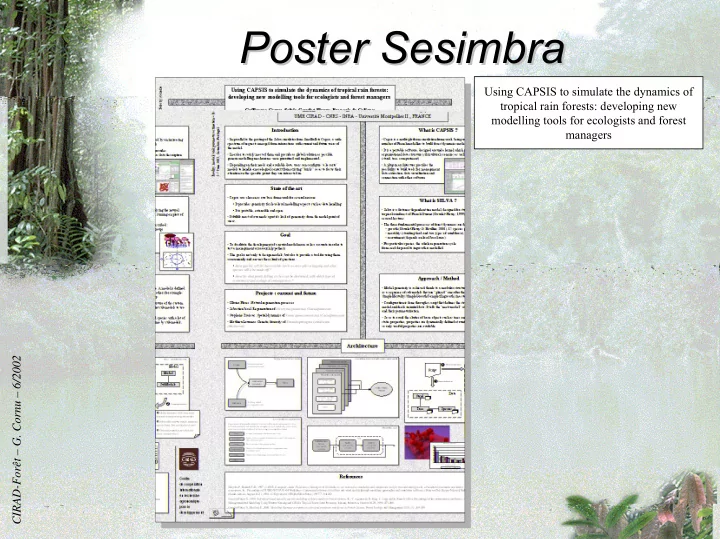
Using CAPSIS to simulate the dynamics of tropical rain forests: developing new modelling tools for ecologists and forest managers
Poster Sesimbra Sesimbra Poster Using CAPSIS to simulate the - - PowerPoint PPT Presentation
Poster Sesimbra Sesimbra Poster Using CAPSIS to simulate the dynamics of tropical rain forests: developing new modelling tools for ecologists and forest managers CIRAD-Fort G. Cornu 6/2002 Selva Selva Portage du simulateur
CIRAD-Forêt – G. Cornu – 6/2002
Using CAPSIS to simulate the dynamics of tropical rain forests: developing new modelling tools for ecologists and forest managers
CIRAD-Forêt – G. Cornu – 6/2002
CIRAD-Forêt – G. Cornu – 6/2002
natural tropical rainforest of French Guiana (Gourlet-Fleury, 1999), running on plots of several hectares.
from seed dispersal to ingrowth is modelled
natural tropical rainforest of French Guiana (Gourlet-Fleury, 1999), running on plots of several hectares.
from seed dispersal to ingrowth is modelled
?
x y
CIRAD-Forêt – G. Cornu – 6/2002
Taking the best of two worlds Taking the best of two worlds Capsis Capsis Generic tools and common framework Working model for tropical forests Add model genericity Add model genericity Selva Selva Old Selva Old Selva
CIRAD-Forêt – G. Cornu – 6/2002
is defined as a sequence of sub-models that are “played” one after the
SimpleMortality/SimpleGrowth/ComplexIngrowth
custom model and feeds in initial data. It tells the “meta-model” what sub-models to use and their parameterization.
with a lot of static properties, properties are dynamically defined at runtime by sub-models, so only useful properties are available.
is defined as a sequence of sub-models that are “played” one after the
SimpleMortality/SimpleGrowth/ComplexIngrowth
custom model and feeds in initial data. It tells the “meta-model” what sub-models to use and their parameterization.
with a lot of static properties, properties are dynamically defined at runtime by sub-models, so only useful properties are available.
CIRAD-Forêt – G. Cornu – 6/2002
Assembling bricks to build a tailor-made model Assembling bricks to build a tailor-made model Other sub models … Other sub models … Ingrowth sub models Ingrowth sub models Growth sub models Growth sub models Tailor-Made Model Tailor-Made Model Mortality sub models Mortality sub models Trivial Mortality (%) Trivial Mortality (%) Simple Mortality (G, age) Simple Mortality (G, age) Complex mortality (G, age, windfalls …) Complex mortality (G, age, windfalls …) Other … Other …
CIRAD-Forêt – G. Cornu – 6/2002
An extensible set of properties An extensible set of properties
Simple Calculated History Neighbourhood Gaps Property value is computed on demand and is kept for subsequent use (Total stand basal area) The last n values of this property are kept Handle a list of neighbours that obey a neighbourhood rule (Competition index) Handle a list of shaped gaps and manage their life cycle Others …
Properties are dynamically added to trees (as well as stands and species) to store extra data needed by sub models. For example a growth model may want to know what trees are within a radius of 30 m to compute a competition index.
A single value property with optional initial value
CIRAD-Forêt – G. Cornu – 6/2002
Initialisation du modèle
propriétés
des données
CIRAD-Forêt – G. Cornu – 6/2002
Trees Add tree Remove tree Update Step process
CIRAD-Forêt – G. Cornu – 6/2002
Model flow chart Model flow chart Initialization Model, sub models and data Apply sub models
Update sub models and data Step
CIRAD-Forêt – G. Cornu – 6/2002
#import "selva.test" #log_level 10 #log_file "paracou.log" description = "Petit essai de simulation" //! Choix des sous-modeles subModels = ( submodels.SimpleDeathSubModel { killer = killers.StandingDeadKiller { a=4.96 b=3.42 } }, submodels.GrowthSubModel { grower = DummyGrower { increment = 1 } }, DummyIngrowthSubModel ) //! Definition des especes species = ( SelvaSpecies { name = "Angelique" inventoryCodes = ( 103 ) grower = growers.Gourlet13Grower { a=1 b=2 c=1 d=0.5 m=0.3 K=1 residualCorrelation=0.5 residualMean=0.1 residualDispersion=0.1 neighbourhoodStrategy=neighbourhoods.BigTreesWithinRadius { radius=30 minDbh=20 } } } ) //! chargement du peuplement stand = SelvaStand { trees = SelvaInventoryReader { filename = "data/test.inv" } } do describe do simulate(5) timed //! Impression des resultats do print
CIRAD-Forêt – G. Cornu – 6/2002
(Caesalpinaceae)
americana (Caesalpinaceae)
cylindricum (Meliaceae)
(Caesalpinaceae)
americana (Caesalpinaceae)
cylindricum (Meliaceae)