#post_modern Branch-and-Cut Implementation Matteo Fischetti, - - PowerPoint PPT Presentation

post modern branch and cut implementation
SMART_READER_LITE
LIVE PREVIEW

#post_modern Branch-and-Cut Implementation Matteo Fischetti, - - PowerPoint PPT Presentation

#post_modern Branch-and-Cut Implementation Matteo Fischetti, University of Padova 1 ISMP 2018, Bordeaux, July 6, 2018 Why bothering about implementations at ISMP? ISMP 2018, Bordeaux, July 6, 2018 2 Why bothering about implementations at


slide-1
SLIDE 1

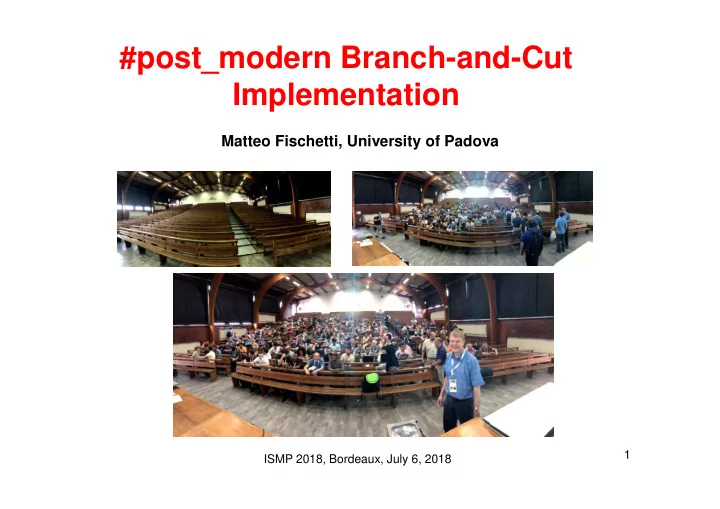
#post_modern Branch-and-Cut Implementation

Matteo Fischetti, University of Padova

ISMP 2018, Bordeaux, July 6, 2018 1
slide-2
SLIDE 2

Why bothering about implementations at ISMP?

ISMP 2018, Bordeaux, July 6, 2018 2

slide-3
SLIDE 3

Why bothering about implementations at ISMP?

  • Implementation

is not just coding!

  • Needed if we #orms want to have an impact in practical applications
  • Ask yourself: would Artificial Intelligence (notably: deep learning) be

so successful without gradient-descent algorithms served with their efficient #backpropagation implementations?

ISMP 2018, Bordeaux, July 6, 2018 3

slide-4
SLIDE 4

Algorithms without implementation

Proof: omitted as of no interest to the typical MP reader.

Describing an Algorithm without Implementation is like stating a Theorem without Proof

#just_a_computational_conjecture

ISMP 2018, Bordeaux, July 6, 2018 4

slide-5
SLIDE 5

Algorithms without implementation

Proof: omitted as of no interest to the typical MP reader.

Describing an Algorithm without Implementation is like stating a Theorem without Proof

#just_a_computational_conjecture

ISMP 2018, Bordeaux, July 6, 2018 5

slide-6
SLIDE 6

Branch & Cut ™

  • A “trademark” of Manfred Padberg and Giovanni Rinaldi
  • Proposed in the 1990’s for the TSP (and soon extended)
  • Comes as an algorithm entangled with its implementation
  • Theorem. Using cuts within an enumerative scheme is good.
  • Proof. Assume w.l.o.g. a good LP solver. Then apply B&Bound but

– make use of families of (problem dependent) globally-valid inequalities – perform efficient exact/heuristic cut separation on the fly – use a data-structure (cut pool) to effectively share cuts among nodes – price variables in a dynamic way (well before branch-and-price!) – alternate row and column generation in a sound way … – suspend a node if “unattractive” – …

ISMP 2018, Bordeaux, July 6, 2018 6

slide-7
SLIDE 7

Modern B&C implementation

  • Modern B&C solvers such as Cplex, Gurobi, Express, SCIP etc. can be

fully customized by using callback functions

  • Callback functions are just entry points

in the B&C code where an advanced user (you!) can add his/her customizations (you!) can add his/her customizations

  • Most-used callbacks (using Cplex’s jargon)

– Lazy constraint: add “lazy constr.s” that should be part of the original model – User cut: add additional contr.s that hopefully help enforcing feasibility/integrality – Heuristic: try to improve the incumbent (primal solution) as soon as possible – Branch: modify the branching strategy

– …

ISMP 2018, Bordeaux, July 6, 2018 7

slide-8
SLIDE 8

Lazy constraint callback

  • Automatically invoked when a solution is going to update the

incumbent (meaning it is integer and feasible w.r.t. current model)

  • This is the last checkpoint where we can discard a

solution for whatever reason (e.g., because it violates a constraint that is not part of the current model)

  • To avoid be bothered by this solution again and again, we can/should

return a violated constraint (cut) that is added (globally or locally) to the current model

  • Cut generation is often simplified by the

fact that the solution to be cut is known to be integer (e.g., SECs for TSP)

ISMP 2018, Bordeaux, July 6, 2018 8

slide-9
SLIDE 9

User cut callback

  • Automatically invoked at every B&B node when the current solution

is not integer (e.g., just before branching)

  • A violated cut can possibly be returned, to be added (locally or

globally) to the current model often leads to an improved convergence to integer solutions

  • If no cut is returned, branching occurs as usual
  • If no cut is returned, branching occurs as usual
  • Cut generation can be hard as the point is not integer (heuristic

approaches can be used)

  • User cuts are not mandatory for B&C correctness being too

clever on them can actually slow-down the solver because of the

  • verhead in generating and using them (larger/denser LPs etc.)

ISMP 2018, Bordeaux, July 6, 2018 9

slide-10
SLIDE 10

Other callbacks

  • Branch callback: invoked at the end of each node (even when the

LP solution is integer and apparently does not require any cut/branching) and used to impose/customize branching

  • Incumbent callback: invoked just before updating the incumbent

(after the lazy constraint callback) to possibly kill a solution without providing any violated cut providing any violated cut

  • Heuristic callback: used to build new (possibly problem-specific)

feasible integer solutions

  • Informative: to just compute/print internal statistics
  • etc. etc.

ISMP 2018, Bordeaux, July 6, 2018 10

slide-11
SLIDE 11

Application: non-convex MIQP

(based on ongoing work with Michele Monaci, U. Bologna, and Domenico Salvagnin, U. Padova)

  • Goal: implement a Mixed-Integer (non-convex) Quadratic solver
  • Two approaches:
  • 1. start with a continuous QP solver and add enumeration on top of it

implement B&B to handle integer var.s

  • 2. start with a MILP solvers (B&C) and customize it to handle the

non-convex quadratic terms add McCormick & spatial branching PROS: … CONS: …

ISMP 2018, Bordeaux, July 6, 2018 11

slide-12
SLIDE 12

MIQP as a MILP with bilinear eq.s

  • The fully-general MIQP of interest reads

and can be restated as and can be restated as

ISMP 2018, Bordeaux, July 6, 2018 12

slide-13
SLIDE 13

McCormick inequalities

  • To simplify notation, rewrite the generic bilevel eq. as:
  • Obviously
  • (just replace xy by z in the products on the left)
  • Note: mc1) and mc2) can be improved in case x=y gradients cuts

ISMP 2018, Bordeaux, July 6, 2018 13

slide-14
SLIDE 14

Spatial branching

  • McCormick inequalities are not perfect

they are tight only when x and/or y are at their lower/upper bound at some B&C nodes, it may happen that the current (fractional or integer) solution satisfies all MC inequalities but some bilinear eq.s z = xy are still violated (we call this #bilinear_infeasibility) we need a bilinear-specific branching (the usual MILP branching

  • n integrality does not work if all var.s are integer already)
  • Spatial branching: if z* = x* y* is an offended bilinear eq., branch on

(x ≤ x*) OR (x ≥ x*) to make the upper (resp. lower) bound on x tight at the left (resp. right) child node – thus improving the corresponding MC inequality

ISMP 2018, Bordeaux, July 6, 2018 14

slide-15
SLIDE 15

Vanilla B&C implementation

  • Lazy constraint callback: separation of MC inequalities
  • Usercut callback: not needed (and sometimes detrimental)
  • Branch callback: spatial branching on the “most offended” z = xy
  • Incumbent callback: very-last resort to kill a bilinear-infeasible integer

solution (when everything else fails e.g. because of tolerances)

  • Precision: LP precision higher (more restrictive) than bilinear tolerance
  • MILP heuristics (kindly provided by the MILP solver): active at their default
  • MILP heuristics (kindly provided by the MILP solver): active at their default

level

  • MIQP-specific heuristics: not implemented
  • Implemented but not used in the vanilla version:
  • additional bilinear-specific cuts Balas’ Intersection Cuts (ICs)
  • semi-spatial branching (branch threshold x*+δ x* violates the x-

bound in one of the two children, MC only needed in the other one)

ISMP 2018, Bordeaux, July 6, 2018 15

slide-16
SLIDE 16

Does it work?

  • Comparison with the SCIP 5.0 MIQP solver using CPLEX 12.8 as LP

solver + internal nonlinear solver

  • Preliminary test on the quadratic MINLPlib (700+ instances) …

… but some instances removed as root LP was unbounded they need bound tightening by preprocessing (TODO)

  • Results of our B&C callback-based vanilla implementation using CPLEX

12.8 as MILP solver; 1-thread runs (parallel runs not allowed in SCIP);

  • nly instances solved by both codes in the 1-hour time limit.

– Overall, we are as fast as SCIP (but the latter solves more instances within the time limit SCIP qualifies as a more robust solver). – We are 2 to 10 times faster than SCIP when the optimal/best-known solution from MINLPlib is used as a warm-start for both codes evidently, we miss a sound bilinear-specific heuristic (TODO)

ISMP 2018, Bordeaux, July 6, 2018 16

slide-17
SLIDE 17

More detailed comparison

  • SCIP vs noic (our “vanilla”

version with no ICs and classical spatial branching)

  • Results with incumbent warm-start (only instances solved by both codes)

ISMP 2018, Bordeaux, July 6, 2018 17

slide-18
SLIDE 18

Thanks for your attention!

Slides available at http://www.dei.unipd.it/~fisch/papers/slides/

.

ISMP 2018, Bordeaux, July 6, 2018 18