
SLIDE 1
POST-CONSTRUCTION STORMWATER MANAGEMENT
A Programmatic Overview of Central State Hospital Post-Construction Stormwater Management Program and Process EEE C Cons
- nsul
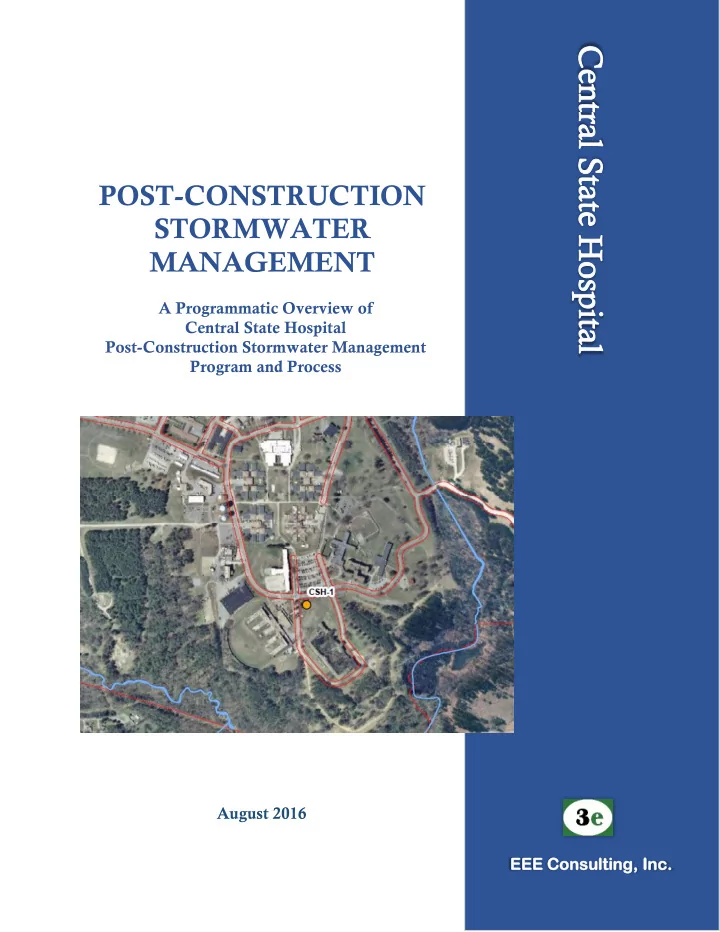
POST-CONSTRUCTION STORMWATER MANAGEMENT A Programmatic Overview of - - PDF document
POST-CONSTRUCTION STORMWATER MANAGEMENT A Programmatic Overview of Central State Hospital Post-Construction Stormwater Management Program and Process August 2016 EEE C Cons onsul ulting ng, I Inc. TABLE OF CONTENTS 1.0 INTRODUCTION
Post-Construction Stormwater Management Program Manual i August 2016
Post-Construction Stormwater Management Program Manual ii August 2016
BMP Best Management Practice CSH Central State Hospital CWA Clean Water Act DEQ Virginia Department of Environmental Quality EPA U.S. Environmental Protection Agency MEP Maximum Extent Practicable MS4 Municipal Separate Storm Sewer System NPDES National Pollutant Discharge Elimination System VSMP Virginia Stormwater Management Program
Post-Construction Stormwater Management Program Manual 1 August 2016
Land development disturbs stable vegetated landscapes and increases impervious area, which in turn increases the stormwater runoff that leaves an area. Development increases pollutant concentrations in runoff, as pollution associated with development is deposited onto disturbed surfaces and carried by runoff into nearby water bodies. Such pollutants include sediment, suspended solids, nutrients, pesticides, herbicides, heavy metals, chlorides, hydrocarbons, other organics, and bacteria. To remove pollutants from stormwater runoff, stormwater management structures are installed to filter, slow, and treat drainage using various processes. These stormwater structures are also called Best Management Practices, commonly referred to as BMPs. They are designed to reduce flooding, remove pollutants, and decrease the amount of runoff from stormwater that ultimately flows to our creeks, streams, and rivers. Ensuring that these structures function correctly requires long-term maintenance and inspections. This manual presents the standard protocol for post-construction stormwater management for the typical BMPs that relate to water quality. As a facility contributing to the regulated small municipal separate storm sewer system (MS4), Central State Hospital (CSH) is obligated to meet the requirements of the MS4 General Permit. The MS4 Permit is issued through Virginia’s Stormwater Management Program (VSMP) regulations, which is administered at the state level by the Virginia Department of Environmental Quality (DEQ). The MS4 program is part of the Federal National Pollutant Discharge Elimination System (NPDES), which is authorized through the Clean Water Act (CWA) and regulated through the U.S. Environmental Protection Agency (EPA). In accordance with the MS4 Permit, CSH must “develop, implement, and enforce a MS4 program designed to reduce the discharge of pollutants from the small MS4 to the maximum extent practicable (MEP).” This Post-Construction Stormwater Management Manual has been developed in fulfillment of Minimum Control Measure 5 as described in the MS4 Permit. The post-construction stormwater management program, which is a series of written procedures in this manual, ensures adequate long-term operation and maintenance of the stormwater management basin at CSH. CSH’s post-construction stormwater management program includes three distinct components:
management process are outlined in Section 2 of this manual.
description of the components involved in the inspection process are outlined in Sections 3 and 4
BMP inspections are outlined in Section 4 of this manual. The stormwater management BMP inspection form can be found in Appendix A.
Section 5 of this manual.
Post-Construction Stormwater Management Program Manual 2 August 2016
Documentation of post-construction stormwater management is critical for demonstrating compliance with the MS4 permit. All documentation related to post-construction stormwater management is required to be kept for a minimum of 3 years for annual reporting and potential audits.
Inspections are a necessary and important part of the post-construction stormwater management
that currently exists at CSH, which is an extended detention basin. Inspection forms for other types of BMPs, if needed, can be found within the Virginia Stormwater Management Handbook, latest edition. For proprietary stormwater practices, the manufacturer specifications for inspection and maintenance should be utilized for inspections. The inspections forms are intended to provide documentation that the stormwater management BMPs were inspected on an annual basis and that any maintenance items were noted. A follow-up inspection should be completed after every noted deficiency with the following information: BMP number Date of initial inspection Date corrective maintenance performed Description of corrective maintenance performed
CSH must annually report to DEQ information pertaining to its post-construction stormwater management efforts. The information is included in the overall MS4 annual report due October 1st of each year. CSH must maintain an electronic database or spreadsheet to be submitted annually that includes the following information:
impervious acres;
use June 30, 2005, as the date brought online for all previously existing stormwater management BMPs;
located;
Water Quality Assessment Integrated Report to which the stormwater management BMP discharges;
number of enforcement actions taken to ensure long-term maintenance.
Post-Construction Stormwater Management Program Manual 3 August 2016
Modifications to the post-construction stormwater management program may occur as part of an iterative process to protect water quality. Updates and modifications to the program may be made in accordance with the following procedures:
management program outlined in this manual may be made by CSH at any time. Additions shall be reported as part of the annual report.
described in this manual are permitted provided that the updates and modifications are done in a manner that:
Permit; and
and practices described in this manual with alternate strategies, policies, and practices may be requested at any time. Such requests must include the following:
including cost prohibitive;
practices to be replaced;
ability to meet the goals of the strategies and policies being replaced;
executive officer or a duly authorized representative. The duly authorized representative must have overall responsibility of the BMP’s operations and written authorization must be provided to DEQ.
Post-Construction Stormwater Management Program Manual 4 August 2016
This section describes the type of stormwater management BMP located at CSH and its general layout and function. If additional BMPs are added at CSH that differ in type, the manual will require updates for compliance. The type of stormwater management BMP that can be found at CSH is an extended detention basin. An explanation of this BMP type and its key components are included in the sub-section below. Inventory of the BMP at CSH is maintained by the Director of Physical Plant Services. This BMP inventory should be utilized and updated as necessary for tracking inspections and maintenance of the stormwater management BMP.
Extended detention basins have at least one inflow channel, an embankment or dam, a bottom level
and an outlet structure. These basins do not have a pool, and remain dry except during and shortly after storm events. Some extended detention basins may have a wet marsh with plantings in the bottom for additional pollutant removal. On rare occasions the extended detention basin may be designed to have a wet pool, in which case verification with the design plans may be necessary. Figure 1: Typical Extended Detention Basin Schematic.
Post-Construction Stormwater Management Program Manual 5 August 2016
Inspection forms are an integral part of the post-construction stormwater management program and provide documentation that the inspection took place. The following sub-sections are intended to provide a description of components found in the inspection form located in Appendix A.
Individuals performing inspections of the stormwater management BMP for CSH are required to maintain a Stormwater Inspector Certification from DEQ. Information regarding the certification requirements is available at the DEQ Stormwater Certification webpage.
The MS4 Permit requires an annual inspection of the CSH stormwater management BMP. In addition to the annual inspections, VSMP regulations require a stormwater management BMP inspection after any storm event that exceeds the principal spillway, or more specifically, whenever the emergency spillway is
the form in Appendix A.
This section describes the general information found on the top portion of the inspection form in Appendix A.
the site mapping.
yes or no.
The inspection form in Appendix A is designed so that different components of the stormwater management BMP are inspected for specific issues. The first column of the form lists different components or elements of the stormwater management BMP. The following column lists the common issues to evaluate for within each of the BMP element categories. Not all elements or issues may apply to each BMP. For each of the possible inspection issues, check either “Yes,” “No,” or “N/A” as appropriate. Refer to the last column for the recommended maintenance action. Further information on maintenance recommendations for various stormwater management BMPs can be found at the Virginia BMP Clearinghouse at http://www.vwrrc.vt.edu/swc/NonProprietaryBMPs.html. The following sub-sections describe various elements and issues that are common to extended detention basins and may be applicable to the BMP at CSH.
The contributing drainage area includes any land that drains to the BMP, both onsite and offsite. These areas should be examined as a potential source of trash, debris, or erosion that affect the functionality of
Post-Construction Stormwater Management Program Manual 6 August 2016
the BMP. Eliminating the source of the issue is essential and works as a preventative measure to ensure long term functionality of the BMP.
Pretreatment is the initial structure through which stormwater drainage is routed before it enters the main BMP. It serves as a preliminary filter to remove silt and sediment that will impact the main system. As a result, the pretreatment structures require clean out more often than the BMP structure itself. If there are significant amounts of sediment or growth in the pretreatment structure, it cannot store and filter the volume of flow it was designed for and therefore cannot fully function.
A sediment forebay is a pretreatment structure that traps debris, trash, sediment and other pollutants from entering the BMP. Sediment must be cleaned out once the level in the forebay reaches 50% of the
level.
Inlets route flow into the BMP for treatment from the contributing drainage area. Some issues in the inflow system may indicate upstream pollutants, sediment, or debris are being transported to the BMP. Inlets should be stable to properly function and not create additional impacts to the BMP, such as contributing debris or sediment that may hinder access to the wetland plant system.
A main design component for several types of BMPs is the planting plan, which is designed by a
Having more plants than what is shown on the plans is acceptable as long as it is not an invasive species, such as cattails or phragmites, and/or the overgrowth is not impacting the storage volume and the BMP’s ability to drain. Checking the general planting location in the BMP is also helpful. For example, if there is a section of plants adjacent to a road shoulder that is dying, it may be indicative of contaminated runoff. De-icing salts on the roads is an example of this. Vegetation should be replaced in accordance with the approved plans, or permission for an equivalent replacement species granted.
The embankment or berm, also termed a dam, is the fill section that blocks the drainage and holds the water in the BMP. The face of the dam is the front side that interacts with the water level and the top, or crown, is the highest flat surface. The downstream side is the back of the dam from the top down to where the fill section meets the natural grade structure (called the “toe” of the dam), typically just below the outlet. Basins outlet on the downstream side, which can be a more problematic area due to the effects of water pressure and saturation on the face and through the embankment. A dug basin, however, will not have all of these components since it is excavated into the existing earth and not created by fill
pipes through them to convey stormwater effectively, but are not designed as stormwater BMPs. Issues with the embankment can be critical to the function of the BMP. Note the conditions related to the principal spillway through the dam, as damage in this area can have a significant impact on BMP
Post-Construction Stormwater Management Program Manual 7 August 2016
The principle spillway is the structure routing flow out of the BMP to the receiving channel through the embankment, if present. It can be in the form of a pipe or an open channel. The principle spillway is used in most storm events, unlike the emergency spillway that is only used during very large events. Because this is typically the only conduit through the dam, the functionality and structural integrity of the principle spillway is critical.
The emergency spillway is a channel that conveys stormwater during large storm events from the BMP to an outfall, usually the same one as the principle spillway or main outlet. It prevents the BMP from
lined with various materials including grass with or without erosion control matting, rip-rap, or concrete, based on the flow rate. The spillway is usually visible as a low spot a minimum of 1 foot below the top of embankment off to one side. Consult the design plans for additional details.
The riser is a vertical structure that connects with the principal spillway pipe to route flows out of the
through the system. Thus, the functionality of the riser can have a large impact on the water level in the basin, the outlet system as a whole, and meeting the designed pollutant removal. Damage or deterioration can take the form of rust, cracking, exposed rebar, or additional holes in the structure.
The low flow orifice is the smaller outflow hole, usually in the riser, that meters out the flow and decreases the post-development flows to the receiving channel. The low flow orifice tends to clog because of its size and will typically have a trash rack grate on the front of it.
Some BMPs have a drainage system to fully raise and lower the water level. This is usually in the form of a gate valve, which is a steel plate that can be raised and lowered to cut off or open up various outlets of the BMP. Be sure to exercise them at least yearly to keep them functional.
The outlet section refers to the structural end of the BMP system where drainage exits the BMP and enters the receiving channel. The outlet structure engages on all storm events, unlike the emergency spillway that is only used during very large storm events.
The outfall channel is the receiving channel for the discharge from the stormwater management BMP. At the point of discharge there is usually a section of riprap, also known as outlet protection, to slow the
is to protect the downstream channel, and thus a thorough evaluation of the outfall should be conducted.
This section captures any other pertinent features or issues of the BMP. It evaluates the BMP footprint area and general issues such as access. Note any of the criteria needing repair, and include applicable location information for reporting.
Post-Construction Stormwater Management Program Manual 8 August 2016
The effectiveness of post-construction stormwater management BMPs depends upon regular inspections and maintenance of all aspects of the structure. There are typically two types of BMP maintenance, referred to as routine maintenance and corrective maintenance. Corrective maintenance consists of repairs performed to correct a deficient part of the BMP as identified in the inspection. Maintenance action returns the BMP component to the original design conditions for proper function. These activities are further described below.
Routine maintenance consists of preventative measures that are essential to the ongoing care and upkeep
potential nuisances (odors, mosquitoes, weeds, etc.), reduces the need for corrective maintenance, and reduces the chance of polluting stormwater runoff by identifying and repairing problems before they further deteriorate. The failure of structural stormwater BMPs can lead to downstream flooding, which can cause property damage, injury, and even death. This also leads to very costly repairs. Examples of routine maintenance include:
Corrective maintenance is any maintenance that should be addressed for the BMP to properly function in accordance with the plans. These items require more intensive repair efforts and should be addressed as a higher priority than routine maintenance. If there are structural deficiencies, or issues that raise the water level in the structure beyond the design requirements, corrective action is required. Examples of corrective maintenance include:
spalling, joint failure, leakage, corrosion, etc.
sediment storage capacity has been filled.
periodic harvesting for proper long term management.
impacts to the storage volume (i.e. water levels rise because the vegetation is taking up the water storage space).
Post-Construction Stormwater Management Program Manual August 2016
BMP Element Issue Yes No N/A Corrective Action Excessive trash/debris Remove trash/debris and properly dispose. Bare exposed soil Stabilize with seed and mulch. E&S measures may be warranted until stabilized. Evidence of erosion Backfill area, seed, mulch and consider matting. E&S measures may be warranted until stabilized. Excessive landscape waste/yard clippings Remove landscape waste and yard clippings to prevent clogging and properly dispose of them. Excessive trash/debris/sediment or other blockage Remove trash/debris/sediment or blockages and properly dispose of. Dead vegetation, exposed soil Replace vegetation and stabilize according to plans. E&S measures may be warranted until stabilized. Evidence of erosion, undercutting, or bare soils Backfill area, seed, mulch and consider matting, E&S measures may be warranted until stabilized. Structural deterioration of inlets, outfalls or pretreatment overflow weirs into the facility Repair and restabilize area. Consult plans for approved configuration or an engineer. E&S measures may be warranted until stabilized. Animal burrows Fill in immediately and stabilize. Plantings inconsistent with approved plans. Consult approved plans and/or management to ensure no approved plant substitutions were used. Remove unapproved plants and replace any required plantings in kind. Dead vegetation/exposed soil Replace vegetation and stabilize according to plans. E&S measures may be warranted until stabilized. Invasive plants, such as cattails and phragmites, exceeds 15% of the planted area. Invasive plants should be removed immediately. Vegetation may require periodic harvesting for proper long term management. As-built plans available: Date of Last Inspection: Inspector: Does the current inspection, as summarized herein, identify maintenance needs? If yes, please complete a BMP Maintenance Follow-up Form and provide to the Director of Physical Plant Services. Were issues identified during the previous inspection that required maintenance? If so, was the maintenance performed and recorded on a BMP Maintenance Follow-up Form? If no, explain: Date of Inspection:
Central State Hospital BMP Operation & Maintenance Inspection for Retention, Dry Detention, and Extended Detention Basins
Owner Name: Facility ID # (See Mapping): Contributing Drainage Area Pretreatment / Forebay / Inflow Aquatic Bench / Vegetation 1
Overgrown, including woody growth 5' beyond the outfall pipe and/or embankment. Removal of woody species near or on the embankment is critical for proper function and long term stability. Remove all woody growth including stumps. Consult an engineer for backfill specifications. Mow thick growth. There is sparse vegetative cover and erosion channels are present. Backfill area with structural fill and consult engineer for proper specifications. Stabilize with seed and mulch, consider matting. E&S measures may be warranted until stabilized. Cracking, bulging, sloughing and seepage Consult an engineer immediately to prevent failure. Evidence of animal burrows. Fill in immediately and stabilize. Structural condition of the riser is deteriorating. Consult an engineer to recommend a repair and review the approved plans. Adjustable control valve inaccessible and inoperable (if present). Repair valve to be operational. Pieces of the riser are broken or missing. Repair immediately in accordance with the approved
Riser or low flow orifice is blocked. Remove blockage and properly dispose of. Riser provides inadequate conveyance out of facility. Repair to properly convey drainage to the outfall per the approved plan. Consult an engineer as needed. Evidence of erosion or undermining at/around riser. Repair erosion. Consult engineer for structural repairs as needed. Structural deterioration Consult engineer for proper repair procedures. Exposed rebar, joint failure, loss of joint material, misalignment, leaking or corrosion Repair concrete to cover rebar. Consult engineer for all
Excessive trash/debris/sediment or blockages. Remove trash/debris/sediment/blockages and properly dispose of. Evidence of erosion and bare soil. Backfill area, seed, mulch and consider matting, E&S measures may be warranted until stabilized. Valves, manholes or locks cannot be opened
Repair/replace any broken fixtures. Erosion of outfall channel or riprap deterioration. Repair and/or supplement riprap outlet protection in accordance with the approved plans. Outlets provide inadequate conveyance out of facility. Repair to properly convey drainage to the outfall per the approved plan. Consult an engineer as needed. Access to the facility is in need of repair. Restore access for maintenance equipment per the approved plans. Encroachment on facility or easement by buildings or other structures. Contact Operations and Maintenance or Plant Services Division Evidence of oil/chemical accumulation, odor, algae, color or pollution. Report to management and consult IDDE manual. Fences and/or safety signage is inadequate. Repair fences and signage for public safety. Trash in the pool Remove immediately and observe safety procedures. Riser Outlet / Outfall Overall Additional notes: Berm / Embankment 2
Post-Construction Stormwater Management Program Manual August 2016
Facility ID Facility Type Latitude Longitude Total Drainage Area (Acres) Pervious Area (Acres) Impervious Area (Acres) Year Built HUC6 Receiving Water 2010 303(d)/305(b) Impairement(s) Operator or Privately Owned? Maintenance Agreement? Date of Last Inspection # of Inspections Completed During Reporting Year CSH‐1 Extended Detention Basin 37.20966 ‐77.447798 3.09 1.66 1.43 6/30/2005 JA40 Unnamed Tributary to Cattail Run Not Assessed Operator (Central State Hospital) N/A (Applies only to Private) 8/30/2016 1
Appendix B ‐ Central State Hospital Stormwater Management BMP Inventory
Post-Construction Stormwater Management Program Manual August 2016
To be completed by inspector Location: _________________________________________ BMP ID # (see BMP Inventory map): ______________ Was the maintenance need generated from an inspection? ______________ If yes, date on inspection form: __________ Description of required maintenance: ____________________________________________________________________ ____________________________________________________________________________________________________ Is maintenance critical to the function of the BMP? Yes No Not sure To be completed by the Stormwater Program Manager Individual performing or overseeing maintenance: __________________________________________________________ Requested date for maintenance to be completed by: _______________________________________________________ Date(s) maintenance completed: __________________________________________ Did maintenance solve the identified problem? Yes No Not sure If no or not sure, describe further necessary maintenance and a date for the additional maintenance to be performed: ___________________________________________________________________________________________________ ___________________________________________________________________________________________________ ___________________________________________________________________________________________________ Description of maintenance performed: _________________________________________________________________ ___________________________________________________________________________________________________ ___________________________________________________________________________________________________ ___________________________________________________________________________________________________
__________________________________________________________________________________________ Attach photographs to this form and retain for records.