SLIDE 1 Slide 1 / 112 Slide 2 / 112
5th Grade
Geometry
2015-11-23 www.njctl.org
Slide 3 / 112 Geometry Unit Topics
· Coordinate Plane · First Quadrant · Polygons
Click on the topic to go to that section
· Classifying Triangles & Quadrilaterals
Slide 4 / 112
Polygons
Click to return to the table of contents
Slide 5 / 112
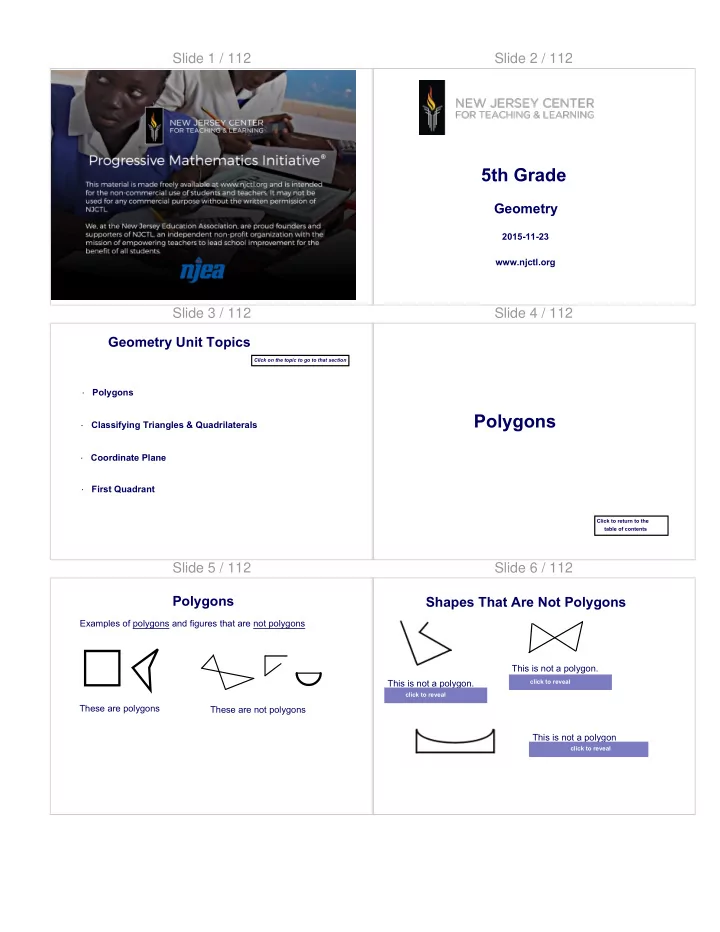
Examples of polygons and figures that are not polygons These are polygons These are not polygons
Polygons Slide 6 / 112
This is not a polygon. It is open, not closed. This is not a polygon. The sides cross over. This is not a polygon Not all sides are straight.
click to reveal click to reveal click to reveal
Shapes That Are Not Polygons
SLIDE 2 Slide 7 / 112
A polygon is a simple, closed plane figure made up of 3
Simple - line segments do not intersect (remember, line segments are straight, not curved) Closed - When you trace the figure, it ends at the starting point. Plane figure - a two-dimensional (flat) shape
Polygons Slide 8 / 112 Slide 9 / 112
1 Is this figure a polygon? Yes No
Slide 10 / 112
2 Is this figure a polygon? Yes No
Slide 11 / 112
3 Is this figure a polygon? Yes No
Slide 12 / 112
4 Is this figure a polygon? Yes No
SLIDE 3 Slide 13 / 112
5 Is this figure a polygon? Yes No
Slide 14 / 112
Polygons are named by their number of sides. Name
Number
Triangle 3 Quadrilateral 4 Pentagon 5 Hexagon 6 Heptagon 7 Octagon 8 Nonagon 9 Decagon 10
Polygons Slide 15 / 112 3 sides 3 angles 10 sides 10 angles Polygons
Interesting fact: A polygon's number of sides and number of angles are always the same.
Slide 16 / 112
6 How many sides does a heptagon have?
Slide 17 / 112
7 How many angles does a nonagon have?
Slide 18 / 112
8 Name the figure. A Quadrilateral B Hexagon C Decagon D Octagon
SLIDE 4
Slide 19 / 112
9 Name the figure. A Decagon B Hexagon C Nonagon D Octagon
Slide 20 / 112 Regular vs. Irregular Polygons
If the figure's sides and angles are congruent, it is called a regular polygon.
Slide 21 / 112 Regular vs. Irregular Polygons
If either the figure's sides or angles are not congruent, it is called an irregular polygon.
Slide 22 / 112 Slide 23 / 112
10 What kind of polygon is this? A regular B irregular C not a polygon
Slide 24 / 112
11 What kind of polygon is this? A regular B irregular C not a polygon
SLIDE 5 Slide 25 / 112
12 What kind of polygon is this? A regular B irregular C not a polygon
Slide 26 / 112
13 What kind of polygon is this? A regular B irregular C not a polygon
Slide 27 / 112
14 What kind of polygon is this? A regular B irregular C not a polygon
Slide 28 / 112
15 What kind of polygon is this? A regular B irregular C not a polygon
Slide 29 / 112
Classifying Triangles & Quadrilaterals
Click to return to the table of contents
Slide 30 / 112
By Sides Equilateral Triangle All sides are congruent. Isosceles Triangle At least two sides are congruent. Scalene Triangle No sides are congruent.
Match the picture to the definition
Triangles
Classifying Triangles- Triangles can be classified by their angles or their sides.
SLIDE 6 Slide 31 / 112
16 Classify the triangle by its sides A equilateral B scalene C isosceles
Slide 32 / 112
17 Classify the triangle by its sides A equilateral B scalene C isosceles
Slide 33 / 112
By Angles Acute Triangle All three angles are less than 90 degrees. Right Triangle One angle is 90 degrees. Obtuse Triangle One angle is more than 90 degrees.
Match the picture to the definition
Triangles Slide 34 / 112
18 Classify the triangle by its angles A acute B
C right
Slide 35 / 112
19 Classify the triangle by its angles A acute B
C right
Slide 36 / 112
20 Classify the triangle by its angles A acute B obtuse C right
SLIDE 7 Slide 37 / 112
Click to go to web site then choose Triangle Sort.
Slide 38 / 112
21 Classify the triangle. A equilateral B isosceles C scalene D acute E right F obtuse
Remember: Classify by sides and angles (put in two answers)
Slide 39 / 112
22 Classify the triangle. A equilateral B isosceles C scalene D acute E right F
Remember: Classify by sides and angles (put in two answers)
Slide 40 / 112
23 If each of the angles in a triangle measures 60 º , what is the triangle? A equilateral B isosceles C scalene D acute E right F
Remember: Classify by sides and angles (put in two answers)
Slide 41 / 112
24 Classify the triangle. A equilateral B isosceles C scalene D acute E right F
Remember: Classify by sides and angles (put in two answers)
Slide 42 / 112
25 Classify the triangle in the yield sign. A equilateral B isosceles C scalene D acute E right F
Remember: Classify by sides and angles (put in two answers)
SLIDE 8 Slide 43 / 112
26 Classify the triangle this bridge makes. A equilateral B isosceles C scalene D acute E right F
Remember: Classify by sides and angles (put in two answers)
Slide 44 / 112 Quadrilaterals
Classifying Quadrilaterals You must use the properties of quadrilaterals to identify and classify them. Trapezoids - Exactly one pair of parallel sides.
Slide 45 / 112
Parallelogram - Opposite sides are congruent & parallel.
Quadrilaterals
Interesting fact: The opposite angles
- f a parallelogram are also congruent.
Classifying Quadrilaterals You must use the properties of quadrilaterals to identify and classify them.
Slide 46 / 112
Classifying Quadrilaterals You must use the properties of quadrilaterals to identify and classify them. Similar to triangles, quadrilaterals are classified by the relationships between their sides and angles. Rectangle - Special parallelogram with four right angles
Quadrilaterals Slide 47 / 112
Classifying Quadrilaterals You must use the properties of quadrilaterals to identify and classify them. Rhombus - Parallelogram with four congruent sides and opposite angles congruent
Quadrilaterals Slide 48 / 112
Classifying Quadrilaterals You must use the properties of quadrilaterals to identify and classify them. Square - Rhombus with four right angles
- r a Rectangle with four congruent sides.
Quadrilaterals
SLIDE 9 Slide 49 / 112
Match the shape with the description.
Slide 50 / 112
Square Rectangle Rhombus Parallelogram Trapezoid Quadrilateral
two pairs of // sides all angles ~ = all sides ~ = all angles ~ = all sides ~ = two pairs of // sides two pairs of // sides two pairs of // sides 4-sided polygon 4-sided polygon 4-sided polygon 4-sided polygon 4-sided polygon 4-sided polygon
Quadrilaterals Slide 51 / 112 Polygon
Quadilateral
Slide 52 / 112 Polygon
Quadilateral
Trapezoid
Slide 53 / 112
Quadilateral
Trapezoid Parallelogram
Polygon Slide 54 / 112
Quadilateral
Trapezoid Parallelogram Rectangle
Polygon
SLIDE 10 Slide 55 / 112
Quadilateral
Trapezoid Parallelogram Rectangle Rhombus
Polygon Slide 56 / 112
Quadilateral
Trapezoid Parallelogram Square Rectangle Rhombus
Polygon Slide 57 / 112
Click for web site and then choose polygon sort.
Slide 58 / 112
From PARCC EOY sample test #13
Drag and drop the names to complete the diagram that shows the relationship among the figures listed. Each category will be used only once.
rhombuses rectangles parallelograms quadrilaterals
Slide 59 / 112
27 Which of the following shapes is a trapezoid? A B C D
Slide 60 / 112
28 Which of statement(s) do NOT describe the figure? A trapezoid B parallelogram C rectangle D rhombus E square
SLIDE 11
Slide 61 / 112
29 Which of the statements does NOT describe the figure? A trapezoid B parallelogram C rectangle D rhombus E square
Slide 62 / 112
30 Which of the statement(s) does NOT describe the figure? A trapezoid B parallelogram C rectangle D rhombus E square
Slide 63 / 112
31 Which of the following statements is true? A A square is not a rectangle. B A rectangle is a square. C A square is not a parallelogram. D A square is a rectangle.
Slide 64 / 112
32 Which shape has exactly one pair of // sides? A square B rhombus C triangle D trapezoid
Slide 65 / 112
33 Which shape has two sets of congruent angles and adjacent sides congruent? A square B rectangle C rhombus D kite
Slide 66 / 112
34 Describe the figure. Choose all answers that apply. A Quadrilateral B Trapezoid C Parallelogram D Rectangle E Rhombus F Square G None of the Above
SLIDE 12
Slide 67 / 112
35 Describe the figure. Choose all answers that apply. A Quadrilateral B Trapezoid C Parallelogram D Rectangle E Rhombus F Square G None of the Above
Slide 68 / 112
36 Describe the figure. Choose all answers that apply. A Quadrilateral B Trapezoid C Parallelogram D Rectangle E Rhombus F Square G None of the Above
Slide 69 / 112
37 Describe the figure. Choose all answers that apply. A Quadrilateral B Trapezoid C Parallelogram D Rectangle E Rhombus F Square G None of the Above
Slide 70 / 112
38 Describe the shape of the top of the desk. Choose all answers that apply. A Quadrilateral B Trapezoid C Parallelogram D Rectangle E Rhombus F Square G None of the Above
Slide 71 / 112
39 Describe the shape for the face of the clock. Choose all answers that apply. A Quadrilateral B Trapezoid C Parallelogram D Rectangle E Rhombus F Square G None of the Above
Slide 72 / 112
40 Describe the shape of the mouth of the shark. Choose all answers that apply. A Quadrilateral B Trapezoid C Parallelogram D Rectangle E Rhombus F Square G None of the Above
SLIDE 13 Slide 73 / 112
41 Describe the shape of this marker. Choose all answers that apply. A Quadrilateral B Trapezoid C Parallelogram D Rectangle E Rhombus F Square G None of the Above
Slide 74 / 112
42 Which of the following shapes could never have perpendicular sides? A rectangle B triangle C circle D square
Slide 75 / 112
43 Which of these shapes could never have parallel opposite sides? A trapezoid B triangle C rectangle D rhombus
Slide 76 / 112
44 Which explanation about figures is correct? A All rhombuses are parallelograms. Parallelograms have 2 pair of parallel sides. Therefore, all rhombuses have 2 pairs of parallel sides. B All rhombuses are parallelograms. Parallelograms have exactly 1 pair of parallel sides. Therefore, all rhombuses have exactly 1 pair of parallel sides. C Only some rhombuses are parallelograms. Parallelograms have 2 pairs of parallel sides. Therefore, only some rhombuses have 2 pair of parallel sides. D Only some rhombuses are parallelograms. Parallelograms have exactly 1 pair of parallel sides. Therefore, only some rhombuses have exactly 1 pair
From PARCC EOY sample test #7
Slide 77 / 112
45 Select an answer for each blank. Because a ________ is a ________, it must have 4 A square B rectangle C trapezoid D square E rectangle F rhombus
- pposite angles ≅ and all four sides ≅.
Slide 78 / 112
Coordinate Plane
Click to return to the table of contents
SLIDE 14
Slide 79 / 112
The coordinate plane is formed by two intersecting number lines called axes. The horizontal line is the x-axis. The vertical line is the y-axis.
Coordinate Plane Slide 80 / 112
The point at which the x and y axes intersect is called the origin. The coordinates of the origin are (0, 0).
Origin (0, 0)
Coordinate Plane Slide 81 / 112
(x,y)
x y Coordinate Plane
Points can be plotted on the plane using one coordinate from each of the axes. These sets are called ordered pairs. The x coordinate always appears first in these pairs. The y coordinate appears second.
Slide 82 / 112
(4,3) To graph an ordered pair, such as (4,3): · Start at the origin (0,0). · Move right on the x-axis, since the first number is positive. · Then, move up since the second number is positive. · Plot the point.
Coordinate Plane Slide 83 / 112
(x,y)
x y
This point is (3,2). To plot the point,
go over 3, then up 2.
Coordinate Plane Slide 84 / 112
(x,y)
x y
This point is (1,4). To plot the point,
go over 1, then up 4.
Coordinate Plane
SLIDE 15
Slide 85 / 112
(x,y)
x y
This point is (5,0). To plot the point,
go over 5, then up 0.
Coordinate Plane Slide 86 / 112 x y
46 Which point is at the origin? A B C D
Slide 87 / 112 x y
47 Which point is at (1,3)? A B C D
Slide 88 / 112 x y
48 Which point is at (3,3)? A B C D
Slide 89 / 112 x y
49 Which point is at (0,5)? A B C D
Slide 90 / 112
50 Which ordered pair is the origin? A (4,0) B (0,0) C (0,4) D (4,4)
SLIDE 16 Slide 91 / 112
51 Which number in the ordered pair (7,3) is the x-coordinate? A 7 B 3 C 0 D x
Slide 92 / 112
52 Which number in the ordered pair (5,9) is the y-coordinate? A 0 B 5 C 9 D y
Slide 93 / 112
53 Which number in the ordered pair (7,12) is the y-coordinate? A 7 B 12 C 0 D y
Slide 94 / 112
54 Which number in the ordered pair (7,12) is the x-coordinate? A 7 B 12 C 0 D x
Slide 95 / 112
55 Select three statements that correctly describe the coordinate system. A The x- and y-axes intersect at 10. B The x- and y-axes intersect at the origin. C The x- and y-axes are parallel number lines. D The x- and y-axes are perpendicular number lines. E The x- and y-axes are used to locate points on a coordinate plane.
From PARCC EOY sample test #32
Slide 96 / 112
From PARCC EOY sample test #26
Mia is playing several rounds of a word game. Each coordinate pair shows the number of the round and Mia's score fore that round. She is keeping track of these coordinate pairs on a graph. · Round 1: (1, 3) · Round 2: (2, 6) · Round 3: (3, 3) Part A Graph Mia's scores for the first three rounds of play. Move the 3 points to their location on the graph.
A B C
SLIDE 17 Slide 97 / 112
56 Part B In round 4, Mia scores the same number of points as in rounds 2 and 3 combined. What is the coordinate pair that represents Mia's score for round 4? A (4, 5) B (9, 4) C (5, 4) D (4, 9)
From PARCC EOY sample test #26
Slide 98 / 112
57 The following points were graphed on the coordinate
- plane. Select the correct letter that corresponds with each
point on the graph. A B C D E F
- 1. (4,6)
- 2. (6,4)
- 3. (3,0)
(A or B) (B or C) (D or E) A B C D E
From PARCC EOY sample test #2
Slide 99 / 112
First Quadrant
Click to return to the table of contents
Slide 100 / 112
First Quadrant
First Quadrant
When the x and y coordinates are both positive, points are plotted in the first quadrant.
Slide 101 / 112
Play Billy Bug and His Quest for Grub Game Click for web site.
http://resources.oswego.org/games/BillyBug/bugcoord.html
Slide 102 / 112 First Quadrant
Sometimes we are asked to create a shape in the first Quadrant by finding the missing point.... Try these examples.
SLIDE 18 Slide 103 / 112
58 Which point will create a square? A (3,2) B (5,1) C (2,1) D (1,2)
Slide 104 / 112
59 Which point will create a right triangle? A (1,4) B (4,1) C (3,4) D (2,1)
Slide 105 / 112
60 Which point will create a parallelogram? A (4, 8) B (8, 4) C (9, 5) D (7, 4)
Slide 106 / 112
61 Which point will create a trapezoid? A (1, 3) B (1, 1) C (3, 3) D (3, 1)
Slide 107 / 112
62 Emily drew a figure on a coordinate grid. The figure has one pair of opposite sides that are parallel, but not equal. Which of the following figures could Emily have drawn? A B C D
Slide 108 / 112
63 Chose an answer to fill in each blank. Point A is _____ units ____________ to the x-axis and _____ units ______ to the y-axis than point C. A 2 B 5 C 7
D closer to E further from
F 2 G 5 H 7 I closer to J further from
1 2 3 4 5 6 8 9 10 2 3 4 5 6 7 8 9 10 1 7
A B C D E
SLIDE 19 Slide 109 / 112
64 Chose an answer to fill in each blank. Point D is _____ units ____________ to the x-axis and _____ units ______ to the y-axis than point B. A 2 B 3 C 4
D closer to E further from
F 2 G 3 H 4 I closer to J further from
1 2 3 4 5 6 8 9 10 2 3 4 5 6 7 8 9 10 1 7
A B C D E
Slide 110 / 112
1 2 3 4 5 2 3 4 1
# of customers (in tens.)
65 The coordinate plane shows the number of customers the Ice Cream Shoppe had in the first 3 weeks of June. If the pattern continues, how many customers will they have during the 4th week of June? A 5 B 6 C 55 D 60
Slide 111 / 112
1 2 3 4 5 2 3 4 1
# of customers (in tens.)
66 The coordinate plane shows the number of customers the Ice Cream Shoppe had in the first 3 weeks of
- September. If the pattern continues, how many
customers will they have during the 5th week of September? A 15 B 20 C 25 D 30
Slide 112 / 112
Click above to practice using the National Library of Virtual Manipulatives web site.
This example, the vertices are: (1,3) (4,1) (4,3) · Work in partners. · One partner creates a polygon on the geoboard and writes down the vertices. · Other partner plots the points, and connects them with line segments. · Compare the polygons, then switch roles.
Coordinate Grid Geoboards Activity