POLL 3 1 6/5/2019 Young children as engineers? 4 Goals for - - PDF document

poll
SMART_READER_LITE
LIVE PREVIEW

POLL 3 1 6/5/2019 Young children as engineers? 4 Goals for - - PDF document

6/5/2019 Engineering Design In ECE Beth VanMeeteren - Carrie Lynne Draper - Peggy Ashbrook Supporting young childrens creative thinking using problems they care about. 1 Engineering Design In ECE Beth VanMeeteren - Carrie Lynne Draper -


slide-1
SLIDE 1

6/5/2019 1

Beth VanMeeteren - Carrie Lynne Draper - Peggy Ashbrook

Engineering Design In ECE

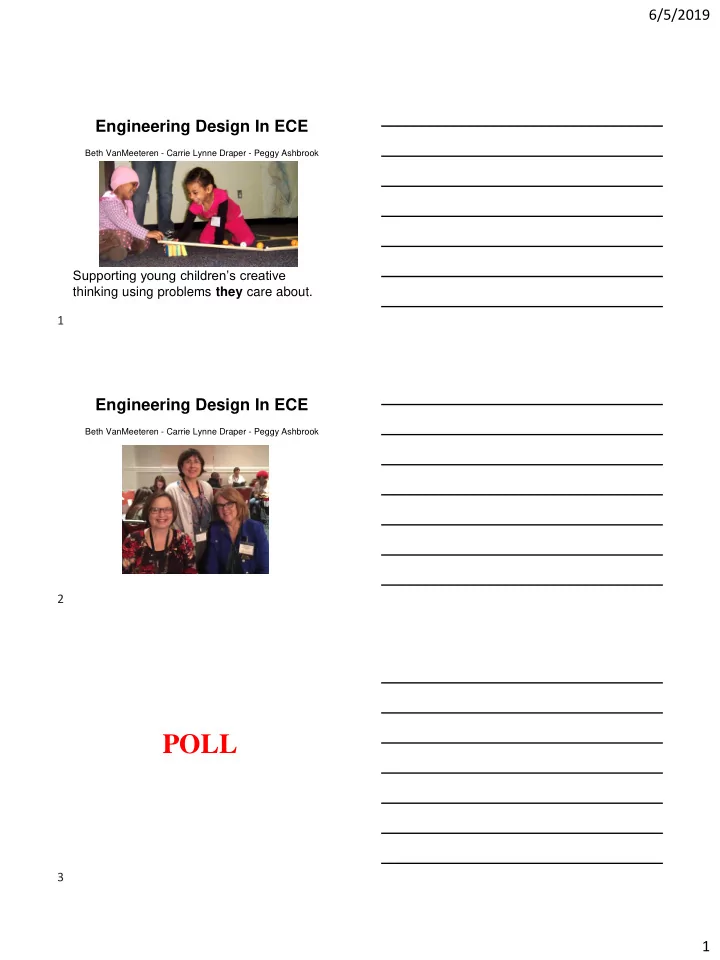
Supporting young children’s creative thinking using problems they care about.

Beth VanMeeteren - Carrie Lynne Draper - Peggy Ashbrook

Engineering Design In ECE

POLL

1 2 3

slide-2
SLIDE 2

6/5/2019 2

Young children as engineers? Young children as engineers?

Goals for webinar

Use the lens of DAP to:

  • 1. Examine Early Engineering
  • 2. Analyze Examples

Flipping Perspectives

4 5 6

slide-3
SLIDE 3

6/5/2019 3

  • Need to know science
  • Create designs for:

structures machines processes

  • Understand & Predict

how a design works

  • Are respectful

Practicing Engineers:

http://news.cornell.edu/sites/default/files/styles/full_size/public/2018- 08/0830_engineering4.jpg?itok=_tg7CKOr

  • Need to know science
  • Create designs for:

structures machines processes

  • Understand & Predict

how a design works

  • Are respectful

Practicing Engineers:

http://news.cornell.edu/sites/default/files/styles/full_size/public/2018- 08/0830_engineering4.jpg?itok=_tg7CKOr

  • Need to know science
  • Create designs for:
  • structures
  • machines
  • processes
  • Understand & Predict

how a design works

  • Are respectful

Practicing Engineers:

http://news.cornell.edu/sites/default/files/styles/full_size/public/2018- 08/0830_engineering4.jpg?itok=_tg7CKOr

7 8 9

slide-4
SLIDE 4

6/5/2019 4

  • Need to know science
  • Create designs for:
  • structures
  • machines
  • processes
  • Understand & Predict

how a design works

  • Are respectful

Practicing Engineers:

http://news.cornell.edu/sites/default/files/styles/full_size/public/2018- 08/0830_engineering4.jpg?itok=_tg7CKOr

  • Need to know science
  • Create designs for:

structures machines processes

  • Understand & Predict

how a design works

  • Are respectful

Focus of Many Early Engineering Curricula

http://news.cornell.edu/sites/default/files/styles/full_size/public/2018- 08/0830_engineering4.jpg?itok=_tg7CKOr

Engineering Design Process

Define a problem Imagine a solution Draw a plan Build your solution Test your solution Improve your solution

Practicing Engineers

10 11 12

slide-5
SLIDE 5

6/5/2019 5

Engineering Habits of Mind

https://www.freeimages.com/photo/expressions-of-mads-1-1058795
  • 1. Systems Thinking
  • 2. Creativity
  • 3. Optimism
  • 4. Collaboration
  • 5. Communication
  • 6. Attention to Ethical

Considerations

National Research Council. (2009). Engineering in K-12 education: Understanding the status and improving the prospects. National Academies Press.

Developmental Engineering

Engineering Habits of Mind

https://www.freeimages.com/photo/expressions-of-mads-1-1058795
  • 1. Systems Thinking
  • 2. Creativity
  • 3. Optimism
  • 4. Collaboration
  • 5. Communication
  • 6. Attention to Ethical

Considerations

13 14 15

slide-6
SLIDE 6

6/5/2019 6

Practicing Engineers vs Developing Engineers

Practicing Engineers:

Engineer for others’ purpose Use science to engineer Design under constraints

Developing Engineers:

Engineer for their own purpose Use engineering to learn science Design under constraints

https://www.carrier.com/carrieruniversity/en/us/

Flipping Perspectives Flipping Perspectives

Developmental Engineering

16 17 18

slide-7
SLIDE 7

6/5/2019 7

Noticing and Naming Developmental Engineering

A novel way to use ordinary materials as tools to solve a problem that is important to them

Noticing and Naming Developmental Engineering Noticing and Naming Developmental Engineering

19 20 21

slide-8
SLIDE 8

6/5/2019 8

Noticing and Naming Developmental Engineering Noticing and Naming Developmental Engineering Noticing and Naming Developmental Engineering

22 23 24

slide-9
SLIDE 9

6/5/2019 9

Noticing and Naming Developmental Engineering

Engineering, for children, is the study of the whole world.

Supporting Children’s Engineering

25 26 27

slide-10
SLIDE 10

6/5/2019 10

Developmental Engineering

What is a good length for a spindle for a top? I need to use safety practices if I want to use tools to cut a dowel to make a spindle. How can I get the body where I want it

  • n the spindle?

Where is the best place to strike the wheel with a hammer to get it to move up or down a spindle? I want to change and test the length of the spindle, and where the wheel is placed on the spindle to figure out what works best.. How can I record what I am trying? How can I use my records as evidence to make a claim?

Designing a process to safely make tops is also engineering.

Developmental Engineering

Designing a process to safely make tops is also engineering.

Systems thinking Creativity Optimism Communication Collaboration Attention to Ethical Considerations

Spontaneously writing a reflection on the experience

I made a top and it actually spins and it is 5 inches and 1 quarter.

Noah Age 6

28 29 30
slide-11
SLIDE 11

6/5/2019 11

Planning and Documenting Designs “wood” and “foam”

Planning and Documenting Designs

Try making a quick sketch of a block structure you would make using just these four blocks: Photography, rather than drawing, is another way to document children’s designs.

Planning and Documenting Designs

31 32 33

slide-12
SLIDE 12

6/5/2019 12

POLL

Systems thinking Creativity Optimism Communication Collaboration Attention to Ethical Considerations

Creating an environment to support engineering

Materials

Creating an environment to support engineering

Materials

34 35 36

slide-13
SLIDE 13

6/5/2019 13

Creating an environment to support engineering

Materials

Systems thinking Creativity Optimism Communication Collaboration Attention to Ethical Considerations

Creating an environment to support engineering

Materials

Creating an environment to support engineering

Materials

37 38 39

slide-14
SLIDE 14

6/5/2019 14

  • 1. Producible
  • 2. Immediate
  • 3. Observable
  • 4. Variable

Begin with the child’s idea

Developmental Engineering Creating an environment to support engineering

Materials and Child-Set Challenges

Creating an environment to support engineering

Materials

40 41 42

slide-15
SLIDE 15

6/5/2019 15

Creating an environment to support engineering

Materials

POLL

Creating an environment to support engineering

Time to fail and try again

43 44 45

slide-16
SLIDE 16

6/5/2019 16

How do you help children benefit from failure? How do you help children benefit from failure?

Child’s first idea for a solution: Build a fence. Didn’t work.

Observing Differences, Benefits, and Drawbacks of Materials “wood” and “foam”

46 47 48

slide-17
SLIDE 17

6/5/2019 17

A Child Who Acted Out

In School:

  • Slow verbal development
  • Hated strict rules and rote

learning Out of School:

  • Curious about ordinary things
  • Loved to build & construct
  • Loved to figure things out

Albert Einstein

“It’s not that I’m so smart. It’s just that I stay with problems longer.” 49 50 51

slide-18
SLIDE 18

6/5/2019 18

Executive Functions

Inhibitory Control (self-control)

  • resisting temptations,

distractions Working Memory

  • mentally holding and using

information Cognitive Flexibility

  • adjusting to change

Experiences that require

  • a challenge to hold in mind previous beliefs while they

develop and discard potential theories

  • strategy and reflection
  • logic and reasoning
  • problem-solving
  • think about categorization

What helps develop executive functions?

Experiences that require

  • a challenge to hold in mind previous beliefs while they

develop and discard potential theories

  • strategy and reflection
  • logic and reasoning
  • problem-solving
  • think about categorization

What helps develop executive functions?

Engineering experiences that start with us!

52 53 54

slide-19
SLIDE 19

6/5/2019 19

Young Engineers at Work

Adults need to experience engineering design work to best understand how to support children. End Effector

Two other designs of an end effector

See link to video in handout

55 56 57

slide-20
SLIDE 20

6/5/2019 20

Explore Math and Science Experiences to Promote Engineering Habits of Mind

  • Obstacle Course
  • Geometric & Spatial Hunt
  • Direction Mission
  • Across the bars
  • Up the ladder
  • Down the slide
  • Through the tunnel
  • Under the jungle gym

Explore Math and Science Experiences to Promote Engineering Habits of Mind

Child-Designed Play Spaces

Photo by Rachelle Doorley, https://tinkerlab.com/fridge-box-imaginative-play/

Documenting

  • Print outs of children’s work for discussion
  • Slow motion feature on cell phones for action

58 59 60

slide-21
SLIDE 21

6/5/2019 21

Trusted resources for more in-depth learning about STEM in early childhood.

61 62 63

slide-22
SLIDE 22

6/5/2019 22

Thank you for supporting children’s engineering design thinking! Beth Van Meeteren Beth.VanMeeteren@uni.edu Carrie Lynne Draper carrie@readinesslearning.net www.ReadinessLearning.net Peggy Ashbrook scienceissimple@yahoo.com

64