Policy 9.01 Client Compliance Paul R. Francart December 3, 2015 - - PDF document

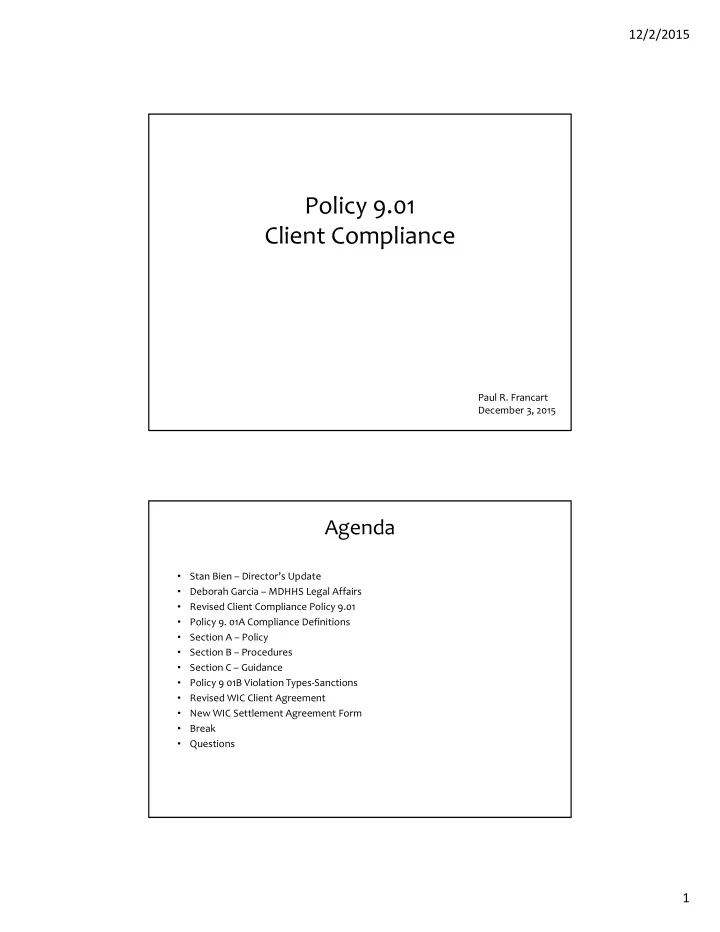
policy 9 01 client compliance
SMART_READER_LITE
LIVE PREVIEW

Policy 9.01 Client Compliance Paul R. Francart December 3, 2015 - - PDF document

12/2/2015 Policy 9.01 Client Compliance Paul R. Francart December 3, 2015 Agenda Stan Bien Directors Update Deborah Garcia MDHHS Legal Affairs Revised Client Compliance Policy 9.01 Policy 9. 01A Compliance Definitions


slide-1
SLIDE 1

12/2/2015 1

Policy 9.01 Client Compliance

Paul R. Francart December 3, 2015

  • Stan Bien – Director’s Update
  • Deborah Garcia – MDHHS Legal Affairs
  • Revised Client Compliance Policy 9.01
  • Policy 9. 01A Compliance Definitions
  • Section A – Policy
  • Section B – Procedures
  • Section C – Guidance
  • Policy 9 01B Violation Types‐Sanctions
  • Revised WIC Client Agreement
  • New WIC Settlement Agreement Form
  • Break
  • Questions

Agenda

slide-2
SLIDE 2

12/2/2015 2

  • Introduction and background
  • Update and status
  • Next steps

Stan Bien Director’s Update Deborah Garcia , JD, MAHS MDHHS Office of Legal Affairs

  • Legal Authority
  • Federal, State and/or Local Laws
  • HIPAA, Public Health Code
  • Relevant Facts
  • Who, What, Where, When, Why
  • How Condition or Activity Threatens Public Health
  • Violation of Specific Law
  • Injurious to Public Health, Safety, Environment
  • Tax Payers State Funds
  • Action Required
  • Know Your Local Attorneys, Health Officers, Judges
  • Cooperation with interagency
  • Consequences
  • Preventing Fraud and Abuse
  • Communication Gaps between Agencies
  • Right to Review
  • Due Process
  • Substantive
  • Procedural
slide-3
SLIDE 3

12/2/2015 3

Policy 9.01A Compliance Definitions

New Definitions

  • Authorized Person ‐ Pregnant, breastfeeding, and non‐breastfeeding postpartum women.
  • Client ‐ A customer or a person who uses services. Michigan uses the term client/s for

individuals on WIC.

  • Participant ‐ A person who takes part in something. USDA uses the term participant/s for

individuals on WIC.

  • Preponderance of Evidence ‐ A more convincing amount of evidence than the other side has;

the general standard of proof for finding for one side in a case; enough proof to convince the hearing official that something is more likely to have occurred than not to have occurred.

  • Proxy ‐ A proxy is an individual designated by the client to pick up Food Instruments
  • Substantiated ‐ To establish by proof or competent evidence.
  • Transfer ‐ Hand over, pass on, make over, turn over, sign over, consign, devolve, assign,

delegate.

  • Unsubstantiated ‐ Having no basis in reason or fact
slide-4
SLIDE 4

12/2/2015 4

Policies 9.01 & 9.01A , 9.01B will be posted on the Michigan Department of Health and Human Services WIC Division website at: www.michigan.gov/wic under the WIC Providers tab on December 7, 2015.

Policy 9.01 Client Compliance

Background: The overall goal of this policy is to assure WIC program integrity, by protecting clients who follow program rules and educating and promptly counseling those clients who do not. WIC Coordinators must assure that their program staff is educating and counseling clients about WIC Program rules set forth in the WIC Client Agreement. The overall objective is to educate, counsel and prevent WIC Program fraud and abuse, while serving those in need of WIC services. The State Agency will work to assist, support and coordinate with all stakeholders in this effort.

Background and Purpose

New Additions

Purpose: This policy defines client fraud and abuse and establishes procedures which the Local Agency, with the assistance of the State Agency will follow when identifying, investigating, and resolving allegations of client fraud and abuse within the WIC Program. The State Agency determines uniform procedures and sanctions to be applied to cases of program abuse by clients. A sanction, which is based on the severity of the abuse, may range from education and/or a warning letter to disqualification from the program for a maximum of one year and/or repayment of benefits. If the State Agency and/or Local Agency determine that program benefits have been obtained or disposed of improperly as a result of client violations of program integrity, the State Agency and/or Local Agency will establish a claim against the client for the full value of such benefits.

NEW NEW

  • Educate, counsel client during certification, recertification, etc. that selling WIC food/formula is illegal.
  • State Agency will give more assistance to local agencies
  • State Agency determines uniform procedures and sanctions to be applied to cases of program abuse by clients.

Rationale

slide-5
SLIDE 5

12/2/2015 5

Section A – Policy

Policy

New Additions

#2. Local agency staff are responsible for assigning food packages which meet the needs of WIC clients. If the Local Agency CPA determines that the maximum food package is not appropriate for the client, a custom food package shall be

  • provided. (MI‐WIC Policy 7.01, Food Package Determination).
  • The clients age, food preferences, nutritional and medical risks, culture, and food storage and preparation abilities

should be considered when determining a clients food package.

NEW Rationale

Mandated by * Federal WIC Regulations 7 CFR 246.2 * USDA Policy Memorandum #2012‐1 * USDA Policy Memorandum #2013‐4

Rationale

#3. “Any form of participant fraud and abuse, such as using WIC benefits in any way other than the method and purpose for which they were intended, violates the Federal WIC Regulations and constitutes a participant violation under 7 CFR 246.2. Making a verbal offer of sale to another individual or posting WIC foods/formula benefits and/or EBT cards for sale in print or online, or allowing someone else to do so, is evidence that the participant committed a participant violation. Intentionally making false or misleading statements or intentionally misrepresenting, concealing, or withholding facts to

  • btain benefits is evidence that the participant committed a participant violation. FNS expects all State agencies to

sanction and issue claims against participants for all participant violations” (See MI‐WIC Policy 9.01, Exhibit C., USDA Policy Memorandum #2012‐1). “Buying, selling or otherwise misusing WIC benefits is a violation” (See Exhibit D, USDA Policy Memorandum #2013‐4)

Revised

slide-6
SLIDE 6

12/2/2015 6

Policy

New Additions

#4. When a complaint of potential client fraud is received by the local agency, it must be logged into the MI‐WIC System by the person who received the complaint and investigated by the Local Agency WIC Coordinator or designee(s). (See section B. Procedures, 1. Procedures Processing Complaints) #5. When complaints of client fraud and abuse are found to be substantiated, a Compliance Letter must be sent

  • r given to the client to notify them of their sanction.

NEW

  • The person who takes the complaint, must enter the complaint otherwise it’s considered hearsay.
  • Clients must be notified!

Rationale Rationale #6. Fair Hearing notices shall be issued with the Compliance Letter as well as a copy of the most recently signed WIC client agreement for the family involved in the case (See MI‐WIC Policy 1.04, Fair Hearing Procedure for Clients). NOTE: Refer to Policy 9.02, Employee Compliance, for complaints of fraud and abuse involving a WIC staff person. #7. Customer service complaints regarding Local Agency WIC service provision shall not be logged as a fraud and abuse complaint in the MI‐WIC system. The Local Agency may determine how to document and resolve customer service complaints based on Local Agency procedures. #8. All vendor complaints will be processed and coordinated by the Vendor Management and Operations Section (VMO),

  • f

the MDHHS/WIC Division. The fraud hotline number is 1‐800‐CALL‐WIC

  • r

Email: wicfraudinvestigations@michigan.gov. Local Agency staff shall provide the hotline number or email address to the complainant as needed.

  • Number 6 was revised and moved from #4. Substantiated Allegations and Client Sanctions Notes
  • Number 7 and 8 where revised and moved from #3. Processing Complaints Notes
  • Move these sections from old policy procedures to new policy, update language, so policy flowed better.

Revised

Policy

slide-7
SLIDE 7

12/2/2015 7

Section B – Procedures

The following new statements appear numerous times throughout section B of this policy.

  • Preferably same day or next business day
  • The Local Agency WIC Coordinator or designee(s)

Commonly used

  • 1. Processing Complaints
  • 1a. The Local Agency (preferably same day or next business day) will enter a complaint in MI‐WIC upon detection, verbal or

written report of client fraud and abuse. (See Exhibit 9.01B Violation Types/Sanctions). This is not an exhaustive list of violation types/sanctions. Other potential types of fraud and abuse must be reported to MDHHS WIC staff for further determination of potential sanctioning.

  • b. The Local Agency will email the complaint number and family ID to the State Agency at

wicfraudinvestigations@michigan.gov

  • c. A complaint will be entered based on, but not limited to, any of the following:
  • Anonymous tips (i.e. phone calls, letters, or emails) of alleged client fraud & abuse.
  • Report from WIC vendors, WIC employees, other clients or the general public alleging client fraud and abuse.
  • Actual or threatened verbal or physical abuse to WIC staff member, client, grocery store staff or farmers.
  • Potential dual participation evidenced by same client with over‐lapping benefits and dual redemption verified in EPPIC

(See MI‐WIC Policy 3.03, Dual Participation).

  • Public information reports (i.e. newspaper/social media sites such as Craigslist, eBay, Facebook (i.e.

mommies2mommies sites, yard sale sites in your areas/counties), and etc. internet information suggesting potential client violation).

Revised

Sending the case number and Family Id to the wicfraudinvestigations@michigan.gov email address will help eliminate duplicating cases. The State Agency also searches social media sites.

  • Craigslist
  • Some Facebook sites.

The States Agency depends on Local Agencies to search local Swap Sites and Facebook mom 2 mom and yard sale sites.

Rationale

slide-8
SLIDE 8

12/2/2015 8

  • Baby and Toddler online garage sale Grand

Rapids MI area

  • Baby Items Sell And Swap Genesee County
  • battle creek sell and trade all things
  • Belding and Greenville area Online Sales
  • Belding Area Online Yard Sale
  • Clare County Yard Sale
  • Davison, Goodrich, Ortonville mom 2 mom
  • Davison/Lapeer Yard Sale Page
  • DETROIT SELL EVERYTHING
  • Downriver Mom2Mom
  • Fenton Mom to Mom
  • Genesee County Yard/Garage sale site
  • Grand Haven/Holland/Muskegon/Grand Rapids

Online Garage Sales

  • GRAND RAPIDS MI GARAGE SALE
  • Grand Rapids Online Garage Sale.
  • Grand Rapids Online Garage Sales
  • Harrison/Clare County Virtual Yard Sale
  • Harrison/Clare FREE OR CHEAP
  • Holland/Zeeland/Hudsonville Online Garage Sale
  • Howard City area yard sale.
  • Jackson County Children's Sale
  • Kent City/Sparta Buy Sell Swap
  • Lansing and Surrounding Areas Virtual Buy and Sell
  • Livingston county area BUY AND SELL.
  • Make Offer Site
  • Mecosta County Mom to Mom sale
  • Mecosta County Moms Swap, Buy, Sell and Trade.
  • Mecosta County Yard and Garage Sales LISTING.....
  • Mecosta, Isabella, Clare, and Midland CountiesYard Sale (MI)
  • Mom2Mom Northville/Plymouth

Facebook sites searched

Any allegation of fraud and abuse that is made and logged into the MI‐WIC System must be investigated!

  • 2. Conducting the Review and Investigations
slide-9
SLIDE 9

12/2/2015 9

Conducting the Review and Investigations

  • 2a. The Local Agency WIC Coordinator or designee(s) will identify and document complaints requiring an

investigation accessing messages sent by State agency staff and by reviewing the Client Compliance Log Report at least bi‐weekly (every other week). The Local Agency WIC Coordinator or designee(s) will follow up on complaints logged by the State Agency and their local agency staff. The Local Agency WIC Coordinator or designee(s) must complete the review and investigations within 30 days of any reported incident.

  • Number 2a was revised and is a combination of #3 Conducting Investigations a, b and c of the old policy.
  • Don’t want case to go cold.

Rationale Revised

Conducting the Review and Investigations

  • 2b. The following steps will be taken to conduct an investigation when applicable:

i. Review complaint documentation in the MI‐WIC Compliance Investigations screen. ii. Identify and document in MI‐WIC the client Violation Type(s) alleged in the complaint. iii. Collect, review, and document in Investigation Notes/Compliance Notes section of MI‐WIC system all information related to the allegation. This information may include:  Screenshots from items being sold from social media sites.  Certification data (i.e. Income or other eligibility documentation)  System reports  Records of meetings or conversations from complainant, client or witnesses  Benefit data from MI‐WIC and/or EPPIC  Any other documentation or information regarding this complaint  Any pertinent client complaint history Revised Rationale

  • Number 2b was revised. Added “Screenshots from items being sold from social media sites “ as a bullet to #3d

Conducting Investigations of old Policy.

  • Needed for evidence
slide-10
SLIDE 10

12/2/2015 10

#2b. iv. Request a meeting/phone conference with the client to discuss the allegation. In a unique circumstance, upon request Michigan WIC staff may provide support in contacting the client.

  • Ask authorized person to clarify the items in question. If the “preponderance of evidence” suggests

this is WIC purchased formula, it is the responsibility of the authorized person to prove it is not and clarify the incident.

  • Take detailed notes during the interview.
  • Discuss the allegation and the documentation / information collected. Review the overall intent of the

WIC program.

  • Review the signed WIC Client Agreement, re‐educate client regarding WIC Program violations and

potential penalties.

  • Explain the investigation process including the right to a Fair Hearing if applicable (MI‐WIC Policy 1.04,

Fair Hearing). Revised

Conducting the Review and Investigations

Rationale

  • The preponderance of evidence will fall on the client to prove they are not abusing the WIC program.
  • To protect the integrity of the WIC program.
  • Look at all the information available.
  • 2d. If the Local Agency WIC Coordinator or designee(s) is unable to contact the authorized person, (i.e. the

authorized person will not answer the phone, hangs up on Coordinator or designee, changes their number without informing the Local Agency), a warning letter or sanction shall be imposed based on the authorized person’s failure to communicate with the Local Agency Coordinator or designee. At that point, the client may be terminated, based on evidence collected by the Local Agency WIC Coordinator or designee(s) or the State Agency, as their failure to contact the local agency may be taken as an admission of guilt. New Rationale A warning/compliance letter or sanction shall be imposed when a client/authorized person/proxy is deliberately avoiding you and you have exhausted all avenues in trying to contact the client/authorized person/proxy about a fraud and abuse complaint.

Conducting the Review and Investigations

New Addition

slide-11
SLIDE 11

12/2/2015 11

  • 3a. The Local Agency WIC Coordinator or designee(s) will determine the sanction to be applied based on the

type(s) of violation(s) substantiated. If more than one violation is substantiated, the more severe sanction shall be applied. (See Exhibit 9.01 B, Violation Types/Sanctions.) Revised

Rationale

Number 3a was revised and is a of combination #4 Substantiated Allegations and Client Sanctions a and b of the

  • ld policy.

NOTE: For the welfare of the client, the WIC clinic may request the client/s be brought in for a health and nutrition assessment, when four or more cans of formula intended for the infant or child are posted for sale on social media sites which is the formula prescribed to the authorized person/proxy. The client’s response shall be documented in MI‐WIC. NEW Rationale

  • For the health and wellbeing of the infant or child.
  • To protect the State Agency, Local Agency WIC Coordinator and staff.
  • 3. Substantiated Allegations and Client Sanctions

New Addition

Revised Rationale

  • Item 3b was revised and is a of combination #4 Substantiated Allegations and Client Sanctions c, d of the old

policy.

  • Number 3b3. Client signs a Settlement Agreement form, so there is a record.
  • 3b. The Local Agency WIC Coordinator or designee(s) will determine if the client violation resulted in program

benefits being obtained or disposed of improperly. If so, these actions must be taken: i. Select the appropriate client sanction action in the MI‐WIC sanction screen.

  • ii. Contact the State Compliance Lead to confirm if restitution is required and to coordinate follow‐up.
  • iii. If restitution is required, include “Repayment” as a Sanction Action and generate a sanction/repayment letter

notification for client. Indicate in the letter that the client must enter and sign a Settlement Agreement as part

  • f the repayment plan.

Substantiated Allegations and Client Sanctions

New Addition

slide-12
SLIDE 12

12/2/2015 12

Revised Rationale

  • Mandated by USDA * Federal WIC Regulations 7 CFR 246.2 * USDA Policy Memorandum #2012‐1 * USDA

Policy Memorandum #2013‐4

  • Further defining the process.
  • 4. Generate the Compliance Letter

#4. a. To ensure the Claim Amount appears in the Compliance Letter, enter it in the Claim Amount field on the Compliance Investigations screen in MI‐WIC.

  • b. The system will auto assign the Sanction Effective Date fifteen days into the future as required pursuant to

federal regulations.

  • c. The Compliance Letter may be printed when saving the Sanction screen data or by accessing the Print

Docs screen.

  • d. The Local Agency WIC Coordinator or designee(s) will issue a sanction letter to the client.

Revised

  • 5. Notify the client of the sanction

#5. a. Client notification must be initiated as soon as possible (preferably same day or next business day) of sanction assignment. Options include:

  • Deliver the compliance letter via return receipt.
  • For clients’ with “Preference No Mailing” or if the letter is returned as undeliverable, attempt to reach the

client by phone or provide the letter at the clients’ next appointment.

  • Obtain the authorized person’s signature on WIC Program Settlement Form if applicable. (If restitution is
  • wed to the State WIC Program.) (See Exhibit E, WIC Settlement Agreement Form)
  • Text messages and emails to the client are acceptable means of notification.
  • To make sure the client is notified by any means necessary.
  • Documenting the process to ensure client understands.

Rationale

slide-13
SLIDE 13

12/2/2015 13

  • 6. Notify the client of the sanction

New Addition

#6. The Local Agency WIC Coordinator or designee(s) will inform the authorized person to return the WIC items in question to the WIC clinic when applicable. If items are not received by the due date set by the Local Agency WIC Coordinator or designee(s), the authorized person may be disqualified from the program and be required to pay full restitution for those items. New Rationale If the client still has WIC foods/formula, the client can bring them into the clinic. NOTE: The Local Agency shall follow local WIC formula return policy when handling returned formula. Rationale When a client returns formula determine how you want to handle it.

  • 7. Implement the sanction

New #7. ii. The client may reapply for the program at the end of a disqualification period. However, the client must meet eligibility criteria before certification. If income is questionable, request previous years W‐2’s. iii.Continue the sanction period until such time that all restitution payments are made in full. (Once restitution is paid in full, the State Agency will notify the Local Agency Coordinator.)

  • c. More severe violations of program integrity, such as selling of WIC food instruments, EBT cards, benefits or

foods purchased using WIC benefits verbally, in print or online, may result in disqualification after review by State Agency. The State Agency may refer clients found guilty of abusing the WIC program to federal, state

  • r local authorities for prosecution under applicable statutes where appropriate.

Rationale

  • Michigan‐WIC Policy 2.0 Eligibility/Certification and 2.05 Income Guidelines
  • Keep WIC Coordinators up to date.
slide-14
SLIDE 14

12/2/2015 14

  • 8. Mandatory Disqualification

New Addition

New

#8. A Sanction Action of a 1 year disqualification is required if: i. The claim amount is $100.00 or more

  • ii. The violation is for dual participation.
  • iii. This is a second or subsequent claim of any amount.
  • a. Local Agencies may allow, in consultation with the State Compliance Lead, clients to avoid mandatory disqualification,
  • r reapply before the end of a mandatory disqualification period if, within 30 days of receiving the Compliance Letter:
  • Full restitution is made.
  • The clinic is contacted by the client to create a repayment plan and enter into a written settlement agreement.
  • The clinic approves designation of a proxy for a client who is an infant, child, or under the age of 18, or other instances
  • n a case by case basis.
  • Determine if benefits need to be suspended/terminated for the authorized person. Do not suspend/terminate the

pregnant woman, infant/children’s benefits except in cases of dual participation. (See Dual Participation Policy 3.03) and or income ineligible.

Rationale

  • We are not going to punish the infant/child(ren).
  • If a sanction is required, the sanction will take effect after the child is born. (Unless the client is

breastfeeding.)

  • All efforts will be made to find a Proxy.
  • 9. Unsubstantiated Allegations and

Warning Letter

The Local Agency WIC Coordinator or designee(s) will not sanction a client/authorized person/proxy if the allegations of fraud are unsubstantiated.

slide-15
SLIDE 15

12/2/2015 15

Unsubstantiated Allegations and Warning Letter

#9. The Local Agency WIC Coordinator or designee(s) will not sanction a client/authorized person/proxy if the allegations

  • f fraud are unsubstantiated. The Local Agency WIC Coordinator or designee(s) will re‐educate and counsel the client
  • n WIC policy and issue a warning letter. (See Exhibit 9.01 B, Violation Types/Sanctions.)
  • a. On the MI‐WIC Sanction screen under Case Number select “Case Number”.
  • b. Under Sanction Action select “Warning Letter”.
  • c. Generate the Warning Letter.

New Rationale

NOTE: Refer to the MI‐WIC help screen for instructions on customizing and printing the Warning Letter. i. Send the warning letter as soon as possible (preferably same day or next business day). Options include:

  • Deliver the compliance letter via return receipt.
  • For clients’ with “Preference No Mailing” or if the letter is returned as undeliverable, attempt to reach the client

by phone or provide the letter at the clients’ next appointment.

  • Text messages and emails to the client are acceptable means of notification.
  • You cannot punish someone if they didn’t do anything wrong, but you can remind them of program rules.
  • Educate clients on WIC policy.
  • Send a Warning Letter to establish a record.

Revised Rationale

  • To make sure the client is notified by any means necessary.
  • Documenting the process to ensure client understands.
  • 10. Disqualification in Error

New Addition

#10. If the Local Agency WIC Coordinator or designee(s) determines that a client has been disqualified in error; the client(s) will be reinstated immediately. Retroactive benefits may not be issued to a client disqualified in error. New

Rationale

Mistakes do happen and need to be fixed immediately.

slide-16
SLIDE 16

12/2/2015 16

Section C – Guidance

Guidance

If Local Agencies need assistance, we are here to help. Rationale

  • 1. State Agency Staff and the State Compliance Lead are available for guidance in compliance

investigations and assignment of sanctions. For cases involving restitution, the State Agency will be responsible for monitoring repayment and collaborating with local agencies as needed. State agency staff, are available to assist in determining restitution payment amounts if needed.

Revised

slide-17
SLIDE 17

12/2/2015 17

  • 2. The State Agency will assist with investigating social media site postings of WIC items that are posted

for sale. The State Agency will add complaints in MI‐WIC upon detection, verbal or written reports of client fraud and abuse. New Mandated by USDA. * Federal WIC Regulations 7 CFR 246.2 * USDA Policy Memorandum #2012‐1 * USDA Policy Memorandum #2013‐4 Rationale

Guidance

New Additions

  • 3. The State Agency will email the Local Agency WIC Coordinator with any complaint information and

screenshots of suspected online posts. If four or more cans of WIC formula intended for the infant/child are posted for sale on social media sites which is the formula prescribed to the authorized person/proxy, and the infant/child is between the ages of 1 month old up to 6 months old, the State Agency may call the Local Agency WIC Coordinator. The Local Agency WIC Coordinator or designee(s) will attempt to contact their client as soon as possible (preferably on the same day or the next business day about the allegation.) Local Agency Coordinator’s will be provided with screenshots of social media post along with the fraud

  • complaint. For the welfare of the child, the State Agency may call the Local Agency when the client is

between 1 and 6 months and 4 or more cans of formula is being sold online that is meant for the client. New Rationale

Guidance

New Additions

slide-18
SLIDE 18

12/2/2015 18

Guidance

New Additions

Removing social media post of WIC foods/formula being sold, may stop the sale of those items. 4. The State Agency will contact the social media sites to have suspected WIC fraud postings removed.

New

Rationale 5. Copies of emails to clients sent from the State Agency regarding suspected postings will be forwarded to the Local Agency WIC Coordinator. The State Agency will update MI‐WIC accordingly.

New Any email that can be used as evidence or supporting evidence will be forwarded to WIC Coordinators

Rationale

Guidance

New Additions

8. In cases where The Office of the Inspector General (OIG) is conducting an investigation, compliance/sanction notes do not need to be entered until a final outcome of the investigation has been made by the OIG in the case New 9. The State Agency and USDA reserves the right to sanction and/or disqualify a client who violates this policy and any other actions not listed herein if the client violates program rules and regulations. New Wait until there is a final judgement in the case before entering notes . Rationale USDA OIG and the State Agency are obligated to uphold USDA policies and regulations. Rationale

slide-19
SLIDE 19

12/2/2015 19

Policy 9.01B Violation Types‐Sanctions

Revised

Client Violation – per Federal Regulations Client Violation Sanction Actions

“Intentionally making false or misleading statements or intentionally misrepresenting, concealing, or withholding facts to

  • btain benefits;”

Make false or misleading statements, or misrepresent, conceal or withhold information to become eligible or to continue eligibility for participation in the WIC program. Termination from the program with 15 days advance notice and pay full restitution for benefits received

Rationale:

Previous policy did not have this Client Violation or Sanction Action

Violation Types‐Sanctions

slide-20
SLIDE 20

12/2/2015 20

Revised

“Intentionally making false or misleading statements or intentionally misrepresenting, concealing, or withholding facts to

  • btain benefits;”

False reporting of lost EBT card or benefits Falsifying information or other documents (i.e. medical documentation, W‐2s, income tax information, SS#) Use of another person’s EBT benefits, with or without permission, except as an authorized proxy 1st Offense: Claim amount < $100.00 – 6 month disqualification and pay full restitution Claim amount > $100.00 – 1 year disqualification and pay full restitution Repeat Offense: Mandatory 1 year disqualification and full restitution

Rationale:  Removed Misrepresentation of eligibility under Client Violation because Client Violation – per Federal Regulations covers it.  Removed failure to notify staff of change in eligibility and broaden it by adding the statement falsifying information or other documents. Restitution will be sought if warranted. If there are repeat offenses, the client will be disqualified for a period of 6 months to 1 year.

Violation Types‐Sanctions

Revised

“Exchanging cash value vouchers, food

instruments or supplemental foods for cash, credit, non‐food items, or unauthorized food items, including supplemental foods in excess of those listed on the participant’s food instrument;” Selling WIC formula/foods to purchase new/different non‐ perishable formula “Sale of or intent to sell, WIC foods, benefits and/or EBT cards verbally, in print or online through websites such as Craigslist, Facebook, Twitter, eBay, etc.” Altered EBT benefits Return of WIC foods to vendor for unapproved food items, non‐food items, credit or cash (attempted or actual) Buy, trade, exchange, transfer, sell, or offer to buy, trade, exchange, transfer, sell or allow any

  • ther person to buy, trade, exchange, transfer,

sell or offer to buy, trade, exchange, transfer,

  • r sell, WIC foods for unapproved food items,

non‐food items, cash or favors Buy, trade, exchange, transfer, sell, or offer to buy, trade, exchange, transfer, sell or allow any

  • ther person to buy, trade,

exchange, transfer, sell, or offer to buy, trade, exchange, transfer, or sell WIC EBT card/benefits for unapproved food items, non‐food items, cash or favors Theft of EBT card Allowing an unauthorized person to use EBT card 1st Offense: Unsubstantiated claim – No Sanction Re‐Education/Counseling Warning Letter Claim amount < $100.00 – 6 month disqualification and pay full restitution Claim amount > $100.00 – 1 year disqualification and pay full restitution Repeat Offense: Mandatory 1 year disqualification and full restitution

Violation Types‐Sanctions

Client Violation – per Federal Regulations Client Violation Sanction Actions
slide-21
SLIDE 21

12/2/2015 21

  • Based on recommendations by MDHHS Legal Affairs.
  • The welfare of the child(ren) is the number one priority!
  • Clients should be educated/informed during certification that:
  • 1. Selling WIC foods/formula is a violation and what the penalties for those violations are.
  • 2. If their child has a Qualifying Condition, they are able to return unused formula to the
  • clinic. Client should be reminded that formula will be reissued according to the proration

amount indicated for their current month’s food package. Client should be reminded that formula was purchased with government funds.

  • If a claim is unsubstantiated, sanctions cannot be made. but they can be re‐educate and counseled on the WIC

rules in the form of a warning letter. If a claim is substantiated (i.e. the client cannot prove the Foods or Formula was not purchased with WIC funds, the following may apply: Rationale

Violation Types‐Sanctions

Revised

“Threatening to harm either directly or indirectly or physically harming clinic, farmer or vendor staff” Physical abuse (directly or indirectly carrying

  • ut the actual harm or threatening to do

harm) of WIC staff, farmer or vendor staff and/or other WIC clients Destruction of property Theft from staff, farmer, vendor, or agency Any Offense – 1 year disqualification *Notify local police authority

  • r defer to local agency

administration

Rationale:

  • Directly or indirectly was added to Client Violation – per Federal Regulations per recommendation by MDHHS

Legal Affairs.

  • Directly or indirectly carrying out the actual harm or threatening to do harm was added to Client Violation

per recommendation by MDHHS Legal Affairs.

Violation Types‐Sanctions

Client Violation – per Federal Regulations Client Violation Sanction Actions

slide-22
SLIDE 22

12/2/2015 22

WIC Client Agreement

Use WIC benefits correctly: I will only use WIC benefits and/or EBT cards authorized to me. I will not directly or indirectly, nor will I allow any other person to trade, sell, transfer or exchange, or offer to trade, sell, transfer or exchange, any food/formula instrument or benefits issued to me or any WIC food/formula that is the same type as a WIC food/formula item included in the WIC food package prescribed to me and my child(ren) by the WIC Program. I will keep all sales receipts for food/formula identical to those issued by WIC that was privately purchased, if I intend on selling these items. These receipts will be documentation that I must provide to the WIC Program, if requested, to prove/clarify I am not directly or indirectly trading, selling, transferring or exchanging,

  • r offering to trade, sell, transfer or exchange any food(s) or formula provided by the WIC Program

for cash, credit, non‐food item(s), or unauthorized food(s), including food(s) in excess of that

  • authorized. An offer includes any direct or indirect offer that is made verbally, in print, or online

through a website such as Craigslist, Facebook, eBay, or other websites. I understand that I will not receive a replacement for benefits if they are lost or stolen.

Revised

Informing clients of expectations.

Rationale

WIC Client Agreement

By signing this form I also understand and agree: The information I have given to the WIC Program is true. WIC staff may check any of this information. I understand that if I or my proxy intentionally make false or misleading statements, or intentionally misrepresent, conceal, or withhold facts, use my benefits incorrectly, or receive food benefits because of any of the above, I may be required to repay to the State agency the amount of those benefits. If I do not make the payments

  • n time or repay the amount agreed upon, I may be taken off (terminated from) the Program. I

understand that breaking (violating) Program rules may also be cause for prosecution under State and Federal law. I will tell the WIC office of any change in my address, phone number or income. I will tell WIC if there is a change in custody of any children under my care.

Revised

Informing clients of expectations.

Rationale

slide-23
SLIDE 23

12/2/2015 23

WIC Client Agreement New Women, Infants & Children (WIC) Settlement Agreement Form

  • New form to be

used when a client has to pay restitution.

  • When a client is

found at fault during a Fair Hearing.

  • Scan into MI‐WIC

and keep in client’s file.

Rationale 517‐335‐9206

  • r email to

wicfraudinvestigations@michigan.gov

Fax form to State

Agency at

slide-24
SLIDE 24

12/2/2015 24

BREAK

Questions?

Paul R. Francart francartp@michigan.gov 517‐373‐7038

slide-25
SLIDE 25

12/2/2015 25

Thank You!

Thank you for taking the time to view this webcast. We appreciate your efforts to help reduce WIC client fraud and abuse. Please call the WIC Help line at 1‐800‐942‐1636 option 1 then 2 if you have any questions regarding client fraud and abuse.