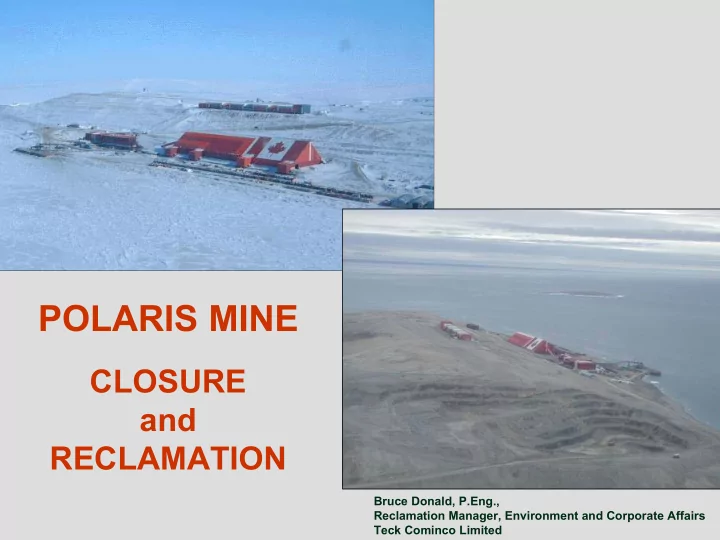
SLIDE 1 POLARIS MINE
CLOSURE and RECLAMATION
Bruce Donald, P.Eng., Reclamation Manager, Environment and Corporate Affairs Teck Cominco Limited
SLIDE 2
Presentation Agenda Presentation Agenda
Introduction Mine Site Components Site Reclamation
SLIDE 3 INTRODUCTION
LOCATION
Approximately 100 km northwest of
Resolute Bay, Nunavut
75oN & 97oW Flying time from Yellowknife approx. 2 hrs
by 737
SLIDE 4
Yellowknife Iqaluit
SLIDE 5
SLIDE 6 INTRODUCTION
MINERALIZATION
ORE – Galena (lead sulphide) – Sphalerite (zinc sulphide) Host Rock – Limestone Important Characteristics of Ore Body – Non-Acid Generating – Enclosed Within Continuous Permafrost
SLIDE 7 INTRODUCTION
WEATHER CONDITIONS
Mean annual air temperature -170C Average Precipitation – 250mm of which
200 is snow
Average of 8 frost free days per year Temperatures range from about a high of
15 to a low of -500C
Average wind speed of 20 km/hr Snow melts starting early June, returns
mid August.
SLIDE 8 INTRODUCTION
PHYSICAL SETTING
Terrain – Very gently rolling hills Overburden is a thin mantle over
calcareous rocks. Surface material in the area of the mine is classed as a barren gravel
Vegetation – Arctic Tundra in clusters or as
a dense mat and is low lying due to the harsh climate, high winds, and shallow soils.
SLIDE 9
INTRODUCTION
HISTORY OF SITE
1960 Discovery of lead-zinc deposit 1973 Resource of 25 million tons grading 14% zinc & 4% lead defined 1981 – Mine started production 2002 – Ore body exhausted 2002 - 2004 Decommissioning & reclamation 2005 - 2011 Site monitoring.
SLIDE 10 MINE SITE COMPONENTS
Mine Workings Processing Facilities / Concentrate Storage Deep Sea Dock / Ship Loading Tailings Disposal System Accommodations Complex Fuel Storage / Distribution System Landfills Freshwater System Roads / Other Services
SLIDE 11 MINE SITE COMPONENTS
Mine Workings
Underground
4 portals Raisebore Holes Subsidence Area
Open Pits
North Pit – small outcrop mined by open pit LRD Limestone Quarry – rock for CRF New Quarry – overburden for roads, etc.
SLIDE 12
MINE WORKINGS
SLIDE 13 PROCESSING FACILITIES
BARGE CONTAINS
Concentrator Offices Warehouse Dry
PRODUCT STORAGE BUILDING
SLIDE 14
PROCESSING FACILITIES
SLIDE 15
PROCESSING FACILITIES Demolition / Re-Grading
SLIDE 16
PROCESSING FACILITIES
SLIDE 17
DEEP SEA DOCK / LOADING FACILITIES
SLIDE 18
DEEP SEA DOCK / LOADING FACILITIES Dock Demolition
SLIDE 19
TAILINGS DISPOSAL SYSTEM
Tailings Lines between Mill & Thickener Thickener Building Tailings Lines between Thickener and
Garrow Lake
Garrow Dam
SLIDE 20
TAILINGS DISPOSAL SYSTEM
SLIDE 21
TAILINGS DISPOSAL SYSTEM
Thickener Building Demolition
SLIDE 22
TAILINGS DISPOSAL SYSTEM
Decommissioning of Garrow Lake Dam
SLIDE 23
ACCOMMODATIONS
SLIDE 24
ACCOMMODATIONS
Accommodation Building Demolition
SLIDE 25
FUEL STORAGE FUEL STORAGE
SLIDE 26
FUEL STORAGE FUEL STORAGE
Tank Farm Demolition Tank Farm Demolition
SLIDE 27
LANDFILLS
SLIDE 28
LANDFILLS
Capping Nearing Completion
SLIDE 29
FRESH WATER SYSTEM FRESH WATER SYSTEM
SLIDE 30
ROADS
SLIDE 31 SITE RECLAMATION
CLOSURE PLAN ESTABLISHED CONSIDERING:
- Requirements in Water Licence and Land
Leases
- NWT Reclamation Policy
- Corporate Environmental Policy Guide
- Feed-back from Consultants, Regulators
& Local Communities
SLIDE 32 SITE RECLAMATION
OBJECTIVES OF CLOSURE PLAN
To provide a working document that addresses
the concerns and requirements of the stakeholders
Reclaim the site to a condition that health & safety
- f the public and the environment are protected.
Reclamation to minimize or eliminate long term
maintenance and monitoring.
To return the site to an aesthetically acceptable
condition.
SLIDE 33 SITE RECLAMATION
LIMITATIONS OF TK
- Area not highly used for hunting so
interest in area limited
- Nearest resident population not
indigenous to area so knowledge is based
- n recent history
- Issues from local community were
primarily economic rather than environmental or hunting issues.
SLIDE 34 DETERMINING RECLAMATION STANDARDS
SITE SPECIFIC STANDARDS
Soils quality standards based on southern
conditions that were not applicable to the north.
Used risk based standards based on local
knowledge of site usage
Weather / Climate conditions were key in
developing strategies
SLIDE 35 OTHER LIMITATIONS
SCIENTIFIC
Limited baseline studies from before mine
built
Uncertainty of Global warming
REGULATORY
Changing regulatory jurisdiction Changing environmental standards Changing bonding standards
SLIDE 36 BIGGEST CHALLENGES
FINANCIAL
Costs in the far north are extremely high.
REGULATORY
Due to climate and costs, there are tight time frames for
completing work. Decisions generally require Board approval rather than staff approvals for even simple changes which creates delays.
WEATHER
Transportation costs and transportation delays were one of the
most significant challenges.
SKILLS
Local manpower was generally less skilled than would utilize in a
southern project. For short duration work having to train on the job is a significant deterrent to local hire.
SLIDE 37
TEMPORARY ACCOMMODATIONS
SLIDE 38
AUGUST 25, 2004 – ALMOST DONE!