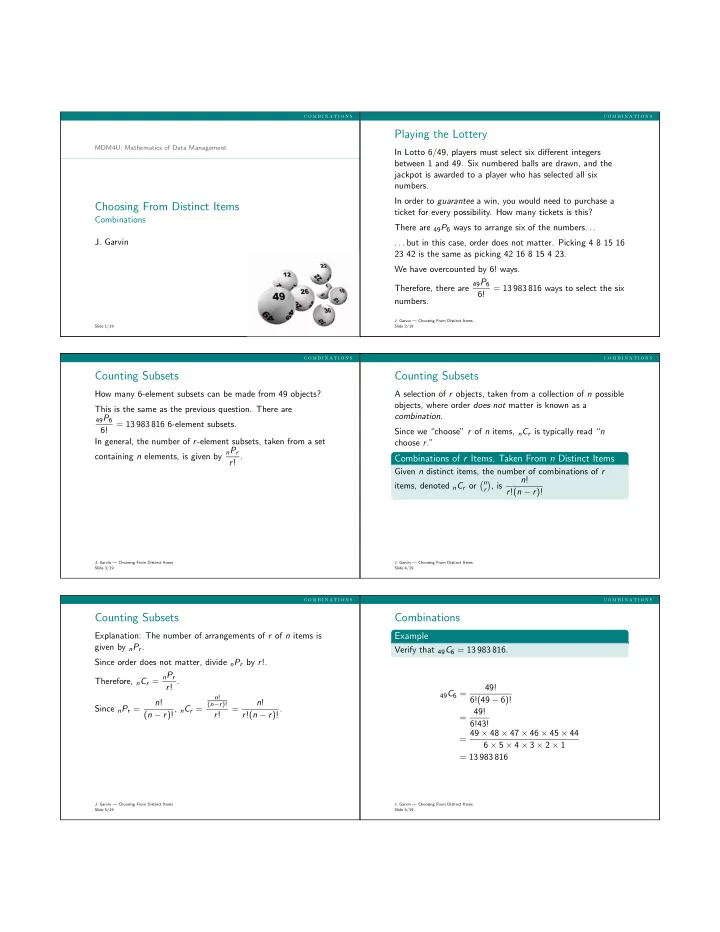
Playing the Lottery MDM4U: Mathematics of Data Management In Lotto - - PDF document

playing the lottery
SMART_READER_LITE
LIVE PREVIEW

Playing the Lottery MDM4U: Mathematics of Data Management In Lotto - - PDF document

c o m b i n a t i o n s c o m b i n a t i o n s Playing the Lottery MDM4U: Mathematics of Data Management In Lotto 6/49, players must select six different integers between 1 and 49. Six numbered balls are drawn, and the jackpot is awarded to a


slide-1
SLIDE 1

c o m b i n a t i o n s

MDM4U: Mathematics of Data Management

Choosing From Distinct Items

Combinations

  • J. Garvin

Slide 1/19

c o m b i n a t i o n s

Playing the Lottery

In Lotto 6/49, players must select six different integers between 1 and 49. Six numbered balls are drawn, and the jackpot is awarded to a player who has selected all six numbers. In order to guarantee a win, you would need to purchase a ticket for every possibility. How many tickets is this? There are 49P6 ways to arrange six of the numbers. . . . . . but in this case, order does not matter. Picking 4 8 15 16 23 42 is the same as picking 42 16 8 15 4 23. We have overcounted by 6! ways. Therefore, there are 49P6 6! = 13 983 816 ways to select the six numbers.

  • J. Garvin — Choosing From Distinct Items

Slide 2/19

c o m b i n a t i o n s

Counting Subsets

How many 6-element subsets can be made from 49 objects? This is the same as the previous question. There are

49P6

6! = 13 983 816 6-element subsets. In general, the number of r-element subsets, taken from a set containing n elements, is given by nPr r! .

  • J. Garvin — Choosing From Distinct Items

Slide 3/19

c o m b i n a t i o n s

Counting Subsets

A selection of r objects, taken from a collection of n possible

  • bjects, where order does not matter is known as a

combination. Since we “choose” r of n items, nCr is typically read “n choose r.”

Combinations of r Items, Taken From n Distinct Items

Given n distinct items, the number of combinations of r items, denoted nCr or n

r

  • , is

n! r!(n − r)!

  • J. Garvin — Choosing From Distinct Items

Slide 4/19

c o m b i n a t i o n s

Counting Subsets

Explanation: The number of arrangements of r of n items is given by nPr. Since order does not matter, divide nPr by r!. Therefore, nCr = nPr r! . Since nPr = n! (n − r)!, nCr =

n! (n−r)!

r! = n! r!(n − r)!.

  • J. Garvin — Choosing From Distinct Items

Slide 5/19

c o m b i n a t i o n s

Combinations

Example

Verify that 49C6 = 13 983 816.

49C6 =

49! 6!(49 − 6)! = 49! 6!43! = 49 × 48 × 47 × 46 × 45 × 44 6 × 5 × 4 × 3 × 2 × 1 = 13 983 816

  • J. Garvin — Choosing From Distinct Items

Slide 6/19

slide-2
SLIDE 2

c o m b i n a t i o n s

Combinations

Example

Evaluate 6C4.

6C4 =

6! 4!(6 − 4)! = 6! 4!2! = 6 × 5 × 4! 4!2! = 6 × 5 2 = 15

  • J. Garvin — Choosing From Distinct Items

Slide 7/19

c o m b i n a t i o n s

Combinations

Without calculating, what is the value of 100C1? There are 100 ways to choose one item. Therefore, nC1 = n. What about the value of 50C0? There is always one way to choose no items – simply do not select any! Therefore, nC0 = 1. These are useful to remember, as they occur frequently.

  • J. Garvin — Choosing From Distinct Items

Slide 8/19

c o m b i n a t i o n s

Combinations

Example

From a standard deck of cards, how many five-card hands are possible? There are 52 cards in a deck, from which five are selected. Therefore, there are 52C5 = 52! 5!(52 − 5)! = 2 598 960 possible five-card hands.

  • J. Garvin — Choosing From Distinct Items

Slide 9/19

c o m b i n a t i o n s

Combinations

Example

From a standard deck of cards, how many five-card hands are made entirely of spades? There are 13 spades in the deck, from which five are selected. Therefore, there are 13C5 = 13! 5!(13 − 5)! = 1 287 possible hands consisting entirely of spades.

  • J. Garvin — Choosing From Distinct Items

Slide 10/19

c o m b i n a t i o n s

Combinations

Sometimes it is necessary to break down the question into two or more pieces that involve combinations. For example, we may want to choose some items from one group, then choose other items from a second group. In this case, we can use the Fundamental Counting Principle

  • r Rule of Sum as appropriate.
  • J. Garvin — Choosing From Distinct Items

Slide 11/19

c o m b i n a t i o n s

Combinations

Example

Your name, along with nine others, is put into a hat. Four names are randomly drawn, without replacement. How many four-name draws include your name? Your name can be selected in 1C1 = 1 way. The remaining three names can be drawn in 9C3 = 84 ways. Thus, there are 1C1 × 9C3 = 1 × 84 = 84 four-name draws that include your name.

  • J. Garvin — Choosing From Distinct Items

Slide 12/19

slide-3
SLIDE 3

c o m b i n a t i o n s

Combinations

Example

In how many ways can a six-member committee of three men and three women be made from a group of eight men and seven women? There are 8C3 ways to choose the men. There are 7C3 ways to choose the women. Therefore, the number of ways to create the six-member committee is 8C3 × 7C3 = 1 960.

  • J. Garvin — Choosing From Distinct Items

Slide 13/19

c o m b i n a t i o n s

Combinations

Example

How many six-member committees of three men and three women, made from a group of eight men and seven women, contain both Bob and Alice? Since Bob and Alice must be part of the committee, we need

  • nly select two additional men from the remaining seven, and

two additional women from the remaining six. There are 7C2 ways to choose the men, and 6C2 ways to choose the women. Therefore, there are 7C2 × 6C2 = 315 possible committees.

  • J. Garvin — Choosing From Distinct Items

Slide 14/19

c o m b i n a t i o n s

Combinations

Example

A car dealership sells 9 different sedans, 6 trucks and 4 sports

  • cars. How many ways are there to select a dozen vehicles for

its showroom, including at least one of each type of vehicle, if order is unimportant? First, select one of each type of vehicle. This can be done in

9C1 × 6C1 × 4C1 ways.

Next, select the other 9 vehicles from the remaining 16. This can be done in 16C9 ways. Thus, there are 9C1 × 6C1 × 4C1 × 16C9 = 2 471 040 ways to select the cars.

  • J. Garvin — Choosing From Distinct Items

Slide 15/19

c o m b i n a t i o n s

Combinations

As a comparison, how many combinations of a dozen cars are there with no restrictions? There are 19C12 = 50 388 ways to select 12 cars from 19.

Uh oh.

Our value of 2 471 040 is approximately 49 times too big, so where did we go wrong? Let’s look closer at the expression we used to calculate the number of combinations.

  • J. Garvin — Choosing From Distinct Items

Slide 16/19

c o m b i n a t i o n s

Combinations

9C1

  • 1 sedan

× 6C1

  • 1 truck

× 4C1

  • 1 sport

×

16C9

  • remaining

Choosing the sedans occurs twice – once for the initial selection (9C1) and once for the remaining cars (16C9). Let’s assume, for example, that a blue sedan is chosen initially, then a silver sedan chosen later. In a similar fashion, we might choose a silver sedan initially, followed later by a blue sedan. These options are counted twice, even though they might result in the same selection of cars. The same applied when selecting the trucks and the sports cars.

  • J. Garvin — Choosing From Distinct Items

Slide 17/19

c o m b i n a t i o n s

Combinations

To fix this, we can use an indirect method whereby we eliminate all selections containing zero of each type of car. Criteria Number of Selections 0 sedans

10C12 =not possible

0 trucks

13C12 = 13

0 sports

15C12 = 455

Therefore, there are 50 388 − 13 − 455 = 49 920 selections containing at least one of each type of vehicle.

  • J. Garvin — Choosing From Distinct Items

Slide 18/19

slide-4
SLIDE 4

c o m b i n a t i o n s

Questions?

  • J. Garvin — Choosing From Distinct Items

Slide 19/19