Plantwise and Invasives Presentation to GRA - September 2017 Janny - - PowerPoint PPT Presentation

plantwise and invasives
SMART_READER_LITE
LIVE PREVIEW

Plantwise and Invasives Presentation to GRA - September 2017 Janny - - PowerPoint PPT Presentation

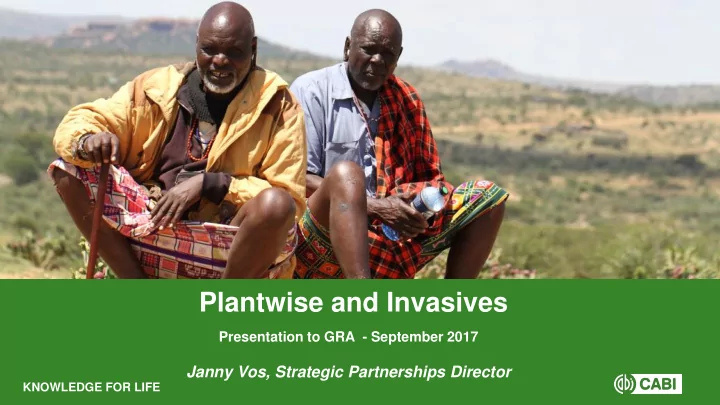
Plantwise and Invasives Presentation to GRA - September 2017 Janny Vos, Strategic Partnerships Director KNOWLEDGE FOR LIFE KNOWLEDGE FOR LIFE CABI not-for-profit intergovernmental organisation established in 1910 by a UN treaty Provides

slide-1
SLIDE 1

KNOWLEDGE FOR LIFE KNOWLEDGE FOR LIFE

Plantwise and Invasives

Presentation to GRA - September 2017

Janny Vos, Strategic Partnerships Director

slide-2
SLIDE 2

KNOWLEDGE FOR LIFE

CABI

  • not-for-profit intergovernmental organisation

established in 1910 by a UN treaty

  • Provides scientific expertise and information about

agriculture and the environment

  • Owned by 48 member countries
  • 500 dedicated staff worldwide in 21 locations
slide-3
SLIDE 3

KNOWLEDGE FOR LIFE

CABI’s mandate

“promote the advancement of agriculture and allied sciences through the provision of information, scientific and related services on a world-wide basis”

slide-4
SLIDE 4

KNOWLEDGE FOR LIFE

Animal Health Environmental Health Soil Health Human Health (Nutrition) Seed Health Plant Health Pests & Disease

Print Electronic Mobile Video Clinics FFS Personal

Communicating Science to Build Knowledge & Capability

CABI’s capacity to build knowledge and capability

slide-5
SLIDE 5

KNOWLEDGE FOR LIFE

40% of crops are lost to pests and diseases

  • “Climate change is altering the distribution,

incidence, and intensity of plant pest and diseases” Climate-Related Transboundary Pests and Diseases, FAO technical report, 2008 As a result

  • Reliance on pesticides is increased
  • Vulnerability to climate shocks is increased
  • Farm productivity and incomes are reduced

Issue

slide-6
SLIDE 6

KNOWLEDGE FOR LIFE

  • Approximately 800 million people have

inadequate access to food and their livelihoods are threatened by invasives

  • Reducing losses by just 1% would

feed 25 million more people

  • In 2009, CABI MCs gave mandate to

develop Plantwise, which was launched in 2011

  • In 2016, we received a mandate to develop

Invasives, which we aim to launch in 2018

Plantwise & Invasives

Anguilla Australia The Bahamas Bangladesh Bermuda Botswana Malaysia Mauritius Montserrat Myanmar The Nigeria Netherlands* Philippines Rwanda Sierra Leone Solomon South Africa Sri Lanka Islands Tanzania Trinidad & Uganda United Vietnam Zambia Tobago Kingdom The Gambia Ghana Grenada Guyana India Jamaica Burundi Canada Chile China Colombia Cote d’Ivoire *Associate member Brunei DPR Korea Malawi Papua New Switzerland British Virgin Darussalam Guinea Islands Kenya Pakistan St Helena Zimbabwe Cyprus

slide-7
SLIDE 7

KNOWLEDGE FOR LIFE KNOWLEDGE FOR LIFE

Plantwise – reducing crop losses to increase food security and improve rural livelihoods

slide-8
SLIDE 8

KNOWLEDGE FOR LIFE

Lose less, feed more

Replicate the human health clinic concept Provide diagnosis and recommendation on any problem and any crop Staffed with plant doctors from government, private sector, public sector Record snapshot of problems on farmers fields fed back to global knowledge bank

Knowledge Bank shares data with partners Partners issue pest alerts & best practice guides Knowledge Bank helps diagnosis Farmer visits plant clinic Plant doctor consults the Knowledge Bank Plant doctor provides management advice

slide-9
SLIDE 9

KNOWLEDGE FOR LIFE

  • Data analysis used in an increasing

number of ways

  • >300,000 plant clinic records from 30

countries

  • Information on partner organisations,

plant clinics, etc.

  • Available in English, French, Spanish

Plantwise Data

slide-10
SLIDE 10

KNOWLEDGE FOR LIFE

Opportunities

  • Making use of Geographic

Information Systems (GIS)

  • Gaining insights by combining

clinic data with other sources 

  • Using satellite data to map the

spread of invasive species 

slide-11
SLIDE 11

KNOWLEDGE FOR LIFE

Barbados Bolivia Brazil Costa Rica Grenada Honduras Jamaica Nicaragua Peru Trinidad & Tobago

Africa

Burkina Faso DR Congo Ethiopia Ghana Kenya Malawi Mozambique Rwanda Sierra Leone Tanzania Uganda Zambia

Asia

Afghanistan Bangladesh Cambodia China India Myanmar Nepal Pakistan Sri Lanka Thailand Vietnam

The Americas

Spread

slide-12
SLIDE 12

KNOWLEDGE FOR LIFE

Reach

Plant health rallies Farmer field schools Mobile messaging Plant clinics Radio & TV broadcasts

slide-13
SLIDE 13

KNOWLEDGE FOR LIFE

Impact

79% of farmers reported yield increases after visiting a plant clinic 70% of farmers reported their income increased after visiting a plant clinic Over half of plant clinic prescriptions recommend non-chemical inputs Plantwise has linked with 70 private sector

  • rganisations

25% of Plantwise plant doctors worldwide are female All Plantwise countries contribute funds and/or staff time towards activities

slide-14
SLIDE 14

KNOWLEDGE FOR LIFE

Plantwise donors

Ministry of Agriculture, People’s Republic of China

slide-15
SLIDE 15

KNOWLEDGE FOR LIFE KNOWLEDGE FOR LIFE

Working together to manage biological invasions

Invasive Species Threatening Livelihoods

slide-16
SLIDE 16

KNOWLEDGE FOR LIFE

Invasive species are a global issue impacting the lives

  • f millions of

people

slide-17
SLIDE 17

KNOWLEDGE FOR LIFE

The estimated total annual losses attributed to IAS in SE Asia is on average $33.2 billion or $55 per capita

slide-18
SLIDE 18

KNOWLEDGE FOR LIFE

slide-19
SLIDE 19

KNOWLEDGE FOR LIFE

Fall Armyworm status as of 21 July 2017

slide-20
SLIDE 20

KNOWLEDGE FOR LIFE

  • Keep pests currently absent out of country
  • Who has primary responsibility
  • Public awareness necessary
  • Potential incursion are spotted and reported early: General surveillance, target species that are known risk
  • Often not feasible either because incursion (arrival) of new species is not spotted early enough; therefore

chance to become widespread.

  • When an incursion is detected, rapid response is required to determine the extent of the incursion and

assess feasibility of an eradication attempt.

  • If possible, action needs to be taken immediately
  • Eradication not feasible once a species becomes established
  • Containment may be the option to limit distribution of the species in part of the area.
  • Concerned with preventing spread of the species that has established
  • Involves regulatory activities like prevention of movement of planting materials and/or produce
  • Involves sustained control activities like maintaining species free areas
  • Requires action by many stakeholders and may not be cost effective
  • Species present in all areas suitable for them
  • Not practical and/or economically justifiable for attempting to create pest free areas
  • Practical solution is to control and prevent crop and biodiversity losses
  • Responsibility falls on the owner of the crop or natural resource but needs advise on how to manage the

problem

  • Extension and solutions needed

Cost vs benefit

slide-21
SLIDE 21

KNOWLEDGE FOR LIFE

Analogy: human health care

Human health clinics

General health care Targeted health care

Control Eradication Prevention

slide-22
SLIDE 22

KNOWLEDGE FOR LIFE

Addressing invasive species

Plantwise

Control and restoration

Early detection and Eradication

Prevention Plant health clinics provide a touch point mechanism for advising individual farmers

  • n invasive management options

Targeted approach to the worst species

slide-23
SLIDE 23

KNOWLEDGE FOR LIFE

Supporting the

SUSTAINABLE DEVELOPMENT GOALS

SDG 2 End hunger, achieve food security and improved nutrition and promote sustainable agriculture SDG 15 Protect, restore and promote sustainable use of terrestrial ecosystems, sustainably manage forests, combat desertification, and halt and reverse land degradation and halt biodiversity loss

slide-24
SLIDE 24

KNOWLEDGE FOR LIFE

Goal: By 2020,

introduce measures to prevent the introduction and significantly reduce the impact of invasive alien species on land and water ecosystems, and control or eradicate the priority species Indicator: Proportion

  • f countries adopting

relevant national legislation and adequately resourcing the prevention or control of invasive alien species

SDG 15.8 – Invasive Alien Species

slide-25
SLIDE 25

KNOWLEDGE FOR LIFE

Partnering for a sustainable future

Known species and solutions, new approach

To manage the worst invasive species:

  • Three stage approach of prevention, early detection

and rapid response, and control and restoration

  • Multi-sectoral and multi-national systems approach
  • Partnerships are key
slide-26
SLIDE 26

KNOWLEDGE FOR LIFE

xie-xie

zikomo

thank you

urakoze terima kasih ke itumetse

dhanyawaad

merci efharistóلبيزج اركش

tak

kiitos

शुक्ऱिया

ありがとう

gracias

zikomo

danke

asante

  • brigado

KNOWLEDGE FOR LIFE

Patricia Neenan p.neenan@cabi.org