
SLIDE 1
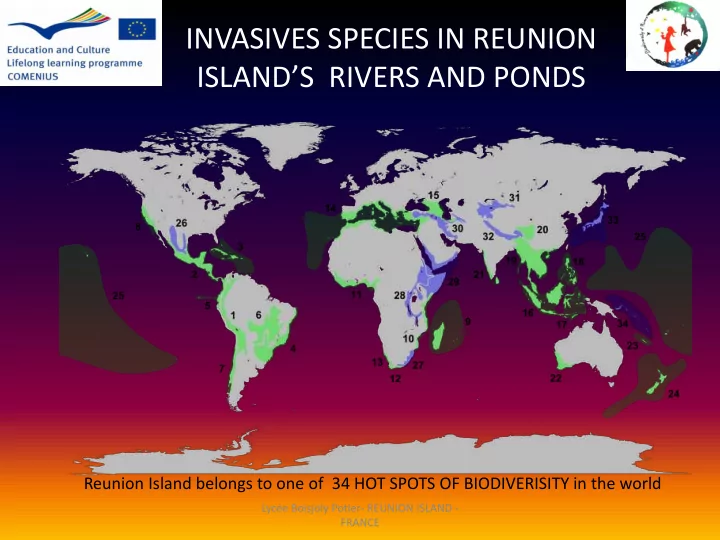
Reunion Island belongs to one of 34 HOT SPOTS OF BIODIVERISITY in the world
Lycée Boisjoly Potier- REUNION ISLAND - FRANCE
INVASIVES SPECIES IN REUNION ISLANDS RIVERS AND PONDS Reunion - - PowerPoint PPT Presentation
INVASIVES SPECIES IN REUNION ISLANDS RIVERS AND PONDS Reunion Island belongs to one of 34 HOT SPOTS OF BIODIVERISITY in the world Lyce Boisjoly Potier- REUNION ISLAND - FRANCE Isolated Young Few rivers high rate of endemicity Lyce
Reunion Island belongs to one of 34 HOT SPOTS OF BIODIVERISITY in the world
Lycée Boisjoly Potier- REUNION ISLAND - FRANCE
Lycée Boisjoly Potier- REUNION ISLAND - FRANCE
Eichhornia crassipes
regions, ponds, soft water
(the roots → 3m)
vegetative and sexual.
Lycée Boisjoly Potier- REUNION ISLAND - FRANCE
When? : 18th century Why? : -To purify the water infested with mosquitoes.
used as an ornemental flower. Where? : From Amazonia and the west of Brazil to St Paul pond
St Paul pond
Lycée Boisjoly Potier- REUNION ISLAND - FRANCE
Gol pond (St Louis) St Paul pond
Lycée Boisjoly Potier- REUNION ISLAND - FRANCE
nutriment in the water.
get into the water.
dioxygen concentration by eutrophication Manual taking. On rainy periods the pond water overflows and the water hyacinth is dispatched towards the sea.
Lycée Boisjoly Potier- REUNION ISLAND - FRANCE
Lycée Boisjoly Potier- REUNION ISLAND - FRANCE
Where : from Africa
Lycée Boisjoly Potier- REUNION ISLAND - FRANCE
Lycée Boisjoly Potier- REUNION ISLAND - FRANCE
(fishes or seaweed)
Lycée Boisjoly Potier- REUNION ISLAND - FRANCE
The Australian crayfish
I- Presentation
And 800 green olive eggs. The incubation takes about 6 weeks .
Australia
Lycée Bois South Africa , Mexico , Jamaica joly Potier- REUNION ISLAND - FRANCE
Lycée Boisjoly Potier- REUNION ISLAND - FRANCE
Species threatened by the Australian crayfish ''Bichique'' and small shrimp .
Lycée Boisjoly Potier- REUNION ISLAND - FRANCE
Fry = baby fish =bichique Cabot bouche ronde = adulte
Managuense (Parachromis managuensis)
America, Honduras, Costa Rica, Reunion Island
1000-2000 eggs
invertebrates
Lycée Boisjoly Potier- REUNION ISLAND - FRANCE
Lycée Boisjoly Potier- REUNION ISLAND - FRANCE
Etang du Gol Etang Saint- Paul
Lycée Boisjoly Potier- REUNION ISLAND - FRANCE
Lycée Boisjoly Potier- REUNION ISLAND - FRANCE
Oreochromis niloticus spp
and ponds
phytoplancton
Lycée Boisjoly Potier- REUNION ISLAND - FRANCE
role
Madagascar to farming pools
Reunion island Maurit ius
Lycée Boisjoly Potier- REUNION ISLAND - FRANCE
Ponds Rivers Presence
Etang St Paul Bois rouge Etang du Gol Grand étang
Lycée Boisjoly Potier- REUNION ISLAND - FRANCE
Lycée Boisjoly Potier- REUNION ISLAND - FRANCE
Lycée Boisjoly Potier- REUNION ISLAND - FRANCE
Where does it come from ? Coast provinces of the south of
How ? Possibly escaped from their breeding space. Why ? To become pets When ? End of 20th century
Lycée Boisjoly Potier- REUNION ISLAND - FRANCE
Lycée Boisjoly Potier- REUNION ISLAND - FRANCE
Rivière des Galets and maybe ponds
Harmful for waterways.
May consume insects and fish.
No real solutions nowadays
Lycée Boisjoly Potier- REUNION ISLAND - FRANCE
Scientific name : Bufo Bufo or Bufo gutturalis Family : Bufonidae Size: 7 to 12 cm Breeding : water Food: other frogs,insects,spiders Class : Amphibia Alternative name : Gutturalis toad
Lycée Boisjoly Potier- REUNION ISLAND - FRANCE
When ?1927 Why ?To fight paludism,malaria Where?From southern Africa
Lycée Boisjoly Potier- REUNION ISLAND - FRANCE
in Reunion island : humid areas The gutturalis toad is very adaptable to any environment.
Lycée Boisjoly Potier- REUNION ISLAND - FRANCE
The Bufo bufo is a great predator. Gecko de Manapany Gecko des Hauts
Lycée Boisjoly Potier- REUNION ISLAND - FRANCE
Lycée Boisjoly Potier- REUNION ISLAND - FRANCE